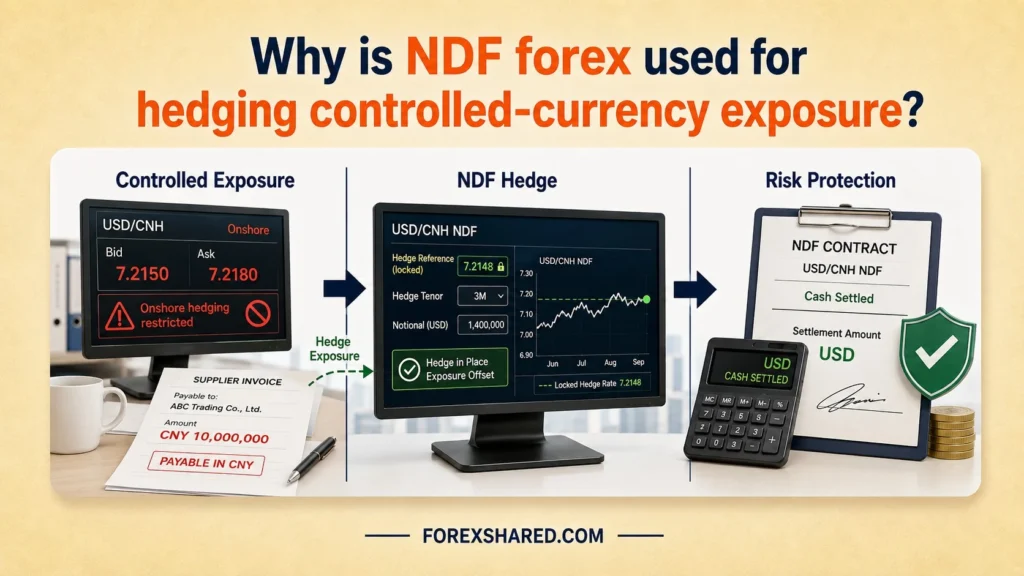
Why Is NDF Forex Used for Hedging Controlled-Currency Exposure?
NDF forex hedging for controlled-currency exposure is used because it lets the user manage exchange-rate risk without physically delivering the controlled local currency. When an underlying currency is heavily restricted or non-convertible, market participants need a functional mechanism to protect their balance sheets offshore.
The hedge references the controlled currency’s exchange-rate movement without requiring physical delivery of that currency. The non-deliverable forward (NDF) simply settles the difference between an agreed rate and a later fixing or reference rate in a more tradable settlement currency. The Bank for International Settlements defines non-deliverable forwards as cash-settled contracts, often settled in US dollars or another pre-agreed currency, without physical delivery of the two underlying currencies at maturity.
Retail off-exchange forex can involve leverage, severe counterparty risk, and rapid losses. The eCFR retail forex risk disclosure explicitly states that leveraged off-exchange foreign currency transactions can cause customers to lose all deposited funds and more than deposited funds.
What does controlled-currency exposure mean in an NDF hedge?
Controlled-currency exposure in an NDF hedge means the user is economically affected by a currency that may not be freely deliverable through normal offshore settlement channels.
This exposure can easily come from corporate revenues, operational costs, international loans, local investments, or future cash flows. The user may urgently need exchange-rate protection without possessing physical local-currency delivery access. Understanding this operational hurdle explains precisely why this strategy belongs within the broader NDF forex category.
Which currency creates the hedge problem?
The controlled local currency creates the exchange-rate exposure because its absolute value movement can negatively affect cash flows, profit margins, debt service, or investment returns.
What makes the exposure difficult to hedge normally?
A normal deliverable forward may require actual currency transfer at maturity, while controlled currencies may not be freely deliverable through offshore settlement channels due to strict government capital controls.
Where does the NDF fit into the exposure problem?
The NDF keeps the controlled currency’s movement as the strict economic reference, removes the burdensome need to deliver the controlled currency, and cleanly turns the exposure into a cash-settled hedge.
Why does non-delivery make NDF forex useful for controlled currencies?
Non-delivery makes NDF forex useful for controlled currencies because the hedge can reference the controlled currency without requiring offshore transfer of that currency.
The NDF references the controlled currency without exchanging it at all. Cash settlement seamlessly replaces physical currency delivery, allowing traders to execute hedging without local delivery violations. The Bank for International Settlements defines NDFs as forwards that settle in cash without physical delivery of the two underlying currencies at maturity [BIS, 2024].
The controlled currency absolutely still drives the economic result. The NDF structure does not imply it removes every risk, but it mechanically solves the specific obstacle of physical transfer barriers.
Which delivery barrier does the NDF avoid?
The NDF effectively avoids the stringent need to receive or deliver the controlled local currency offshore, drastically reducing total dependence on local settlement access when direct transfer is highly impractical.
What remains exposed even without delivery?
The exchange-rate movement of the controlled currency still strictly matters. The NDF does not magically erase the currency risk; it systematically converts that specific risk into a tradable cash-settlement result.
Where does cash settlement replace currency transfer?
At maturity, the financial contract does not physically exchange both currencies. It settles only the net difference calculated directly based on the agreed NDF rate and the final fixing or reference rate.
How does an NDF hedge turn controlled-currency exposure into cash settlement?
An NDF hedge turns controlled-currency exposure into cash settlement by comparing the agreed NDF rate with a later fixing or reference rate.
| Stage | Contract Element | Hedge Function |
|---|---|---|
| Exposure Identified | Controlled-currency risk | Defines what needs protection |
| Trade Start | Agreed NDF rate | Sets the hedge reference |
| Before Settlement | Fixing date | Defines when the reference is observed |
| Settlement Reference | Fixing source | Determines the rate used for comparison |
| Final Payment | Settlement currency | Carries the net cash settlement |
The lifecycle flows sequentially: exposure identified, agreed NDF rate, fixing date, fixing source, and finally settlement currency. The International Monetary Fund describes NDFs as FX forward contracts that do not require physical delivery and are cash-settled through net payments based on the difference between the maturity spot rate and the previously agreed forward rate [IMF, 2020].
Which rate anchors the hedge at the start?
The agreed NDF rate firmly anchors the hedge, explicitly sets the reference level against which the future fixing will be mathematically compared, and gives the user a defined protection structure.
What turns the hedge into a final settlement?
The fixing or reference rate is systematically observed near maturity, giving the contract a final comparison point. The hedge result subsequently becomes a net cash settlement rather than a physical currency exchange.
Where does the settlement currency complete the hedge?
The settlement currency carries the final payment. In many NDF structures, this is USD or another agreed tradable currency, but the settlement currency is exclusively the payment route, not the source of exposure.
Why is the fixing rate central to an NDF hedge?
The fixing rate is central to an NDF hedge because it connects the non-deliverable contract back to the controlled currency’s exchange-rate movement.
The fixing rate provides the final absolute reference for financial settlement. The fixing source and fixing date operate together to enforce timing. The controlled currency perfectly remains economically relevant strictly through the fixing mechanism. Analysts determine hedge accuracy by checking reference match and basis risk.
Which fixing term controls the hedge outcome?
The fixing source explicitly controls the reference rate, while the fixing date controls the exact observation point. Together, they rigorously decide how the NDF hedge is financially settled at maturity.
What makes fixing different from physical exchange?
Physical exchange formally transfers real currencies, while fixing strictly supplies a mathematical reference for net cash settlement. In an NDF, the fixing process safely replaces the final physical delivery exchange.
Where can fixing create hedge mismatch?
Mismatch can readily occur when the fixing source does not perfectly match the user’s real conversion exposure. The hedge may reduce broad risk but still leave residual basis risk, proving fixing source is not a minor contract detail.
How does the settlement currency separate payment from exposure?
The settlement currency separates payment from exposure because the controlled currency drives the hedge result while another tradable currency carries the cash payment.
The controlled currency structurally creates the active exposure. The settlement currency only carries the final payment routing. BIS states that NDFs are settled in cash, very often in US dollars or another pre-agreed currency, without physical delivery of the two underlying currencies [BIS, 2024]. USD settlement does not mean the exposure transforms into only USD risk. Exposure layer and payment layer are rigorously kept separate.
Which currency carries the economic risk?
The exposure currency (the controlled currency) carries the economic risk because its movement determines whether the hedge gains or loses value. The settlement currency absolutely does not remove that core exposure.
Which currency carries the final payment?
The settlement currency carries the ultimate net cash amount, making the entire hedge infinitely more practical for offshore counterparties who cannot access onshore clearing structures.
Where does settlement-currency confusion begin?
Confusion begins when readers incorrectly assume USD settlement implies the hedge is only about USD direction. In reality, USD may simply be the payment channel while the restricted controlled currency drives the entire hedge result.
Why might an NDF be chosen instead of a deliverable forward?
An NDF may be chosen instead of a deliverable forward when the user needs exchange-rate exposure protection without physical delivery of the controlled currency.
| Hedge Type | Currency Delivery | Best Use Case | Main Risk of Misreading |
|---|---|---|---|
| Deliverable Forward | Full exchange of currencies at maturity | Freely transferable currency exposure | Forgetting the delivery obligation |
| NDF | Net cash settlement only | Controlled or restricted currency exposure | Confusing cash settlement with delivery |
| Spot FX | Near-term currency exchange | Immediate currency need | Assuming spot access exists for controlled currencies |
Deliverable forwards terminate entirely in physical currency transfer, while NDFs rigidly end in net cash settlement. BIS explains that NDFs allow investors and borrowers to take positions in currencies that are subject to official controls [BIS, 2014]. They are absolutely not perfectly interchangeable.
Which hedge requires actual currency transfer?
The deliverable forward requires the currencies to be systematically exchanged at maturity. That physical structure works best when both currencies are highly transferable and becomes structurally unsuitable when the local currency is severely controlled.
What does the NDF keep from forward hedging?
The NDF keeps a strict forward-style rate agreement and solid protection against adverse exchange-rate movement, while entirely removing the problematic physical delivery step.
Where does the hedge choice change the user’s interpretation?
The user should aggressively ask whether they practically need exposure protection or actual currency delivery. If they need delivery, an NDF may not solve the operational need. If they need exposure hedging, an NDF may be structurally suitable.
When is NDF forex most useful for controlled-currency hedging?
NDF forex is most useful for controlled-currency hedging when the user has real currency exposure but cannot rely on normal offshore currency delivery.
Use cases prominently include managing future controlled-currency exposure, restricted offshore delivery barriers, corporate cash-flow risk, investor exposure management, and maintaining onshore/offshore separation. Multinationals routinely rely on emerging-market currency hedging via NDFs. IMF research found that many Asian emerging-market NDF markets are large, rapidly growing, often exceed onshore markets in transaction volume, and tend to price significant depreciation during stress episodes such as COVID-19 [IMF, 2020].
When does a corporate hedger use an NDF?
A corporate hedger may realistically expect revenue, costs, or rigid liabilities in a controlled currency. They may not be able to use a deliverable offshore forward, forcing them to use an NDF to reduce exchange-rate uncertainty through cash settlement.
Where does an investor use an NDF as an access substitute?
An investor may forcefully want exposure to the currency’s movement while direct local-market physical access remains heavily limited. The NDF creates a highly functional offshore way to manage that specific exposure.
Which market condition makes NDF hedging more important?
NDF hedging definitively becomes more important when rigid onshore delivery is politically restricted, yet offshore risk demand simultaneously remains intensely active.
What risks remain when using NDF forex as a hedge?
NDF forex can solve the delivery problem, but basis risk, fixing risk, liquidity risk, counterparty risk, and policy risk can still remain.
| Remaining Risk | Why It Matters |
|---|---|
| Basis Risk | The NDF fixing may not match the user’s actual conversion exposure |
| Fixing Risk | Settlement depends on the specified reference source |
| Counterparty Risk | The hedge depends on the counterparty meeting settlement obligations |
| Liquidity Risk | Offshore pricing may widen or shift in stressed conditions |
| Policy Risk | Rule changes can affect onshore/offshore market behavior |
Traders must understand that eliminating delivery issues does not eliminate all market risk. Leveraged off-exchange foreign currency transactions can cause customers to lose all deposited funds and more than deposited funds [eCFR, 2024]. Mismatches frequently lead to severe offshore-local NDF pricing divergence.
Which risk remains even when delivery is avoided?
Exchange-rate risk remains constantly active because the controlled currency still aggressively drives the overall hedge value. The NDF may heavily reduce unwanted currency movement exposure, but it fundamentally does not eliminate uncertainty completely.
Where does basis risk affect hedge accuracy?
Basis risk viciously appears when the NDF reference simply does not match the user’s actual cash-flow exposure. A hedge can be directionally useful but imperfect, which is exactly why reference pricing and fixing source must be strictly checked.
What risk appears during stressed markets?
Liquidity and pricing conditions can dramatically change during market stress. Capital spreads widen drastically, making offshore proxy pricing wildly unreliable when sudden policy changes abruptly segment the market.
What examples make NDF controlled-currency hedging easier to understand?
Examples make NDF controlled-currency hedging easier to understand by separating exchange-rate exposure management from physical currency delivery.
| Example Type | What It Shows |
|---|---|
| Corporate cash-flow hedge | How an NDF protects future controlled-currency exposure |
| Investor exposure hedge | How NDFs manage currency movement without local settlement |
| Fixing-based settlement | How the hedge closes through a reference rate |
| Deliverable-forward contrast | Why an NDF is not the same as physical currency exchange |
By using structured hypotheticals, analysts can clarify exact logical constraints without turning educational articles into financial trading recommendations or overly dense numerical pricing formulas.
What does a corporate cash-flow example reveal?
A company may expect heavy future revenue in a controlled currency. They may be entirely unable to use a deliverable offshore forward, and can therefore use an NDF to radically reduce exchange-rate uncertainty through safe cash settlement.
How does an investor example clarify non-delivery?
An investor may forcefully want raw exposure to the currency’s movement but may not functionally need to receive the local currency. The NDF structurally provides flawless exposure management directly without local-currency delivery.
Where does the deliverable-forward contrast help?
A deliverable forward ends in physical currency exchange, while an NDF ends strictly in net cash settlement. The profound contrast explains instantly why NDFs perfectly fit complex controlled-currency hedging parameters.
How should readers interpret NDF forex as a hedge?
Readers should interpret NDF forex as a controlled-currency exposure hedge, not as a tool that guarantees physical currency delivery.
| Interpretation Layer | Reader Question |
|---|---|
| Exposure Currency | Which controlled currency creates the risk? |
| Settlement Structure | Does the hedge end in delivery or cash settlement? |
| Fixing Source | Which rate controls the final settlement reference? |
| Settlement Currency | Which currency carries the payment? |
| Basis Risk | Could the NDF reference differ from the real exposure? |
Interpreting NDFs requires heavily scrutinizing the fixing source before trusting overall hedge accuracy. Furthermore, readers must firmly separate controlled-currency exposure from settlement-currency payment.
Which layer should be read before the hedge price?
The settlement layer should be rigorously read before the rate level simply because it tells the proactive reader whether the hedge structurally ends in physical delivery or just pure cash settlement.
What does the NDF hedge not guarantee?
The NDF hedge absolutely does not guarantee physical currency delivery, perfect mathematical hedge accuracy, or reliably identical offshore and onshore prices during stress periods.
Where should exposure and payment be separated?
Exposure inherently belongs to the controlled currency, while payment exclusively belongs to the settlement currency. Keeping those designated roles fundamentally separate prevents almost all major NDF confusion.
What mistakes cause confusion about NDF controlled-currency hedging?
Mistakes about NDF controlled-currency hedging usually come from reading a cash-settled hedge as if it were a normal deliverable forward.
Treating the NDF as a deliverable forward
The reader carelessly assumes the controlled currency will automatically be physically exchanged at maturity. An NDF actually settles only the net difference in cash, totally avoiding full currency delivery.
Ignoring the fixing source behind the hedge
The reader dangerously focuses only on the agreed NDF rate. In reality, the heavily specified fixing source completely determines exactly how the entire hedge finally settles.
Confusing settlement currency with exposure currency
The reader incorrectly assumes USD settlement magically removes all controlled-currency exposure. USD may strictly be the payment route, while the highly restricted controlled currency definitively drives the hedge.
Assuming the NDF hedge removes all currency risk
The reader overly optimistically treats the hedge as perfect flawless protection. In structural truth, basis risk, liquidity risk, and fixing mismatch can all heavily remain.
Which contract terms confirm that the NDF hedge fits controlled-currency exposure?
Contract terms confirm that an NDF hedge fits controlled-currency exposure by showing the currency pair, agreed NDF rate, fixing terms, settlement currency, notional, tenor, and non-delivery clause.
| Contract Term | What It Confirms |
|---|---|
| Controlled currency pair | Which currency movement drives exposure |
| Agreed NDF rate | Starting hedge reference |
| Fixing date | When the final reference is observed |
| Fixing source | Which rate controls settlement |
| Settlement currency | How the cash payment is made |
| Notional amount | Size of the exposure being referenced |
| Tenor | Timing of the hedge |
| Non-delivery clause | Controlled currency is referenced, not transferred |
Contract terms rigorously map the theoretical concepts into legal execution. The controlled currency identifies exposure, while fixing terms mechanically control precise settlement timing.
Which term proves the hedge is non-deliverable?
The robust non-delivery or cash-settlement clause explicitly proves the controlled currency will never be physically exchanged. This essential term aggressively distinguishes the NDF from any deliverable forward.
What terms separate exposure from payment?
The controlled currency pair strictly belongs to the exposure layer, the settlement currency solidly belongs to the payment layer, and the designated fixing source tightly connects those layers directly at settlement.
Which terms show whether the hedge matches the real exposure?
The notional amount, tenor, fixing source, and currency pair explicitly show whether the hedge aligns seamlessly with the underlying exposure. If those precise terms diverge, hedge accuracy will weaken.
What should be validated before trusting an NDF hedge for controlled-currency exposure?
Before trusting an NDF hedge for controlled-currency exposure, readers should validate the exposure currency, instrument type, fixing terms, settlement currency, notional, tenor, delivery status, and basis risk.
| Validation Question | Pass Condition |
|---|---|
| Is the exposure linked to a controlled or restricted currency? | Exposure problem is real |
| Is the hedge actually an NDF? | Non-delivery structure is clear |
| Which currency pair is being referenced? | Exposure pair is named |
| What agreed NDF rate anchors the hedge? | Starting reference is identifiable |
| What fixing date applies? | Observation timing is clear |
| Which fixing source controls settlement? | Reference source is named |
| What settlement currency carries the cash payment? | Payment route is clear |
| Is the controlled currency physically delivered or only referenced? | Delivery status is confirmed |
| Does the notional amount match the real exposure? | Hedge size is aligned |
| Does the tenor match the exposure timing? | Hedge timing is aligned |
| Could basis risk affect hedge accuracy? | Residual mismatch is considered |
| Is the hedge being treated as risk reduction, not guaranteed profit? | YMYL safety is preserved |
NDF forex is used for hedging controlled-currency exposure because it deliberately separates currency-risk protection from physical currency delivery. The controlled currency systematically drives the exposure, the designated fixing rate conclusively determines settlement, and the offshore settlement currency safely carries the final cash payment.
Frequently Asked Questions
What is a Non-Deliverable Forward (NDF)?
An NDF is an offshore financial contract where parties agree to a forward exchange rate but, instead of exchanging the currencies at maturity, they settle the net difference in a tradable currency like USD based on an official fixing rate.
Why can’t I just use a regular forward contract?
Regular deliverable forwards strictly require physical delivery of both currencies. If a country imposes strict capital controls or limits currency convertibility, physical offshore delivery is legally or operationally impossible, forcing the use of cash-settled NDFs.
Does settling in USD mean I have no local currency risk?
No. USD is simply the payment mechanism used to transfer the profit or loss. The entire value of the contract is still aggressively driven by the exchange-rate fluctuations of the underlying controlled local currency.