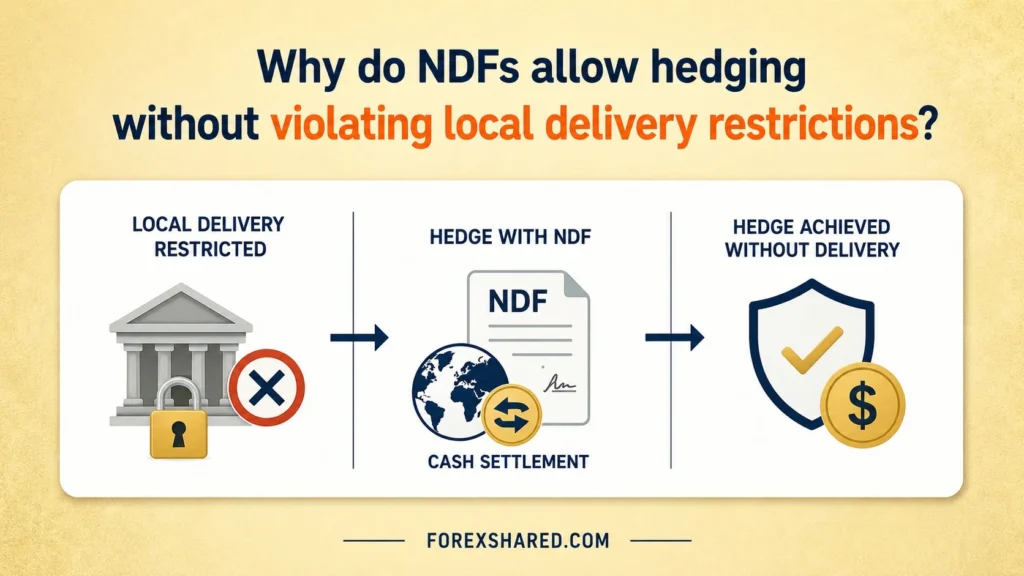
Why Do NDFs Allow Hedging Without Violating Local Delivery Restrictions?
NDFs allow hedging without local delivery because they cleanly separate currency exposure from physical currency transfer. When international participants face strict capital controls, they still need to offset their economic risks without breaching onshore regulations that strictly prohibit the offshore transfer of the domestic currency.
The contract elegantly references the restricted currency’s exchange-rate movement without ever requiring the parties to deliver that local currency. Instead, the entire hedge result is settled through a simple net cash payment. The instrument operates strictly as a cash-settled contract, typically resolving in USD or another pre-agreed currency, completely avoiding physical delivery at maturity.
They function purely as FX forward contracts where net payments are derived from the exact difference between the maturity spot rate and the previously agreed forward rate. This vital structure should always be explained as a legally recognized non-delivery mechanism, not as a questionable shortcut around local sovereign law.
What local delivery restriction problem does an NDF solve?
An NDF expertly solves the local delivery restriction problem by letting the user successfully hedge the restricted currency’s exchange-rate movement without physically transferring that specific currency.
Local delivery restrictions are rigid regulatory limits on whether a domestic currency can be actively transferred, legally settled, converted, or delivered into offshore banking accounts. Despite these firm limits, the business or investor may still carry massive real economic exposure to that localized currency’s volatility. A thorough understanding of controlled-currency hedging with NDFs shows how derivatives adapt to these legal walls. A traditional deliverable forward is fundamentally unsuitable if it contractually requires actual local-currency exchange that regulations outright ban. The NDF addresses the restriction strictly through offshore contract structure, not by blatantly ignoring local sovereign rules.
Which currency movement still needs to be hedged?
The restricted local currency can still violently affect corporate revenues, operational costs, debt service, investment value, or balance-sheet exposure. The hedge exists purely because the user desperately wants protection from exchange-rate movement, even when physical delivery remains heavily restricted.
What makes a deliverable hedge difficult under restrictions?
A deliverable forward normally ends with physical currency exchange. If the local currency cannot be freely delivered into an offshore account, that mandatory contract structure conflicts directly with the practical and legal settlement route.
Where does the NDF fit into the restriction problem?
The NDF brilliantly keeps the restricted currency as the mathematical reference, entirely removes the burdensome need for local-currency transfer at maturity, and turns the underlying hedge into a highly tradable, cash-settled offshore contract.
Why does non-delivery keep the hedge outside local currency transfer?
Non-delivery keeps the hedge outside local currency transfer strictly because the NDF functionally does not exchange the restricted currency at contract maturity.
The NDF explicitly avoids exchanging the two underlying currencies when the settlement date arrives. Because physical delivery is the operational hurdle, avoiding it allows the parties to execute no physical delivery in NDFs seamlessly. The contract merely references the restricted currency’s price movement. The Bank for International Settlements clearly defines NDFs as settled in cash without physical delivery of the two underlying currencies at maturity [BIS, 2024]. The critical non-delivery clause structurally changes the settlement method, not the underlying economic reference.
Which delivery step is removed from the hedge?
The final physical exchange of the restricted local currency is entirely removed. The offshore parties absolutely do not need to deliver or receive the restricted currency into domestic bank accounts, which is the core foundational reason the instrument is officially called non-deliverable.
What remains active if the currency is not delivered?
The massive exchange-rate exposure fiercely remains active. The NDF still meticulously tracks the restricted currency’s precise value movement through the agreed rate and the official fixing reference.
Where does the hedge result appear instead?
The ultimate hedge result brilliantly appears as a net cash settlement. The calculated gain or loss is paid strictly in the agreed settlement currency rather than through a prohibited physical local-currency transfer.
How does cash settlement replace restricted-currency delivery?
Cash settlement brilliantly replaces restricted-currency delivery by directly converting the NDF hedge result into a clean net payment in an agreed settlement currency.
| Stage | Contract Element | Function |
|---|---|---|
| Exposure Identified | Restricted currency pair | Defines the currency movement being hedged |
| Trade Start | Agreed NDF rate | Sets the starting hedge reference |
| Near Maturity | Fixing date | Identifies when the final reference is observed |
| Settlement Reference | Fixing source | Determines which rate controls settlement |
| Final Payment | Settlement currency | Carries the net cash amount |
| Delivery Boundary | Non-delivery clause | Confirms no physical local-currency transfer |
The lifecycle begins with exposure identified, proceeds to the agreed NDF rate, hits the fixing date and fixing source, and finalizes perfectly through the settlement currency, governed strictly by the non-delivery clause.
Which rate anchors the hedge at trade start?
The agreed NDF rate robustly anchors the hedge, permanently records the exchange-rate level comfortably accepted by both offshore counterparties, and immediately becomes the initial baseline side of the later settlement comparison.
What turns the hedge into a cash result?
The fixing or reference rate explicitly gives the contract its final indisputable comparison point. The previously agreed rate and the new fixing reference are algorithmically compared, and the exact result is paid seamlessly as a net cash amount.
Where does the settlement currency complete the process?
The settlement currency logistically carries the final payment. In many structured NDF frameworks, this is USD or another highly liquid pre-agreed currency, but the settlement currency remains solely the payment route, definitely not the restricted currency actually being hedged.
Why does the fixing rate make the NDF legally and economically workable?
The fixing rate makes the NDF workable because it systematically replaces physical delivery with a universally recognized settlement reference.
The fixing rate supplies the final authoritative reference required for cash settlement calculation. The fixing date decisively shows precisely when that reference is captured, and the fixing source shows exactly which rate fundamentally controls the final comparison. The fixing mechanism intelligently lets the complex contract close cleanly without physical currency exchange. Treasury teams must understand basis risk when evaluating this mechanism.
Which fixing term controls the final reference?
The fixing source strictly determines which specific reference rate is aggressively used, while the fixing date legally determines exactly when that reference is actively observed. These terms are operationally essential because the contract simply does not settle through physical delivery.
What makes fixing different from delivery?
Delivery fundamentally transfers the physical underlying currencies between corporate bank accounts, while fixing only mathematically provides a numerical reference for the calculating cash-settlement comparison.
Where can fixing create residual risk?
Residual risk heavily appears when the fixing source severely differs from the user’s actual conversion exposure onshore. The hedge may dramatically reduce macro exchange-rate risk but still silently leave substantial basis risk.
How does the settlement currency separate payment from restricted-currency exposure?
The settlement currency separates payment from restricted-currency exposure because the restricted local currency fiercely drives the hedge economics while USD or another agreed currency actively carries the cash payment.
| Layer | Currency Role | Interpretation |
|---|---|---|
| Exposure Layer | Restricted local currency | Drives the hedge economics |
| Reference Layer | Fixing/reference rate | Determines the settlement comparison |
| Payment Layer | USD or agreed settlement currency | Carries the net cash payment |
It is strictly crucial to grasp that the settlement currency is definitively not the same as the restricted exposure currency. Readers must never treat USD settlement as naive proof that the overarching hedge is merely a USD exposure mechanism.
Which currency creates the hedge exposure?
The restricted local currency effectively creates the exposure because its massive exchange-rate movement aggressively affects the hedge result. This core structural reality remains profoundly true even if the local currency is physically never delivered offshore.
Which currency carries the final settlement?
The settlement currency logistically carries the final net payment. It flawlessly allows the protective hedge to close entirely without cumbersome local-currency delivery.
Where does settlement-currency confusion begin?
Confusion disastrously begins when readers carelessly assume USD settlement implies the hedge is only a USD transaction. In objective reality, USD may simply be the payment channel while the restricted currency violently drives the entire economic result.
How are NDFs different from deliverable forwards under local restrictions?
NDFs are completely different from deliverable forwards under local restrictions because NDFs reliably settle in cash while deliverable forwards actively require full currency exchange at maturity.
| Contract Type | Delivery Requirement | Best Fit | Main Interpretation Risk |
|---|---|---|---|
| NDF | No physical delivery | Restricted or controlled currency exposure | Confusing reference exposure with delivery |
| Deliverable Forward | Full currency exchange at maturity | Freely transferable currencies | Ignoring the delivery obligation |
| Spot FX | Immediate or near-term exchange | Actual currency need | Assuming restricted-market access exists |
Deliverable forwards rigorously require full currency exchange at maturity. Spot FX is functionally best for actual currency need, not delayed restricted-currency exposure. NDFs uniquely solve the restriction crisis by keeping the offshore contract completely cash-settled. They are structurally not perfectly interchangeable.
Which contract requires local-currency transfer?
A deliverable forward demands the underlying currencies to be officially exchanged at maturity. That physical structure works perfectly when both currencies are freely transferable through global settlement channels, but it can be brutally unsuitable when local delivery restrictions forcefully apply.
What does the NDF preserve from forward hedging?
The NDF flawlessly preserves forward-style exposure management and dynamically allows the user to reference a future exchange-rate outcome while entirely removing the problematic physical delivery step.
Where does the comparison change the reader’s interpretation?
The reader should aggressively compare settlement structure before carelessly comparing rates. A superficially similar-looking FX quote can secretly carry a devastatingly different contract outcome if delivery restrictions exist.
When do local delivery restrictions make an NDF the practical hedge structure?
Local delivery restrictions instantly make an NDF practical when the user urgently needs exchange-rate protection but functionally does not need physical receipt or delivery of the local currency.
Restricted or hard-to-deliver local currency exposure forces creative treasury solutions. NDFs perfectly fit structural users who demand price protection, not actual localized currency receipt. Furthermore, nonresident access barriers and offshore settlement limitations amplify the NDF’s utility.
When does a company use an NDF instead of a deliverable hedge?
A company may prominently possess local-currency revenues, costs, or liabilities. It may aggressively need protection from exchange-rate movement but may entirely lack the capability for physical offshore delivery of the local currency.
Where does nonresident access make NDFs relevant?
NDF markets heavily become relevant when offshore participants immediately face intense non-deliverability or onshore-market restrictions. This efficiently makes NDFs useful as an offshore hedge reference pipeline. Furthermore, research indicates that offshore currency markets, including Asian NDFs, can rapidly exceed onshore markets in transaction volume and actively price significant depreciation during stress episodes [IMF, 2020].
Which need should not be solved with an NDF alone?
If the user structurally needs actual local currency for onshore payment, local payroll, corporate taxes, or local operations, an NDF alone absolutely may not supply that currency. It can efficiently hedge exchange-rate exposure, but it utterly does not replace local currency funding or physical settlement access.
What risks remain even when the NDF avoids local delivery?
NDFs securely avoid the physical-delivery problem, but fixing risk, basis risk, liquidity risk, counterparty risk, policy risk, and compliance risk can still dangerously remain.
| Remaining Risk | Why It Matters |
|---|---|
| Basis Risk | The fixing reference may not match the user’s real conversion rate |
| Fixing Risk | The settlement result depends on the specified fixing source |
| Liquidity Risk | Offshore pricing can widen or shift during stress |
| Counterparty Risk | Settlement depends on the counterparty performing |
| Policy Risk | Local rules, offshore access, or market controls can change |
| Compliance Risk | The contract must still be reviewed against applicable rules |
Avoiding severe delivery restrictions certainly does not instantly remove every risk from the treasury operation. Complex compliance risk remains a permanent need for strict rule-aware interpretation. Retail off-exchange forex can involve extreme leverage and counterparty risk; customers can rapidly lose all deposited funds and may lose more than deposited funds [eCFR, 2024].
Which risk remains after delivery is avoided?
Basis risk can tenaciously remain even when the NDF hedge direction is factually correct. The formal fixing reference may practically not perfectly match the user’s actual onshore exposure conversion rate.
What policy risk can affect NDF interpretation?
Macro currency rules and volatile market access conditions can change instantly. Offshore and onshore markets can react violently differently to unpredicted geopolitical stress or sudden capital restrictions.
Where does compliance interpretation need caution?
An NDF structure may technically avoid physical delivery, but it does not automatically guarantee total corporate compliance in every scattered jurisdiction. Contract terms, offshore counterparties, local sovereign rules, and rigorous regulatory permissions still matter profoundly.
What examples make NDF delivery-restriction hedging easier to understand?
Examples make NDF delivery-restriction hedging distinctly easier to understand by structurally showing how exposure can be successfully hedged without ever transferring the local currency.
| Example Type | What It Shows |
|---|---|
| Corporate receivable hedge | Exposure can be hedged without receiving local currency offshore |
| Investor exposure hedge | Currency movement can be referenced without local settlement access |
| Fixing settlement example | The hedge closes through reference comparison |
| Deliverable-forward contrast | Shows why delivery restriction changes contract choice |
Utilizing highly targeted hypothetical examples clarifies the complex mechanism immensely without irresponsibly making the article a calculation-heavy trading recommendation guide.
What does a corporate receivable example reveal?
A firm may highly expect future operational cash flow in a restricted local currency and may urgently want to reduce violent exchange-rate uncertainty. An NDF can seamlessly hedge the currency movement without ever requiring impossible offshore delivery.
How does an investor exposure example clarify non-delivery?
An international investor may purposefully want exposure to a restricted currency’s movement while their direct local-market physical settlement is severely limited. The NDF cleanly provides synthetic reference exposure strictly through cash settlement.
Where does the deliverable-forward contrast help?
A deliverable forward officially ends with full currency exchange, while an NDF definitively ends with a net cash settlement. This fundamental contrast efficiently explains why NDFs are exclusively used when brutal local delivery restrictions matter.
How should readers interpret “without violating local delivery restrictions” correctly?
Readers should interpret “without violating local delivery restrictions” as meaning the NDF functionally avoids physical local-currency delivery, not that the reckless user can comfortably ignore legal, regulatory, or contract limits.
| Interpretation Layer | Reader Question |
|---|---|
| Delivery Layer | Does the contract physically transfer the local currency? |
| Exposure Layer | Which restricted currency drives the hedge economics? |
| Reference Layer | Which fixing source controls settlement? |
| Payment Layer | Which currency carries the cash settlement? |
| Compliance Layer | Are contract terms and local rules being reviewed appropriately? |
| Residual Risk Layer | Could basis, fixing, policy, or liquidity risk remain? |
Treating the NDF heavily as a non-deliverable hedge structure correctly separates pure economic exposure from dangerous physical transfer. It should absolutely not be described broadly as a guaranteed way to maliciously bypass local sovereign law.
Which layer should be read before the hedge price?
The delivery layer should forcefully be read first because it actively tells the reader whether the contract secretly involves toxic local-currency transfer. Without properly checking this layer, the NDF can easily be disastrously mistaken for a standard deliverable forward.
What does the NDF structure not guarantee?
It explicitly does not guarantee perfect mathematical hedge accuracy, blanket local legal compliance in every single jurisdiction, or immediate physical access to the local currency.
Where should local restrictions sit in the interpretation?
Local sovereign restrictions should be intensely treated as the functional operational reason for non-delivery. They should fundamentally not be treated as completely irrelevant simply once the financial contract is placed offshore.
What mistakes cause confusion about NDFs and local delivery restrictions?
Mistakes about NDFs and local delivery restrictions usually come directly from misreading the complex contract as either a physical-delivery tool or an invincible legal shortcut.
Treating an NDF as a deliverable forward
The reader dangerously assumes the local currency will be fully exchanged at maturity. An NDF actually settles purely the net difference in the freely tradable settlement currency.
Thinking non-delivery means no local-currency exposure
The reader blissfully assumes the highly restricted currency magically no longer matters. The restricted currency still fundamentally drives the entire hedge result actively through the reference rate.
Confusing offshore settlement with automatic compliance
The reader irresponsibly assumes offshore cash settlement somehow automatically satisfies every intricate local rule. Non-delivery aggressively reduces the physical delivery issue, but strict contract and regulatory review absolutely still matter.
Ignoring the fixing source
The reader carelessly focuses solely on the initially agreed NDF rate. The fixing source ultimately determines exactly how the final cash settlement is financially calculated.
Which contract terms confirm that the NDF avoids local delivery?
Contract terms decisively confirm that the NDF avoids local delivery when they clearly specify cash settlement, settlement currency, fixing source, fixing date, and a legally binding non-delivery clause.
| Contract Term | What It Confirms |
|---|---|
| Non-delivery clause | No physical local-currency exchange |
| Settlement currency | How cash payment is made |
| Fixing source | Which reference rate controls settlement |
| Fixing date | When final reference is observed |
| Restricted currency pair | Which currency movement drives exposure |
| Notional amount | Hedge size |
| Maturity date | Timing alignment |
The non-delivery clause mathematically confirms absolutely no physical local-currency exchange will ever occur. Settlement currency dictates how the cash payment is ultimately made, while fixing source dictates which reference rate powerfully controls that settlement calculation.
Which term proves there is no physical local-currency delivery?
The non-delivery or cash-settlement clause is emphatically the strongest legal confirmation. It legally separates the NDF derivative completely from a traditional deliverable forward obligation.
What terms separate exposure from payment?
The restricted currency pair explicitly belongs to the exposure layer, the settlement currency solidly belongs to the payment layer, and the designated fixing source heavily connects exposure and settlement exactly at maturity.
Which terms show the hedge still matches the real exposure?
Notional, maturity, currency pair, and fixing source definitively show whether the hedge structurally fits the underlying corporate risk. A highly secure non-deliverable structure can still be poorly matched if these vital terms are disastrously wrong.
What should be validated before relying on an NDF under delivery restrictions?
Before relying on an NDF under delivery restrictions, readers should rapidly validate the currency restriction, instrument type, non-delivery language, fixing source, settlement currency, notional, maturity, and residual risk.
| Validation Question | Pass Condition |
|---|---|
| Is the currency subject to delivery, convertibility, or offshore access restrictions? | Restriction problem is real |
| Is the instrument actually an NDF? | Non-deliverable structure is clear |
| Does the contract include non-delivery or cash-settlement language? | Physical local-currency transfer is excluded |
| Which currency pair defines the exposure? | Exposure reference is named |
| What notional amount is being hedged? | Hedge size is identifiable |
| What maturity date applies? | Hedge timing is clear |
| Which fixing source determines settlement? | Settlement reference is named |
| What settlement currency carries the cash payment? | Payment route is clear |
| Is the local currency physically delivered or only referenced? | Delivery status is confirmed |
| Could basis risk remain? | Residual mismatch is considered |
| Could policy or regulatory rules affect the hedge? | Compliance caution is preserved |
| Is the NDF being treated as risk reduction, not guaranteed protection or legal advice? | YMYL safety is preserved |
NDFs beautifully allow hedging under severe local delivery restrictions primarily because they conceptually separate economic currency exposure from highly regulated physical currency transfer. The restricted currency continuously drives the hedge, the fixing source officially determines settlement, and the offshore settlement currency safely carries the final cash payment without friction.
Frequently Asked Questions
Does a non-delivery clause make the NDF exempt from all local regulations?
No. While the non-delivery clause avoids the direct offshore transfer of the local currency, international participants must still rigorously evaluate counterparties and their respective jurisdictional compliance frameworks.
Can I request physical delivery of the restricted currency if I change my mind later?
No. An NDF contract is fundamentally and legally structured to settle exclusively in cash (typically USD or another major proxy). You cannot arbitrarily demand physical delivery of a non-convertible currency upon maturity.
Is basis risk eliminated since the NDF avoids local physical transfer?
No. Basis risk powerfully remains because the offshore fixing reference rate used to calculate your cash settlement might wildly diverge from the real onshore exchange rate you actually experience operationally.