How Do Standard, Mini, and Micro Lots Differ?
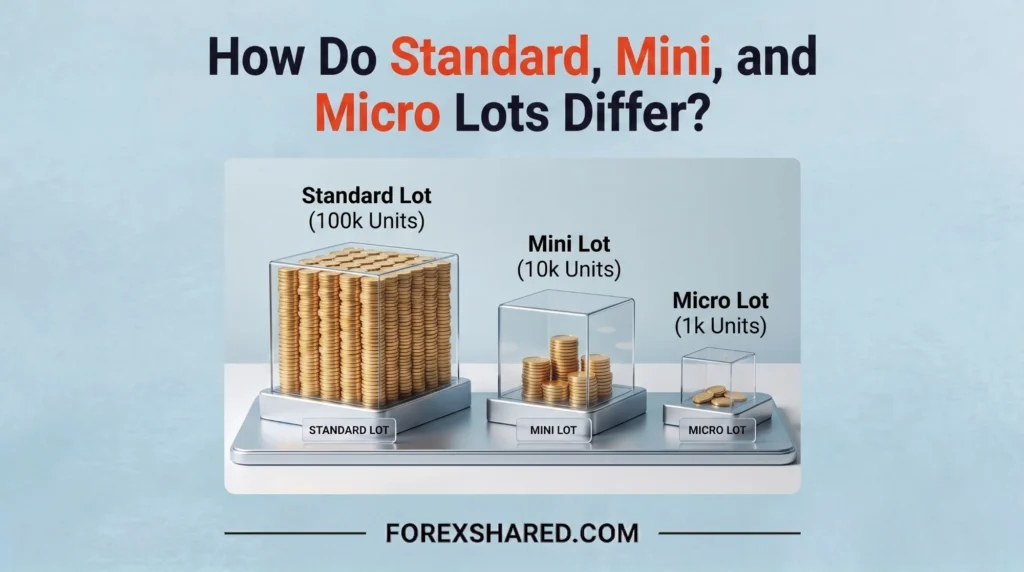
How Do Standard, Mini, and Micro Lots Differ? Standard, mini, and micro lots differ by the number of base-currency units they represent. The core unit ladder dictates that a standard lot equals 100,000 units, a mini lot equals 10,000 units, and a micro lot equals 1,000 units. These specific volume tiers establish the foundational baseline for all modern forex position sizing. These lot categories create a forex position-unit ladder that structures the entire retail trading environment. Instead of navigating the market by inputting raw, complex numeric strings—like 43,250 Euros—traders universally use these standardized intervals to precisely manage trade execution and rigorously control capital exposure. This article completely demystifies position sizing mechanics. We will examine unit comparisons, explore how different lot sizes manipulate exposure impact, and clarify platform display conventions. Furthermore, we will break down real-world examples, definitively separate lot size from margin and pip value, highlight frequent sizing mistakes, apply pre-trade fixes, and present a practical validation checklist. warning EDUCATIONAL DISCLAIMER This article is educational only and does not constitute financial advice. Trading foreign exchange on margin carries a high level of risk. What Do Standard, Mini, and Micro Lots Mean in Forex? Standard, mini, and micro lots are forex position-size categories that show how many currency units a trade controls. By grouping volume into predefined brackets, they strip away the complexity of raw numerical execution. It acts as a strict position-unit category, not a direct profit formula. When interpreting Forex lot size units, understand that the selected lot category sets the absolute starting scale of the position before any price movement ever occurs (BabyPips, IG). Key Takeaway Standard, mini, and micro lots are forex position-size categories that show how many currency units a trade controls. Why Do These Lot Sizes Create Different Position Scales? These lot sizes create different position scales because each lot category controls a different number of currency units. The physical volume deployed into the market expands or shrinks dynamically depending on the specific tier selected. Larger lots naturally inject greater volume, which usually creates larger exposure and a stronger price-movement impact on equity. Conversely, smaller lots give traders finer position-size control, allowing meticulous scaling. Why Is a Standard Lot Considered Large? A standard lot is considered large because it controls 100,000 base-currency units. It controls the largest unit amount among the three common categories. Due to this massive baseline, even very small market movements can feel immensely significant and rapidly exhaust available margin if unaccounted for. Why Is a Mini Lot a Middle Position Size? A mini lot is a middle position size because it controls fewer units than a standard lot but more units than a micro lot. Controlling exactly 10,000 units, the mini lot heavily reduces exposure compared to the standard tier, creating a stable intermediary step for active risk management. Why Is a Micro Lot Useful for Smaller Position Control? A micro lot is useful for smaller position control because it controls far fewer units than a standard or mini lot. Sitting at 1,000 units, micro lots proactively keep exposure small. They are exceptionally useful for learning environments, strategic testing, or strict smaller-account control. Key Takeaway The three lot sizes differ because each one changes the number of currency units controlled by the trade. How Many Units Does Each Lot Size Control? Each lot size controls a different number of base-currency units. This specific 10x geometric unit difference is the absolute core distinction separating the three primary lot sizes. Understanding this strict step-down hierarchy is mandatory, and traders must consistently confirm how their specific broker displays these exact lot entries on the execution terminal (BabyPips, IG). Lot Size Common Unit Size Relative Scale Practical Meaning Standard lot 100,000 units Largest of the three High position scale Mini lot 10,000 units One-tenth of standard Moderate position scale Micro lot 1,000 units One-tenth of mini Smaller position scale VOLUMETRIC UNIT COMPARISON STANDARD 100,000 Units MINI 10,000 Units MICRO 1,000 Units FOREXSHARED.COM Figure 1.0: Volumetric representation of the 90% geometric reduction connecting Standard, Mini, and Micro lots. Key Takeaway The main difference is simple: standard lots control more units, mini lots control fewer, and micro lots control the smallest position size among the three. How Does Each Lot Size Affect Exposure and Price Sensitivity? Each lot size affects exposure and price sensitivity because the number of units controlled changes how strongly the trade responds to market movement. Assessing Lot size and trade exposure validates that the currency pair itself can remain fundamentally identical while the raw position scale dictates entirely divergent outcomes. Traders must stringently avoid judging trade safety solely by whether the margin platform algorithmically accepts the input order. How Does a Standard Lot Affect Exposure? A standard lot affects exposure by creating a larger controlled position than mini or micro lots. Placing 100,000 physical units directly into open market crosshairs ensures acute sensitivity to even minor trend fluctuations. Deploying standard lots amplifies profit velocity while simultaneously demanding highly developed risk awareness parameters to survive drawdown. How Does a Mini Lot Reduce Exposure? A mini lot reduces exposure by lowering the controlled unit amount compared with a standard lot. Controlling exactly 10,000 units, mini lots engineer a more robust operational cushion. This strategically bridges the hazardous gap between heavy interbank scale and basic fractional entry constraints. How Does a Micro Lot Reduce Price Sensitivity? A micro lot reduces price sensitivity by creating a smaller position-unit base. Price movement inherently generates a radially smaller account impact when vastly fewer units (1,000) absorb the hit. Micro lots heavily support algorithm verification and precise fractional sizing, but they absolutely do not render trading risk-free. SENSITIVITY TO A STATIC 10-PIP MOVE MICRO LOT 1,000 Units LOW IMPACT MINI LOT 10,000 Units MED IMPACT STANDARD LOT 100,000 Units HIGH IMPACT FOREXSHARED.COM Figure 2.0: The Dashboard Metaphor. Identical chart movement produces wildly divergent financial pressures depending on the unit multiplier selected. Key Takeaway Each smaller lot size reduces the number of currency units controlled, which usually reduces exposure and
Which Lot Sizes Define Forex Position Units?
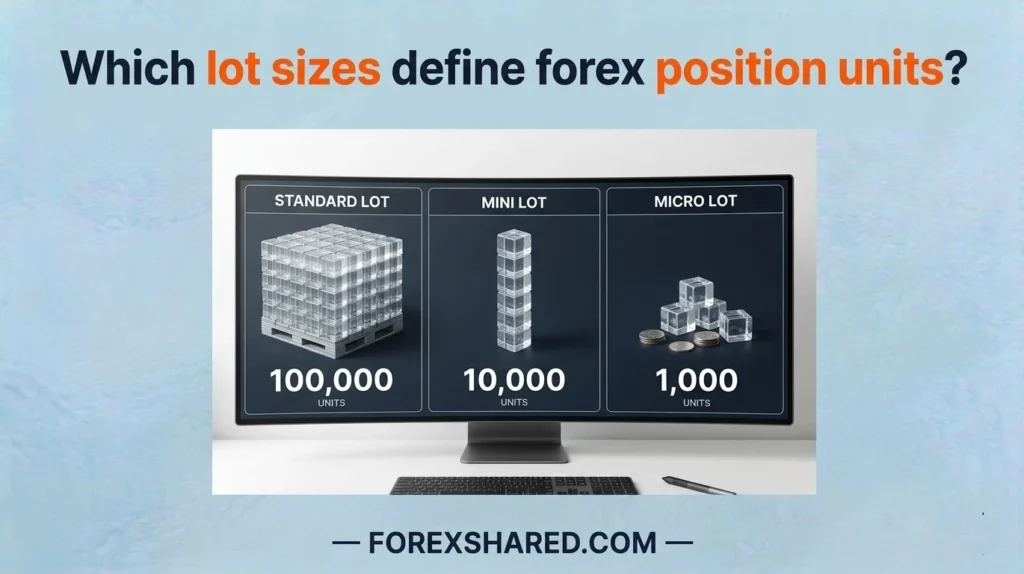
Which Lot Sizes Define Forex Position Units? Forex Lot Sizes define position units by grouping currency trades into standard, mini, micro, and nano lot categories. These highly formalized volume tiers exist because attempting to buy or sell fractional raw currency units on the open market would create immense execution chaos. Lot sizes tell traders exactly how many base-currency units a position controls before pip value, margin requirements, or systemic leverage are even judged. The institutional foundation of this system rests on a strict common unit ladder. At the top sits the standard lot, which unequivocally equates to 100,000 units. Sizing down dynamically, the mini lot represents 10,000 units, the micro lot governs 1,000 units, and the highly specific nano lot controls exactly 100 units. Mastering this progression allows market participants to scale exposure intelligently. This article clearly maps out the functional reality of forex position units. We will cover the definitive definition of lot size, why standardized categories replaced raw units, detail the core unit scale hierarchy, and examine precise operational timing. We will then compare lot metrics against secondary risk layers, demystify platform lot entries, analyze practical examples, identify severe unit miscalculations, provide absolute pre-trade fixes, and conclude with a vital validation checklist. EDUCATIONAL DISCLAIMER This article is educational only and does not constitute financial advice. Trading foreign exchange on margin carries a high level of risk. What Does Lot Size Mean in a Forex Position? Lot size means the standardized quantity used to describe how many currency units a forex position controls. It establishes the physical magnitude of the trade you are executing in the market. To accurately grasp Lot size basics, it is vital to acknowledge that the lot is not just a nominal broker label; it is the raw, unadjusted geometric base that defines your unit volume. Consequently, lot size is fundamentally different from margin collateral, variable pip value, aggregate leverage limits, and ultimate cash risk. The lot acts purely as the quantitative bedrock. You cannot evaluate how much capital is at risk without first knowing exactly how many units you control (BabyPips, IG). THE FOREX LOT SIZE LADDER STANDARD 100,000 Units MINI 10,000 Units MICRO 1,000 Units NANO (100) FOREXSHARED.COM Figure 1.0: The structural hierarchy of standard forex position-unit categories mapping true exposure base. Key Takeaway Lot size defines how many currency units a forex position controls. Why Do Forex Traders Use Lots Instead of Raw Currency Units? Forex traders use lots instead of raw currency units because lot categories make large position quantities easier to organize, communicate, and compare. Attempting to parse raw currency volumes during rapid execution is cognitively taxing. Categorization eliminates mathematical friction. How Do Lots Simplify Trade-Size Language? Lots simplify trade-size language by replacing large currency-unit numbers with recognizable position-size categories. Stating “one standard lot” is profoundly more efficient than repeatedly detailing “one hundred thousand units.” Likewise, confirming “one micro lot” immediately and universally signals a specific, smaller position layout, unifying sizing communication globally. Why Does Lot Size Matter Before Risk Is Judged? Lot size matters before risk is judged because it sets the base quantity that later affects exposure, pip impact, and margin need. The trader must completely know the unit size first. Mathematical metrics like pip value, required margin, and account leverage remain mathematically impossible to interpret accurately without first solidifying the lot category foundation. Key Takeaway Lots make forex position units easier to understand because they convert large currency quantities into recognizable trade-size categories. Which Lot Sizes Define the Main Forex Position-Unit Categories? The main forex lot sizes are standard lots, mini lots, micro lots, and nano lots. These specifically designed categories construct the common position-unit ladder relied upon by all retail environments. Dissecting Standard, mini, and micro lots firmly establishes these intervals so traders can easily manage scaling. Platform display rules can vary dramatically, but the physical quantity behind these definitions remains permanently fixed (BabyPips, IG). Lot Size Common Unit Size Practical Meaning Standard lot 100,000 units Large position unit Mini lot 10,000 units Smaller than standard Micro lot 1,000 units Small retail-friendly size Nano lot 100 units Very small position size Key Takeaway The main forex lot sizes define a position’s unit scale from large standard lots down to very small nano lots. How Does Each Lot Size Change the Scale of a Position? Each lot size changes the scale of a position by changing how many currency units the trade controls. Transitioning up or down the lot ladder natively amplifies or restricts the physical volume held. Evaluating Lot size and trade exposure highlights exactly how utilizing identical pip distances on the exact same pair creates radically different outcomes purely because the lot category shifted. How Does a Standard Lot Define a Large Position? A standard lot defines a large position by controlling 100,000 currency units. It serves as the baseline maximum size parameter in standard retail contexts, creating the largest common exposure scale. Traders must comprehensively grasp this magnitude before utilizing standard lots; executing trades at this tier naturally demands substantial collateral buffers. How Does a Mini Lot Reduce Position Scale? A mini lot reduces position scale by controlling fewer units than a standard lot. Controlling exactly 10,000 units, the mini lot sits perfectly in the middle of the ladder. It creates significantly more moderate position sizing, allowing intermediate participants to maneuver effectively without committing to the overwhelming capital weight of standard sizing. How Does a Micro Lot Support Smaller Position Control? A micro lot supports smaller position control by reducing the trade to a much smaller unit quantity. At strictly 1,000 units, the micro lot systematically collapses the exposure scale. This smaller unit architecture greatly assists aggressive risk-management and account-fit control, though utilizing smaller size does not automatically neutralize market threats. How Does a Nano Lot Create Very Small Exposure? A nano lot creates very small exposure by reducing the position to 100 currency units. It establishes the finest operational slice currently accessible to retail traders. Nano lots dramatically minimize dimensional scaling, yet