How Does Pip Size Vary by Pair Convention?
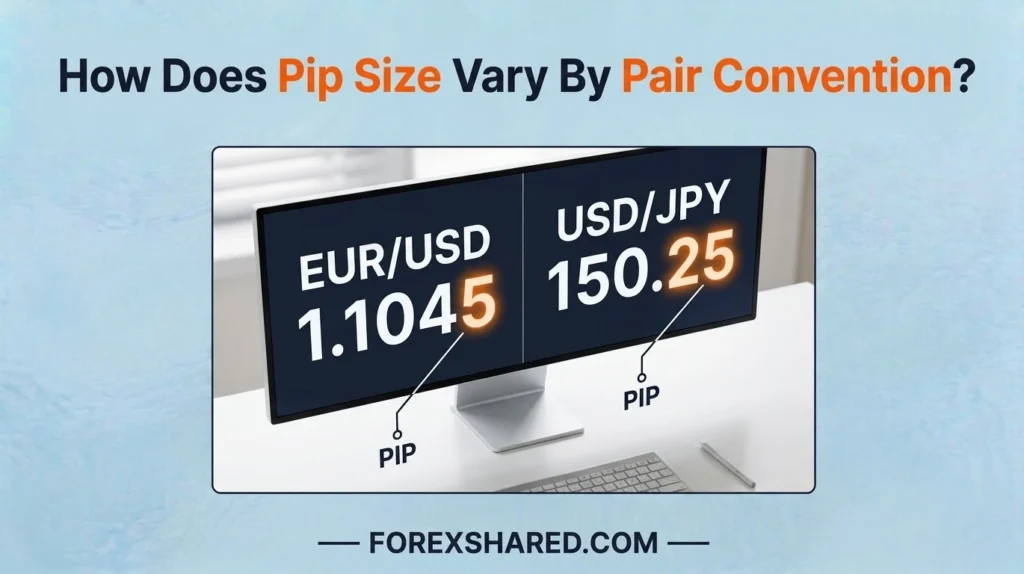
How Does Pip Size Vary by Pair Convention? Pip Size varies by pair convention because forex pairs are quoted using different decimal-place standards. For many non-JPY pairs, the industry standard definitively places the pip at the fourth decimal place. Conversely, because of distinct historical currency valuations, many JPY pairs enforce a strict second-decimal convention to maintain practical quote structures. This fundamental divergence is entirely about quote convention, not pair importance. The global interbank market scales the price increment to fit the vast difference in quotation ranges between fiat currencies. Whether tracking the Euro or the Japanese Yen, discovering where the standard pip sits is an absolute prerequisite before measuring any market activity. This article details exactly how to interpret these critical pricing conventions. We will explore the core definition of a pip, analyze pair conventions, break down non-JPY and JPY quote reading, and examine how fractional pips uniquely affect quote display. Furthermore, we will clarify spread and stop-distance reading, review practical examples, identify common mistakes, provide immediate fixes, and conclude with an essential validation checklist. warning EDUCATIONAL DISCLAIMER This article is educational only and does not constitute financial advice. Trading foreign exchange on margin carries a high level of risk. What Does Pip Size Mean in a Forex Quote? Pip Size means the price increment inside a forex quote that counts as one full pip. It acts as the definitive structural unit for measuring market movement. Sitting securely within the broader forex quote and pricing framework, pip size helps traders seamlessly read spreads, accurately measure stop distances, define take-profit targets, and precisely track price movement. It is crucial to remember that pip size represents pure quote distance, which is entirely different from the resulting pip value (OANDA, n.d.)(IG, n.d.). EUR/USD QUOTE ANATOMY 1 . 1 0 5 4 2 THE PIP (4th Decimal) FRACTIONAL PIP (Pipette) FOREXSHARED.COM Figure 1.0: Quote anatomy isolating the standard fourth-decimal pip increment from fractional precision. Why Do Pair Conventions Change Where the Pip Appears? Pair conventions change where the pip appears because currency pairs are not all quoted on the same numerical scale. To fully master Pip size conventions, traders must realize that different fiat currencies trade at drastically varying nominal exchange rates. Consequently, most non-JPY pairs commonly utilize a fourth-decimal pip reading methodology to standardize micro-movements, while many JPY pairs commonly use second-decimal pip reading to match their inherently higher numerical basis (OANDA, n.d.)(IG, n.d.). NON-JPY CONVENTION e.g., EUR/USD, GBP/USD 0.0001 4TH DECIMAL JPY CONVENTION e.g., USD/JPY, EUR/JPY 0.01 2ND DECIMAL FOREXSHARED.COM Figure 2.0: The structural divergence displaying how base conventions dictate pip size based on numerical scale. Why Do Most Non-JPY Pairs Use a Smaller Decimal Increment? Most non-JPY pairs use a smaller decimal increment because their quotes are commonly read with the pip at the fourth decimal place. Currencies like the Euro and British Pound frequently price near parity or low single digits against the US Dollar. Therefore, pairs such as EUR/USD, GBP/USD, and AUD/USD are commonly displayed with several decimal places. To capture adequate volatility data within such tight constraints, an increment of 0.0001 is commonly treated as one pip for many non-JPY pairs. Why Do Many JPY Pairs Use a Larger Decimal Increment? Many JPY pairs use a larger decimal increment because their full pip is commonly read at the second decimal place. JPY-style quotes often sit at much higher numerical levels, trading at triple digits relative to major bases. Extending pip analysis to the fourth decimal on these assets would generate incredibly confusing and uselessly granular metrics. Thus, an increment of 0.01 is commonly treated as one pip for many JPY pairs to preserve sensible charting scales. How Do Non-JPY Pairs Usually Define Pip Size? Most non-JPY pairs usually define Pip Size as a one-digit movement at the fourth decimal place. If an asset like EUR/USD moves deliberately from 1.1000 to 1.1001, that geometric shift of 0.0001 defines exactly one full pip. A fifth decimal, if shown on your execution terminal, is usually a fractional pip or pipette. Constraining interpretation to the fourth digit prevents massive distance overestimation (OANDA, n.d.)(IG, n.d.). How Should Traders Read the Fourth Decimal Place? Traders should read the fourth decimal place as the standard full-pip position for many non-JPY forex quotes. While checking technical distance, ensure that your eyes immediately anchor to this fourth digit. The fifth decimal, if displayed by your broker, usually represents fractional precision designed for high-frequency pricing. Treating every single displayed digit as a full pip is a critical mistake that drastically overestimates market movement. How Do JPY Pairs Usually Define Pip Size? Many JPY pairs usually define Pip Size as a one-digit movement at the second decimal place. If USD/JPY moves decisively from 150.00 to 150.01, that clean 0.01 shift represents exactly one pip. A third decimal, if shown on the pricing feed, is usually a fractional pip. Ignoring this structural disparity leads directly to critical mathematical failures when calculating Yen exposure (OANDA, n.d.)(IG, n.d.). Why Does the Second Decimal Place Matter in JPY Quotes? The second decimal place matters in JPY quotes because many JPY pairs use it as the standard full-pip position. JPY pairs are commonly quoted quite differently from many non-JPY pairs to reflect their unique equilibrium levels. Relying on fourth-decimal thinking while trading USD/JPY or EUR/JPY creates massive misreads, forcing the trader to misunderstand the physical quote distance completely. How Do Fractional Pips Affect Pip-Size Reading? Fractional pips affect Pip Size reading by adding quote precision without replacing the standard full-pip convention. When distinguishing a Pipette vs pip, traders must recognize that a fractional pip is merely a smaller-than-one-pip quote increment. Commonly called a pipette, it is usually exactly one-tenth of a standard pip. Understanding Quote precision from fractional pips reveals that extra broker digits heavily improve pricing accuracy but regularly confuse traders trying to locate the true full-pip value (OANDA, n.d.)(FOREX.com, n.d.). 1.10542 FULL PIP PIPETTE (Fractional) 1/10th of a Full Pip FOREXSHARED.COM Figure 3.0: Quote resolution breakdown. The pipette adds fractional detail
Why Does Pip Movement Matter for Risk?
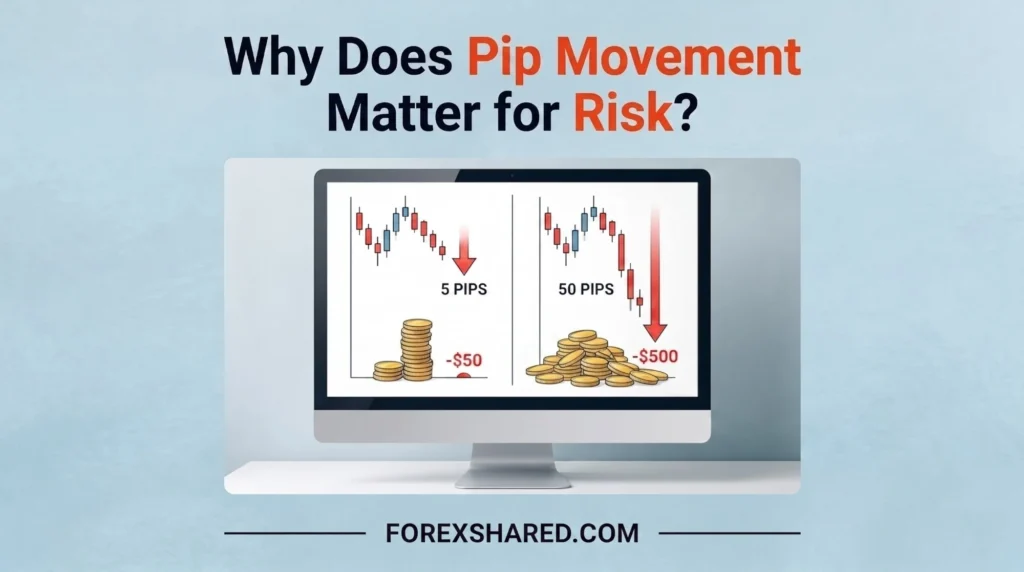
Why Does Pip Movement Matter for Risk? | FOREXSHARED Why Does Pip Movement Matter for Risk? Pip Movement matters for risk because it measures how far price can move against a position before that distance becomes money loss. Many readers know a pip is a small move in forex, but that description is too weak. In reality, pip movement provides the foundational distance layer, creating an absolute spatial boundary for your capital’s survival. Pip movement executes four connected jobs: measuring adverse price distance, defining stop-loss distance, scaling potential loss through pip value and trade size, and giving traders a common way to compare planned risk across setups. Pip movement is fundamentally the distance layer of risk, while cash loss appears only later through pip value, position size, spread, and execution handling. warning EDUCATIONAL DISCLAIMER This page is educational only. It is not trading advice, not a signal page, not a broker recommendation, and not execution coaching. The article must explain risk mechanics, not promise profit protection. Why Do So Many Readers Misunderstand Why Pip Movement Matters for Risk? Many readers misunderstand why Pip Movement matters for risk because they hear pips first in profit language and only later as adverse-distance language. If risk distances are ignored during the learning phase, the resulting financial damage is sudden and extreme. Why Does Pip Movement Sound Like a Profit Topic Instead of a Risk Topic? Pip movement sounds like a profit topic instead of a risk topic because beginners often first hear pips in gain-and-loss conversations. When a single standardized movement unit is continually highlighted strictly to describe massive wins, the structural risk-distance role is inevitably missed (OANDA, n.d.)(IG, n.d.). Why Do Beginners Confuse Pip Movement with Money Risk? Beginners confuse pip movement with money risk because they mix distance measurement with cash translation. Since distance is enthusiastically measured first but the money meaning must carefully be added later, the two distinct layers frequently get disastrously confused (IG, n.d.)(OANDA, n.d.). Why Does This Misread Create Bigger Problems Later? This misread creates bigger problems later because it distorts stop placement, trade-size reading, and the meaning of pip value. Risk begins as adverse pip distance before it becomes cash damage. Because the pip movement is erroneously mistaken for fixed cash upfront, the critical stop and size logic heavily breaks down later (OANDA, n.d.)(IG, n.d.). THE RISK DISTANCE BOUNDARY PIP MOVEMENT Quote Distance Only Structural Space E.g., 20 Pips Risk Requires Trade Size Multiplier REALIZED CASH LOSS Financial Impact Calculated Debt E.g., $200 USD Loss Pip movement defines the dimensional threat before sizing determines the financial bleed. FOREXSHARED.COM Figure 1.0: The Risk Distance Boundary. Movement identifies spatial threat, but money interpretation strictly requires independent sizing logic to trigger loss. What the Reader Assumes What Pip Movement Actually Tells You About Risk Why It Matters A pip move is an automatic dollar loss. It measures the dimensional distance the market traveled against you. Fusing distance with cash blindly guarantees massive overleveraging. 30 Pips risk means exactly $30. It dictates that the quote can shift 30 standardized steps before invalidation. Pip value dynamics adjust constantly based on active lot constraints. What Is Pip Movement, and Why Does It Matter for Risk at All? Pip Movement (quote distance measured in pip units) is the quote distance a currency pair has moved, and it matters for risk because every adverse move begins there. Connecting to Pip size and quote interpretation ensures the foundational distance logic remains rigorously solid. What Is Pip Movement in Plain English? In plain English, Pip Movement is the number of pips price has moved from one quote level to another. If the quote visibly changes, pips successfully count the change, ensuring movement reliably becomes comparable (OANDA, n.d.). What Is Pip Movement Not? Pip movement is not automatically a dollar amount, not the same thing as pip value (money attached to one pip of movement after size and pair inputs are added), and not the same thing as realized account loss. Once pip distance is bounded correctly, money and outcome layers abruptly stop being mixed (IG, n.d.)(OANDA, n.d.). Why Does Risk Need a Standard Distance Unit? Risk needs a standard distance unit because adverse movement cannot be managed consistently without one common measure. Since risk must definitively be measured, pips elegantly standardize the distance, meaning stops completely become readable (OANDA, n.d.)(IG, n.d.). Pair Type Pip Convention What Pip Movement Measures Why That Matters for Risk Non-JPY (EUR/USD) 4th Decimal The precise structural step count away from entry. Quantifies exactly how far the trade deviates from equilibrium. JPY Cross (USD/JPY) 2nd Decimal The exact standardized distance via Yen parameters. Unifies Japanese Yen volatility into a common defensive scale. How Does Adverse Pip Movement Create Risk? Adverse Pip Movement creates risk because price movement against the position is what threatens the trade. An adverse pip move (price movement in pips against the position) physically erodes the structural safety margin of the setup. Why Does Pip Movement Against the Trade Represent Risk? Pip movement against the trade represents risk because each adverse pip increases the distance between the trade and safety. As price stubbornly moves against the position, adverse pip distance ominously grows, ensuring trade risk deeply deepens (OANDA, n.d.)(IG, n.d.). Why Is Risk Better Understood as Distance First and Money Second? Risk is better understood as distance first and money second because price must move before that movement can be translated into cash loss. When distance is measured, pip value is rigorously applied later, meaning cash risk safely appears afterward (IG, n.d.). Why Is Pip Movement the First Layer of Trade Risk? Pip movement is the first layer of trade risk because the market hurts the position in distance terms before it hurts it in money terms. The market hurts you in pips before it hurts you in cash. Because the quote aggressively moves first, risk exists in pips first, meaning the money effect inevitably follows (OANDA, n.d.)(IG, n.d.). ADVERSE PIP DISTANCE LONG ENTRY (1.1050) CURRENT QUOTE (1.1030)