How does lot size connect position scale to risk?
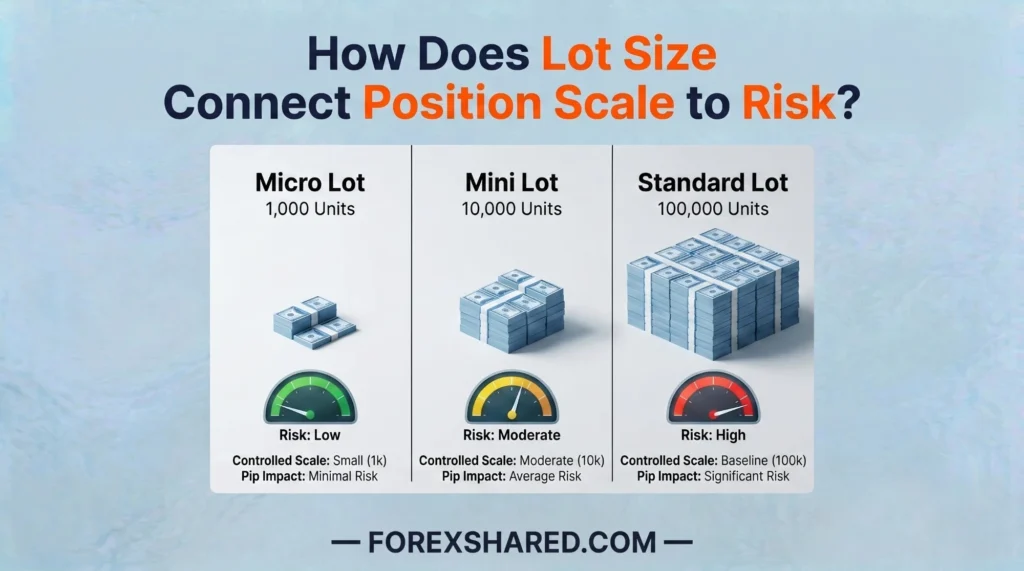
How Does Lot Size Define Trade Exposure? Lot Size defines trade exposure by setting how many currency units a forex position controls. It establishes the physical unit-scale layer that transforms an abstract chart idea into real, measurable market involvement long before concepts like pip sensitivity or margin utilization are interpreted. A larger lot size unequivocally controls more units, whereas a smaller lot size controls fewer units. By utilizing globally standardized categories, including Standard Lot, Mini Lot, Micro Lot, and Nano Lot, retail traders can incrementally manipulate their footprint. Crucially, the margin collateral required to open a trade should never be confused with the full exposure scale operating behind the scenes. This article provides a rigorous, mechanism-first explanation of how lot size anchors trade exposure. We will define what trade exposure truly means, explain how unit quantity expands market sensitivity, and clarify why a tiny margin deposit frequently hides massive risk. Furthermore, we will compare lot categories, isolate critical miscalculations, apply immediate structural fixes, and conclude with a rigid pre-trade validation framework. warning EDUCATIONAL DISCLAIMER This article is educational only and does not constitute financial advice. Trading foreign exchange on margin carries a high level of risk. What Does Trade Exposure Mean Before Lot Size Is Applied? Trade exposure means the market position affected by price movement before the trader judges margin, leverage, or planned risk. Exposure exists independently of how much collateral your broker demands to open the position; it is the raw mass of the asset currently navigating the live market order book. Exposure is fundamentally about what the trade technically controls and not exclusively what the broker asks for upfront. Reviewing Notional value and total exposure confirms that the complete face value of the position represents your true vulnerability. Lot size is the initial switch that sets this entire exposure engine into motion. Key Takeaway Trade exposure is the amount of market position affected by price movement, and lot size is one of the main ways that exposure is created. THE EXPOSURE BLUEPRINT TRADE IDEA Abstract Setup LOT SIZE Unit Multiplier TRADE EXPOSURE Physical Market Mass FOREXSHARED.COM Figure 1.0: The Exposure Blueprint. Demonstrating how abstract setups must pass through the Lot Size multiplier to gain market mass. How Does Lot Size Turn Currency Units Into Exposure? Lot Size turns currency units into exposure because it sets the quantity of the position that price movement can affect. By converting an arbitrary numerical input into Position Units, lot size establishes the rigid volumetric base. A larger quantity of units forces the identical currency pair to generate drastically divergent financial outcomes. How Does a Larger Lot Increase Controlled Exposure? A larger lot increases Controlled Exposure because it places more currency units inside the open position. Expanding the physical unit count makes the trade exponentially more sensitive to price movement. Consequently, the chart setup may look exactly the same visually, while the underlying financial exposure becomes significantly heavier. How Does a Smaller Lot Reduce Controlled Exposure? A smaller lot reduces controlled exposure because fewer currency units are affected by the same market movement. Deflating the geometric mass systematically diminishes Pip Sensitivity and actively suppresses Margin Pressure. While smaller exposure can make trade management substantially more controlled, smaller lots do not automatically make a trade completely safe from directional risk. Key Takeaway Lot size defines exposure because it determines how many units are exposed to market movement. THE EXPOSURE AMPLIFIER 1 LOT Digital Entry MULTIPLIER EFFECT 100,000 UNITS Massive Physical Exposure FOREXSHARED.COM Figure 2.0: The Amplifier Effect. Shows how a single digital lot entry expands outward into massive physical base-currency units. Why Does Lot Size Matter More Than the Margin Shown on the Platform? Lot Size matters more than the margin shown on the platform because margin shows collateral, while lot size shows the position quantity being controlled. Relying on collateral metrics to judge your position dimension guarantees perilous overexposure. The lot mathematically isolates the physical structure entirely independent of the broker’s specific lending constraints (Charles Schwab, National Futures Association). Why Can Low Margin Hide Large Exposure? Low margin can hide large exposure because it shows the access cost of the position, not the full unit quantity controlled by the trade. Heavy leverage can make a massive unit block appear remarkably affordable on the execution screen, yet the volatile market movement continues to affect the full, unreduced position. Why Should Traders Compare Margin With Notional Value? Traders should compare margin with Notional Value because margin shows access cost while Notional Value shows exposure scale. Understanding that affordability does not automatically mean the trade is proportionate helps shield the portfolio from trades that technically fit the margin allowance but functionally crush the account’s risk tolerance. Key Takeaway Margin can make a trade look smaller than it is, but lot size shows the real position quantity behind the trade. THE COLLATERAL ILLUSION MARGIN Tiny Deposit EXPOSURE Massive Units A small margin requirement cannot counterbalance the crushing weight of total exposure. FOREXSHARED.COM Figure 3.0: The Collateral Illusion. Small margin deposits routinely disguise the massive physical exposure looming on the other side of the trade. How Do Standard, Mini, Micro, and Nano Lots Change Exposure Scale? Standard, mini, micro, and nano lots change Exposure Scale because each category controls a different number of currency units. The structural ladder remains consistent: standard lots inject aggressive volume, while scaling downward proportionately shrinks the physical footprint. Investigating Forex lot size units validates that platform displays can occasionally vary, making rigorous pre-verification essential (IG). Lot Category Common Unit Size Exposure Meaning Standard lot 100,000 units Large position scale Mini lot 10,000 units Moderate position scale Micro lot 1,000 units Smaller position scale Nano lot 100 units Very small position scale Key Takeaway Each lot category changes exposure because each one controls a different number of currency units. How Does Lot Size Change Pip Sensitivity? Lot Size changes pip sensitivity because it changes the number of units affected by each price movement. Expanding the geometric mass guarantees that every single tick
How does lot size define trade exposure?
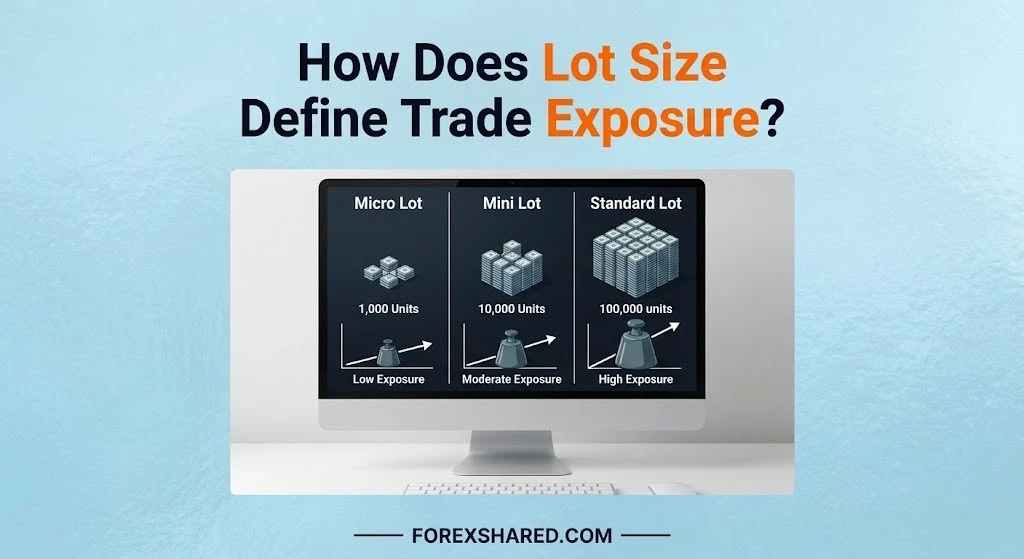
How Does Lot Size Define Trade Exposure? Lot Size defines trade exposure by setting how many currency units a forex position controls. It establishes the physical unit-scale layer that transforms an abstract chart idea into real, measurable market involvement long before concepts like pip sensitivity or margin utilization are interpreted. A larger lot size unequivocally controls more units, whereas a smaller lot size controls fewer units. By utilizing the globally standardized categories—Standard Lot, Mini Lot, Micro Lot, and Nano Lot—retail traders can incrementally manipulate their footprint. Crucially, the Margin collateral required to open a trade should never be confused with the full exposure scale operating behind the scenes. This article provides a rigorous, mechanism-first explanation of how lot size anchors trade exposure. We will define what trade exposure truly means, explain how unit quantity expands market sensitivity, and clarify why a tiny margin deposit frequently hides massive risk. Furthermore, we will compare lot categories, isolate critical miscalculations, apply immediate structural fixes, and conclude with a rigid pre-trade validation framework. warning EDUCATIONAL DISCLAIMER This article is educational only and does not constitute financial advice. Trading foreign exchange on margin carries a high level of risk. What Does Trade Exposure Mean Before Lot Size Is Applied? Trade exposure means the market position affected by price movement before the trader judges margin, Leverage, or planned risk. Exposure exists independently of how much collateral your broker demands to open the position; it is the raw mass of the asset currently navigating the live market order book. Exposure is fundamentally about what the trade technically controls, not exclusively what the broker asks for upfront. Reviewing Notional value and total exposure confirms that the complete face value of the position represents your true vulnerability. Lot size is the initial switch that sets this entire exposure engine into motion. Key Takeaway Trade exposure is the amount of market position affected by price movement, and lot size is one of the main ways that exposure is created. THE EXPOSURE BLUEPRINT Trade Idea (Abstract Setup) LOT SIZE Unit Scale Modifier TRADE EXPOSURE A trade idea has no financial weight until the Lot Size translates it into physical exposure. FOREXSHARED.COM Figure 1.0: The Exposure Blueprint. Demonstrating how abstract setups must pass through the Lot Size multiplier to gain market mass. How Does Lot Size Turn Currency Units Into Exposure? Lot Size turns currency units into exposure because it sets the quantity of the position that price movement can affect. By converting an arbitrary numerical input into Position Units, lot size establishes the rigid volumetric base. A larger quantity of units forces the identical currency pair to generate drastically divergent financial outcomes. How Does a Larger Lot Increase Controlled Exposure? A larger lot increases Controlled Exposure because it places more currency units inside the open position. Expanding the physical unit count makes the trade exponentially more sensitive to price movement. Consequently, the chart setup may look exactly the same visually, while the underlying financial exposure becomes significantly heavier. How Does a Smaller Lot Reduce Controlled Exposure? A smaller lot reduces controlled exposure because fewer currency units are affected by the same market movement. Deflating the geometric mass systematically diminishes Pip Sensitivity and actively suppresses Margin Pressure. While smaller exposure can make trade management substantially more controlled, smaller lots do not automatically make a trade completely safe from directional risk. Key Takeaway Lot size defines exposure because it determines how many units are exposed to market movement. THE EXPOSURE AMPLIFIER 1 LOT Entry 100,000 UNITS Exposure MULTIPLIER EFFECT FOREXSHARED.COM Figure 2.0: The Amplifier Effect. Shows how a single digital lot entry expands outward into massive physical base-currency units. Why Does Lot Size Matter More Than the Margin Shown on the Platform? Lot Size matters more than the margin shown on the platform because margin shows collateral, while lot size shows the position quantity being controlled. Relying on collateral metrics to judge your position dimension guarantees perilous overexposure. The lot mathematically isolates the physical structure entirely independent of the broker’s specific lending constraints (Schwab Brokerage, National Futures Association). Why Can Low Margin Hide Large Exposure? Low margin can hide large exposure because it shows the access cost of the position, not the full unit quantity controlled by the trade. Heavy leverage can make a massive unit block appear remarkably affordable on the execution screen, yet the volatile market movement continues to affect the full, unreduced position. Why Should Lot Size Be Checked Before Margin Comfort? Lot size should be checked before margin comfort because exposure must be understood before affordability is judged. Checking if the broker mathematically allows the trade via margin is completely irrelevant if the raw scale of the asset violently exceeds your portfolio’s volatility tolerance. Key Takeaway Margin can make a trade look smaller than it is, but lot size shows the real position quantity behind the trade. THE COLLATERAL ILLUSION MARGIN Tiny Deposit EXPOSURE Massive Units A small margin requirement cannot counterbalance the crushing weight of total exposure. FOREXSHARED.COM Figure 3.0: The Collateral Illusion. Small margin deposits routinely disguise the massive physical exposure looming on the other side of the trade. How Do Standard, Mini, Micro, and Nano Lots Change Exposure Scale? Standard, mini, micro, and nano lots change Exposure Scale because each category controls a different number of currency units. The structural ladder remains consistent: standard lots inject aggressive volume, while scaling downward proportionately shrinks the physical footprint. Investigating Forex lot size units validates that platform displays can occasionally vary, making rigorous pre-verification essential (IG). Lot Category Common Unit Size Exposure Meaning Standard lot 100,000 units Large position scale Mini lot 10,000 units Moderate position scale Micro lot 1,000 units Smaller position scale Nano lot 100 units Very small position scale Key Takeaway Each lot category changes exposure because each one controls a different number of currency units. How Does Lot Size Change Pip Sensitivity? Lot Size changes pip sensitivity because it changes the number of units affected by each price movement. Expanding the geometric mass guarantees