How Does Lot Size Define Trade Exposure?
Lot Size defines trade exposure by setting how many currency units a forex position controls. It establishes the physical unit-scale layer that transforms an abstract chart idea into real, measurable market involvement long before concepts like pip sensitivity or margin utilization are interpreted.
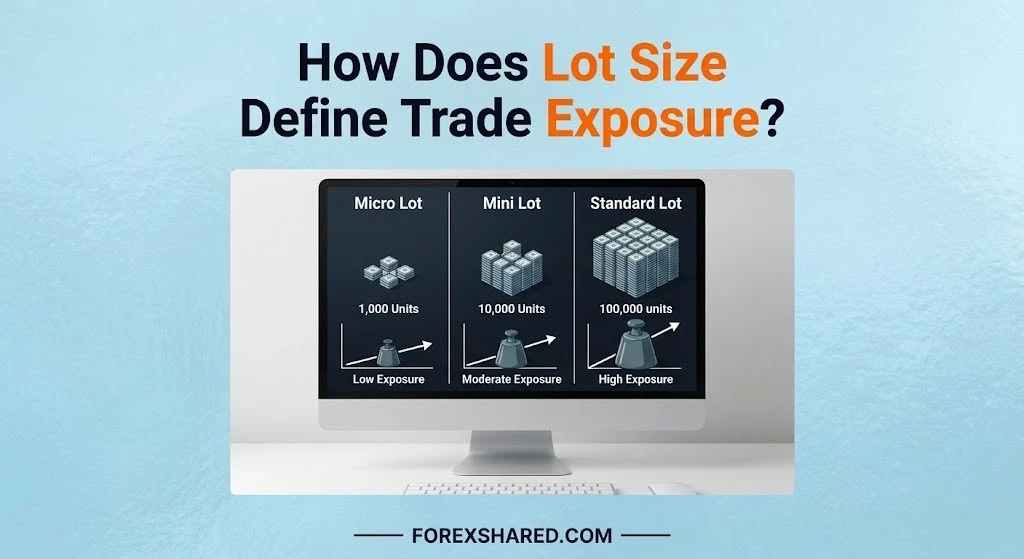
A larger lot size unequivocally controls more units, whereas a smaller lot size controls fewer units. By utilizing the globally standardized categories—Standard Lot, Mini Lot, Micro Lot, and Nano Lot—retail traders can incrementally manipulate their footprint. Crucially, the Margin collateral required to open a trade should never be confused with the full exposure scale operating behind the scenes.
This article provides a rigorous, mechanism-first explanation of how lot size anchors trade exposure. We will define what trade exposure truly means, explain how unit quantity expands market sensitivity, and clarify why a tiny margin deposit frequently hides massive risk. Furthermore, we will compare lot categories, isolate critical miscalculations, apply immediate structural fixes, and conclude with a rigid pre-trade validation framework.
This article is educational only and does not constitute financial advice. Trading foreign exchange on margin carries a high level of risk.
What Does Trade Exposure Mean Before Lot Size Is Applied?
Trade exposure means the market position affected by price movement before the trader judges margin, Leverage, or planned risk. Exposure exists independently of how much collateral your broker demands to open the position; it is the raw mass of the asset currently navigating the live market order book.
Exposure is fundamentally about what the trade technically controls, not exclusively what the broker asks for upfront. Reviewing Notional value and total exposure confirms that the complete face value of the position represents your true vulnerability. Lot size is the initial switch that sets this entire exposure engine into motion.
Trade exposure is the amount of market position affected by price movement, and lot size is one of the main ways that exposure is created.
How Does Lot Size Turn Currency Units Into Exposure?
Lot Size turns currency units into exposure because it sets the quantity of the position that price movement can affect. By converting an arbitrary numerical input into Position Units, lot size establishes the rigid volumetric base. A larger quantity of units forces the identical currency pair to generate drastically divergent financial outcomes.
How Does a Larger Lot Increase Controlled Exposure?
A larger lot increases Controlled Exposure because it places more currency units inside the open position. Expanding the physical unit count makes the trade exponentially more sensitive to price movement. Consequently, the chart setup may look exactly the same visually, while the underlying financial exposure becomes significantly heavier.
How Does a Smaller Lot Reduce Controlled Exposure?
A smaller lot reduces controlled exposure because fewer currency units are affected by the same market movement. Deflating the geometric mass systematically diminishes Pip Sensitivity and actively suppresses Margin Pressure. While smaller exposure can make trade management substantially more controlled, smaller lots do not automatically make a trade completely safe from directional risk.
Lot size defines exposure because it determines how many units are exposed to market movement.
Why Does Lot Size Matter More Than the Margin Shown on the Platform?
Lot Size matters more than the margin shown on the platform because margin shows collateral, while lot size shows the position quantity being controlled. Relying on collateral metrics to judge your position dimension guarantees perilous overexposure. The lot mathematically isolates the physical structure entirely independent of the broker's specific lending constraints (Schwab Brokerage, National Futures Association).
Why Can Low Margin Hide Large Exposure?
Low margin can hide large exposure because it shows the access cost of the position, not the full unit quantity controlled by the trade. Heavy leverage can make a massive unit block appear remarkably affordable on the execution screen, yet the volatile market movement continues to affect the full, unreduced position.
Why Should Lot Size Be Checked Before Margin Comfort?
Lot size should be checked before margin comfort because exposure must be understood before affordability is judged. Checking if the broker mathematically allows the trade via margin is completely irrelevant if the raw scale of the asset violently exceeds your portfolio’s volatility tolerance.
Margin can make a trade look smaller than it is, but lot size shows the real position quantity behind the trade.
How Do Standard, Mini, Micro, and Nano Lots Change Exposure Scale?
Standard, mini, micro, and nano lots change Exposure Scale because each category controls a different number of currency units. The structural ladder remains consistent: standard lots inject aggressive volume, while scaling downward proportionately shrinks the physical footprint. Investigating Forex lot size units validates that platform displays can occasionally vary, making rigorous pre-verification essential (IG).
| Lot Category | Common Unit Size | Exposure Meaning |
|---|---|---|
| Standard lot | 100,000 units | Large position scale |
| Mini lot | 10,000 units | Moderate position scale |
| Micro lot | 1,000 units | Smaller position scale |
| Nano lot | 100 units | Very small position scale |
Each lot category changes exposure because each one controls a different number of currency units.
How Does Lot Size Change Pip Sensitivity?
Lot Size changes pip sensitivity because it changes the number of units affected by each price movement. Expanding the geometric mass guarantees that every single tick traversing the market impacts a vastly wider volume of capital. The lot parameter does not change the market distance moved; it changes how severely that distance attacks the portfolio.
Why Does the Same Pip Movement Feel Different Across Lot Sizes?
The same pip movement feels different across lot sizes because the trade impact changes when the position size changes. The currency pair can easily traverse an identical 30-pip distance, but executing that move utilizing standard lots generates immense visceral strain compared to holding a modest micro-lot parameter.
Why Should Pip Sensitivity Be Understood Before Scaling Up?
Pip sensitivity should be understood before scaling up because added units can make normal market movement feel harder to manage. Scaling relentlessly increases the total units controlled. Higher unit exposure dramatically tightens the psychological boundaries required to sit through ordinary price fluctuations.
Lot size changes pip sensitivity because it changes the number of units affected by each price movement.
When Should Traders Review Lot Size Before Exposure Becomes Too Large?
Traders should review Lot Size before exposure becomes too large whenever position scale, market conditions, or account fit can change. Operating blindly without verifying geometric capacity routinely annihilates portfolios during turbulent news releases, complex scaling procedures, or while transitioning between demo test parameters and live execution.
When Does Lot Size Matter Before Entry?
Lot size matters before entry because the first order creates the initial exposure level. A carelessly assigned large lot can inject lethal gravitational pressure onto equity long before the tactical trade develops. Meticulous review helps completely block unforced, accidental oversizing.
When Does Lot Size Matter During Scaling?
Lot size matters during scaling because each added position increases total exposure. Multiple small entries routinely stack and mutate into a surprisingly large combined position—an invisible hazard known strictly as exposure creep. The total cumulative sum requires constant moderation.
When Does Lot Size Matter in Volatile Markets?
Lot size matters in volatile markets because fast price movement can make oversized positions harder to manage. Exposing vast unit structures during chaotic liquidity sweeps subjects the equity curve to immense hazard. Exposure must logically conform to both the rigid account structure and the ambient market hostility prevailing at execution.
Lot size should be reviewed whenever the position’s scale could change exposure, account pressure, or trade-management difficulty.
How Is Lot Size Different From Position Risk, Leverage, and Margin?
Lot Size is different from position risk, leverage, and margin because it defines trade quantity while the other concepts explain effects of that quantity. The lot represents the core dimensions of the asset, standing independent of external borrowing privileges and fluid exit boundaries.
Why Is Lot Size Not the Same as Leverage?
Lot size is not the same as leverage because lot size defines quantity while leverage describes how exposure is accessed. Broker Leverage acts exclusively as a static permission structure. The trader’s physical exposure actively shifts downward via smaller lot sizes even if the overarching broker lending ratio remains extraordinarily high.
Why Is Lot Size Not the Same as Planned Risk?
Lot size is not the same as Planned Risk because planned risk depends on how the trade is managed or exited. Lot sizing engineers your pip sensitivity matrix, but your precise stop-loss logic permanently shapes the final planned loss parameters.
| Concept | Simple Meaning |
|---|---|
| Lot Size | Number of units traded |
| Trade Exposure | Market position controlled |
| Margin | Collateral required |
| Leverage | Exposure accessed with less upfront capital |
| Pip Sensitivity | How strongly price movement affects the position |
| Planned Risk | Loss level based on the trade plan |
Lot size defines the trade quantity, while margin, leverage, pip sensitivity, and planned risk explain different effects of that quantity.
What Simple Examples Show Lot Size Defining Exposure?
Simple examples show Lot Size defining exposure by showing how different unit quantities change the scale of the same trade idea. Translating abstract terminology into concrete numbers illuminates the functional contrast separating standard frames from tightly scaled fractions.
What Does a Standard-Lot Example Show?
A standard-lot example shows how a trade can control a large number of currency units. Operating 100,000 baseline units inherently renders the trade hypersensitive to marginal swings, mandating aggressive risk awareness and superior account fortification.
Executing 1.00 on EUR/USD places 100,000 units directly into open market traffic, transforming a minor 10-pip fluctuation into significant financial volatility.
What Does a Micro-Lot Example Show?
A micro-lot example shows how reducing lot size reduces controlled exposure. Confining the parameter down to 1,000 base units effortlessly facilitates nimble management, making the scale exceptionally suitable for strategic formulation without inducing capital panic.
Executing 0.01 on GBP/JPY anchors precisely 1,000 units. The exact same market swing now generates fractional disturbance, preserving strategy composure.
What Does a Scaling Example Show?
A scaling example shows how several smaller entries can become one larger combined position. Rapidly stacking 0.01 inputs mechanically balloons cumulative total exposure. Expanding position load systematically demands constant surveillance of the final combined footprint rather than viewing micro additions lightly.
Simple examples show that lot size defines exposure by changing how many units the trade controls.
How Should Traders Choose Lot Size for Manageable Exposure?
Traders should choose Lot Size for manageable exposure by judging account fit, trade plan, and price-movement tolerance before trusting margin availability. Selecting parameters derived exclusively from Position scale and risk guarantees structural harmony across shifting volatility cycles.
Why Should Account Fit Guide Lot-Size Choice?
Account Fit should guide lot-size choice because the same lot size can feel very different across different account sizes. An allocation effortlessly absorbed by substantial equity brutally liquidates undersized portfolios. Matching geometric mass strictly to capital resilience shields portfolios from unforced ruin.
Why Should Traders Increase Lot Size Gradually?
Traders should increase lot size gradually because sudden exposure jumps can make trade management less stable. Shifting abruptly initiates severe psychological friction; gradual volume transition ensures exposure increments remain observable, comprehensible, and strategically sound.
A manageable lot size is one that fits the account, trade plan, and trader’s ability to handle normal price movement.
What Mistakes Cause Traders to Underestimate Lot-Size Exposure?
Traders underestimate lot-size exposure when they judge labels, margin, or confidence instead of the actual position scale. Decisively correcting these cognitive blind spots instantly improves long-term portfolio survivability.
Judging Exposure Only by Margin
Judging exposure only by margin creates a false reading because margin is collateral, not the full position quantity. The visual illusion of affordable security deposits masks lethal underlying unit mass.
Correction: Margin is collateral; lot size defines the position quantity.
Treating Lot Labels as Harmless
Treating lot labels as harmless creates risk confusion because every lot category still represents real units. Assuming terms like "micro" imply an absolute absence of threat is devastating.
Correction: Mini, micro, and nano labels reduce unit scale, but they do not remove exposure.
Scaling Without Checking Total Exposure
Scaling without checking total exposure can turn several smaller entries into one oversized combined position. Layering orders indiscriminately bloats the volume matrix completely out of sync with established stop-loss tolerances.
Correction: Every added position increases total units controlled.
Copying Another Trader’s Lot Size
Copying another trader’s lot size creates poor exposure fit because account size and trade plans differ. Transplanting external size metrics blindly injects toxic incompatibility into individualized equity foundations.
Correction: Lot size should fit the individual account and strategy context.
Most lot-size exposure mistakes happen when traders judge labels, margin, or confidence instead of the actual position scale.
How Can Traders Fix Oversized Exposure Caused by Lot Size?
Traders can fix oversized exposure caused by Lot Size by reducing the units controlled and reviewing the total position before relying on margin availability. Initiating swift physical contraction isolates the portfolio from unnecessary drawdowns and re-establishes quantitative boundaries.
Why Is Reducing Lot Size the Cleanest Fix?
Reducing lot size is the cleanest fix because it directly reduces the number of units controlled. Shedding volumetric scale instantaneously lowers compounding pip sensitivity, simultaneously releasing encumbered margin. It renders subsequent trade management exponentially more stable, though directional uncertainty inherently persists.
Why Should Total Exposure Be Reviewed After Adding Trades?
Total exposure should be reviewed after adding trades because separate entries can hide the size of the combined position. Examining multi-legged orders through an aggregated lens calculates the genuine risk parameter; isolated micro perspectives routinely mask immense compounded vulnerability.
The cleanest fix for oversized exposure is to reduce lot size and recheck the total position before relying on margin availability.
What Should Traders Validate Before Trusting Lot-Size Exposure?
Traders should validate lot-size exposure by confirming the selected lot size, unit quantity, platform display, margin meaning, and account fit before trusting the position scale. Bypassing these mandatory checkpoint variables invites systematic failure.
The biggest mistake is treating lot size as just an order-field number. A better process starts by recognizing that Lot Size defines the trade’s exposure scale. Implementing proper unit scaling neutralizes impulsive geometric leaps long before volatile price action can shatter strategic constraints (National Futures Association).
Trade Exposure FAQs
Does a larger lot size guarantee a larger financial loss?
A larger lot size guarantees larger exposure to market movement, meaning each pip of adverse movement will cost more. However, the final financial loss also depends heavily on your stop-loss distance and trade management.
Why is my exposure large if my required margin is small?
Margin is simply the collateral the broker requires to hold the position open, largely dictated by leverage rules. Your exposure is based entirely on the total unit quantity your lot size controls, which is almost always vastly larger than the margin deposit.
How can I reduce my trade exposure quickly?
The fastest, most direct method to reduce trade exposure is to execute a smaller lot size (e.g., using micro lots instead of mini or standard lots), which immediately lowers the number of base currency units you control.