Which Lot Sizes Define Forex Position Units?
Forex Lot Sizes define position units by grouping currency trades into standard, mini, micro, and nano lot categories. These highly formalized volume tiers exist because attempting to buy or sell fractional raw currency units on the open market would create immense execution chaos. Lot sizes tell traders exactly how many base-currency units a position controls before pip value, margin requirements, or systemic leverage are even judged.
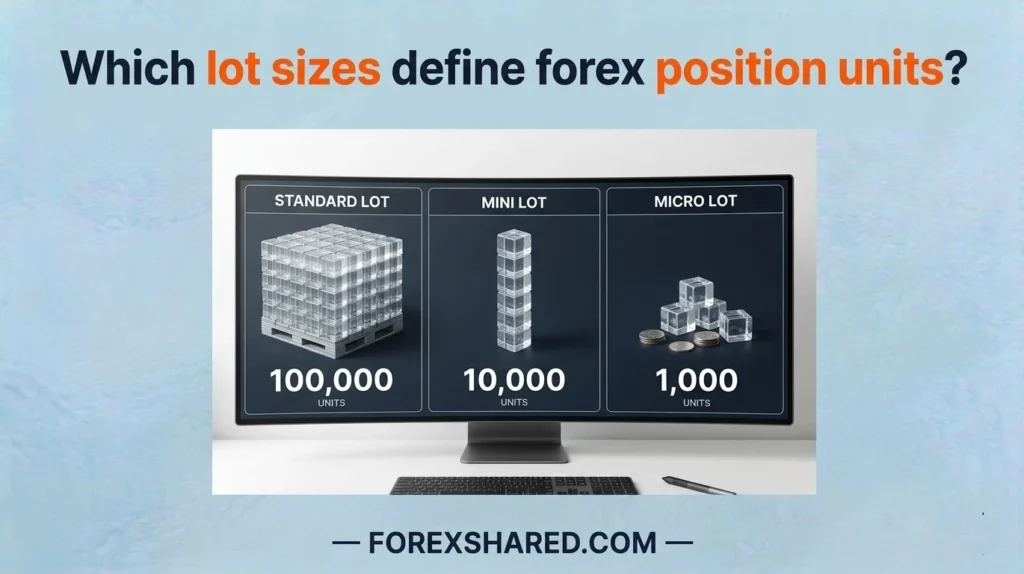
The institutional foundation of this system rests on a strict common unit ladder. At the top sits the standard lot, which unequivocally equates to 100,000 units. Sizing down dynamically, the mini lot represents 10,000 units, the micro lot governs 1,000 units, and the highly specific nano lot controls exactly 100 units. Mastering this progression allows market participants to scale exposure intelligently.
This article clearly maps out the functional reality of forex position units. We will cover the definitive definition of lot size, why standardized categories replaced raw units, detail the core unit scale hierarchy, and examine precise operational timing. We will then compare lot metrics against secondary risk layers, demystify platform lot entries, analyze practical examples, identify severe unit miscalculations, provide absolute pre-trade fixes, and conclude with a vital validation checklist.
This article is educational only and does not constitute financial advice. Trading foreign exchange on margin carries a high level of risk.
What Does Lot Size Mean in a Forex Position?
Lot size means the standardized quantity used to describe how many currency units a forex position controls. It establishes the physical magnitude of the trade you are executing in the market. To accurately grasp Lot size basics, it is vital to acknowledge that the lot is not just a nominal broker label; it is the raw, unadjusted geometric base that defines your unit volume.
Consequently, lot size is fundamentally different from margin collateral, variable pip value, aggregate leverage limits, and ultimate cash risk. The lot acts purely as the quantitative bedrock. You cannot evaluate how much capital is at risk without first knowing exactly how many units you control (BabyPips, IG).
Lot size defines how many currency units a forex position controls.
Why Do Forex Traders Use Lots Instead of Raw Currency Units?
Forex traders use lots instead of raw currency units because lot categories make large position quantities easier to organize, communicate, and compare. Attempting to parse raw currency volumes during rapid execution is cognitively taxing. Categorization eliminates mathematical friction.
How Do Lots Simplify Trade-Size Language?
Lots simplify trade-size language by replacing large currency-unit numbers with recognizable position-size categories. Stating "one standard lot" is profoundly more efficient than repeatedly detailing "one hundred thousand units." Likewise, confirming "one micro lot" immediately and universally signals a specific, smaller position layout, unifying sizing communication globally.
Why Does Lot Size Matter Before Risk Is Judged?
Lot size matters before risk is judged because it sets the base quantity that later affects exposure, pip impact, and margin need. The trader must completely know the unit size first. Mathematical metrics like pip value, required margin, and account leverage remain mathematically impossible to interpret accurately without first solidifying the lot category foundation.
Lots make forex position units easier to understand because they convert large currency quantities into recognizable trade-size categories.
Which Lot Sizes Define the Main Forex Position-Unit Categories?
The main forex lot sizes are standard lots, mini lots, micro lots, and nano lots. These specifically designed categories construct the common position-unit ladder relied upon by all retail environments. Dissecting Standard, mini, and micro lots firmly establishes these intervals so traders can easily manage scaling. Platform display rules can vary dramatically, but the physical quantity behind these definitions remains permanently fixed (BabyPips, IG).
| Lot Size | Common Unit Size | Practical Meaning |
|---|---|---|
| Standard lot | 100,000 units | Large position unit |
| Mini lot | 10,000 units | Smaller than standard |
| Micro lot | 1,000 units | Small retail-friendly size |
| Nano lot | 100 units | Very small position size |
The main forex lot sizes define a position’s unit scale from large standard lots down to very small nano lots.
How Does Each Lot Size Change the Scale of a Position?
Each lot size changes the scale of a position by changing how many currency units the trade controls. Transitioning up or down the lot ladder natively amplifies or restricts the physical volume held. Evaluating Lot size and trade exposure highlights exactly how utilizing identical pip distances on the exact same pair creates radically different outcomes purely because the lot category shifted.
How Does a Standard Lot Define a Large Position?
A standard lot defines a large position by controlling 100,000 currency units. It serves as the baseline maximum size parameter in standard retail contexts, creating the largest common exposure scale. Traders must comprehensively grasp this magnitude before utilizing standard lots; executing trades at this tier naturally demands substantial collateral buffers.
How Does a Mini Lot Reduce Position Scale?
A mini lot reduces position scale by controlling fewer units than a standard lot. Controlling exactly 10,000 units, the mini lot sits perfectly in the middle of the ladder. It creates significantly more moderate position sizing, allowing intermediate participants to maneuver effectively without committing to the overwhelming capital weight of standard sizing.
How Does a Micro Lot Support Smaller Position Control?
A micro lot supports smaller position control by reducing the trade to a much smaller unit quantity. At strictly 1,000 units, the micro lot systematically collapses the exposure scale. This smaller unit architecture greatly assists aggressive risk-management and account-fit control, though utilizing smaller size does not automatically neutralize market threats.
How Does a Nano Lot Create Very Small Exposure?
A nano lot creates very small exposure by reducing the position to 100 currency units. It establishes the finest operational slice currently accessible to retail traders. Nano lots dramatically minimize dimensional scaling, yet their availability depends heavily on the specific broker and execution platform providing the liquidity feed.
Each smaller lot size reduces the number of currency units controlled, which usually reduces exposure and price-movement impact.
When Should Traders Think About Lot Size Before Opening a Trade?
Traders should think about lot size whenever the selected unit scale could change exposure, pip impact, margin need, or account fit. Ensuring exact awareness regarding the active lot denomination prevents arbitrary entries from crippling available equity.
Why Does Lot Size Matter Before Entry?
Lot size matters before entry because it determines the starting unit scale of the position. The exact number of units firmly dictates how violently the trade responds to upcoming price movement. Verifying the correct lot size preemptively blocks accidental, oversized executions that obliterate carefully planned tolerances.
Why Does Lot Size Matter When Scaling?
Lot size matters when scaling because adding lots increases total position units. A beautifully controlled initial entry can rapidly metastasize into an intolerably oversized block if secondary additions are layered without restraint. Acknowledging cumulative lot size protects the system from fatal compounding errors.
Why Does Lot Size Matter When Changing Account Size?
Lot size matters when changing account size because a unit scale that fits one account may not fit another. Transitioning from a conservative budget environment to a larger portfolio inherently skews positional geometry. Increasing lot sizes exclusively because trading heavier volume "feels correct" reliably damages equity curves.
Traders should think about lot size whenever the position’s unit scale could change the exposure, pip impact, or account fit.
How Is Lot Size Different From Pip Value, Margin, and Leverage?
Lot size is different from pip value, margin, and leverage because it defines position units, while the other concepts describe effects created around that position. Erroneously fusing the physical quantity of an asset with its downstream cash requirement or debt ratio entirely obliterates rigorous hazard modeling.
Why Is Lot Size Not the Same as Pip Value?
Lot size is not the same as pip value because lot size sets trade quantity, while pip value and price-movement impact describes the money translation. Though deploying larger lot categories geometrically magnifies the subsequent pip impact, the physical volume quantity (the lot) remains rigidly disjointed from the final monetary result. Implementing a pip and lot value calculator properly addresses this translation phase.
Why Is Lot Size Not the Same as Margin?
Lot size is not the same as margin because lot size describes position quantity, while margin versus trade exposure describes required collateral. Margin acts exclusively as the security deposit commanded by the exchange to enforce control. Specific broker rules define the margin demand, not strictly the raw lot label.
Why Is Lot Size Not the Same as Leverage?
Lot size is not the same as leverage because lot size is the trade amount, while leverage describes exposure controlled relative to capital. Opting for significantly smaller lots can effectively suppress market exposure even if the broker's leverage allowance remains extraordinarily high. You must permanently separate broker permission from physical position quantity.
| Concept | Simple Meaning | What It Should Not Be Confused With |
|---|---|---|
| Lot Size | Number of currency units traded | Pip value or margin |
| Pip Value | Money impact of one pip movement | Lot category itself |
| Margin | Collateral required for the position | Full trade size |
| Leverage | Exposure controlled relative to capital | Lot label |
| Position Size | The selected trade quantity | Broker margin permission |
Lot size defines position units, while pip value, margin, and leverage explain different effects created by that position size.
How Do Lot Sizes Appear on Trading Platforms?
Lot sizes can appear on trading platforms as whole lots, decimal lots, or actual currency-unit entries. Depending securely on how the operational interface is modeled, distinct ecosystems apply varied naming conventions. Prominent MetaTrader-style inputs will display a standard lot precisely as 1.00, a mini-lot configuration explicitly as 0.10, and a micro-lot exposure directly as 0.01 (OANDA Help).
Why Can Decimal Lot Entries Confuse Beginners?
Decimal lot entries can confuse beginners because a small-looking number can still represent a meaningful unit quantity. In standard platform architectures, keying in 0.10 visibly appears minimal but fundamentally anchors a 10,000-unit position. Assuming 0.01 translates to zero risk proves catastrophic when the market actively exerts pressure on the resultant 1,000-unit structural frame.
Why Should Traders Confirm Broker Display Rules?
Traders should confirm broker display rules because trading interfaces do not always show position size in the same format. A system requesting explicit units interprets an entry of "10" as literally ten coins, whereas standard retail environments process the same numeric "10" as ten standard lots (one million units). Recognizing the input methodology preempts irrecoverable sizing faults.
Lot sizes can appear differently across platforms, so traders should understand whether they are entering lots or actual units.
What Examples Make Forex Lot Sizes Easier to Understand?
Examples make Forex Lot Sizes easier to understand by showing how each lot category changes the number of units controlled. Distilling these definitions into highly illustrative position-unit examples effectively clears numerical hesitation.
What Does a Standard Lot Example Show?
A standard lot example shows what a large common forex position unit looks like. Launching one standard lot on EUR/USD unequivocally instructs the market maker to control precisely 100,000 Euros. This inherently generates an aggressive exposure footprint that drives intensive pip sensitivity.
Entering 1.00 on MT4 commands 100,000 units. The exposure is massive, responding fiercely to any quote volatility.
What Does a Mini Lot Example Show?
A mini lot example shows a position smaller than standard but larger than micro. Locking in exactly one mini lot commands exactly 10,000 units. Placing itself firmly in the middle of the common lot-size ladder, it secures intermediate capacity for moderate accounts.
Entering 0.10 commands 10,000 base units. This actively reduces physical volume by 90% compared to a full standard lot.
What Does a Micro Lot Example Show?
A micro lot example shows how traders can use smaller position units. Triggering one micro lot structures the trade around exactly 1,000 units. Micro lots efficiently make position scale profoundly easier to maneuver for smaller equity pools.
Entering 0.01 commands 1,000 units. This permits highly granular staging while restricting extreme price-movement consequences.
Lot-size examples show that changing the lot category changes the number of units controlled by the trade.
How Should Traders Choose a Lot Size That Fits Their Account?
Traders should choose a lot size by checking whether the selected unit scale fits the account, expected pip impact, margin requirement, and trade plan. Bypassing theoretical guesses and using a position size calculator prevents leveraging beyond mathematical survival. A lot size should absolutely not be chosen purely because a lenient broker technically allows it.
Why Do Smaller Lots Help With Position Control?
Smaller lots help with position control because they reduce the number of units controlled by the trade. Decreasing the baseline asset dimension drastically shrinks raw exposure scale. Smaller lot sizes ensure volatile price movement stays manageable and observable, shielding novice psychology from erratic account bleeding.
Why Should Larger Lots Be Used Carefully?
Larger lots should be used carefully because they increase exposure, pip sensitivity, and potential margin pressure. Expanding the lot category geometrically magnifies the practical effect of price movement. Demonstrating pure account fit definitively matters before abandoning micro categories for structurally demanding standard lots.
A suitable lot size is one that fits the trader’s account, risk comfort, and ability to manage price movement without hidden overexposure.
What Mistakes Cause Traders to Misread Forex Lot Sizes?
Traders misread Forex Lot Sizes when they confuse unit quantity, margin affordability, and platform display. Identifying and deleting these behavioral defects ensures precise capital deployment.
Why Is Mistaking Lot Labels for Small Risk a Problem?
Mistaking lot labels for small risk is a problem because every lot label represents a specific quantity of currency units. The physical asset bulk directly threatens the equity if left unchecked.
Correction: Every lot size must be read through its unit quantity, not through the label alone.
Why Is Confusing Lot Size With Margin Cost a Problem?
Confusing lot size with margin cost is a problem because lot size defines units, while margin is only collateral. Assessing lot impact purely by deposit affordability completely buries authentic position size.
Correction: Lot size defines position quantity; margin shows the collateral requirement.
Why Is Entering the Wrong Platform Size a Problem?
Entering the wrong platform size is a problem because decimal lot fields can create larger positions than the trader intended. Mistyping "1" instead of "0.10" initiates calamitous exposure.
Correction: Confirm whether the platform uses lots, decimal lots, or raw units before interpreting the position size.
Why Is Scaling Up Lot Size Too Quickly a Problem?
Scaling up lot size too quickly is a problem because larger lot categories create larger unit exposure. Moving from micro directly to standard sizing explosively transforms trade behavior.
Correction: Increase lot size only after understanding how the new unit scale changes exposure, pip impact, and margin context.
Most lot-size mistakes happen when traders confuse unit quantity, margin affordability, and platform display.
How Can Traders Fix Lot-Size Confusion Before Placing a Trade?
Traders can fix lot-size confusion by confirming the lot category, unit quantity, platform display, and account fit before interpreting the trade. Slowing down to verify the core inputs guarantees mechanical alignment.
Why Should Traders Confirm the Unit Size First?
Traders should confirm the unit size first because unit size reveals the real position quantity behind the lot label. Determining accurate unit load decisively prevents accidental oversizing. Pip impact and true exposure subsequently become overwhelmingly easier to calculate.
Why Should Traders Start Smaller When Uncertain?
Traders should start smaller when uncertain because smaller lots reduce the practical impact of position-size mistakes. Deploying micro quantities allows the trader much more room to observe live platform display without experiencing fatal account destruction.
The simplest fix for lot-size confusion is to confirm the unit scale before entering the order.
What Should Traders Validate Before Choosing a Lot Size?
Traders should validate a lot size by confirming the selected lot category, unit quantity, platform display, account fit, pip impact, and margin context.
- Is the selected lot category clear?
- Does the trader know how many units it represents?
- Is the platform input shown in lots or actual units?
- Does the chosen lot size fit the account?
- Is the expected pip impact tolerable?
- Is the required margin being treated as collateral, not trade size?
- Is the trader avoiding unnecessary scaling?
- Is the lot size consistent with the trade plan?
The biggest mistake is treating lot size as a simple label instead of the position’s unit structure. A better process starts by understanding how many currency units the trade controls. Forex Lot Sizes matter because they define the trade’s unit scale before pip value, margin, leverage, or exposure can be interpreted correctly.
Lot Size FAQs
Does 1 lot equal the same amount of risk on every pair?
No. While 1 standard lot always equals 100,000 units of the base currency, the actual cash risk fluctuates depending on the pip value and current quote currency conversion rate.
Why is my lot size input failing on the platform?
Ensure you understand the interface. If you type '1.00' on a platform designed for units, it reads as one single unit. On MT4, '1.00' represents a 100,000 unit standard lot.
Can I trade a fraction of a micro lot?
This depends strictly on broker offerings. Nano lots (100 units or 0.001 inputs) allow this, but many retail brokers limit minimum order sizes to 0.01 (micro lots).