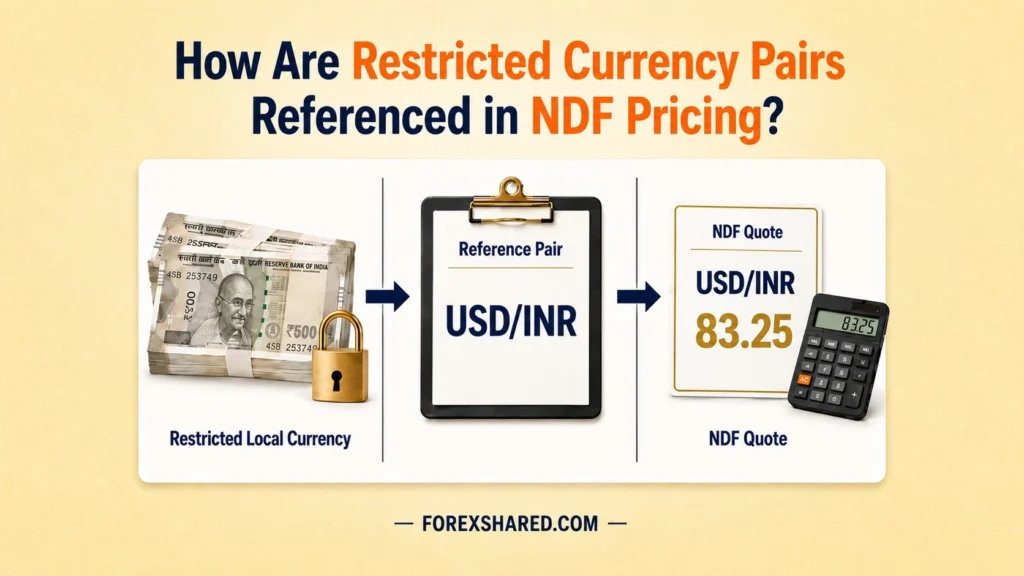
How Are Restricted Currency Pairs Referenced in NDF Pricing?
Restricted currency pairs are referenced in NDF pricing by using the local currency’s exchange-rate relationship as the economic basis of the contract, even though the local currency is not physically delivered at maturity. This mechanical separation allows offshore institutional participants to gain precise, mathematically accurate financial exposure to highly guarded emerging markets without triggering onshore logistical roadblocks.
The entire pricing architecture hinges on distinguishing the economic exposure from the delivery route. The contract formally establishes an agreed NDF rate at inception, anchoring the trader’s position in the restricted asset. At maturity, this initial rate is ruthlessly compared against an official, independently published fixing rate. The ensuing variance exclusively dictates the payout, which is then wired in a freely convertible proxy settlement currency, completely bypassing the local banking grid.
This synthetic structuring transforms the very definition of foreign exchange hedging. The restricted pair drives the mathematical pulse of the contract, but it never legally forces a physical exchange of gross capital, cementing NDFs as contracts for the difference between an agreed exchange rate and the actual spot rate at maturity (BIS). This article deconstructs how reference pairs function inside non-deliverable frameworks, covering fixing mechanics, proxy settlement roles, forward comparisons, risk variables, and mandatory validation checkpoints.
This article is educational only and does not constitute financial advice. Trading foreign exchange on margin carries a high level of risk.
What does it mean to reference a restricted currency pair in NDF pricing?
Referencing a restricted currency pair in NDF pricing means the pair is used to define the contract’s economic exposure, even though the restricted currency is not physically delivered. In standard currency operations, quoting a pair means you intend to swap those literal assets. In the NDF forex category, the pair merely serves as the measuring tape to calculate financial distance, completely divorced from physical ownership.
Which part of the currency pair drives the NDF outcome?
The restricted local currency drives the NDF outcome because its exchange-rate movement shapes the contract’s cash-settlement result. Whether the domestic asset appreciates or depreciates against the designated base currency flawlessly dictates the terminal mathematical variance.
Where does the reference pair appear inside the contract?
The reference pair appears inside the agreed NDF rate and again through the fixing or reference rate used near maturity. It acts as the permanent yardstick: you open the trade based on the pair's initial value, and you close the trade based on the pair's official value recorded by a trusted data source.
What makes the pair “referenced” rather than delivered?
The pair is referenced rather than delivered because it measures economic movement without requiring full exchange of the underlying currencies. No local currency ever lands in the trader's onshore bank account; only the financial consequence of its movement is acknowledged.
A restricted currency pair is referenced in NDF pricing because it determines the economic result, even though the local currency is not physically delivered.
Why can an NDF price a restricted currency without delivering it?
An NDF can price a restricted currency without delivering it because the contract separates exchange-rate exposure from physical currency settlement. The ingenuity of the non-deliverable framework lies entirely in its capacity to construct a synthetic mirror of the onshore market. Understanding Offshore pricing for restricted currencies proves that derivatives do not legally require gross asset transfers to be mathematically functional.
What problem does non-delivery solve for pricing?
Non-delivery solves the pricing problem created when a currency can be economically referenced but cannot be easily transferred offshore. Sovereign capital controls effectively quarantine domestic liquidity. Non-delivery brilliantly bypasses these jurisdictional guardrails, allowing global participants to price and trade the asset's risk trajectory without triggering illegal physical expatriation.
How does the contract preserve local-currency exposure?
The contract preserves local-currency exposure by keeping the restricted pair inside the agreed rate and fixing-rate comparison. The mathematical distance between inception and maturity is calculated exactly as if physical units were shifting hands. Consequently, the trader absorbs the exact same market threat or opportunity.
Where does the proxy currency take over?
The proxy currency takes over at settlement by carrying the final net cash payment. Once the domestic pricing variance is accurately quantified via the fixing reference, the derivative immediately translates that specific sum into a liquid offshore asset like USD, concluding the execution cycle without domestic interference.
An NDF can price a restricted currency without delivering it because the contract separates economic reference from physical currency transfer.
How does the agreed NDF rate reference the restricted pair?
The agreed NDF rate references the restricted pair by setting the contract’s starting exchange-rate benchmark. The instant a trade is executed, counterparties lock in a highly specific numeric ratio evaluating the restricted currency against a base currency. This initial coordinate serves as the unmoving fulcrum for all subsequent portfolio evaluations.
Which rate becomes the contract’s starting anchor?
The contracted NDF rate becomes the starting anchor because both parties agree to use it as the forward-style reference point. Formulated using prevailing interest rate differentials and spot pricing, this value establishes the exact threshold required to generate a surplus or deficit upon maturity.
What does the agreed rate say about future exposure?
The agreed rate expresses future exchange-rate exposure without creating an obligation to deliver the local currency. It represents pure, unadulterated market expectation. It dictates the specific price at which you are theoretically securing the restricted asset, locking your vulnerability to its macro direction.
Where can readers confuse price with settlement?
Readers can confuse price with settlement when they assume the agreed NDF rate means the currencies will be exchanged at maturity. In reality, the agreed rate solely exists to be compared mathematically against terminal reality. It is a calculation metric, not a delivery receipt.
The agreed NDF rate references the restricted currency pair by creating the starting exchange-rate benchmark for the contract.
Why does the fixing rate matter after the NDF is priced?
The fixing rate matters after the NDF is priced because it converts the referenced restricted pair into the final cash-settlement outcome. An agreed rate is meaningless without a terminal finish line. Examining Offshore reference pricing in NDFs validates that without a universally trusted observation metric to definitively close the loop, non-deliverable structures would dissolve into counterparty disputes.
Which moment turns the reference pair into a settlement outcome?
The fixing date turns the reference pair into a settlement outcome by capturing the rate used for final comparison. Occurring prior to the actual settlement day, this specific chronological snapshot permanently freezes the active spot price, ruthlessly dictating the financial destiny of the trade.
What makes the fixing source important?
The fixing source is important because it defines which rate will be trusted for the final settlement comparison. Contract documentation explicitly names the central bank publication, Reuters screen, or Bloomberg feed authorized to provide the data. Any ambiguity regarding this source radically destabilizes the derivative.
Where does fixing replace physical exchange?
Fixing replaces physical exchange by providing the rate used to determine the cash payment instead of triggering currency delivery. Rather than shipping millions of restricted units, counterparties simply align the agreed NDF rate with the fixing rate, subtracting one from the other to finalize obligations.
The fixing rate matters because it converts the referenced restricted pair into the final cash-settlement outcome.
How does the proxy settlement currency interact with the restricted pair?
The proxy settlement currency interacts with the restricted pair by carrying the payment while the restricted pair continues to drive the economic exposure. It isolates logistics from economics. Understanding this dual-layer construction is paramount; the proxy exists solely to facilitate unhindered delivery across offshore banking environments.
Which currency carries the risk signal?
The restricted local currency carries the main risk signal because its exchange-rate movement drives the NDF outcome. A violent depreciation in the domestic asset cascades instantly into the derivative's valuation. Shifting the payment conduit does not inoculate the position from brutal market volatility.
What role does the settlement currency actually play?
The settlement currency provides the practical payment channel for the net cash amount. It acts as the universally accepted financial messenger. Once the restricted variance is cleanly calculated, it is meticulously converted into USD (or another agreed liquid asset) and disbursed immediately.
Where do readers mix up exposure and payment?
Readers often mix up exposure and payment when they assume the settlement currency is the only currency that matters. Executing a trade entirely settled in USD frequently lures novices into believing their exposure is insulated by American economic stability, disastrously ignoring the restricted asset charting their fate.
The proxy settlement currency handles payment, while the restricted currency pair still drives the NDF’s price exposure.
When are restricted currency pairs most likely to be referenced through NDFs?
Restricted currency pairs are most likely to be referenced through NDFs when users need exchange-rate exposure but cannot easily settle the local currency offshore. Analyzing Controlled-currency hedging with NDFs reveals that these derivatives dominate regions enforcing aggressive sovereign capital controls.
When does offshore access become the main constraint?
Offshore access becomes the main constraint when participants need exposure to a local currency but cannot easily receive or deliver it outside the domestic market. Without NDF architecture, global liquidity would systematically bypass strictly guarded emerging markets entirely, leaving institutional portfolios dangerously unprotected.
Where do companies use reference-pair exposure?
Companies may use reference-pair exposure when revenues, costs, loans, or investments are linked to a restricted local currency. A multinational firm generating profound revenue streams inside a restricted jurisdiction must mathematically hedge against anticipated local depreciation without physically moving trapped cash across borders.
Which market condition pushes users away from deliverable forwards?
Restricted convertibility can push users away from deliverable forwards because physical settlement may be unavailable or impractical. If regulatory decrees prohibit massive gross capital transfers, traditional deliverable forwarding becomes structurally invalid, forcing reliance strictly upon non-deliverable synthetic alternatives.
Restricted currency pairs are most likely to be referenced through NDFs when users need exchange-rate exposure but cannot easily settle the local currency.
How does NDF pricing differ from deliverable forward pricing?
NDF pricing differs from deliverable forward pricing because the NDF references the restricted pair for economic exposure, then settles through cash instead of currency delivery. Both structures inherently secure a precise future valuation via prevailing interest rate dynamics, yet their culmination strictly diverges.
| Contract Type | Pricing Reference | Maturity Result |
|---|---|---|
| Deliverable Forward | Future rate for deliverable currencies | Actual currency exchange |
| NDF | Forward-style rate for restricted pair | Net cash settlement |
| Spot FX | Current exchange rate | Immediate or near-term exchange |
Which contract turns the price into currency delivery?
The deliverable forward turns the price into currency delivery because the agreed currencies are physically exchanged at maturity. Complete gross notional capital formally trades hands across deeply integrated, heavily capitalized correspondent banking ledgers.
What does the NDF price become at maturity?
The NDF price becomes one side of the comparison against the fixing rate at maturity. It abruptly ceases to represent a transfer instruction and exclusively acts as the mathematical hurdle rate required to evaluate terminal profit or loss.
Where does the restricted-pair reference change the comparison?
The restricted-pair reference changes the comparison because the NDF price must be interpreted alongside fixing, settlement currency, and non-delivery terms. Evaluating NDF premiums blindly against standard spot feeds without recognizing the offshore structural restrictions yields violently flawed institutional analytics.
NDF pricing differs from deliverable forward pricing because the NDF references the restricted pair for economic exposure, then settles through cash rather than delivery.
What examples make restricted pair referencing easier to understand?
Examples make restricted pair referencing easier to understand when they show how the pair drives exposure while settlement happens elsewhere. Decoupling academic definitions from applied institutional scenarios forcefully clarifies these synthetic derivatives.
What does a corporate exposure example reveal?
A corporate exposure example reveals how a company can be affected by a restricted currency without needing offshore delivery of that currency. If a multinational firm possesses massive inventory tied up in restricted local fiat, they desperately need price protection. The NDF flawlessly hedges their economic bleeding without illegally circumventing national export laws.
How does an offshore investor example clarify access limits?
An offshore investor example clarifies access limits by showing how exposure can be referenced even when direct local-currency settlement is difficult. Global hedge funds frequently seek exposure to volatile emerging markets. NDFs enable these entities to seamlessly speculate via reference pairs while remaining entirely insulated from localized banking bureaucracy.
Where does the fixing example make the structure visible?
The fixing example makes the structure visible by showing the agreed rate at the start and the fixing rate near settlement. It isolates exactly when the initial reference coordinate confronts live market reality, crystallizing the pure mathematics underlying terminal payouts.
Examples show that NDF pricing references restricted currency pairs to preserve exposure while avoiding physical settlement.
How should readers interpret the quoted pair in an NDF?
The quoted pair in an NDF should be interpreted as the exposure reference, not as a promise that both currencies will be physically exchanged. Misinterpreting this initial data field virtually guarantees severe strategic collapse.
Which currency pair should be treated as the economic reference?
The NDF’s quoted restricted pair should be treated as the economic reference because it defines which exchange-rate movement matters. It represents the underlying asset fundamentally steering your equity. It maps precisely where your vulnerability or opportunity logically originates.
What does the quote not promise?
The quote does not promise full currency exchange or physical delivery of the restricted local currency. Executing an NDF implicitly waives all rights regarding physical capital repatriation, cleanly substituting it for proxy resolution.
Where should settlement currency be placed in the interpretation?
Settlement currency should be placed in the payment layer, while the quoted pair belongs to the exposure layer. Fusing these two distinct dimensions causes analytical paralysis. The reference dictates the "why," whereas the settlement dictates the "how."
The quoted pair in an NDF should be read as the exposure reference, not as a promise of physical currency delivery.
What mistakes cause confusion about restricted pair references?
Confusion about restricted pair references usually comes from mixing up the quoted pair, fixing source, settlement currency, and delivery obligation. Aggressively untangling these parameters restores institutional clarity.
Treating the quoted pair as a deliverable currency pair
Mistake: The reader assumes the referenced currencies will be exchanged.
Correction: In an NDF, the quoted pair drives the cash-settlement outcome without full delivery.
Ignoring the fixing source behind the price
Mistake: The reader focuses only on the agreed NDF rate.
Correction: The fixing source is essential because it definitively dictates final settlement accuracy.
Assuming proxy-currency settlement removes local-currency exposure
Mistake: The reader thinks payment in USD or another proxy currency removes the restricted currency from the risk.
Correction: The restricted pair remains actively weaponized and still fundamentally drives the economic result.
Comparing NDFs only by quoted rate
Mistake: The reader compares NDF prices without checking settlement structure.
Correction: Pricing must be explicitly interpreted alongside fixing, settlement currency, and non-delivery terms.
Most confusion comes from mixing up the quoted pair, fixing reference, settlement currency, and delivery obligation.
How can readers fix misunderstanding before analyzing NDF pricing?
Readers can fix misunderstanding before analyzing NDF pricing by separating the reference pair, fixing source, settlement currency, and delivery status. Methodically isolating these contractual inputs restores diagnostic capability and prevents severe execution failures.
What should be separated before reading the NDF price?
Before reading the NDF price, the reader should separate the exposure currency from the settlement currency. Furthermore, the initially agreed rate must be firmly distinguished from the terminal fixing rate. Recognizing these dualities solidifies economic reference versus physical delivery execution.
Which contract terms reveal the pricing reference?
The currency pair, fixing source, fixing date, and settlement currency reveal how the NDF price should be interpreted. These specific lexical markers clearly define whether the contract functions legally as a deliverable structure or as a synthetically restricted proxy offset.
Where should pricing analysis begin?
Pricing analysis should begin with settlement structure before comparing the agreed rate with other forward prices. A fundamentally attractive forward rate operates as a meaningless parameter if the derivative forces a delivery protocol your institution cannot legally or functionally satisfy.
The cleanest fix is to separate reference pair, fixing source, and settlement currency before interpreting the NDF price.
What should be validated before trusting an NDF price reference?
Before trusting an NDF price reference, readers should confirm that the restricted pair, agreed rate, fixing source, settlement currency, and non-delivery terms are clearly understood. Implementing rigid validation protects strategic intent.
Restricted currency pairs are referenced in NDF pricing by separating economic exposure from physical currency delivery. The pair drives the contract’s price logic, the fixing rate determines the settlement reference, and the proxy currency seamlessly executes the final cash payment without breaching capital controls (BIS).
NDF Pricing FAQs
Why doesn't the agreed NDF rate perfectly match the onshore spot rate?
Because NDFs frequently absorb offshore speculative pressures and varied interest rate differentials that are structurally severed from the heavily controlled onshore market dynamics, causing noticeable pricing basis risk.
Can the fixing source be changed during the contract?
Generally, no. The fixing source is legally bound at inception. However, robust institutional contracts contain fallback provisions detailing alternative reference sources if the primary central bank or data screen fails on the fixing date.
Does referencing a restricted pair remove counterparty risk?
No. Even though physical delivery is removed, you remain entirely dependent upon your offshore counterparty executing the proxy cash settlement. If the opposing institution defaults, your localized hedge offers no protection.