Why Does Offshore Reference Pricing Matter in NDF Contracts?
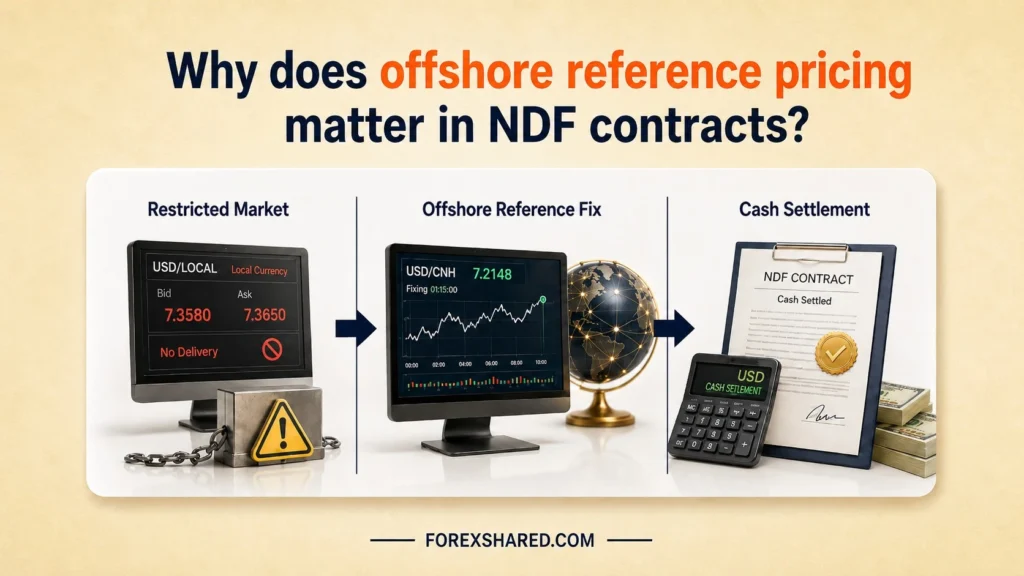
Offshore reference pricing matters in NDF contracts because the NDF price is not a normal deliverable currency quote; it is a reference price for restricted-currency exposure. It gives the contract a way to represent movement in a currency that may be difficult, restricted, or impractical to physically deliver outside its local market.
NDFs are contracts for the difference between an agreed exchange rate and the actual spot rate at maturity, and they settle through a single cash payment rather than funding the underlying currencies. That means the offshore price, the fixing rate, and the settlement currency must be read together.
This article is educational only. It explains the NDF pricing mechanism, fixing structure, onshore/offshore divergence, hedge interpretation, and contract validation. It does not recommend trades, brokers, leverage, hedge timing, position size, or live-risk decisions.
What does offshore reference pricing mean inside an NDF contract?
Offshore reference pricing in NDF contracts means the offshore quote gives the contract a benchmark for restricted-currency exposure without requiring physical delivery of that currency. It is a pricing reference formed outside the local delivery market, not a promise that the restricted currency can be freely transferred.
The offshore reference price gives the NDF its economic exposure layer. The agreed NDF rate starts the contract, the fixing source later supplies the final reference, and the settlement currency carries the net payment. These elements must be separated before the NDF price can be interpreted correctly.
Which price layer gives the NDF its economic exposure?
The offshore reference price gives the NDF its exposure layer because it identifies which restricted-currency movement the contract represents. The contract can reference a local currency’s movement without requiring that currency to be delivered offshore.
What should readers not assume from the offshore quote?
Readers should not assume the offshore quote means the restricted currency is freely transferable, deliverable, or equal to an executable onshore delivery price. The quote is a settlement reference, not proof of unrestricted local-market access.
Where does the reference price appear in the contract logic?
The reference price appears through the agreed NDF rate, connects to the later fixing reference, and shapes the final cash-settlement comparison. The price is meaningful because it becomes one side of a settlement calculation, not because it triggers physical currency delivery.
Why does offshore pricing matter when the currency is difficult to deliver?
Offshore reference pricing in NDF contracts matters when the currency is difficult to deliver because market participants still need a way to price restricted-currency exposure. Some currencies face capital controls, settlement limitations, or offshore access constraints, so the NDF creates a reference layer where a standard deliverable forward may be unavailable, limited, or unsuitable. In broader FX market context, BIS surveys track global foreign exchange and OTC derivatives activity across instruments, currencies, and counterparty categories. [BIS, 2025]
This is why restricted currency pair referencing matters. BIS explains that NDFs allow investors and borrowers to take positions in currencies that are subject to official controls. [BIS, 2014]
Which delivery problem makes offshore pricing useful?
Offshore pricing becomes useful when the local currency cannot be easily transferred, received, or settled outside the domestic market. The NDF solves the reference problem, not the physical delivery problem.
What market need keeps the offshore reference active?
Companies, investors, and banks may still need exposure pricing, hedge interpretation, or client-risk references even without direct settlement access. The offshore quote gives those users a market-based reference for a restricted-currency movement.
Where can offshore pricing reveal pressure that onshore markets hide?
Offshore prices can reflect external demand, liquidity stress, depreciation expectations, and policy concerns that may not fully appear in the onshore market. IMF research found that many Asian emerging-market NDF markets are large, rapidly growing, often exceed onshore markets in transaction volume, and can price significant depreciation during stress episodes. [IMF, 2020]
How does the offshore reference price move through the NDF contract lifecycle?
Offshore reference pricing in NDF contracts moves through the lifecycle from agreed NDF rate to fixing reference to final cash settlement. The agreed rate anchors the starting offshore reference, the fixing date determines when the final reference will be observed, and the fixing source determines which rate controls settlement.
The agreed NDF rate becomes meaningful at maturity because the contract compares it with the actual spot or reference rate, then settles the difference through a single cash payment. [BIS, 2014] The restricted currency is referenced, not physically delivered.
| Stage | Contract Element | What It Does |
|---|---|---|
| Trade Start | Agreed NDF Rate | Sets the starting offshore reference price. |
| Before Maturity | Fixing Date | Identifies when the final reference will be observed. |
| Settlement Reference | Fixing Source | Determines which rate controls settlement. |
| Final Payment | Settlement Currency | Carries the net cash payment. |
| Contract Boundary | Non-Delivery Clause | Confirms no physical delivery of the restricted currency. |
Which starting rate anchors the NDF?
The agreed NDF rate anchors the initial exposure and becomes one side of the final settlement comparison. It is not the final settlement rate by itself because the fixing reference still has to be observed at maturity.
What turns the offshore quote into a settlement result?
The fixing rate turns the offshore quote into a settlement result. It provides the final reference, and the contract compares the agreed NDF rate with that fixing reference to determine the net cash payment.
Where does the settlement currency enter the process?
The settlement currency enters at final payment. It carries the cash settlement, often in USD or another agreed tradable currency, while the restricted currency remains the exposure reference rather than the delivered asset.
Why does the fixing rate make offshore reference pricing contract-critical?
The fixing rate makes offshore reference pricing in NDF contracts contract-critical because it decides how the offshore price becomes the settlement result. The fixing date controls when the final reference rate is observed, while the fixing source controls which market, official, or contract-defined reference rate is used.
The fixing date should be read beside the offshore quote because the quote does not settle itself. Learn more about the NDF fixing date when comparing the agreed rate, final reference, and settlement timing.
Which fixing term controls the final reference?
The fixing source controls which reference rate is used, while the fixing date controls when that rate is captured. Both terms are necessary because a price without a fixing source is not enough to interpret settlement.
What makes fixing different from delivery?
Delivery transfers currencies. Fixing supplies a reference for net settlement. In an NDF, fixing allows the contract to close without moving the restricted currency through a physical settlement channel.
Where can fixing create basis risk?
Basis risk appears when the fixing reference does not match the user’s real conversion exposure. The hedge may reduce one risk while leaving mismatch against another reference.
How can offshore reference prices differ from onshore currency prices?
Offshore reference prices in NDF contracts can differ from onshore currency prices because offshore and onshore markets may have different access rules, liquidity, and policy pressures. Market segmentation should be understood before the price gap is interpreted as basis, spread, or mispricing.
BIS notes that pricing in deliverable forward and NDF markets is segmented, with NDFs tending to lead during times of market strain. [BIS, 2014] That makes the offshore price informative, but not automatically identical to the onshore conversion outcome.
Which market barrier allows the price gap to exist?
Capital controls and settlement restrictions can weaken direct arbitrage, so offshore and onshore prices do not always move identically. A visible price gap may reflect market structure rather than a simple error.
What can the offshore price include that the onshore price may not show?
Offshore prices can include external investor demand, offshore hedging pressure, liquidity stress, convertibility expectations, or policy expectations. These pressures can appear before or differently from onshore price adjustment.
When does the onshore/offshore gap become more visible?
The gap can become more visible during volatility, policy uncertainty, liquidity stress, or periods when offshore participants price risks differently from domestic markets.
For broader FX timing context, the trading day is often explained through Asian, London/European, and New York/North American sessions; however, session labels should not be confused with the fixing source in an NDF contract. [Investopedia, 2025]
How does offshore reference pricing affect hedge accuracy?
Offshore reference pricing in NDF contracts affects hedge accuracy because the hedge works only as well as the reference price matches the user’s real exposure. The NDF may hedge price exposure, but it does not provide local currency access or remove every possible mismatch.
A hedge can weaken if the fixing source differs from the user’s real conversion rate. That leaves the user hedged against one reference while still exposed to another reference, especially when onshore/offshore basis is meaningful.
Which mismatch can weaken an NDF hedge?
A hedge can weaken if the fixing source differs from the user’s real conversion rate. The NDF may settle correctly under the contract while still failing to match the cash-flow economics of the user’s real exposure.
What does offshore pricing protect better than delivery access?
Offshore pricing can help represent exchange-rate exposure. It does not necessarily provide access to the local currency, solve convertibility limits, or remove settlement restrictions.
Where does hedge confidence become too high?
Confidence becomes too high when readers assume the NDF perfectly mirrors the local market or fully removes onshore/offshore basis risk. The offshore reference is useful, but it is still a reference.
How is offshore reference pricing different from deliverable forward pricing?
Offshore reference pricing in NDF contracts differs from deliverable forward pricing because an NDF prices exposure for cash settlement rather than future currency delivery. A deliverable forward turns price into a future currency exchange, while an NDF turns price into a fixing-based settlement comparison.
Deliverable forwards require funding in the underlying currencies, while NDFs settle without funding those currencies. [BIS, 2014] Similar-looking FX quotes can therefore carry very different contract meanings.
| Contract Type | Price Reference | Maturity Result | Main Interpretation Risk |
|---|---|---|---|
| Deliverable Forward | Future exchange rate for deliverable currencies | Full currency exchange | Underestimating delivery obligation |
| NDF | Offshore reference price for restricted-currency exposure | Net cash settlement | Confusing reference price with deliverable price |
| Spot FX | Current exchange rate | Immediate or near-term exchange | Assuming access exists in restricted markets |
Which contract turns price into currency delivery?
A deliverable forward turns the agreed price into a future currency exchange when both currencies can be transferred through settlement channels. The price is connected to delivery rather than only cash-settlement comparison.
What does the NDF price become at maturity?
The NDF price becomes part of the comparison against the fixing reference. It does not become an instruction to deliver the restricted currency.
Where does the comparison change the reader’s interpretation?
The comparison changes interpretation because rate level alone is not enough. Readers must compare settlement structure before comparing rate levels.
When is offshore reference pricing most important in NDF contracts?
Offshore reference pricing in NDF contracts is most important when restricted-currency exposure must be priced outside the local delivery market. It becomes especially meaningful when delivery access is restricted, hedge demand is high, market stress appears, or the onshore/offshore gap widens.
IMF research found that many Asian emerging-market NDF markets are large, rapidly growing, often exceed onshore markets in transaction volume, and tend to price significant depreciation during stress episodes such as COVID-19. [IMF, 2020]
When does a corporate hedger rely on offshore pricing?
A corporate hedger may rely on offshore pricing when future cash flows are tied to a restricted currency but deliverable forward access is limited. The NDF reference can help represent exposure without solving delivery restrictions.
Where does an investor treat the NDF quote as an access substitute?
An investor may treat the NDF quote as a way to express restricted-currency exposure without direct local market access. That access substitute still settles in cash and still depends on fixing terms.
Which market condition makes the offshore quote especially informative?
Market stress can make offshore NDF pricing especially informative because offshore prices may reflect depreciation expectations, hedge demand, and liquidity conditions before those pressures fully appear onshore.
When volatility is discussed as a general FX condition, Average True Range is a technical range-based indicator rather than an NDF pricing input; it may describe market movement, but it does not replace contract terms, fixing source, or settlement-currency validation. [Fidelity, n.d.] [Investopedia, n.d.]
What examples make offshore reference pricing easier to understand?
Examples make offshore reference pricing easier to understand by showing how restricted-currency exposure connects to fixing-based cash settlement. The point is not to create a trading formula, but to clarify which part of the NDF is exposure, which part is fixing, and which part is payment.
| Example Type | What It Shows |
|---|---|
| Corporate hedge example | Why an NDF can hedge exposure without delivering currency. |
| Fixing example | How the offshore price becomes settlement. |
| Basis example | Why offshore and onshore references can differ. |
| Deliverable-forward contrast | What the NDF avoids at maturity. |
What does a corporate hedge example reveal?
A corporate hedge example reveals that a company expecting local-currency revenue can use an NDF to reference exchange-rate exposure without requiring offshore delivery of that currency.
How does a fixing example clarify settlement?
A fixing example clarifies settlement by showing that the agreed offshore NDF rate starts the contract, the fixing rate provides the final reference, and settlement depends on the comparison between them.
Where does an onshore/offshore basis example help?
An onshore/offshore basis example helps show why the offshore reference may not equal the onshore conversion outcome and why readers must avoid treating the two as identical.
How should readers interpret offshore reference pricing correctly?
Readers should interpret offshore reference pricing in NDF contracts through settlement structure, fixing source, exposure currency, settlement currency, and basis risk. The quoted rate should not be read in isolation because the settlement mechanism gives the price its contract meaning.
| Interpretation Layer | Reader Question |
|---|---|
| Settlement structure | Does the contract settle by delivery or cash payment? |
| Offshore reference price | What restricted-currency exposure is being represented? |
| Fixing source | Which rate controls the final settlement reference? |
| Settlement currency | Which currency carries the payment? |
| Basis risk | Could offshore and onshore references diverge? |
Which layer should be read before the quoted rate?
The settlement layer should be read before the quoted rate because it determines whether the contract ends in delivery or cash settlement. Without that layer, the quoted rate can be misread as a normal deliverable FX price.
What does the offshore reference price not guarantee?
The offshore reference price does not guarantee physical delivery, local-market convertibility, or perfect alignment with the user’s real conversion rate. It is a reference for exposure and settlement comparison.
Where should the fixing source sit in interpretation?
The fixing source should sit beside the offshore quote because it explains how the quote becomes a final settlement reference. The source is not a minor detail; it controls the settlement comparison.
What mistakes cause confusion about offshore reference pricing?
Mistakes about offshore reference pricing usually come from treating a cash-settled restricted-currency reference like a normal deliverable FX price. That error leads readers to confuse exposure pricing, payment route, fixing source, and physical currency access.
Retail-FX risk warnings are relevant background because leveraged foreign currency products can expose individuals to substantial losses, and regulators warn against misleading or guaranteed-profit currency trading claims. [SEC, 2011] [CFTC/NASAA, n.d.] Fraud alerts also caution that market-volatility narratives can be used to attract victims into risky or fraudulent offers. [CFTC, 2020]
Treating the offshore reference price as a deliverable price
Common mistake: The reader assumes the restricted currency will be exchanged. Correction: In an NDF, the offshore reference price supports cash settlement, not physical delivery.
Ignoring the fixing source behind the NDF quote
Common mistake: The reader focuses only on the offshore NDF rate. Correction: The fixing source determines how settlement is finalized.
Confusing settlement currency with exposure currency
Common mistake: The reader assumes USD settlement means USD is the only relevant currency. Correction: USD may carry the payment while the restricted currency drives the exposure.
Comparing offshore and onshore prices without checking restrictions
Common mistake: The reader treats the price gap as simple mispricing. Correction: The gap may reflect capital controls, liquidity, funding pressure, policy expectations, or segmentation.
Which contract terms confirm the role of offshore reference pricing?
Contract terms confirm the role of offshore reference pricing by showing the agreed NDF rate, fixing date, fixing source, settlement currency, and non-delivery language. These terms prove whether the price is a restricted-currency reference or a deliverable exchange obligation.
| Contract Term | What It Confirms |
|---|---|
| Agreed NDF rate | Starting offshore reference. |
| Fixing date | When the final reference is observed. |
| Fixing source | Which rate controls settlement. |
| Settlement currency | How payment is made. |
| Restricted pair | Which currency movement drives exposure. |
| Non-delivery language | Restricted currency is referenced, not transferred. |
Which term proves the starting offshore reference?
The agreed NDF rate proves the starting reference price and should not be confused with the final fixing reference. It starts the contract but does not complete settlement.
What terms separate pricing reference from payment route?
The restricted currency pair belongs to the exposure layer, while the settlement currency belongs to the payment layer. This distinction prevents readers from confusing what is referenced with what is paid.
Which terms distinguish NDF pricing from deliverable forward pricing?
Fixing date, fixing source, settlement currency, and non-delivery wording signal NDF structure. Full exchange language signals deliverable forward structure.
What should be validated before trusting offshore reference pricing in an NDF?
Before trusting offshore reference pricing in an NDF, readers should validate the contract type, restricted pair, agreed rate, fixing terms, settlement currency, and delivery status. This is light validation, not a trading workflow or hedge recommendation.
Position-sizing and risk-management frameworks should remain separate from contract interpretation because a smaller or larger position does not change what the NDF reference price, fixing source, or settlement currency mean. [Van Tharp Institute, n.d.]
| Validation Question | Pass Condition |
|---|---|
| Is the contract actually an NDF? | Non-delivery structure is clear. |
| Which restricted currency pair is referenced? | Exposure pair is named. |
| What offshore NDF rate was agreed? | Starting reference is identifiable. |
| What fixing date applies? | Observation timing is clear. |
| Which fixing source controls settlement? | Reference source is named. |
| What settlement currency is used? | Payment currency is clear. |
| Is the local currency delivered or only referenced? | Delivery status is confirmed. |
| Could basis affect hedge accuracy? | Onshore/offshore gap is considered. |
| Are onshore and offshore prices being compared under the same settlement lens? | Comparison is structurally fair. |
| Is the offshore price being treated as exposure pricing, not delivery pricing? | Interpretation is correct. |
Closing Insight
Offshore reference pricing matters in NDF contracts because it supplies the market benchmark for restricted-currency exposure. The NDF price anchors the contract, the fixing reference converts that price into settlement, and the settlement currency carries the final cash payment without delivering the local currency.
FAQ
Is offshore reference pricing the same as a deliverable exchange rate?
No. Offshore reference pricing gives an NDF a benchmark for restricted-currency exposure, while deliverable exchange rates support actual currency transfer through settlement channels.
Does an NDF deliver the restricted currency at maturity?
No. An NDF references the restricted currency but normally settles the net difference in an agreed settlement currency, often USD.
Why does the fixing source matter?
The fixing source determines which final reference rate controls settlement, so it gives practical meaning to the agreed offshore NDF rate.
Can offshore and onshore prices differ?
Yes. They can differ because of capital controls, liquidity conditions, settlement restrictions, policy expectations, and market segmentation.
Does offshore reference pricing remove hedge risk?
No. It can support exposure pricing, but hedge accuracy still depends on the reference match, fixing source, basis, and the user’s real conversion exposure.