How Do Offshore Markets Quote Currencies That Cannot Be Freely Delivered Onshore?
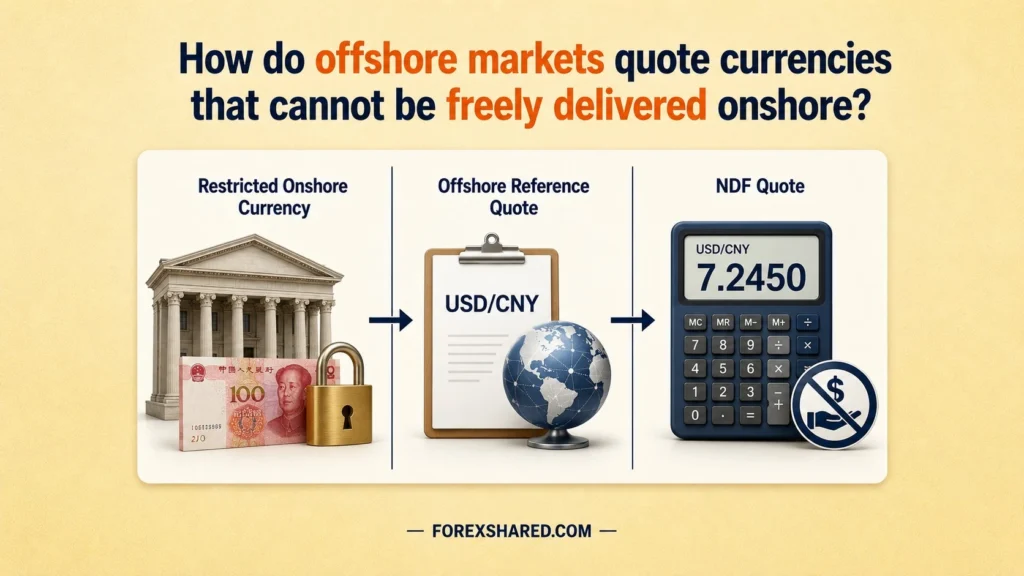
Offshore markets usually quote currencies that cannot be freely delivered through non-deliverable forward structures. When a nation enforces strict capital controls, making it impossible to freely move its local currency across borders, global market participants still demand a mechanism to price and trade exposure to that economy. The offshore market solves this problem by abstracting the risk away from the physical asset.
These quotes provide participants with pure economic exposure without any guaranteed delivery of the underlying physical currency. Instead of relying on traditional correspondent banking networks to exchange principals, these trades are constructed as non-deliverable forward (NDF) style contracts. They observe a designated reference rate and settle the mathematical difference in a secondary, liquid currency via cash settlement.
By shifting the contract away from domestic settlement constraints, institutions can effectively hedge localized risk in a fully globalized venue. These structures are commonly understood across global financial centers as cash-settled forward structures, completely stripping away the logistical complexities of onshore banking friction [Bank of England FXJSC, 2025].
What does an offshore restricted-currency quote actually represent?
An offshore restricted-currency quote represents a tradable exchange-rate reference outside the local delivery market. It is a synthetic reflection of value that exists independently of the restricted currency's domestic payment rails. When viewing an offshore quote, market participants are looking at a legally binding derivative price rather than an actionable inventory receipt for physical cash.
Which currency relationship gives the quote its exposure?
The restricted currency pair gives the offshore quote its exposure because the pair defines which exchange-rate movement matters. If an institution enters an NDF contract referencing the USD/BRL (US Dollar vs. Brazilian Real), the economic signal of the contract is entirely tethered to the volatility of that specific ratio. The pair creates the fundamental exposure, while the cash settlement mechanism simply determines how the final payment is facilitated [Bank of England FXJSC, 2025].
What does the quote not promise to the buyer or hedger?
The quote does not promise local-currency receipt, local-market settlement access, or physical transfer of the restricted currency. Acquiring an offshore quote structurally waives all rights to claim the underlying asset at maturity. A non-deliverable quote rigidly references currency movement without ever requiring, or permitting, physical currency transfer [Bank of England FXJSC, 2025].
Where does the offshore venue change the quote’s function?
The offshore venue changes the quote’s function by separating the quotation layer from the local delivery layer. By legally executing the trade in an external jurisdiction (such as London or New York), the contract transitions from a logistics-based transaction into a pure price-exposure tool. Offshore quotation creates tradable exposure entirely outside normal local settlement channels [Bank of England FXJSC, 2025].
Why do offshore markets use non-deliverable structures for restricted currencies?
Offshore markets use non-deliverable structures because restricted currencies may be difficult or impossible to deliver outside the local market. Strict regulatory barriers block the exportation of the monetary asset, rendering standard settlement processes structurally broken.
Which delivery constraint forces a cash-settled quote?
A cash-settled quote becomes necessary when offshore parties cannot reliably receive, deliver, or settle the local currency. If the central bank prohibits foreign entities from holding onshore bank accounts or moving currency out of the domestic jurisdiction, a standard forward contract immediately fails. This delivery restriction forcefully pushes the contract toward a net cash settlement framework [Bank of England FXJSC, 2025].
What market need remains even when delivery is blocked?
The need for exchange-rate exposure remains even when physical delivery is blocked. Global businesses operating inside restricted jurisdictions still face severe balance sheet risk from local currency volatility. The global market can still actively price this exposure and supply hedging instruments even when core settlement channels are artificially restricted [Bank of England FXJSC, 2025].
Where does offshore pricing become a workaround?
Offshore pricing becomes a workaround when the market can quote currency exposure without transferring the restricted currency. Rather than fighting the local central bank's capital controls, the offshore market builds a parallel derivative layer. Offshore pricing preserves the desired financial exposure while entirely avoiding the onshore logistical settlement constraints [Bank of England FXJSC, 2025].
How does an NDF quote reference a currency that cannot be delivered?
An NDF quote references a currency that cannot be delivered by using the restricted currency pair as the economic price reference. Even though the actual currency never transfers, the contract mathematically links its final value directly to the localized pricing signal. This is heavily reliant on Restricted currency pair referencing, a mechanism designed to track targeted price action securely.
Which pair becomes the pricing anchor?
The restricted currency pair becomes the pricing anchor because it identifies the exchange-rate relationship the NDF is built around. If the quote displays USD/KRW, the Korean Won establishes the exact volatility profile driving the contract's profit and loss. The pair anchors the economic exposure, while the eventual payment mechanism occurs entirely separately [Bank of England FXJSC, 2025].
What does the agreed offshore rate represent?
The agreed offshore rate represents the forward-style level both parties use as the starting reference for later settlement. When the trade is executed, this numerical rate is locked in as the baseline. The agreed rate functionally becomes the first reference point utilized before the final maturity fixing arrives [Bank of England FXJSC, 2025].
Where does pair notation mislead beginners?
Pair notation misleads beginners when they assume the quoted restricted pair will be physically exchanged. The format looks identical to standard, highly liquid FX pairs, leading inexperienced participants to assume standard clearing processes apply. In NDFs, the quoted pair is exclusively a reference layer, absolutely not a delivery promise [Bank of England FXJSC, 2025].
Why does the fixing rate control the final offshore settlement?
The fixing rate controls final offshore settlement because it converts the original offshore quote into the exact, rigid reference used for calculating the cash payout. An exposure contract requires an indisputable endpoint; the Offshore reference pricing role provides this by serving as the ultimate bridge between floating risk and finalized settlement.
Which date turns the quote into a settlement reference?
The fixing date turns the offshore quote into a settlement reference by capturing the exact rate used for final comparison. Dictated by the contract terms, this designated day initiates the observation phase. The fixing date decisively determines the precise moment when the floating market reference is frozen and observed [Bank of England FXJSC, 2025].
What makes the fixing source contract-critical?
The fixing source is contract-critical because it defines which specific institution or screen determines the final settlement comparison. Without a legally agreed-upon source—such as a specific central bank daily publication or a recognized interbank screen—the contract cannot function. The fixing source functionally turns the quoted exposure into an actionable settlement reference [Bank of England FXJSC, 2025].
Where does the onshore market still influence the offshore contract?
The onshore market can still influence the offshore contract when the fixing source reflects a local or officially recognized onshore reference rate. Even though the trade executes and settles in an external jurisdiction, the contract may explicitly pull its final settlement metric from an onshore central bank's daily fix. The offshore contract settles offshore but frequently remains tethered to a recognized rate deeply connected to the underlying domestic currency [Bank of England FXJSC, 2025].
How does the settlement currency separate payment from exposure?
The settlement currency separates payment from exposure because the restricted pair drives the quote while another currency carries the physical cash payment. This dual-layer architecture ensures that strict domestic banking friction does not interrupt the smooth execution of global financial contracts.
Which currency carries the final cash payment?
The settlement currency carries the final cash payment, while the restricted currency pair completely remains the exposure reference. Often denominated in US Dollars (USD) or Euros (EUR), the settlement currency assumes the logistical burden of moving funds. The settlement currency seamlessly handles payment without ever attempting to replace the exposure currency [Bank of England FXJSC, 2025].
What remains tied to the restricted currency?
The quote remains tied to the restricted currency because the fixing comparison still depends exclusively on that currency’s exchange-rate movement. If the underlying emerging market currency crashes, the contract holder heavily absorbs that loss. The restricted pair dictates the ultimate economic result; the settlement currency only mechanically carries the resulting net payment [Bank of England FXJSC, 2025].
Where does settlement-currency confusion begin?
Settlement-currency confusion begins when readers treat a USD settlement payment as absolute proof that the restricted currency no longer matters. Because the transaction deposits USD into their bank account, novices often mistake the trade for a pure dollar-based asset. The payment currency strictly carries the settlement outcome, whereas the restricted pair strictly carries the market exposure [Bank of England FXJSC, 2025].
Why can offshore quotes differ from onshore deliverable prices?
Offshore quotes can differ from onshore deliverable prices because the two markets may operate under aggressively different settlement access, systemic liquidity, funding costs, and local policy conditions. An offshore quote reflects a freely traded environment, whereas an onshore price is frequently managed, capped, or artificially stabilized by authorities.
Which market barrier allows prices to diverge?
Capital controls and restricted settlement access can allow offshore and onshore prices to diverge rapidly. Normally, arbitrageurs correct price gaps by buying in one market and simultaneously selling in the other. When capital controls sever this mechanical link, limited arbitrage effectively allows offshore and onshore prices to structurally drift apart [Bank of England FXJSC, 2025].
What does the offshore quote sometimes price earlier?
The offshore quote may aggressively price external investor expectations, massive hedging demand, deteriorating liquidity conditions, or widespread concerns about future restrictions. Large global institutions often execute heavily on offshore NDF platforms ahead of looming economic data. Consequently, offshore quotes can reflect external demand and restricted access significantly faster than onshore prices fully adjust [Bank of England FXJSC, 2025].
When does the offshore basis become especially visible?
The offshore basis becomes especially visible when local policy uncertainty, liquidity pressure, or domestic settlement restrictions sharply increase. During a crisis, the offshore market may violently reprice risk while the domestic central bank artificially holds the local spot rate steady. Segmented market access can radically widen the visible price gap between offshore and onshore references [Bank of England FXJSC, 2025].
| Quote Layer | Offshore NDF Quote | Onshore Deliverable / Local Quote | Reader Interpretation |
|---|---|---|---|
| Delivery | No local-currency delivery | May involve local settlement or delivery | Check settlement clause first |
| Exposure | Restricted pair remains central | Local currency pair remains central | Exposure can exist without delivery |
| Settlement | Net cash payment | Currency transfer or local settlement | Payment method changes meaning |
| Reference | Fixing or reference rate | Spot or local market rate | Fixing source must be identified |
| Price Gap | Offshore basis may appear | Local price may be controlled or segmented | Do not assume simple mispricing |
When are offshore restricted-currency quotes most useful?
Offshore restricted-currency quotes are most useful when participants need currency exposure, hedging reference, or market information without full local delivery access. They serve as essential toolkits for managing institutional risk inside economies heavily insulated by strict monetary barriers.
When does a corporate hedger need reference exposure?
A corporate hedger may need reference exposure when business cash flows are linked to a restricted currency but offshore delivery is not practical. If a manufacturer generates massive quarterly revenue in a controlled currency, they must offset the exchange rate risk to protect their global balance sheet. The offshore quote helps seamlessly translate that restricted-currency exposure into a manageable, cash-settled financial reference [Bank of England FXJSC, 2025].
Where does an investor use the offshore quote as an access substitute?
An investor may use the offshore quote as an access substitute when direct local-market participation is legally or systemically limited. Large institutional funds attempting to gain exposure to specific emerging markets often encounter aggressive foreign investment quotas. Structured NDF quoting effectively gives them the exact price exposure they seek without ever requiring direct, physical currency delivery [Bank of England FXJSC, 2025].
What makes the quote useful for monitoring currency pressure?
The quote can be useful for monitoring currency pressure because offshore prices may heavily reflect external expectations and restricted-market demand. While the domestic central bank may hold the official onshore fix rigid, the offshore market floats freely to find true demand. Offshore quotes critically act as a second analytical lens when local prices are fiercely constrained by policy [Bank of England FXJSC, 2025].
What examples make offshore restricted-currency quotation easier to understand?
Examples make offshore restricted-currency quotation easier to understand by showing precisely how financial exposure can be cleanly priced without any subsequent physical currency delivery.
What does a corporate hedge example reveal?
A corporate hedge example reveals that a company can have localized local-currency exposure without ever needing to receive that currency offshore. If an importer is worried about depreciation, they can buy an NDF. The NDF quote meticulously references the pair's volatility while eventual settlement smoothly happens entirely in cash [Bank of England FXJSC, 2025].
How does a fixing example make the quote visible?
A fixing example makes the quote visible by showing how the agreed offshore rate is later compared with a final reference rate. If an institution buys a contract at an agreed rate of 80.00, and the official central bank fixes the rate at 82.00 on the observation date, the two points are compared. The mathematical fixing comparison powerfully converts the original quote into a finalized settlement outcome [Bank of England FXJSC, 2025].
Where does the onshore/offshore contrast become clearest?
The onshore/offshore contrast becomes clearest when the onshore market supports true local settlement while the offshore market simultaneously quotes purely cash-settled exposure. An onshore bank delivers the actual notes; the offshore broker delivers a net mathematical difference. These fundamentally different settlement methods completely change how the raw numerical quote should be interpreted [Bank of England FXJSC, 2025].
How should readers interpret an offshore quote without assuming delivery?
Readers should interpret an offshore quote by methodically separating the quoted pair, the designated fixing source, the specific settlement currency, and the overarching delivery status.
Which layer should be read before the price level?
The settlement layer should be read before the price level because it tells the reader whether the quote technically ends in physical delivery or pure cash settlement. Viewing a quote of 45.30 is completely devoid of context if you incorrectly assume you will be taking possession of the asset. The settlement method rigidly defines whether the quote is a deliverable instrument or a non-deliverable contract [Bank of England FXJSC, 2025].
What does the quoted pair not guarantee?
The quoted pair does not guarantee physical delivery, deep local convertibility, or legal access to the underlying onshore currency. The notation serves purely as an informational tether. Pair notation simply identifies the source of the exposure, not necessarily any subsequent settlement delivery [Bank of England FXJSC, 2025].
Where should the fixing source sit in interpretation?
The fixing source should sit beside the quote because it explains exactly how the offshore price eventually becomes a tangible settlement amount. A quote is only as reliable as the reference rate measuring its conclusion. The fixing mechanism firmly connects the floating quote to the final cash-settlement outcome [Bank of England FXJSC, 2025].
What mistakes cause confusion about offshore currency quotes?
Most confusion about offshore currency quotes comes from naively treating them exactly like normal, highly liquid deliverable FX prices.
Treating an offshore NDF quote as a deliverable forward quote
Mistake: The reader automatically assumes the restricted currency will be delivered at maturity.
Correction: In an NDF, the quote references the currency but rigidly settles only in cash. A non-deliverable quote absolutely does not equate to standard forward delivery [Bank of England FXJSC, 2025].
Ignoring the fixing source behind the quote
Mistake: The reader focuses only on the offshore rate while ignoring the observation mechanism.
Correction: The fixing rate specifically determines how the final settlement is interpreted. Fixing acts as the non-negotiable bridge from a floating quote to finalized settlement [Bank of England FXJSC, 2025].
Confusing USD settlement with USD-only exposure
Mistake: The reader assumes that a USD payment means the local currency no longer matters.
Correction: USD may be the logistical payment route, while the restricted currency entirely drives the economic result. The payment currency merely carries the settlement; the restricted pair carries the actual risk exposure [Bank of England FXJSC, 2025].
Comparing onshore and offshore prices without checking restrictions
Mistake: The reader assumes distinct price differences are a sign of simple, exploitable mispricing.
Correction: Differences may strongly reflect capital controls, localized liquidity traps, institutional funding limits, and policy expectations. Systemically segmented markets can produce widely different quotes without permitting simple arbitrage [Bank of England FXJSC, 2025].
Which contract terms confirm that an offshore restricted-currency quote is non-deliverable?
The contract terms that confirm a non-deliverable structure are the specific settlement clause, the fixing date, the designated fixing source, the specified settlement currency, and strict non-delivery language.
Which settlement clause proves the quote is cash-settled?
The settlement clause proves the quote is cash-settled when it explicitly states that the contract closes exclusively through a net cash payment rather than mutual currency delivery. This clause acts as the legal barricade preventing actual currency transfer. The explicit settlement clause is the absolute strongest proof of a non-deliverable structure [Bank of England FXJSC, 2025].
What terms identify exposure currency versus settlement currency?
The formally quoted pair identifies the risk exposure currency relationship, while the settlement currency designates the logistical payment route. Contracts clearly bifurcate these functions. Separating pure exposure from the final payment mechanism prevents severe NDF misclassification [Bank of England FXJSC, 2025].
Which terms distinguish an NDF from a deliverable forward?
A designated fixing date, fixing source, settlement currency, and restrictive non-delivery language collectively distinguish an NDF from a deliverable forward. Deliverable forwards structurally rely on physical currency delivery; NDFs rely purely on fixing-based cash settlement [Bank of England FXJSC, 2025].
| Contract Term | What to Check | What It Confirms |
|---|---|---|
| Settlement clause | Cash settlement or currency delivery? | Whether the quote is structurally non-deliverable |
| Fixing date | When is the reference rate observed? | When the quote formally becomes a settlement reference |
| Fixing source | Which institutional rate is used? | Which reference legally controls the final settlement |
| Settlement currency | Which highly liquid currency carries payment? | The designated logistical payment route |
| Quoted pair | Which exact currency relationship is referenced? | The fundamental source of economic exposure |
| Delivery language | Are physical currencies exchanged? | Deliverable versus cash-settled non-deliverable structure |
What should be validated before trusting an offshore restricted-currency quote?
Before trusting an offshore restricted-currency quote, readers should validate the precise instrument type, the referenced pair, the fixing source, the settlement currency, and the legal delivery status.
Offshore markets quote restricted currencies by meticulously separating price exposure from currency delivery. The quote rigidly references the restricted pair, the highly specified fixing rate converts the floating quote into a formalized settlement result, and the designated settlement currency seamlessly carries the final cash payment.
Frequently Asked Questions
Do offshore quotes guarantee I will receive the local restricted currency?
No. Offshore restricted-currency quotes, usually structured as Non-Deliverable Forwards (NDFs), strictly separate price exposure from physical delivery. The contract legally guarantees a cash settlement calculation, not local currency receipt.
Why does the quote look like a normal FX pair if it isn't delivered?
The standard notation (like USD/BRL or USD/INR) is used simply to identify the economic exposure relationship. It tells the participants which exchange rate is being tracked for volatility, even though the final settlement is paid out in a singular, unconstrained currency.
How is the final payout calculated if no currency changes hands?
The originally agreed offshore quote is mathematically compared against an official "fixing rate" observed right before maturity. The difference between your entry rate and the fixing rate dictates the net cash amount paid by the losing party to the winning party.
Can I profit simply because the offshore quote is higher than the onshore quote?
No. Arbitraging the difference between offshore (NDF) and onshore prices is exceedingly difficult because strict capital controls prevent the physical transfer of currency necessary to close the loop. The "offshore basis" exists specifically because access between the two segmented markets is heavily restricted.