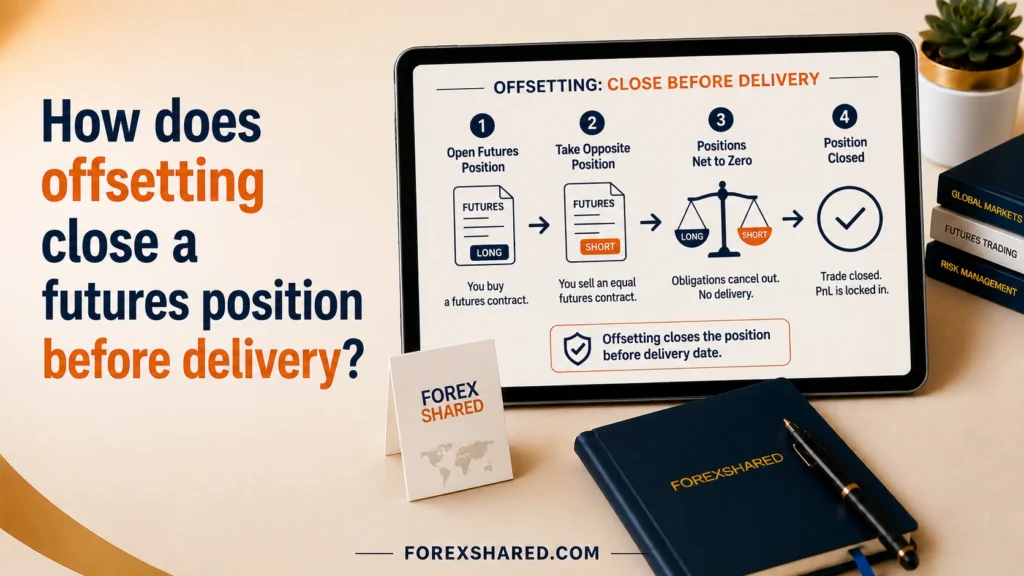
How Does Offsetting Close a Futures Position Before Delivery?
Offsetting closes a futures position when a trader enters an equal and opposite transaction in the same futures contract and delivery month, neutralizing the open long or short position so no net obligation remains.
The trader does not need the original counterparty to return. Exchange futures are standardized and cleared through a common clearing structure, so an executed equal opposite transaction in the matching contract month changes the participant’s net position rather than recreating a private bilateral unwind.
This article explains the exact closure path and the checks needed before relying on it. The parent lifecycle page is Futures offsetting.
This article explains futures position-closure mechanics for educational purposes and does not provide individualized financial or trading advice. Contract specifications, delivery rules, first-notice timing, last-trading timing and broker procedures are product-specific and should be verified before an expiring position is managed.
What Does Offsetting Mean for an Open Futures Position?
Offsetting means entering an equal and opposite transaction in the same futures contract and delivery month so that the trader’s net open position becomes zero.
CFTC defines offset as liquidating a futures purchase by selling an equal number of contracts of the same delivery month, or liquidating a futures short sale by buying an equal number of contracts of the same delivery month. CFTC The result is position closure in that specific contract and month, not transfer of the underlying asset.
How does CFTC define a futures offset?
The CFTC defines offset as liquidating a futures purchase by selling an equal number of contracts of the same delivery month, or liquidating a futures short sale by buying an equal number of contracts of the same delivery month.
The direction of the offsetting transaction depends on the existing position: sell to close a long, buy to close a short. The CFTC definition specifically requires the same delivery month and equal quantity. CFTC
What elements must match for a complete offset?
A complete offset requires the transaction to match the open position in futures product, contract specifications, delivery or expiration month, and quantity, while using the opposite direction.
All four must match simultaneously; a mismatch in any element prevents complete closure. The clearing structure recognizes offsets only within the same standardized contract.
What changes after the complete offset?
After a complete offset, the trader’s net position moves from net long or net short to zero, ending the open futures exposure.
Show the transition: Net Long or Net Short → Net Position = Zero. A partial offset leaves residual exposure.
Is offsetting the same as transferring the underlying asset?
No, offsetting is a futures-position transaction, while physical asset or currency transfer belongs to the delivery process.
Offsetting neutralizes the futures position; asset transfer, if it occurs, happens through the delivery process for physically settled contracts. Offsetting is a position-closure mechanism, not a settlement or delivery mechanism.
| Existing Position | Required Offsetting Transaction |
|---|---|
| Long 5 September contracts | Sell 5 September contracts of the same futures product |
| Short 5 September contracts | Buy 5 September contracts of the same futures product |
Why Must the Offset Use the Same Futures Contract and Delivery Month?
The offset must use the same futures contract and delivery month because only an equal opposite transaction in the identical standardized contract can neutralize the existing cleared position.
The identity match is structural rather than optional. CFTC’s offset definition requires the same delivery month, while its fungibility definition ties interchangeability to standardized futures for the same commodity and delivery month on the same exchange. CFTC
Why is an opposite trade in the same product necessary?
An opposite trade in the same product is necessary because the offset must represent the same standardized contractual exposure as the existing position.
A position in one product cannot be extinguished by an opposite position in a different product. The clearing structure matches offsets only within the same standardized contract.
Why must the delivery month also match?
The delivery month must match because the CFTC’s definition of offset specifically requires an equal opposite transaction in the same delivery month.
Use the example: Long September EUR futures plus Short December EUR futures does not create a zero position; it creates exposure across two different expiries. The clearing structure tracks each delivery month separately. CFTC
What does an opposite position in another month create instead?
An opposite position in another month creates a calendar spread or forms part of a roll, not a closure of the original position.
CFTC describes a switch or rolling-forward structure as offsetting one delivery month while establishing a similar position in another delivery month. The current month remains open until it is itself offset. CFTC
Why is equal quantity required for complete closure?
Equal quantity is required for complete closure because a smaller opposite transaction removes only part of the position.
Use the example: Long 5, then Sell 3, results in Net Long 2, not Net Zero. Residual exposure remains when the opposite quantity is smaller.
Why Can an Opposite Futures Trade Extinguish the Existing Position?
An opposite futures trade extinguishes the existing position because standardized, fungible contracts and centralized clearing make the participant’s net position decisive.
CFTC states that exchange futures are cleared through a clearinghouse that acts as buyer to sellers and seller to buyers. Because the position faces the common clearing structure, a futures contract that is bought and subsequently sold can be offset and extinguished without locating the original counterparty. CFTC
Why are identical futures contracts interchangeable?
Identical futures contracts are interchangeable because futures contracts for the same commodity and delivery month on the same exchange are fungible due to their standardized specifications.
Standardized specifications make contracts of the same product and delivery month interchangeable. Fungibility here is specific to standardized exchange-traded futures. CFTC
Why does fungibility matter for offsetting?
Fungibility matters because the second transaction does not need to recreate a private agreement with the original counterparty: it only needs to create the opposite standardized position in the same cleared contract.
The offsetting trade only needs to create the opposite standardized position in the same cleared contract. The delivery month must also match. CFTC
Why does the original counterparty not need to return?
The original counterparty does not need to return because exchange futures are cleared through a clearinghouse that acts as buyer to sellers and seller to buyers.
Because contracts face the common clearing structure, buying and subsequently selling the same futures contract can offset the position and extinguish the open obligation. The clearing structure makes the original bilateral match irrelevant. CFTC CFTC
What does the clearing structure see after equal opposite transactions?
After equal opposite transactions, the clearing structure sees a net open position of zero for that contract.
The participant no longer carries the original futures exposure. The net position is what determines remaining obligations.
| Stage | Position State |
|---|---|
| Initial Trade | Long 4 contracts in the same product and delivery month |
| Cleared Position | Net Long 4 |
| Offsetting Trade | Sell 4 of the same product and delivery month |
| Clearing Position Updated | Long 4 plus Short 4 |
| Net Position = 0 | No remaining open quantity in that contract month |
How Does Offsetting Work Differently for Long and Short Futures Positions?
A long position closes when the trader sells an equal number of the same contract month, while a short position closes when the trader buys an equal number of the same contract month.
Direction depends on the position already held. A long is neutralized by selling the matching quantity, while a short is neutralized by buying the matching quantity. Repeating the original direction adds exposure rather than closing it. CFTC
How does a long position close?
A long position closes when the trader who previously bought the futures contract sells an equal number of the same contract month.
The relationship is Long + Equal Short Transaction = Flat. Buying increases the long exposure.
How does a short position close?
A short position closes when the trader who previously sold the futures contract buys an equal number of the same contract month.
The relationship is Short + Equal Long Transaction = Flat. Selling increases the short exposure.
Why is repeating the original trade direction not an offset?
Repeating the original trade direction is not an offset because buying additional contracts increases a long position and selling additional contracts increases a short position.
The position closes only when the new transaction is opposite to the existing exposure. Those actions increase the existing exposure.
Can only part of a futures position be offset?
Yes, an opposite transaction smaller than the existing position reduces rather than eliminates the open quantity.
A smaller opposite transaction reduces the open quantity without eliminating it. Residual exposure remains.
| Structure | Transaction | Result |
|---|---|---|
| Complete Offset | Long 10 March, then Sell 10 March | March Net 0 |
| Partial Offset | Long 10 March, then Sell 6 March | March Net Long 4 |
| Different-Month Exposure | Long 10 March, then Sell 10 June | March still Long 10; June Short 10 |
What Happens to Futures P&L When the Position Is Offset?
Futures P&L does not wait entirely until offset because futures positions are marked to market during their life, with gains and losses already reflected through recurring settlement processes.
Offsetting closes the remaining open exposure, but futures P&L has already been affected by recurring mark-to-market during the life of the position. CFTC explains that futures positions are marked to market daily and profits or losses are reflected in the margin account. CFTC
The recurring accounting mechanism is covered in Mark-to-market settlement.
Does futures P&L wait entirely until offset?
No, futures positions are marked to market during their life, so gains and losses are already reflected through recurring settlement processes before the position is finally closed.
Mark-to-market reflects gains and losses during the position’s life. Futures are marked to market continuously.
What does the offset determine economically?
The offset determines the trader’s final exit price for the remaining open exposure, and no further futures price movement affects that position after it has been fully neutralized.
After full neutralization, no further price movement affects that position. Mark-to-market has already reflected interim results.
How should total trade P&L be interpreted?
Total economic result reflects the price difference across the complete position history, while the account may have already received or paid portions of that result through daily mark-to-market.
Portions of that result may have already been received or paid through daily mark-to-market. Recurring settlement has already distributed portions of the result.
What happens to margin requirements after a complete offset?
Once the open futures exposure has been fully removed, the margin requirement associated specifically with that position no longer needs to support that position, subject to other positions, pending settlement, broker procedures, and portfolio margin effects.
Relevant qualifiers include other positions in the account, pending settlement, broker procedures, portfolio margin effects. The page owns position closure, not margin mechanics generally.
How Does Offsetting Before Delivery Remove the Delivery Obligation?
Offsetting before delivery removes the delivery obligation because delivery obligations apply to qualifying open positions, and a completely offset position has zero open quantity from which to make or take delivery.
For a physically delivered contract, the delivery issue belongs to qualifying open positions. CME explains that positions still open around the applicable delivery process can be required to make or take delivery, while positions closed before that boundary do not carry the same open delivery quantity. CME
The alternative lifecycle path is explained in Physical settlement in futures.
Why does a flat position not proceed into physical delivery?
A flat position does not proceed into physical delivery because delivery obligations apply to qualifying open positions, and a completely offset position has zero open quantity.
With Open Quantity = 0, there is no remaining position from which to make or take delivery. Delivery applies to open positions, not zero positions.
What happens if the position is not offset in time?
If the position is not offset in time, remaining open positions in physically settled contracts can enter the delivery process under the applicable contract rules.
This applies to physically settled contracts under the applicable contract rules. Cash-settled contracts proceed to financial settlement instead. CME
What can the long side face?
Depending on the contract, a long open position can face a potential obligation to take delivery.
Qualify with “depending on the contract”. Contract rules vary.
What can the short side face?
Depending on the contract, a short open position can face a potential obligation to make delivery.
Qualify with “depending on the contract”. Contract rules vary.
Is ordinary offset necessarily available after a contract has already expired into delivery?
No, positions remaining after expiration can become subject to delivery requirements, and post-expiration offset procedures may be limited to specific exceptional circumstances rather than ordinary trading exits.
Post-expiration offset procedures may be limited to exceptional circumstances. Contract rules may restrict post-expiration procedures. CME CME
Which Expiration and Delivery Deadlines Matter for a Pre-Delivery Offset?
The deadlines that matter for a pre-delivery offset vary by contract, so the exact futures contract must be checked rather than assuming one universal date.
There is no single universal deadline. CME distinguishes expiration, first notice day and last trading day, and its delivery materials emphasize that contract-specific lifecycle rules must be checked. Clearing firms can also act before expiration when an account cannot demonstrate delivery capability. CME CME
Why does the exact futures contract need to be checked?
The exact futures contract needs to be checked because expiration and delivery rules vary by product.
Futures have finite lifespans and expiration timing varies by contract. Contract rules vary by product and exchange. CME
What is the last trading day?
The last trading day is the final day on which the expiring futures contract trades according to its rules, and for some contracts, reaching the end of trading with an open position leads into settlement.
For some contracts, an open position at the end of trading leads into settlement. First notice day and broker deadlines may be earlier. CME
Why can First Notice Day matter in physically delivered futures?
First Notice Day can matter in physically delivered futures because delivery notices can begin before or during the delivery period, and long holders who do not intend to take delivery may need to exit before the relevant notice process.
Long holders of certain physically delivered contracts need to exit before the relevant notice process if they do not intend to take delivery. It is relevant only for applicable deliverable contracts. CME
Why might the practical broker deadline be earlier?
The practical broker deadline might be earlier because a clearing member or broker may need to determine whether an account is capable of satisfying physical delivery.
CME rules place responsibility on clearing members to assess an account owner’s ability to make or take delivery and, when satisfactory delivery capability is absent, ensure open positions are liquidated before trading expires. Clearing members are responsible for assessing delivery capability. CME
What is the correct deadline rule?
The correct deadline rule is to verify the specific contract’s notice, trading, settlement, delivery, and broker deadlines before deciding the final safe offset point.
List the deadline types to verify: notice, trading, settlement, delivery, and broker deadlines. First notice day and broker deadlines may be earlier.
How Does the Offset Boundary Change for Cash-Settled Futures?
For cash-settled futures, the offset boundary changes because the contract resolves financially under its final settlement methodology rather than requiring physical transfer of the underlying asset.
Cash-settled futures do not create physical make-or-take delivery obligations. CME explains that at expiry a final settlement price is determined and the remaining financial amount is settled, so the precise boundary is offset before final settlement rather than offset before physical delivery. CME
Do cash-settled futures create physical delivery obligations?
No, a cash-settled contract resolves financially under its final settlement methodology rather than requiring physical transfer of the underlying asset.
The contract resolves financially under its final settlement methodology. Cash-settled contracts resolve financially. CME
What happens if the trader offsets a cash-settled future before expiration?
If the trader offsets a cash-settled future before expiration, the open futures position is removed before final financial settlement.
The offset works the same way: equal opposite transaction in the same contract: but the boundary is final settlement rather than physical delivery. They resolve financially. CME
What happens if the position remains open?
If the position remains open, the contract can proceed to cash settlement at expiration rather than physical delivery.
Positions held through the last trading day in cash-settled contracts are settled according to the contract’s applicable settlement price. They resolve financially. CME
Why is the wording important?
The wording is important because “offset before delivery” is literal for physically delivered futures, while “offset before final settlement” is more precise for cash-settled futures.
“offset before delivery” is literal for physically delivered futures, while “offset before final settlement” is more precise for cash-settled futures. The precise boundary is final settlement, not delivery.
How Does Offsetting Differ From Rolling a Futures Position?
Offsetting differs from rolling because offsetting neutralizes the current position and ends the futures exposure, while rolling combines an offset with establishing a new position in a later contract month.
CME describes rolling as two linked actions: offset the current contract and establish a new position in a later contract month. A simple offset ends the current exposure; a roll closes one expiry while preserving exposure in another. CME
What happens in a simple offset?
In a simple offset, the current open position is neutralized and the futures exposure ends.
The futures exposure ends. Closure ends the exposure.
What happens in a roll?
A roll combines two actions: offsetting the current contract and establishing a new position in a later contract month.
CME describes rolling in exactly this two-step economic structure. It combines an offset and a new position.
Why does the later contract not itself offset the expiring contract?
The later contract does not offset the expiring contract because it represents a different delivery month, and the September position must itself be offset.
Use the example: Long September plus Short December does not make September disappear; the September position must itself be offset. Each delivery month is tracked separately by the clearing structure.
What determines whether the result is closure or continuation?
The result is closure when the current contract is offset with no new position, and continuation when the current contract is offset and a later-month position is established.
Use the two equations: Current Contract Offset + No New Position = Exposure Ends; Current Contract Offset + Later-Month Position = Exposure Continues Through Roll. Rolling includes a new position while simple offsetting does not.
| Path | Action | Structure | Outcome | Boundary |
|---|---|---|---|---|
| Offset | Equal opposite transaction in same contract month | One current position is neutralized | Current exposure ends | Must execute before the applicable lifecycle boundary |
| Roll | Offset current month and establish later month | Two linked transactions across expiries | Exposure continues in a new month | Later month does not by itself close current month |
| Settlement | Remain open through the applicable settlement process | Cash or physical according to contract terms | Contract reaches lifecycle resolution | Requirements are contract-specific |
What Example Shows an Offset Closing a Position Before Delivery?
A trader who is long 3 September FX futures closes the position before delivery by selling 3 September contracts of the exact same FX futures product, leaving a net position of zero.
The worked example below uses the source blueprint’s September position and keeps the arithmetic deliberately simple. It demonstrates product identity, month identity, equal quantity, opposite direction, clearing recognition and the final net-zero state without inventing a contract-specific delivery date.
What is the trader’s open position before offset?
The trader’s open position before offset is a net September position of Long 3, which can create a currency-delivery obligation under the contract rules if carried into the applicable delivery process.
If carried into the applicable delivery process, the open long position can create a currency-delivery obligation under the contract rules. It depends on the contract rules and the applicable delivery process.
What transaction creates the offset?
The offset is created when the trader sells 3 September contracts of the exact same FX futures product.
Emphasize that the product and delivery month must match exactly. The offset requires the exact same contract.
What does the clearing position become?
The clearing position becomes Long 3 minus Sell 3, which equals a net position of zero.
The clearing structure recognizes the net zero position. The net position is zero.
Does the trader need to find the sellers from the original purchase?
No, the futures clearing structure and fungibility of the same standardized contract make the original bilateral trading match irrelevant to the offset.
The clearing structure and fungibility make the original bilateral match irrelevant. The clearing structure handles the offset.
What happens to physical delivery?
If the complete offset is validly executed before the applicable delivery boundary, no September open position remains, so no delivery obligation remains from that position.
CME notes for FX futures that most customers trade out of or roll their positions before delivery, while positions retained through the last trading day require appropriate funding for the physical exchange of currencies. The offset must occur before the applicable delivery boundary. CME CME
How Should a Trader Verify That the Futures Position Is Actually Closed?
A trader verifies that a futures position is actually closed by confirming the exact product, delivery month, quantity, execution, and resulting net open position.
Verification requires more than submitting an order. The exact product and month must match, the intended quantity must execute in the opposite direction, and the resulting position record must show the intended net quantity, zero for a complete offset.
Is the offsetting trade in the exact same futures product?
The offsetting trade must be in the exact same futures product, matching the product, contract code, underlying, and contract specification.
The elements to verify are product, contract code, underlying, contract specification. The offset requires the exact same standardized contract.
Is the delivery or expiration month identical?
The delivery or expiration month must be identical because a different expiry does not extinguish the current-month position.
A different expiry does not extinguish the current-month position. Each delivery month is tracked separately.
Is the opposite quantity equal to the amount intended to be closed?
The opposite quantity must equal the amount intended to be closed, and the trader must determine whether the desired result is full closure or partial reduction.
The trader must determine whether the desired result is full closure or partial reduction. Residual exposure remains with a partial offset.
Has the trade actually executed?
The trade must have actually executed because an unfilled order does not offset an open futures position.
An unfilled order does not offset an open futures position; the trader should verify execution rather than relying on order submission alone. Only an executed opposite transaction changes the open futures position.
What should the resulting position record show?
For complete closure, the resulting position record should show a net open quantity of zero for that exact contract month.
Specify that this applies to the exact contract month. The check applies to the exact contract month being closed.
Are any delivery deadlines already active?
Before assuming ordinary offset remains available, the trader must confirm whether first notice day, last trading day, delivery period, broker deadline, or any contract-specific restrictions are already active.
List the deadline types: first notice day where applicable, last trading day, delivery period, broker deadline, contract-specific restrictions. Post-expiration procedures may be limited.
What is the correct verification sequence?
The correct verification sequence is to identify the exact open futures contract, confirm its expiration or delivery month, confirm the current long or short quantity, enter the equal opposite transaction, confirm execution, confirm the same contract month, confirm the net open quantity, verify zero for complete closure, confirm the delivery boundary has not been crossed, and distinguish any later-month position.
Order the steps logically from identification through execution through confirmation. An unfilled order or an unverified record does not confirm closure.
How Can Traders Avoid Offsetting Mistakes Before Delivery?
Traders can avoid offsetting mistakes by verifying the contract month, quantity, execution, and delivery deadlines rather than assuming any opposite trade closes the position.
Most errors arise from confusing related but different mechanisms: a later-month trade is not closure of the current month, a partial offset leaves residual quantity, an unfilled order changes nothing, mark-to-market does not close the position, and lifecycle deadlines are contract-specific.
Why is using the wrong contract month a serious offsetting error?
Using the wrong contract month is a serious offsetting error because an opposite position in another expiry does not close the existing contract: it leaves separate open positions.
A different-month trade creates separate open positions. Each delivery month is tracked separately.
Why is using the wrong quantity a problem?
Using the wrong quantity is a problem because an undersized opposite transaction leaves residual exposure, while an oversized opposite transaction can reverse the position.
Undersized leaves residual exposure and oversized reverses the position. The quantity must match the intended closure amount.
Why is confusing order placement with execution dangerous?
Confusing order placement with execution is dangerous because only an executed opposite transaction changes the open futures position.
An unfilled order leaves the position open. An unfilled order does not offset an open position.
Why is assuming the original counterparty must agree incorrect?
Assuming the original counterparty must agree is incorrect because clearinghouse interposition and standardized futures allow exchange-style offset without privately unwinding the original trade.
CFTC describes clearinghouse interposition and standardized futures as enabling exchange-style offset without private unwinding. The clearing structure handles the offset. CFTC
Why is assuming offset can wait until after delivery begins risky?
Assuming offset can wait until after delivery begins is risky because normal pre-delivery liquidation options can disappear after applicable lifecycle deadlines, with remaining positions entering settlement or delivery procedures instead.
Remaining positions enter settlement or delivery procedures instead. Post-expiration procedures may be limited.
Why is confusing a later-month opposite trade with offsetting incorrect?
Confusing a later-month opposite trade with offsetting is incorrect because different months create different futures positions, and the current contract itself must be neutralized.
The current contract itself must be neutralized. The current month remains open until it is itself offset.
Why should daily P&L realization not be confused with offset closure?
Daily P&L realization should not be confused with offset closure because mark-to-market can financially settle gains and losses while the futures position remains open, whereas offsetting changes the open contract quantity itself.
Mark-to-market settles gains and losses while the position remains open; offsetting changes the open contract quantity. The position remains open until an equal opposite transaction is executed.
What should be verified before relying on an offset to avoid delivery?
Before relying on an offset to avoid delivery, the trader should verify the exact product, delivery month, quantity, execution, net position, different-month status, and all applicable deadlines.
The verification sequence covers all ten required checks. Each item addresses a distinct failure mode.
- Verify the exact futures product.
- Verify the exact delivery or expiration month.
- Verify the quantity intended to be closed.
- Use the opposite transaction direction.
- Confirm the order actually executed.
- Confirm the resulting net open quantity for that contract month.
- Check whether any different-month position remains separately open.
- Verify first notice, last trading and other applicable contract deadlines.
- Verify any earlier broker or clearing-firm delivery deadline that applies.
- Keep offset closure separate from mark-to-market and final settlement.
Conclusion
Offsetting closes a futures position before delivery by creating an equal and opposite transaction in the same futures contract and delivery month.
CFTC’s definition supplies the transaction rule: liquidate a long by selling an equal number of the same delivery month, or liquidate a short by buying an equal number of the same delivery month. CFTC Fungibility and the common clearing structure explain why the original counterparty does not need to participate in that exit. CFTC
Complete closure therefore requires the matching contract, matching month, intended quantity, opposite direction and actual execution. If a physically delivered position remains open into the applicable delivery process, make-or-take delivery obligations can become relevant; for cash-settled futures, the contract instead resolves financially at its final settlement. CME CME
FAQs
The FAQs answer the most common offsetting questions directly: how to offset a long, how to offset a short, why the same month matters, why the counterparty is irrelevant, and whether offsetting always prevents delivery.
How do you offset a long futures position?
Sell an equal number of the same futures contract and delivery month. A smaller sale is only a partial offset, and a sale in another month creates separate month exposure rather than closing the current month. CFTC
How do you offset a short futures position?
Buy an equal number of the same futures contract and delivery month. Buying the matching quantity neutralizes the short position; selling more would increase the short exposure. CFTC
Why must the same delivery month be used?
Because futures positions are tracked by standardized contract and delivery month. CFTC’s offset definition expressly requires the same delivery month, and a different-month opposite trade forms a different exposure structure rather than closing the current month. CFTC
Why does the original counterparty not need to participate?
Because exchange futures are cleared through a common clearinghouse and identical same-month contracts are fungible. The participant only needs an opposite standardized transaction that changes the net position. CFTC
Does offsetting always prevent physical delivery?
Only when the complete offset executes before the applicable delivery boundary. If a physically delivered position remains open into the relevant notice or expiration process, delivery obligations can become effective under the contract rules. CME