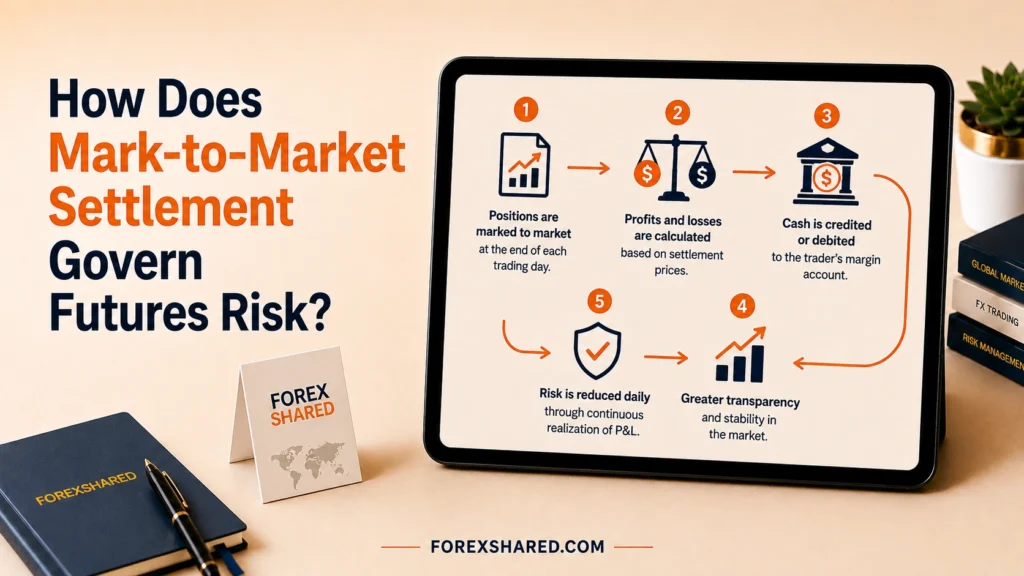
How Does Mark-to-Market Settlement Govern Futures Risk?
Mark-to-market settlement governs futures risk by repeatedly revaluing open positions against an official settlement price and converting resulting gains and losses into financial transfers rather than allowing them to remain unresolved until expiration.
The mechanism is a recurring financial reset rather than a forecast or a contract closure. Each settlement cycle converts current price movement into a measurable gain or loss, updates financial capacity, and reduces the amount of current exposure left unresolved into the next cycle.
The broader exchange context is covered in Forex futures risk structure.
This article explains futures settlement and risk mechanics for educational purposes and does not provide individualized financial or trading advice. Settlement methodologies, margin requirements and account procedures should be verified for the specific contract and account because they can change.
What Does Mark-to-Market Settlement Mean in Futures?
Mark-to-market settlement in futures is the recurring process by which an open position is revalued against an official settlement price and the resulting gain or loss becomes a financial obligation.
The position can remain open while its value change is financially recognized. CME describes daily mark-to-market as a defining feature of futures and states that the final daily settlement price is used to determine daily profit or loss for open positions. CME
What does mark-to-market do to an open futures position?
Mark-to-market periodically revalues an open futures position using the applicable official settlement price.
The position itself remains open, only its financial value is updated. The position can remain open while its gains and losses are financially recognized. CME
Does mark-to-market close and reopen the futures contract every day?
No, mark-to-market does not close and reopen the futures contract; the position can remain open while its gains and losses are financially recognized through settlement.
The distinction is between the contract's open status from the settlement of its current value change. The position continues to exist and carry exposure after settlement.
What financial result is produced?
The change between the relevant settlement values determines the period profit or loss associated with the open futures position.
The comparison is between the relevant settlement values, not arbitrary intraday prices. The official settlement price is the rule-based valuation anchor. CME
Why is this a risk-governance mechanism rather than merely a valuation convention?
Mark-to-market is a risk-governance mechanism because the valuation is connected to actual financial obligations, not merely a bookkeeping update.
Settlement variation transfers money from losing to gaining clearing members, which means value changes are financially settled rather than deferred. The financial-transfer connection is what makes it a risk-governance mechanism.
| Stage | Mechanism | Risk Consequence |
|---|---|---|
| 1 | Market price moves | Open position value changes |
| 2 | Official settlement price established | A common rule-based valuation point is created |
| 3 | Open position revalued | Period value change becomes measurable |
| 4 | Period gain or loss calculated | The market move is converted into a monetary result |
| 5 | Settlement variation exchanged | Current gains and losses become financial transfers |
| 6 | Account equity updated | Financial resources supporting the position change |
| 7 | Margin capacity tested | Funding sufficiency is reassessed |
| 8 | Position maintained, funded, reduced, or liquidated | Exposure continuation depends on financial capacity |
| 9 | Residual risk rebased for next cycle | Unresolved current exposure is reduced before the next settlement cycle |
How Does the Official Settlement Price Anchor Futures Risk Measurement?
The official settlement price anchors futures risk measurement by providing the common, rule-based valuation reference used for daily P&L, settlement variation, and margin assessment.
The settlement price is the rule-based reference used for recurring valuation, not simply an arbitrary intraday print. CME notes that settlement methodologies can differ by contract and are disclosed through product specifications, settlement procedures and exchange rules. CME CME
Why does the exchange establish an official settlement price?
The exchange establishes an official settlement price to provide the reference used for daily futures valuation and related P&L calculations.
The same settlement price applies consistently to market participants. It establishes the official value for the settlement process at a point in time. CME
Is the daily settlement price necessarily the final trade of the session?
No, the daily settlement price is not necessarily the final trade of the session; settlement methodologies can differ by contract and can use defined calculation windows or other rule-based methodologies.
Settlement methodologies are contract-specific and disclosed through specifications and exchange rules. Methodologies differ by contract and are defined in product specifications. CME
Why does using a common settlement price matter for risk?
A common settlement price matters for risk because it gives the clearing process a single valuation basis for daily P&L, settlement variation, account reconciliation, and margin assessment.
The four functions are daily P&L, settlement variation, account reconciliation, margin assessment. Margin appears here only as a consequence of the common valuation basis.
Does a common settlement price remove disagreement about future market value?
No, a common settlement price establishes the official value used for the settlement process at that point in time; it does not predict subsequent prices.
The settlement price resolves the current official value, not the future price path. It is a point-in-time official valuation, not a forecast.
How Does Mark-to-Market Convert Market Risk Into Settlement Variation?
Mark-to-market converts market risk into settlement variation by measuring the change in settlement value, calculating the resulting gain or loss, and transferring that amount between losing and gaining clearing positions.
The conversion path moves from a settlement-price change to a monetary gain or loss and then into settlement variation. CME Clearing defines settlement variation as portfolio profits or losses between settlement cycles and uses it to exchange current gains and losses through the clearing structure. CME
The account-level result of this mechanism is developed in Daily gains and losses in futures accounts.
How does a price change become a monetary gain or loss?
A price change becomes a monetary gain or loss through the relationship: change in settlement price × contract value sensitivity × number of contracts = period futures gain or loss.
Explain each component: the settlement-price change, the contract's value sensitivity, and the number of contracts. Contract-value mechanics must remain subordinate to the mark-to-market mechanism.
What is settlement variation?
Settlement variation is the profit or loss on a portfolio between settlement cycles.
It represents the financial result of the position's value change between two settlement points. Settlement variation transfers period gains and losses while initial margin is a separate safeguard against potential future exposure. CME
What happens to losing and gaining clearing positions?
CME Clearing requires payments from clearing members whose positions have lost value and makes corresponding payments to members whose positions have gained value.
This transfer occurs through the clearing structure. The transfer occurs through the clearing-member structure.
Why does this matter for risk governance?
Recurring settlement matters for risk governance because without it, current losses could remain as growing unpaid obligations; recurring settlement reduces the amount of unresolved current exposure carried forward.
Settled losses become current obligations rather than growing deferred amounts. It prevents losses from remaining unrecognized obligations, not from occurring.
| Stage | What Happens |
|---|---|
| Previous settlement value | Starting valuation point for the next period |
| Market moves | Futures value changes during the settlement cycle |
| New official settlement price | Exchange establishes the next rule-based valuation reference |
| Position revalued | Open position is marked to the new settlement value |
| Gain or loss calculated | Settlement-price change becomes a monetary result |
| Settlement variation exchanged | Current gain or loss becomes a clearing payment or receipt |
| Financial exposure rebased | The next settlement cycle begins from the updated financial state |
How Does Mark-to-Market Change Account Equity and Margin Capacity?
Mark-to-market changes account equity and margin capacity by converting settlement gains and losses into changes in the financial resources supporting the position.
Once period gains and losses enter the settlement process, they change the financial resources supporting the position. A loss can move equity toward the applicable margin threshold, but CFTC guidance confirms that a margin call depends on the maintenance threshold being reached or breached rather than on the mere existence of a daily loss. CFTC
The supporting threshold framework is covered in Futures margin requirements.
How does a mark-to-market loss affect financial capacity?
A mark-to-market loss reduces the financial resources supporting the position and can move account equity toward applicable margin thresholds.
The loss moves equity toward margin thresholds. A call depends on whether the applicable threshold is breached. CME
When can additional resources become necessary?
Additional resources can become necessary when losses reduce net equity below required margin levels, which can lead to additional funding requirements or liquidation risk.
The relationship between net equity, required margin levels, and the resulting funding or liquidation consequence. The consequence depends on the account circumstances and applicable rules. CME
Does every mark-to-market loss trigger a margin call?
No, a loss changes account equity, but a margin call depends on whether the applicable margin requirement or account threshold is breached.
The margin call depends on the relationship between equity and the applicable threshold, not on the loss itself. The call depends on whether the threshold is breached.
How does a mark-to-market gain affect capacity?
A mark-to-market gain increases the financial value credited through the settlement process and therefore changes the resources associated with the position.
The gain is credited through the settlement process. Subsequent settlement cycles can reverse the gain.
Why does this make risk governance dynamic?
Risk governance becomes dynamic because risk capacity is repeatedly tested against the actual financial consequences of market movement rather than relying solely on the resources posted when the position was opened.
The test uses actual settlement outcomes, not just opening resources. Recurring settlement continuously updates the financial picture.
Why Does Mark-to-Market Create Liquidity Risk While Reducing Credit Exposure?
Mark-to-market creates liquidity risk while reducing credit exposure because losses that might otherwise remain unrealized become current financial obligations, requiring participants to have funds available when settlement demands them.
Recurring settlement creates a structural trade-off. It reduces the amount of unresolved current exposure carried forward, while also requiring losing positions to fund financial obligations sooner. The mechanism therefore changes funding timing without removing the underlying market exposure. CME
The short-horizon liquidity consequence is examined in Daily settlement and short-term risk pressure.
Why does recurring settlement reduce accumulated credit exposure?
Recurring settlement reduces accumulated credit exposure because settlement variation prevents losses from accumulating in the system.
Settled losses become current obligations rather than growing deferred amounts. It reduces accumulation of current exposure, not all default risk. CME
Why can the same mechanism create liquidity pressure?
The same mechanism creates liquidity pressure because losses that might otherwise remain unrealized until a later date instead become current financial obligations, requiring the participant to have funds available when the settlement process requires them.
The participant needs liquidity at the settlement point. The underlying price exposure already existed; settlement changes when the financial consequence must be funded.
Why can this matter to a hedger whose overall economic hedge still works?
A futures loss can require cash through mark-to-market before the offsetting economic benefit from the underlying commercial exposure is received, so the hedger faces a cash-flow timing issue even when the hedge remains economically sound.
The timing gap between the futures settlement obligation and the commercial benefit. The hedger example serves only to illustrate cash-flow timing.
What risk trade-off does this create?
The trade-off is less accumulated unpaid credit exposure but potentially more immediate liquidity demand.
The same mechanism produces both effects. Both effects are inherent to the mechanism.
Does liquidity pressure mean mark-to-market increased the underlying market risk?
No, the underlying price exposure already exists; mark-to-market changes when the financial consequence must be recognized and funded, not whether the exposure exists.
Settlement changes the timing of financial recognition, not the existence of price exposure. The price exposure already exists independent of the settlement mechanism.
How Does Mark-to-Market Limit Risk Inside the Clearing System?
Mark-to-market limits risk inside the clearing system by preventing unpaid losses from accumulating between settlement cycles, which reduces the size of the obligation that could remain if a clearing member defaults.
CME Clearing states that all products it clears are settled at least once daily and that payments are required from clearing members whose positions lost value while payments are made to members whose positions gained value. That recurring reset limits the accumulation of current unpaid exposure without making the clearing structure risk-free. CME
Why is accumulation of unpaid losses dangerous to a clearing system?
Accumulation of unpaid losses is dangerous to a clearing system because if losing positions could defer obligations for long periods, the unpaid amount associated with a later default could become larger.
Deferred losses grow into larger potential default obligations. The article covers the settlement mechanism, not full default management.
How does settlement variation reduce that accumulation?
Settlement variation reduces loss accumulation because it represents gains and losses between settlement cycles and is exchanged between losing and gaining clearing members, preventing those amounts from building up unresolved.
The transfer prevents amounts from remaining unresolved. It reduces accumulation of current exposure, not all possible risks. CME
How frequently are cleared positions settled?
CME states that all products it clears are settled at least once daily, with settlement variation exchanged between losing and gaining clearing members.
The exchange of settlement variation occurs at each settlement point. Settlement frequency can vary by market, product, and clearing arrangement.
Does recurring settlement eliminate clearinghouse default exposure?
No, recurring settlement does not eliminate clearinghouse default exposure; risks can still arise from price movement between settlement cycles, extreme market gaps, clearing-member default, liquidity failure, and operational disruption.
Remaining risk sources include price movement between settlement cycles, extreme market gaps, clearing-member default, liquidity failure, operational disruption. Multiple risk sources remain between and beyond settlement cycles.
How Can Mark-to-Market Force Earlier Futures Risk Adjustment?
Mark-to-market can force earlier futures risk adjustment because losses affect financial capacity before contract expiration, requiring the participant to continue satisfying applicable account and margin requirements while the position remains open.
Because settlement consequences arrive before expiration, a participant may have to add resources, reduce contracts or close exposure before the original horizon is complete. The constraint is financial capacity and applicable account requirements, not necessarily a conclusion that the original market or hedge thesis was wrong. CME
Why can a participant be unable to wait for the original position horizon?
A participant can be unable to wait for the original position horizon because mark-to-market losses affect financial capacity before contract expiration, and the participant must continue satisfying applicable account and margin requirements while the position remains open.
Ongoing account and margin requirements must be satisfied throughout the position's life. Recurring settlement creates obligations throughout the position's life.
What adjustment choices can follow?
Depending on the account circumstances, the participant may need to add financial resources, reduce contract quantity, or close the position.
The choice depends on account circumstances. The appropriate response depends on the participant's circumstances. CME
Why is this a governance mechanism?
This is a governance mechanism because the settlement process connects market loss directly to financial capacity and then to the ability to continue carrying exposure.
The settlement process enforces this connection. The settlement process connects market outcomes to financial capacity requirements.
Does forced adjustment prove that the original market or hedge thesis was wrong?
No, forced adjustment may instead show that the participant's available liquidity was insufficient to carry the exposure through the required settlement path.
The adjustment may reflect a funding constraint, not an incorrect market view. It may only demonstrate a liquidity limitation.
How Should Daily Mark-to-Market Be Separated From Final Futures Settlement?
Daily mark-to-market and final futures settlement are separate layers: daily settlement supports recurring valuation and margin management while the contract remains open, and final settlement establishes the contract's final value or delivery outcome at expiration.
CME separates the recurring daily settlement layer from the final settlement layer. Daily settlement supports ongoing valuation and risk management while a contract remains open; final settlement applies when the expiring contract is marked to its final value and then settled according to its product terms. CME CME
What does daily settlement accomplish?
Daily settlement establishes recurring valuation and supports daily P&L and margin management while the contract remains open.
It operates while the contract remains open. It supports recurring risk management during the contract's life. CME
What does final settlement accomplish?
Final settlement establishes the contract's final value or applicable delivery outcome at expiration according to the product specification.
It resolves the contract at its lifecycle endpoint. The section covers the settlement boundary, not delivery mechanics. CME CME
Why does this distinction matter for risk interpretation?
The distinction matters because a participant can make or lose money through many mark-to-market cycles without the futures contract having reached final settlement.
The contract remains open through those cycles. Recurring settlement creates financial consequences throughout the contract's life.
Does recurring settlement remove the need to understand expiration terms?
No, recurring settlement does not remove the need to understand expiration terms because daily risk settlement and final contract settlement solve different lifecycle tasks.
The two layers serve different lifecycle functions. Final settlement resolves the contract at its endpoint.
| Comparison Point | Daily Settlement | Final Settlement |
|---|---|---|
| Timing | Recurring during the contract’s life | At the contract’s expiration endpoint |
| Function | Supports recurring valuation, P&L and risk management | Establishes the contract’s final value or delivery outcome |
| Valuation reference | Official daily settlement price under the applicable methodology | Final settlement price under the product’s expiration rules |
| Effect on position | Position can remain open after the daily cycle | Contract is resolved according to final settlement terms |
| Risk-management role | Rebases current financial exposure and margin capacity | Completes the contract lifecycle |
| Relationship to expiration | Operates before expiration while the contract remains open | Occurs at expiration or the prescribed final settlement point |
How Should a Participant Evaluate Mark-to-Market Risk Before Holding Futures?
A participant should evaluate mark-to-market risk before holding futures by verifying the settlement-price methodology, measuring the monetary P&L sensitivity, determining the effect on margin resources, and confirming that sufficient liquidity exists outside the position.
The practical evaluation starts with the contract’s settlement methodology and monetary sensitivity, then moves through contract quantity, account-equity effects, margin capacity, external liquidity and reduction flexibility. The purpose is to test whether the complete recurring cash-flow path is financially supportable.
What settlement-price methodology applies to the contract?
The participant should verify the official settlement source, the calculation methodology, and the settlement timing for the specific contract.
Methodologies differ among products. Settlement methodologies are product-specific.
How much monetary P&L can ordinary price movement create?
The participant should evaluate the contract's value sensitivity, the number of contracts, and the typical adverse movement to estimate the monetary P&L that ordinary price movement can create.
The components combine to determine monetary exposure per settlement cycle. The evaluation serves funding-capacity assessment, not trade optimization.
How does that P&L affect available margin resources?
The participant should determine whether an adverse settlement move leaves sufficient account equity to continue carrying the intended position.
The comparison determines whether the position can continue. Liquidity outside the position also matters.
How much liquidity remains outside the position?
The participant should separate resources already supporting the position from resources available for future settlement losses or margin calls.
External liquidity is the buffer for future settlement demands. External liquidity determines the ability to meet future settlement obligations.
Can the position be reduced if liquidity becomes insufficient?
The participant should know whether risk can be scaled down before margin constraints remove that flexibility.
Proactive reduction preserves flexibility that forced liquidation removes. Market conditions or account constraints can limit flexibility.
What is the correct mark-to-market risk sequence?
The correct mark-to-market risk sequence is: identify the settlement methodology, determine monetary sensitivity, measure contract quantity, estimate settlement-cycle losses, determine the equity effect, compare with margin requirements, identify available liquidity, identify reduction options, keep daily and final settlement separate, and determine whether the complete cash-flow path is supportable.
The sequence moves from contract specifics to funding capacity. It evaluates settlement-driven funding capacity, not trade selection.
How Can Futures Participants Avoid Mark-to-Market Risk Misunderstandings?
Futures participants can avoid mark-to-market risk misunderstandings by recognizing that settlement recognizes value changes financially, does not eliminate market risk, and operates separately from margin collateral and final contract settlement.
The main errors come from collapsing distinct mechanisms into one concept. Mark-to-market recognizes current value changes, settlement variation transfers period gains and losses, initial margin protects against potential future exposure, margin calls depend on thresholds, and final settlement resolves the contract at its lifecycle endpoint. CME CME
Why is "mark-to-market eliminates market risk" incorrect?
The claim is incorrect because mark-to-market settles value changes; it does not stop future prices from moving.
Settlement recognizes value changes but does not control future prices. It only recognizes value changes financially.
Why is "a loss is not real until expiration" incorrect for futures risk management?
The claim is incorrect because open futures positions are repeatedly marked to an official settlement price, with resulting gains and losses entering the settlement and account process.
Recurring settlement creates financial consequences throughout the contract's life. Recurring settlement creates obligations throughout the position's life.
Why is "settlement variation is initial margin" incorrect?
The claim is incorrect because settlement variation represents gains or losses between settlement cycles, while initial margin is a separate resource held against potential exposure following default.
The different functions: settlement variation transfers period gains and losses, initial margin safeguards against potential future exposure. They serve different financial functions in the clearing structure. CME CME
Why is "every daily loss creates a margin call" incorrect?
The claim is incorrect because a daily loss changes account equity, while a margin call depends on whether the applicable margin threshold is breached.
The call depends on the equity-threshold relationship. The call depends on whether the threshold is breached.
Why is "the settlement price is always the closing trade" incorrect?
The claim is incorrect because contract-specific settlement methodologies can use defined formulas and calculation windows rather than simply the last trade.
Methodologies are contract-specific and rule-based. Methodologies differ by contract. CME
Why is "daily settlement is the same as final settlement" incorrect?
The claim is incorrect because CME distinguishes recurring daily settlement from the final value determined at expiration.
The different lifecycle functions. They solve different lifecycle tasks. CME CME
What should be verified before relying on mark-to-market as a futures risk-control framework?
Before relying on mark-to-market as a futures risk-control framework, the participant should verify the settlement-price methodology, monetary sensitivity, settlement-variation distinction, equity effects, margin requirements, available liquidity, reduction options, and the daily-vs-final settlement boundary.
Each item verifies a component of the risk-governance framework. It verifies understanding and capacity, not market outcomes.
- Official settlement-price methodology is identified.
- Monetary P&L sensitivity per contract is understood.
- Intended contract quantity is included.
- Settlement variation is distinguished from initial margin.
- The recurring-loss effect on account equity is understood.
- Applicable maintenance and margin requirements are known.
- Liquidity is available for adverse settlement cycles.
- Position reduction is considered before forced liquidation.
- Daily settlement is distinguished from final settlement.
- The complete settlement-cycle cash-flow path fits financial capacity.
Conclusion Direction
Mark-to-market settlement governs futures risk by converting changes in market value into recurring financial obligations instead of allowing gains and losses to remain unresolved until expiration.
The complete governance chain is official settlement price, recurring revaluation, settlement variation, account-equity change, margin consequence, liquidity constraint and reduced accumulated current exposure. CME Clearing describes settlement variation as profits or losses between settlement cycles and explains that it prevents loss accumulation in the system. CME
That recurring reset limits the amount of current exposure left unresolved, but it does not eliminate future market movement, guarantee liquidity, make every loss a margin call, or replace final settlement. The contract can remain open through many daily cycles before reaching its final settlement endpoint. CME
FAQs
What does mark-to-market mean in futures?
Mark-to-market in futures means open futures positions are repeatedly valued against an official settlement price, with the resulting value change feeding into daily P&L.
CME states that daily settlement prices are used to mark positions to market and determine daily profits or losses. The position can remain open while its financial value is updated through the settlement process. CME
How does mark-to-market reduce clearing risk?
Mark-to-market reduces clearing risk because recurring settlement variation prevents current losses from accumulating unresolved inside the clearing system.
Recurring settlement variation reduces the amount of current unpaid exposure that accumulates inside the clearing system. CME Clearing states that all products it clears are settled at least once daily and that settlement variation transfers current gains and losses between clearing members. CME
Does every mark-to-market loss cause a margin call?
No, losses reduce account equity, while a margin call depends on whether the applicable margin threshold is breached.
No. A loss reduces account equity, while the call depends on whether the applicable maintenance or account threshold is reached or breached. CFTC
Is settlement variation the same as initial margin?
No, settlement variation transfers period gains and losses, while initial margin is a separate financial safeguard against potential future exposure.
No. CME defines settlement variation as portfolio profits or losses between settlement cycles and separately describes initial margin as a safeguard against potential future exposure following default. CME
What is the difference between daily settlement and final futures settlement?
Daily settlement supports recurring valuation and risk management during the contract's life, while final settlement resolves the contract at expiration.
Daily settlement supports recurring valuation and risk management while the contract remains open. Final settlement applies at expiration and establishes the final value or applicable delivery outcome under the product’s terms. CME CME