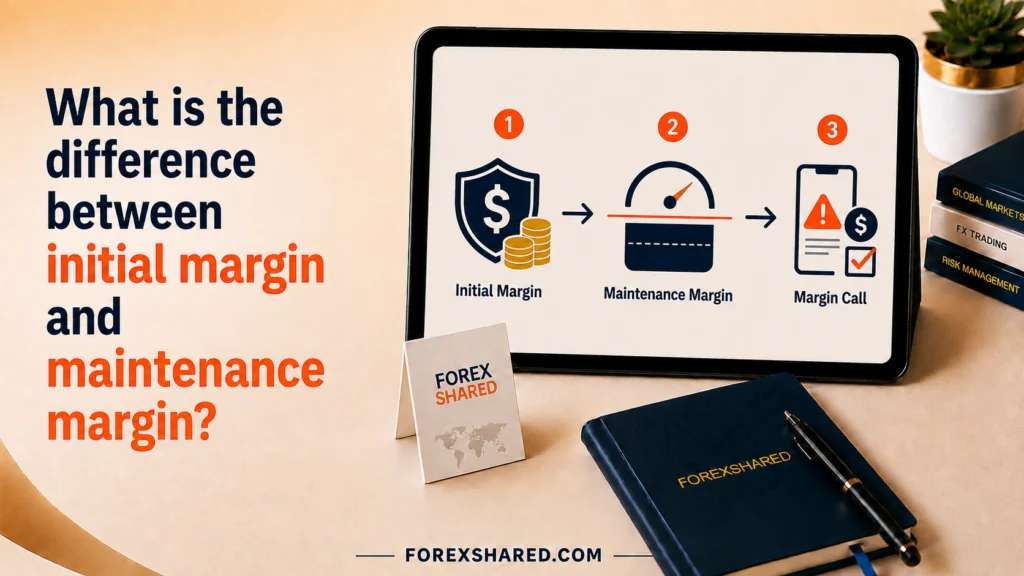
What Is the Difference Between Initial Margin and Maintenance Margin?
Initial margin is the amount required to establish a futures position, while maintenance margin is the minimum account-equity level that must be maintained after the position is open.
The two thresholds work together across the position lifecycle. Initial margin establishes the position, maintenance margin monitors continuing equity, and mark-to-market determines whether account equity remains above the maintenance trigger or requires additional action.
This article compares the two levels by function, timing and consequence. The broader parent framework is covered in Futures margin requirements.
This content explains futures margin mechanics for educational purposes and does not provide individualized financial or trading advice. Current product, exchange, clearing and customer-level requirements should be verified before acting because margin levels and broker procedures can change.
What Do Initial Margin and Maintenance Margin Have in Common?
Initial margin and maintenance margin are both performance requirements that support obligations associated with open futures positions.
Both thresholds belong to the same performance-bond framework. CFTC guidance states that futures margin is money or collateral supporting the position rather than partial payment for an asset, while CME describes performance bonds as deposits supporting clearing obligations. CFTC CME
What does futures margin represent?
Futures margin is money or collateral deposited through the futures account and clearing structure to support obligations associated with open futures positions.
CFTC describes futures margin as money or collateral deposited through the brokerage and clearing chain and says it is not partial payment on a purchase. The performance-bond label therefore describes resources supporting open-position obligations, not ownership of part of the underlying asset. CFTC
Why are both initial and maintenance margin performance requirements?
Both initial and maintenance margin help ensure that sufficient financial resources remain associated with futures positions.
They share a risk-support purpose but operate at different stages. CME describes performance bonds as deposits that help clearing members meet obligations, with requirements varying by product and market volatility. Initial margin applies to establishment; maintenance margin applies to continuing account equity. CME
Why should margin be separated from notional contract value?
Margin determines the resources required to support the position, not the entire economic value or exposure of the futures contract.
The contract’s notional exposure describes the larger economic market exposure represented by the futures position. Margin is the supporting deposit required to carry that exposure. CME and CFTC both caution against treating futures margin as a stock-style down payment. CFTC CME
What Is Initial Margin?
Initial margin is the amount required to establish a futures position.
Initial margin answers the entry question: what resources must be posted to establish the position under the applicable account arrangement? CME defines it as the requirement associated with initiating a futures position, while CFTC guidance notes that customer requirements can be higher than exchange levels. CME CFTC
When does initial margin apply?
Initial margin applies when a market participant initiates a futures position.
CME states that initial margin is the amount required when a participant initiates a futures position. The exact operational timing and amount depend on the applicable clearing and customer account arrangements, so the current customer-level requirement should be verified before entry. CME
What practical function does initial margin serve?
Initial margin establishes the opening funding threshold for the futures position.
Its practical function is to establish whether the account has enough eligible resources to open the intended position. It should be read as an entry threshold inside the futures margin framework, not as the purchase price of the underlying exposure.
Does initial margin remain the minimum threshold throughout the position's life?
Initial margin does not remain the minimum threshold in the same role after the position is established.
After entry, maintenance margin becomes the key continuing-equity threshold. The initial level still matters because it can serve as the standard restoration target following a maintenance breach, but it does not perform the same day-to-day trigger role as maintenance margin. CME
Can the broker require more than the published exchange or clearing margin?
Yes, futures commission merchants may require customers to post margin at higher levels than those specified by the exchange.
CFTC guidance explicitly states that futures commission merchants may require customers to post margin at levels above those specified by the exchange. A published clearing or exchange figure should therefore be treated as a reference point rather than assumed to be the customer’s final requirement. CFTC
What Is Maintenance Margin?
Maintenance margin is the minimum account-equity level that must be maintained after the futures position is open.
Maintenance margin answers a different question after entry: has account equity fallen far enough that additional action is required? CME defines maintenance margin as the minimum amount that must be maintained in the account while the futures position remains open. CME
When does maintenance margin apply?
Maintenance margin applies after the initial performance bond has been deposited and the futures position remains open.
Maintenance margin becomes relevant after the position has been established and the account is being carried over time. CME describes it as the minimum amount that must be maintained in the account, making it the post-entry continuing-equity threshold. CME
What does the maintenance threshold monitor?
The maintenance threshold monitors whether account equity has fallen far enough that additional financial action is required.
It monitors whether account equity has reached the level at which additional action becomes necessary. The threshold is therefore a trigger level, not the amount that must initially be deposited and not necessarily the level to which a deficient account is restored.
Is maintenance margin another separate payment made at entry?
No, maintenance margin is an ongoing equity threshold rather than a second independent opening deposit.
No second independent maintenance deposit is required merely because the position is opened. Initial margin is the opening requirement; maintenance margin is the lower or equal continuing-equity threshold used after entry to test whether the account remains adequately funded.
Why is maintenance margin commonly below the initial requirement?
Maintenance margin is commonly below the initial requirement because the two levels perform different functions.
The levels often differ because they perform different functions: initial margin establishes the position while maintenance margin provides a continuing trigger. The relationship is not universal, however; current CME structures can include cases where initial and maintenance levels are equal, so the applicable figures must be checked. CME
| Comparison Point | Initial Margin | Maintenance Margin |
|---|---|---|
| When it applies | At position initiation | After the position is open |
| What it does | Sets the opening funding threshold | Sets the continuing equity trigger |
| What happens if breached | Entry cannot proceed under that requirement | Additional funds or another applicable account action can follow |
| Restoration target | Acts as the standard restoration reference | Acts as the trigger, not the restoration target |
How Do Initial Margin and Maintenance Margin Work Together?
Initial margin and maintenance margin work together as two stages of the same margin framework.
The two thresholds form a lifecycle. Initial margin establishes the position, mark-to-market changes account equity after entry, maintenance margin acts as the trigger level, and a maintenance breach can require restoration toward the initial level or another account action under the applicable procedures. CFTC CME
What happens after the initial margin requirement is satisfied?
After the initial margin requirement is satisfied, the futures position remains open while account equity changes as gains and losses are reflected in the account.
The position can remain open while account equity changes with market gains and losses. CFTC defines mark-to-market as the daily process in which those gains and losses are calculated and added to or subtracted from account balances. CFTC
What happens as account equity falls toward maintenance margin?
No special conclusion should be drawn merely because equity has fallen below the original initial level; the critical trigger is the applicable maintenance threshold.
A decline below the original initial level does not by itself establish the standard maintenance breach. The critical comparison is with the applicable maintenance threshold. This prevents the entry level from being confused with the continuing trigger level.
What happens if account equity falls below maintenance margin?
If margin equity falls below maintenance margin, a call is issued to bring the account back to initial margin.
CME’s margin materials state that a maintenance breach can lead to a margin call requiring funds to bring the account back to the initial level. Depending on the account arrangement, position reduction or liquidation can also become possible. CME
The downstream account consequence is covered in Margin calls in futures.
Why is the restoration target important?
The restoration target matters because maintenance margin is the trigger level while initial margin is the restoration level.
The restoration target prevents two different functions from collapsing into one. Maintenance tells the account when intervention is required; initial margin is the standard level toward which a deficient account is restored under the basic framework. CME
| Stage | Account State | Threshold Meaning |
|---|---|---|
| 1 | Initial margin requirement met | Position can be established |
| 2 | Position open and marked to market | Equity changes with gains and losses |
| 3A | Equity remains above maintenance | Position continues subject to account rules |
| 3B | Equity falls below maintenance | Margin call or other applicable account action can follow |
| 4 | Account restored toward initial margin or position adjusted | Maintenance is the trigger; initial is the restoration reference |
How Does Mark-to-Market Move an Account Between the Two Margin Thresholds?
Mark-to-market moves account equity between the two margin thresholds by adding gains to or subtracting losses from account balances as futures prices change.
CFTC defines mark-to-market as the daily account process that calculates gains and losses from price changes and adds or subtracts those amounts from account balances. That equity movement is what can carry a fully funded account from above maintenance to a maintenance breach. CFTC
The account revaluation mechanism is explained in Daily mark-to-market settlement.
How do futures gains and losses affect margin equity?
Gains and losses from changes in futures prices are added to or subtracted from account balances through mark-to-market.
CFTC explains that mark-to-market calculates the gain or loss from price changes at the end of the trading session and adds or subtracts the result from the account balance. Gains can lift equity; losses can move equity toward the maintenance threshold. CFTC
Why can a position begin fully margined but later breach maintenance margin?
A position can begin fully margined but later breach maintenance margin because adverse price movement can reduce account equity after the opening requirement has already been satisfied.
Satisfying initial margin only establishes the starting condition. Once the position is open, adverse price movement can reduce equity through mark-to-market, so an account that was fully funded at entry can later fall below maintenance without any contradiction.
Does a decline below initial margin automatically trigger a margin call?
A decline below the original initial-margin level does not automatically trigger a margin call; the standard trigger is the maintenance-margin threshold.
Under the standard framework described by CME and CFTC, the key trigger is the maintenance level rather than any movement below the original initial amount. This is why an account can be below initial margin yet remain above maintenance without a maintenance-based call. CME CFTC
What can happen after maintenance margin is breached?
After maintenance margin is breached, the participant may need to add funds, reduce the position, or face liquidation if the requirement is not satisfied.
CME identifies several possible outcomes: additional funds may be requested, the position may be reduced, or liquidation may occur under the applicable account rules. The specific outcome is not universal, so broker procedures and timing should be verified. CME
What Example Shows the Difference Between Initial and Maintenance Margin?
A simple example shows the difference: with an $8,000 initial margin and a $6,500 maintenance margin, the two thresholds perform different jobs.
The figures in this section are illustrative educational numbers, not current requirements for a specific FX futures contract. CME’s margin lesson uses the same $8,000 initial and $6,500 maintenance example to test the restoration relationship. CME
What happens when the position is opened?
When the position is opened, the participant begins by satisfying the $8,000 initial requirement.
In the supplied illustration, $8,000 is the opening threshold. The number is not a contract price or loss cap; it is simply the example initial requirement used to demonstrate the lifecycle relationship between the two margin levels. CME
What if account equity falls to $7,200?
If account equity falls to $7,200, the account is below the original initial level but remains above the $6,500 maintenance threshold.
At $7,200, equity is below the illustrative $8,000 initial level but still above the $6,500 maintenance threshold. That intermediate state shows why falling below initial margin alone is not the standard maintenance trigger.
What if account equity falls below $6,500?
If account equity falls below $6,500, the maintenance threshold has been breached and additional funds may be required to bring the account back toward the $8,000 initial level.
Once equity moves below the illustrative $6,500 maintenance threshold, the maintenance condition has been breached. In the standard example, additional funds can be required to restore the account toward the $8,000 initial level. CME
What does the example prove?
The example proves that the two levels have different jobs: $8,000 is the entry and restoration level while $6,500 is the continuing-equity trigger level.
It proves a functional difference rather than merely a numerical one. The $8,000 level establishes the position and serves as the standard restoration reference; the $6,500 level is the continuing trigger. Current real-world figures must still be verified for the specific contract and account.
Why Can Initial and Maintenance Margin Requirements Change?
Initial and maintenance margin requirements can change because margins are adjusted as market volatility and risk conditions change.
The functional difference between the two thresholds is stable, but their current numerical levels are not. CME states that margin levels respond to volatility and broader risk conditions and are part of a neutral risk-management process rather than a tool for encouraging or discouraging participation. CME
Can clearing margin requirements change after a position is opened?
Yes, clearing margin requirements can change after a position is opened because margins are adjusted as market volatility and risk conditions change.
Yes. CME states that margins are adjusted as volatility and other risk conditions change. A participant should therefore separate the stable functional distinction between initial and maintenance margin from the fast-changing numerical values attached to a specific product. CME
How can increased volatility affect both thresholds?
Increased volatility can raise both thresholds because CME typically raises margins when daily price movements become more volatile and can lower them when volatility decreases.
CME explains that margins generally rise in more volatile environments and can decline when volatility falls. The relationship reflects risk coverage rather than market direction, so a margin increase should not be interpreted as a bullish or bearish signal. CME
Why does this matter when comparing initial and maintenance margin?
This matters because the difference between initial and maintenance margin is primarily functional, not a permanently fixed dollar amount.
The primary difference is what each threshold does, not a permanently fixed dollar gap between them. Both levels can change as the risk framework changes, while the entry-versus-continuation distinction remains the core comparison.
Does a margin increase mean the clearinghouse is trying to discourage participation?
No, margins are set as neutral risk-management tools rather than as a mechanism intended to encourage or discourage particular market participants.
No. CME states that margins are part of neutral risk-management services and are not intended to encourage or discourage a category of participant or move the market in a particular direction. CME
How Do Broker Requirements Affect the Initial–Maintenance Margin Difference?
Broker requirements can affect the initial–maintenance margin difference because futures commission merchants may impose customer margin levels above exchange requirements.
Exchange or clearing figures are not automatically the final customer thresholds. CME notes that brokers may collect additional customer funds, and CFTC guidance states that futures commission merchants can require customer margin above exchange-specified levels. CME CFTC
Can a broker impose a higher initial margin?
Yes, a broker can impose a higher initial margin because brokers may be required to collect additional customer funds beyond the CME Clearing amount.
Yes. CME notes that brokers may need to collect additional customer funds beyond the clearing amount, and CFTC guidance confirms that FCMs can require customer margin above exchange levels. CME CFTC
Can customer maintenance requirements also differ from published exchange levels?
Yes, customer maintenance requirements can differ from published exchange levels, so the actual requirements should be verified with the intermediary.
Yes. CFTC’s glossary states broadly that FCMs may require customers to post margin at higher levels than those specified by the exchange. This means both the practical opening and continuing thresholds should be checked at customer-account level. CFTC
What should a participant verify?
A participant should verify customer initial margin, customer maintenance margin, margin-call policy, restoration requirement, liquidation policy, and timing for additional deposits.
The practical checklist includes current customer initial margin, customer maintenance margin, margin-call policy, restoration requirement, liquidation or position-reduction policy, eligible collateral where relevant, and the time allowed for additional deposits. These items can vary by intermediary and account.
Which numbers matter most?
The numbers that matter most are the margin requirements that actually apply to the participant's account and position.
The most useful numbers are the current requirements actually applied to the participant’s contract, position and account. Historical examples and exchange-published figures can explain mechanics, but they should not replace current customer-level verification.
How Can Participants Avoid Confusing Initial Margin With Maintenance Margin?
Participants can avoid confusing initial margin with maintenance margin by understanding that initial margin is the entry threshold while maintenance margin is the continuing-equity trigger.
The safest interpretation is functional: initial margin is the entry and standard restoration level, maintenance margin is the continuing trigger level, and mark-to-market is the mechanism that moves account equity between them. Neither threshold is the contract value or a maximum-loss cap.
Why is "initial margin is the amount I can lose" incorrect?
This is incorrect because initial margin is a performance requirement, not a maximum-loss cap.
Initial margin is a performance requirement, not a maximum-loss cap. The amount deposited does not define the contract’s total economic exposure or guarantee that losses cannot exceed the margin held in the account.
Why is "maintenance margin is what I deposit when opening" incorrect?
This is incorrect because the opening requirement is initial margin, while maintenance margin is the continuing minimum equity threshold.
The opening threshold is initial margin. Maintenance margin becomes relevant after the position is open and functions as the continuing equity trigger, so describing it as a second entry deposit reverses its timing and purpose.
Why is "a margin call only restores the account to maintenance" incorrect?
This is incorrect because CME and CFTC describe the standard margin-call mechanism as restoring account equity to the initial margin level after the maintenance threshold is breached.
CME and CFTC describe the standard maintenance-breach framework as restoring the account toward the initial margin level. Maintenance is the trigger level; initial is the restoration reference. CME CFTC
Why is "the two levels never change" incorrect?
This is incorrect because CME adjusts margin requirements as risk and volatility conditions change.
CME adjusts margin requirements as volatility and risk conditions change. The functional labels remain useful, but the numerical levels can be changed and therefore should not be treated as permanent figures. CME
Why is "exchange margin is always my broker margin" incorrect?
This is incorrect because FCMs can impose customer requirements above exchange levels.
FCMs can impose customer requirements above exchange levels. Practical margin planning must therefore use the requirement that actually applies to the customer account rather than assume an exchange figure is final. CFTC
What should be verified before interpreting a futures margin requirement?
Before interpreting a futures margin requirement, a participant should verify the current applicable levels, the customer-level requirements, and the restoration framework.
Verify the exact contract, current exchange or clearing levels, actual customer initial and maintenance requirements, mark-to-market treatment, margin-call trigger, restoration target, possible position actions and any broker-specific timing. That keeps stable mechanics separate from fast-changing account values.
- Verify the exact futures contract and current applicable margin levels.
- Identify the customer-level initial margin that applies at entry.
- Identify the customer-level maintenance threshold that applies after entry.
- Keep both margin levels separate from notional contract value and maximum possible loss.
- Confirm how mark-to-market changes account equity.
- Verify the maintenance-breach trigger and the restoration target.
- Verify the broker or FCM margin-call and position-reduction procedures.
- Check whether customer requirements exceed exchange or clearing levels.
- Confirm whether margin requirements can change under current risk conditions.
- Use current account-level requirements rather than historical educational examples for an actual position.
Conclusion: Initial margin is the entry and standard restoration reference, while maintenance margin is the continuing-equity trigger. Mark-to-market moves account equity between those states, and current customer-level requirements must be verified because exchange, clearing and broker figures can change.
FAQs
The most common questions about initial and maintenance margin concern their relative levels, breach consequences, payment timing, changeability, and broker discretion.
The answers below preserve the same lifecycle distinction and avoid treating either threshold as a purchase price, a fixed permanent number, or a measure of total market risk.
Is initial margin higher than maintenance margin?
Initial margin is commonly higher than maintenance margin because they perform different functions, but the current applicable figures should be verified for the specific contract and account.
Initial margin is commonly above maintenance margin because the two thresholds perform different functions, but the relationship is not universal. CME currently has structures in which initial and maintenance can be equal, so the specific product and account figures must be verified. CME
What happens when futures equity falls below maintenance margin?
When futures equity falls below maintenance margin, the standard framework can require the account to be restored toward the initial margin level, with position reduction or liquidation possible under applicable broker procedures.
The standard framework can require additional funds to restore the account toward the initial level. Depending on the applicable broker procedures, reducing the position or liquidation can also be possible. CME
Is maintenance margin paid when the futures position is opened?
No, maintenance margin is not paid when the futures position is opened; initial margin applies at position initiation, while maintenance margin is the minimum continuing equity requirement.
No. Initial margin applies when the position is initiated. Maintenance margin is the minimum continuing equity threshold used after entry while the position remains open. CME
Can initial and maintenance margin change?
Yes, initial and maintenance margin can change because margin levels are adjusted as volatility and risk conditions change.
Yes. CME states that margin levels are adjusted with market volatility and risk conditions. Current values should therefore be verified rather than treated as evergreen numbers. CME
Can a broker require more margin than the exchange?
Yes, a broker can require more margin than the exchange because FCMs may impose customer margin levels above exchange requirements.
Yes. CFTC guidance states that FCMs may require customer margin above exchange-specified levels, so the customer account can have stricter thresholds than the published exchange minimums. CFTC