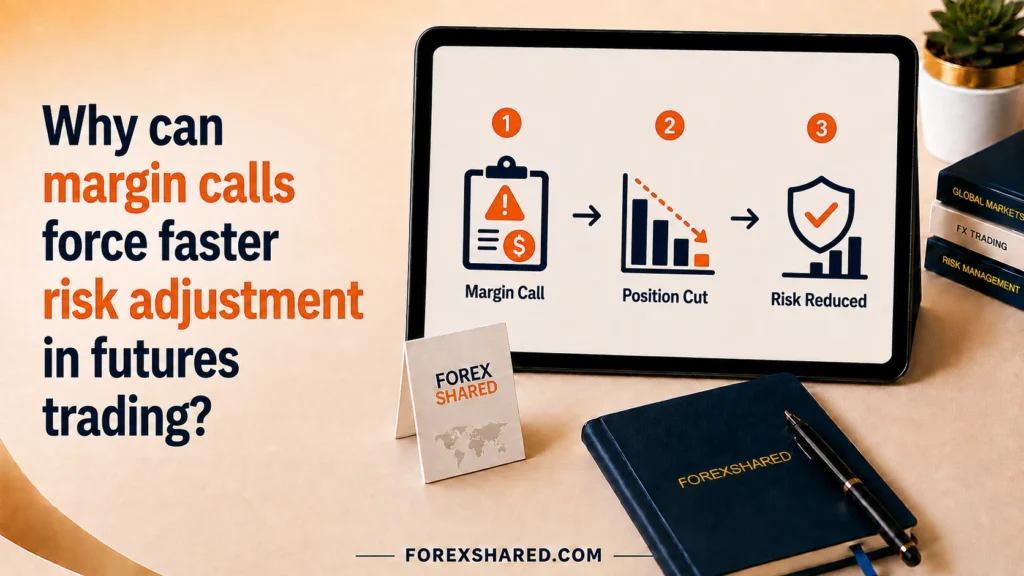
Why Can Margin Calls Force Faster Risk Adjustment in Futures Trading?
Margin calls force faster risk adjustment because futures positions are marked to market and account equity must stay above maintenance requirements, so losses can require funding, exposure reduction, or liquidation before the original horizon.
The critical change occurs when an adverse market move stops being only a market-management problem and becomes an account-compliance problem. From that point, funding capacity, exposure reduction and broker policy can control the response timetable before the participant’s original horizon is complete.
The broader parent context is covered in Futures margin requirements.
This article explains futures margin-call mechanics for educational purposes and does not provide individualized financial or trading advice. Specific customer margin levels, response deadlines, liquidation procedures and broker policies can change and should be verified for the relevant account.
What Turns a Futures Loss Into a Margin Call?
A futures loss becomes a margin call when mark-to-market losses push account equity to or below the applicable maintenance-margin threshold.
The trigger is not simply an adverse price move. The causal path is adverse movement, daily mark-to-market, lower account equity, then a breach of the applicable maintenance threshold. CFTC guidance distinguishes maintenance margin from initial margin and states that a maintenance breach caused by adverse movement leads to a margin call to restore equity to the initial level. CFTC
The threshold roles behind the trigger are explained in Initial versus maintenance margin.
How does mark-to-market change futures account equity?
Mark-to-market changes futures account equity because gains and losses are reflected through the official daily settlement price rather than left unresolved until expiration.
Daily marking converts unrealized market movement into realized account-equity change. Daily marking is a continuing account process while final settlement occurs at contract expiration. CME
Which threshold matters when losses accumulate?
The maintenance-margin threshold matters because it is the minimum account-equity level that must be maintained while the futures position is open.
When equity falls to or below maintenance margin due to adverse price movement, a margin call is issued to restore equity toward the initial level. It is a binding account threshold that creates a funding obligation when breached. CFTC
Does falling below the original initial-margin level automatically create the same trigger?
No, falling below the initial-margin level does not automatically create the same trigger because initial margin and maintenance margin are distinct thresholds.
Initial margin establishes the opening or restoration level while maintenance margin functions as the lower continuing threshold. The margin call is triggered by the maintenance breach, not by falling below the initial level.
Why does crossing the maintenance threshold change the participant's decision?
Crossing the maintenance threshold changes the participant's decision because a market-loss problem becomes an account-compliance problem requiring immediate resolution.
The resulting constraint is Market Decision + Funding Decision. The breach concerns account capacity, not market validity.
| Stage | Account Mechanism | Decision Consequence |
|---|---|---|
| 1 | Position open | Participant follows the original market or hedge horizon |
| 2 | Adverse price movement | Position value moves against the account |
| 3 | Mark-to-market loss | Daily settlement converts the movement into an account-equity change |
| 4 | Account equity declines | Available margin buffer shrinks |
| 5 | Maintenance threshold breached | A market-loss problem becomes a margin-compliance problem |
| 6 | Margin call / deficiency | The account must return to compliance under applicable procedures |
| 7 | Add funds, reduce exposure, or applicable broker liquidation | Capital, exposure, or control over timing changes |
| 8 | Risk adjusted | The position is financially reconfigured before the original horizon may be complete |
Why Does a Margin Call Compress the Time Available for Risk Decisions?
A margin call compresses the time available for risk decisions because the account must return to margin compliance regardless of the participant's preferred holding period.
Once the account breaches its margin requirement, the relevant timetable becomes the account-compliance timetable rather than the participant’s preferred market horizon. CME explains that daily mark-to-market prevents losses from accumulating indefinitely, so adverse value changes are reflected during the life of the position rather than deferred to expiration. CME
Why can the participant no longer simply wait for price recovery?
The participant cannot simply wait for price recovery because a margin requirement is an account condition, not a forecast.
Once the maintenance threshold is breached, the account must return to compliance regardless of whether the participant expects the market to reverse. The point is that waiting is constrained by margin compliance, not that market recovery is impossible.
What does the margin call require the participant to solve immediately?
The margin call requires the participant to determine immediately whether sufficient resources exist to restore account equity, reduce exposure, or satisfy applicable broker requirements.
These are simultaneous considerations, not sequential choices. Position reduction and broker action are also possible outcomes.
Why does this create faster adjustment than an uncollateralized "wait until maturity" approach?
This creates faster adjustment than a "wait until maturity" approach because futures margin mechanics recognize losses during the life of the position rather than deferring them to expiration.
The account cannot defer all adverse value changes until expiration. The trigger is the maintenance breach, not loss recognition itself. CME
The related short-horizon funding mechanism is examined in Daily settlement risk pressure.
Does a margin call mean the investment thesis itself has failed?
No, a margin call means the account's financial capacity has crossed a margin threshold, not that the market thesis has failed.
Market Thesis Failure and Margin-Capacity Failure must remain separate. A valid thesis can still be unfundable under current margin requirements.
How Can Additional Funding Satisfy a Margin Call Without Reducing the Position?
Additional funding can satisfy a margin call by restoring account equity toward the required margin level while allowing the futures exposure to remain open.
Adding eligible funds can restore the financial cushion while leaving contract quantity unchanged. That is a capital-allocation adjustment rather than an exposure reduction, and it remains limited by available liquidity because later losses or higher requirements can create a new deficiency.
What happens when additional funds are supplied?
When additional funds are supplied, account equity is restored toward the required margin level while the futures exposure remains open.
The exposure remains open while the financial cushion changes. Subsequent adverse movement can create new breaches. CFTC CME
Does adding funds reduce the underlying futures exposure?
No, adding funds changes the account's financial cushion, not the number of futures contracts held.
Funding changes the financial cushion while contract count remains unchanged. The contract quantity and market sensitivity remain unchanged.
Why is adding funds still a form of risk adjustment?
Adding funds is still a form of risk adjustment because the participant changes the amount of liquid financial resources committed to support the same market exposure.
The adjustment is Capital Allocation Adjustment rather than Position Exposure Adjustment. It commits additional capital that can be lost to further adverse movement.
What limits the ability to keep meeting calls with additional cash?
Available liquidity limits the ability to keep meeting calls with additional cash because once usable liquidity is exhausted, retaining the entire position may no longer be possible.
Once usable liquidity becomes insufficient, retaining the entire position may no longer be possible under applicable margin requirements. Liquidity is finite and margin requirements can rise.
How Does Position Reduction Restore Margin Compliance Faster?
Position reduction restores margin compliance faster because fewer open contracts require less aggregate margin support.
Reducing open contracts lowers the amount of exposure and margin support that must remain in the account. CME notes that when a call cannot be met, reducing the position according to the funds remaining can be one available response, subject to the applicable broker and account procedures. CME
Why can reducing contracts help resolve a margin deficiency?
Reducing contracts helps resolve a margin deficiency because fewer open contracts generally mean less aggregate futures exposure requiring margin support.
This is a margin-capacity relationship rather than a generic position-sizing lesson. The section's job is the margin-compliance mechanism.
Does position reduction have to mean closing the entire futures position?
Not necessarily: position reduction can mean closing part of the position rather than the entire exposure.
When a margin call cannot be met, the participant may be able to reduce the position according to the funds remaining in the account. Partial reduction can restore compliance while preserving some exposure. CME
What changes when contracts are reduced?
When contracts are reduced, the participant reduces market exposure, future gain/loss sensitivity, and the margin resources required for the remaining position.
Each change follows as a consequence of reduced contract count. The remaining position still carries market and margin exposure.
Why is this adjustment often faster than the participant originally intended?
This adjustment is often faster than originally intended because the number of contracts becomes constrained by available margin resources rather than solely by the participant's original market plan.
This shifts the timing of the adjustment decision. The constraint is financial capacity, not market validity.
| Decision Dimension | Additional Funding | Position Reduction |
|---|---|---|
| What changes | Liquid resources committed to the account | Open contract quantity |
| What remains unchanged | Underlying contract quantity and market sensitivity | The remaining position still carries market exposure |
| Effect on exposure | Exposure is preserved | Exposure and future gain/loss sensitivity decrease |
| Effect on margin compliance | Higher account equity can restore compliance | Lower aggregate margin demand can restore compliance |
| Resource requirement | Requires usable external liquidity | Requires executable reduction of open contracts |
| Primary limitation | Liquidity is finite and new calls can occur | Exposure may be reduced sooner than originally intended |
Why Can Broker Liquidation Make Risk Adjustment Even Faster?
Broker liquidation can make risk adjustment even faster because the intermediary may act on a margin violation under its applicable policies, potentially before the participant would voluntarily change the trade.
The timing can accelerate further when the intermediary acts. CME states that many brokers monitor margin electronically and may liquidate positions when an account violates margin requirements, so the participant’s choice over timing can shrink or disappear under the broker’s applicable policy. CME
What can happen if the margin call is not met?
If the margin call is not met, the participant may need to add funds, reduce the position, or face automatic liquidation.
Liquidation is one possible consequence when the call cannot be met. The outcome depends on applicable broker policies and account circumstances. CFTC
Can broker risk controls operate faster than a participant expects?
Yes, broker risk controls can operate faster than a participant expects because brokers commonly monitor margin electronically and may liquidate positions upon a margin violation.
Electronic monitoring enables rapid detection and action. Liquidation timing depends on each broker's applicable policies. CME
Why does this change the participant's control over timing?
This changes the participant's control over timing because before forced liquidation the participant may choose the response, but after the intermediary acts that discretion can be reduced or removed.
The practical distinction compares pre-action options (add funds, reduce contracts, close position) with the post-action reality. Broker action can remove discretion entirely.
Why must broker margin policy be checked before the position is opened?
Broker margin policy must be checked before the position is opened because the practical adjustment window depends on customer margin requirements, notification procedures, funding deadlines, and liquidation policy.
The relevant factors are customer margin requirements, notification procedures, funding deadlines, liquidation policy. Broker customer requirements can be stricter. CFTC
How Can Higher Margin Requirements Accelerate Adjustment Even Without Another Large Price Loss?
Higher margin requirements can accelerate adjustment even without another large price loss because the same contract quantity can require more supporting resources after the requirement increases.
Margin pressure can rise even if contract quantity is unchanged. CME adjusts margin levels as volatility and other risk conditions change, so the same position can require more supporting resources after a recalibration and leave less available margin capacity. CME CME
Can margin requirements change while a futures position is open?
Yes, margin requirements can change while a futures position is open because they are adjusted as volatility and market-risk conditions change.
Margin requirements are adjusted as volatility and market-risk conditions change. Requirements are recalibrated with changing risk conditions. CME
Why can higher requirements create new pressure on an unchanged position?
Higher requirements create new pressure on an unchanged position because the same contract quantity requires more supporting resources after the margin requirement increases.
The position's resource requirement rises without any change in contract count. Requirement changes can create pressure independently.
What adjustment choices can follow?
The adjustment choices that can follow a margin increase are committing more capital, reducing contracts, or closing part of the position.
These mirror the margin-call response options. Broker policies may compress the response window.
Why does volatility matter twice?
Volatility matters twice because it can simultaneously create larger mark-to-market movements and contribute to higher margin requirements.
Both channels can compress the adjustment window simultaneously. The section concerns margin mechanics, not market prediction. CME
Does a margin increase automatically mean the position itself became economically worse?
No, a margin increase does not automatically mean the position became economically worse because the key change may be the funding requirement, even if the directional or hedging rationale remains unchanged.
The funding requirement can change independently of the position's economic merit. A valid rationale can still face an unfundable requirement.
Why Can Leverage Make the Margin-Call Adjustment Window Feel Short?
Leverage can make the margin-call adjustment window feel short because futures allow significant economic exposure to be supported by a smaller amount of posted margin, so price moves affect equity disproportionately.
Leverage is an amplifier rather than the trigger itself. CFTC warns that futures leverage can magnify the account effect of underlying price movements, which can make equity approach the maintenance threshold more quickly when the market moves adversely. CFTC
Why can a relatively small price move materially affect margin equity?
A relatively small price move can materially affect margin equity because futures allow significant economic exposure to be supported by a smaller amount of posted margin.
The exposure-to-margin ratio amplifies the equity effect of price moves. The trigger remains the maintenance breach. CFTC
How can leverage move an account toward maintenance margin quickly?
Leverage can move an account toward maintenance margin quickly because the economic exposure can generate gains or losses that are large relative to the margin resources initially posted.
Large relative gains or losses accelerate movement toward the maintenance threshold. The outcome depends on price movement and available equity.
Why does this matter for adjustment timing?
This matters for adjustment timing because a participant can move from adequately margined to requiring additional funding over a much shorter price path than someone focused only on the notional margin deposit might expect.
The price path to the breach is shorter than the notional deposit size might suggest. The exposure, not the deposit, determines equity sensitivity.
Does this mean leverage itself automatically causes margin calls?
No, leverage itself does not automatically cause margin calls because the relevant mechanism is the combination of position exposure, adverse price movement, available equity, and applicable margin thresholds.
The full mechanism is Position Exposure + Adverse Price Movement + Available Equity + Applicable Margin Thresholds. Leverage amplifies equity-change speed but does not create the breach by itself.
How Should a Participant Evaluate the Risk of Forced Faster Adjustment?
A participant should evaluate the risk of forced faster adjustment by measuring equity relative to maintenance margin, identifying available liquidity, and verifying broker procedures before the position is opened.
The evaluation should measure the distance to maintenance, liquidity outside posted margin, the amount of exposure that could be reduced, the possibility of higher requirements, and the broker’s own deficiency procedures. The goal is to understand the available response set before a breach occurs, not to predict the market.
Where is account equity relative to maintenance margin?
The participant should identify the distance between current account equity and the maintenance threshold, without treating that distance as a universal risk metric.
This distance is not a universal risk metric without considering position sensitivity. Position sensitivity and changing requirements affect how quickly it can be consumed.
How much liquidity is available outside the posted margin?
The participant should separate posted margin from liquidity available to meet additional requirements, because only the latter can fund a margin call.
Posted margin is already committed while additional liquidity is available for calls. It is already committed to supporting the position.
How much exposure could be reduced if additional funds are unavailable?
The participant should determine whether the position can be partially reduced rather than leaving only an all-or-nothing response.
Partial reduction preserves some exposure while restoring compliance. Partial reduction can restore compliance while preserving exposure.
Could changing margin requirements reduce the available buffer?
The participant should evaluate whether volatility or other changing risk conditions could raise the applicable requirement, because a margin increase can consume the available buffer without further price movement.
A requirement increase reduces capacity on an unchanged position. Margin calibration responds to changing risk conditions.
What broker actions apply after a deficiency?
The participant should verify the broker's margin-call procedure, response deadline, customer margin add-ons, position-reduction process, and liquidation policy.
These determine the practical adjustment window. Customer requirements and liquidation policies vary.
What is the correct pre-participation decision sequence?
The correct pre-participation decision sequence is to identify requirements, calculate the requirement for the intended quantity, measure remaining liquidity, estimate mark-to-market effects, and verify broker procedures before entry.
The sequence converts the margin-call mechanism into a pre-entry control. The sequence evaluates margin-call capacity, not general trade sizing.
How Can Futures Participants Avoid Margin-Call Adjustment Mistakes?
Futures participants can avoid margin-call adjustment mistakes by treating maintenance margin as a binding threshold, preserving liquidity beyond posted margin, and verifying broker procedures before entry.
The main errors are treating market conviction as a substitute for funding capacity, using nearly all liquidity at entry, assuming cash is the only response, ignoring broker liquidation rules, assuming margins stay fixed, and confusing a margin-driven exit with final contract settlement. Each error removes a different part of the response framework.
Why is waiting for the market to recover without checking margin capacity a mistake?
Waiting for the market to recover without checking margin capacity is a mistake because a market thesis does not suspend maintenance-margin requirements.
The account must remain compliant regardless of expectations. The error is waiting without checking capacity, not waiting per se.
Why is using nearly all available liquidity for initial margin dangerous?
Using nearly all available liquidity for initial margin is dangerous because it leaves less capacity to respond when mark-to-market losses create additional funding requirements.
The response capacity depends on liquidity outside posted margin. The appropriate reserve depends on position sensitivity and broker requirements.
Why is treating additional cash as the only response incomplete?
Treating additional cash as the only response is incomplete because position reduction is another possible response when a call cannot be fully funded.
Position reduction can restore compliance when funding is insufficient. The appropriate response depends on available liquidity and the participant's capacity to support the exposure. CME
Why is ignoring broker liquidation rules a mistake?
Ignoring broker liquidation rules is a mistake because the intermediary may reduce or liquidate positions according to its margin policy, potentially before the participant would voluntarily change the trade.
The intermediary may act before voluntary adjustment. Broker policy can remove that control.
Why is assuming current margin requirements will remain unchanged incorrect?
Assuming current margin requirements will remain unchanged is incorrect because margin requirements can change with risk conditions and volatility.
Volatility and risk conditions drive recalibration. Margin calibration responds to changing conditions.
Why is confusing a margin-driven exit with final contract settlement incorrect?
Confusing a margin-driven exit with final contract settlement is incorrect because a margin-driven position reduction occurs when the account cannot satisfy continuing financial requirements, while final settlement occurs when the contract reaches its prescribed lifecycle endpoint.
The practical distinction compares cause of each: account non-compliance versus contract lifecycle endpoint. The two processes have different triggers and different meanings.
What should be verified before carrying a futures position that could face a margin call?
Before carrying a futures position that could face a margin call, the participant should verify the ten items in the final margin-call adjustment checklist.
The checklist converts the article's mechanism into a pre-carry control. It is a verification framework, not a risk-elimination tool.
- Initial and maintenance margin requirements are identified.
- Current account equity is distinguished from both thresholds.
- The effect of mark-to-market losses on equity is understood.
- Liquidity available beyond posted margin is known.
- The amount required to restore a maintenance breach is understood.
- Partial position reduction is considered separately from adding capital.
- Broker margin-call and liquidation procedures are verified.
- Possible margin increases are included in the funding assessment.
- Margin-driven liquidation is kept separate from final futures settlement.
- The position leaves enough financial flexibility for the participant to control the adjustment rather than rely on forced liquidation.
Conclusion Direction
Margin calls can force faster risk adjustment because futures losses are reflected through mark-to-market and open positions must remain within applicable margin requirements.
Daily mark-to-market converts adverse price movement into account-equity change, the maintenance threshold determines when a deficiency becomes actionable, and the response can require additional capital, reduced exposure or broker-directed action. CFTC describes restoration toward the initial margin level after a maintenance breach, while CME identifies funding, position reduction and liquidation as possible account outcomes when margin is insufficient. CFTC CME
The result is faster risk adjustment because the participant may have to change capital allocation or exposure before the original holding or hedge horizon is complete. That does not mean every market loss causes a call, that a call proves the market thesis wrong, or that margin-driven liquidation is the same as final contract settlement. CME
FAQs
Why does a margin call require faster action in futures?
A margin call requires faster action in futures because a maintenance-margin breach creates an account requirement that must be resolved independently of the participant's preferred holding period.
The maintenance breach creates an account-compliance timetable that can take precedence over the participant’s preferred holding period. The exact response window depends on the applicable broker procedures, so no universal deadline should be assumed.
What happens if a futures margin call cannot be met?
If a futures margin call cannot be met, CME identifies additional funding, position reduction, or liquidation as possible outcomes depending on the account circumstances.
CME identifies additional funding, position reduction and liquidation as possible outcomes when margin is insufficient. Which outcome applies depends on account circumstances and broker policy. CME
Can reducing a futures position satisfy a margin deficiency?
Reducing a futures position can satisfy a margin deficiency because reducing open contracts lowers the exposure and margin requirement that must be supported, subject to applicable broker procedures.
Reducing open contracts lowers the market exposure and generally lowers the aggregate margin support required for the remaining position. Whether a specific reduction fully resolves the deficiency depends on the remaining position and applicable customer requirements.
Can margin requirements rise while a futures position is open?
Yes, margin requirements can rise while a futures position is open because volatility and changing risk conditions can cause required margins to change.
Yes. CME adjusts margin requirements as volatility and market-risk conditions change, so an unchanged position can require more support later than it did when opened. CME
Does a margin call mean the futures trade itself was a bad decision?
No, a margin call does not mean the futures trade itself was a bad decision because the call reflects the account's ability to fund the exposure through the required margin process, not the validity of the market or hedge thesis.
No. A margin call is evidence that the account’s funding capacity has crossed a margin threshold. That is different from deciding whether the market or hedge rationale itself remains economically valid.