How Does a Pipette Add Fractional Precision, Broker Quote Detail & Micro-Movement Tracking?

How Does a Pipette Add Fractional Precision, Broker Quote Detail & Micro-Movement Tracking? | FOREXSHARED How Does a Pipette Add Fractional Precision, Broker Quote Detail & Micro-Movement Tracking? The Pipette is best understood as the fractional precision layer that sits below the pip and lets FX quotes show smaller changes without redefining the pip itself. Many readers know a pipette is an extra decimal, but that description is too weak. The pipette structurally serves as the fractional layer rigorously constructed beneath the main pip to inject vital depth into algorithmic execution displays. This article will define the pipette through three connected jobs: fractional precision, broker quote detail, and micro-movement visibility. As market makers demand greater granularity, the pipette fulfills this function effortlessly. Make absolutely clear that the pipette augments but does not replace the pip (OANDA, n.d.)(OANDA Help, n.d.)(IG, n.d.). EDUCATIONAL DISCLAIMER This article is educational only. It is not trading advice, not signal content, not a platform recommendation, and not execution coaching. The article must explain quote precision and display structure, not promise trading results. Why Do So Many Readers Misunderstand What a Pipette Actually Does? Many readers misunderstand the Pipette because they treat it as just another decimal digit rather than as the broker-visible sub-pip layer beneath the main pip. Flattening the display destroys proportional risk awareness. Why Does a Pipette Look Like Just a Tiny Extra Digit? A pipette looks like just a tiny extra digit because readers notice the decimal extension before they notice the precision role behind it. When the extra digit visually appears on screen, the reader inevitably sees the formatting first, meaning the true precision role is carelessly overlooked (OANDA, n.d.)(IG, n.d.). Why Do Beginners Confuse Fractional Precision with a New Core Price Unit? Beginners confuse fractional precision with a new core price unit when they fail to separate the pip from the pipette. As the fractional extension is suddenly added to the feed, the reader routinely mistakes refinement for total replacement, causing the core unit to become dangerously blurred (OANDA, n.d.)(IG, n.d.). Why Does This Misread Create Bigger Problems Later? This misread creates bigger problems later because it distorts quote reading, spread-detail interpretation, and sub-pip movement visibility. The pipette refines the pip; it does not replace it. If the pipette is misread at the initial definition stage, later quote-detail reading guarantees that analysis becomes painfully unreliable (OANDA, n.d.)(OANDA Help, n.d.). Proof Asset: Pipette Misread Snapshot The Pipette Misread Snapshot should show how a tiny extra digit actually carries a distinct precision function. What the Reader Assumes What a Pipette Actually Does Why It Matters It’s just the new standard base unit for measuring currency movement. It is strictly a 1/10th fractional sliver of the actual core movement unit (the Pip). Assuming pipettes are full pips causes users to overleverage positions by 10x mathematically. It adds no real financial value, just visual noise. It permits algorithmic tracking and ultra-tight spread pricing execution. Ignoring the fractional layer obscures granular changes in short-term liquidity costs. MARKET QUOTE DETAIL 1.10485 CORE PIP (4th) PIPETTE (5th) Superscript display visually isolates the fractional extension FOREXSHARED.COM Figure 1.0: Quote Detail Visualized. Broker platforms utilize superscript formatting to distinctly isolate the fractional pipette from the foundational Pip. What Is a Pipette, and What Is It Not? A Pipette is a fractional pip equal to one-tenth of a pip, used to display finer quote precision than a full pip alone. This establishes the structural relationship immediately beneath the Pip as the standard price unit. What Is a Pipette in Plain English? In plain English, a Pipette is one-tenth of a pip and acts as the extra precision layer beneath the main pip unit. The Fractional pip measurement ensures that as the full pip defines the core move, the pipette smoothly divides that exact move into finer visible increments (OANDA, n.d.). What Is a Pipette Not? A pipette is not a full pip, not a replacement for the standard movement unit, and not independent of quote convention or display setting. If the pipette is bounded correctly, the movement unit, platform display setting, and foundational quote structure violently stop being mistakenly mixed (OANDA, n.d.)(OANDA Help, n.d.). Why Does a Pipette Exist as a Fractional Layer Rather Than a Different Market Convention? A pipette exists as a fractional layer because it refines quote visibility without changing the core pip structure. Because the core pip rigidly remains fixed, the pipette adds necessary detail, leaving the primary market convention entirely intact (OANDA, n.d.)(IG, n.d.). Proof Asset: Pipette Definition Table The Pipette Definition Table should show what the pipette adds and what it does not replace. Quote Type Pip Pipette What the Pipette Adds What It Does Not Replace EUR/USD (1.10485) 4th Decimal (8) 5th Decimal (5) Adds 0.5 pips of visible value to the immediate spread readout. It does not replace the 4th decimal as the primary leverage measurement point. USD/JPY (150.255) 2nd Decimal (5) 3rd Decimal (5) Introduces microscopic fractioning to Yen fluctuation analysis. It does not redefine the underlying JPY pricing baseline. How Does a Pipette Add Fractional Precision to the FX Quote? A Pipette adds fractional precision to the FX quote by extending the display one level below the full pip. This allows institutional traders to extract minuscule spread edges during vast high-frequency processing sequences. Why Is a Pipette Best Understood as One-Tenth of a Pip? A pipette is best understood as one-tenth of a pip because it subdivides the core pip into a smaller visible unit. The moment the core pip is structurally defined, the pipette predictably subdivides it, ensuring the quote instantaneously gains finer precision (OANDA, n.d.). Why Does Extra Quote Precision Matter Even When the Pip Remains the Core Unit? Extra quote precision matters because it reveals smaller visible changes even though the pip still anchors standard movement language. Even as the core pip seamlessly remains, the extra fractional layer dynamically appears, meaning remarkably smaller changes fundamentally become visible (OANDA, n.d.)(IG, n.d.). Why Does This Make the Pipette a
Which Price Unit Makes a Pip Central to Minimum Movement, P&L Sensitivity & Risk Measurement?
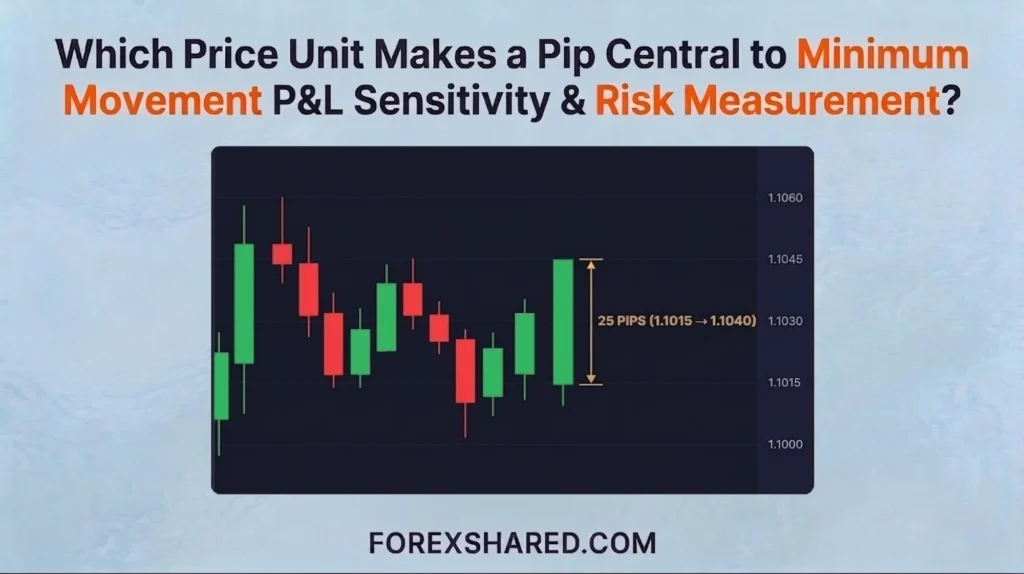
Which Price Unit Makes a Pip Central to Minimum Movement, P&L Sensitivity & Risk Measurement? | FOREXSHARED Which Price Unit Makes a Pip Central to Minimum Movement, P&L Sensitivity & Risk Measurement? The Pip is best understood as the standardized movement unit that turns raw FX quote changes into something measurable, comparable, and risk-relevant. Many readers know a pip is a small price change, but that description is too weak. The pip is the fundamental standardized unit that turns erratic quote movement into a highly usable measurement layer for market operators. This article will define the pip through three connected jobs: minimum movement, P&L sensitivity, and practical risk measurement. Crucially, a pip by itself is not yet a guaranteed money amount until positional size and denomination are confirmed (OANDA, n.d.)(CME Group, n.d.). EDUCATIONAL DISCLAIMER This article is educational only. It is not trading advice, not signal content, not a platform recommendation, and not execution coaching. The article must explain pricing structure and risk measurement, not promise returns. Why Do So Many Readers Misunderstand What a Pip Actually Does? Many readers misunderstand the Pip, the standard FX movement unit used to measure quote changes under pair convention, because they treat it as just a tiny decimal move rather than as the standard unit that makes FX movement measurable across pricing, P&L, and risk. Integrating it into the Forex pricing units system demands moving past the visual decimal. Why Does a Pip Look Like Just a Small Decimal Change? A pip looks like just a small decimal change because readers notice the digits on the screen before they notice the measurement role behind them. When the digits are seen first, the actual measurement purpose is vastly overlooked, and the pip gets disastrously reduced to its appearance only (OANDA, n.d.). Why Do Beginners Confuse “Smallest Move” with “Smallest Money Amount”? Beginners confuse ‘smallest move’ with ‘smallest money amount’ when they forget that movement unit and monetary value are not the same layer. The pip is fundamentally defined as movement; when size is added later, the actual money effect appears only after that specific mathematical translation (OANDA, n.d.)(CME Group, n.d.). Why Does This Misread Create Bigger Problems Later? This misread creates bigger problems later because it breaks pip-value reading, P&L sensitivity, and stop-loss sizing before those topics even start. The pip is a movement unit first, a money number second. If the pip is misread at the definition stage, the value and risk layers are systematically misunderstood later (OANDA, n.d.). Proof Asset: Pip Misread Snapshot The Pip Misread Snapshot should show how a tiny-looking decimal change actually carries a full measurement role. What the Reader Assumes What a Pip Actually Does Why It Matters It’s just the random 4th number after the dot. It standardizes movement across differently priced assets globally. Without standardizing movement, comparing EUR volatility to GBP volatility is impossible. One pip means one dollar. One pip denotes distance; the dollar value depends entirely on trade size. Assuming fixed money value destroys margin and position sizing logic. 1.1060 1.1050 1.1040 1.1030 1.1020 1.1010 10 PIPS (1.1030 → 1.1040) 1.1040 THE MEASUREMENT REALITY Pips translate chart movement into mathematical distance FOREXSHARED.COM Figure 1.0: Pip Measurement on the Chart. A 10-pip move physically translates to distance on the Y-axis, proving it is a structural measurement unit rather than a random decimal. What Is a Pip, and What Is It Not? A Pip is the smallest standardized move by which an FX quote changes under market convention, and it is a measurement unit rather than a money value by itself. Grounding What a pip measures prevents basic pricing errors. What Is a Pip in Plain English? In plain English, a Pip, originally an abbreviation for percentage in point, is the standard movement unit used to describe a small change in an FX quote. When a quote fundamentally changes, the pip measures that change, allowing traders to utilize a highly repeatable, reusable unit (OANDA, n.d.). What Is a Pip Not? A pip is not automatically a dollar amount, not the same thing as a pipette, fractional pip precision below the main pip, and not independent of pair convention. For clarity on fractional precision, examine Pipettes for fractional-pip precision. If the pip is bounded correctly, precision, value, and convention forcefully stop being dangerously mixed (OANDA, n.d.). Why Does a Pip Exist as a Convention-Based Unit Rather Than as a Random Decimal Habit? A pip exists as a convention-based unit because FX markets need a repeatable measurement layer rather than relying on arbitrary decimal interpretation. As market convention strictly fixes the movement unit, quote movement instantly becomes comparable across massive global liquidity pools (OANDA, n.d.). Proof Asset: Pip Definition Table The Pip Definition Table should show what a pip measures and what it does not automatically mean. Pair Type Pip Convention What It Measures What It Does Not Automatically Mean EUR/USD (Standard) 4th Decimal Place (0.0001) One unified increment of quote-side movement. It does not mean your account equity drops $1 for every tick down. USD/JPY (Yen Cross) 2nd Decimal Place (0.01) A standardized fluctuation adapted for JPY denomination. It does not imply JPY pairs are fundamentally less volatile. Which Price Unit Makes the Pip the Core Measure of Minimum Movement? The Pip is the core measure of minimum movement in spot FX because it gives quotes a repeatable, convention-based movement unit. A full grasp of Pip size and quote interpretation reveals how numbers are structured for processing. Why Is a Pip the Standardized Minimum Movement Unit in Spot FX? A pip is the standardized minimum movement unit in spot FX because it lets price changes be compared using one shared convention rather than raw decimal noise. Because the quote convention is strictly fixed, the minimum standard movement seamlessly becomes readable, ensuring broad comparison dramatically improves (OANDA, n.d.). Why Does “Minimum Movement” Depend on Pair Convention? Minimum movement depends on pair convention because JPY pairs and most non-JPY pairs are not quoted with the same decimal structure.