What Role Does the Mid-Price Serve in Benchmark Valuation, Spread Neutrality & Institutional Reference?
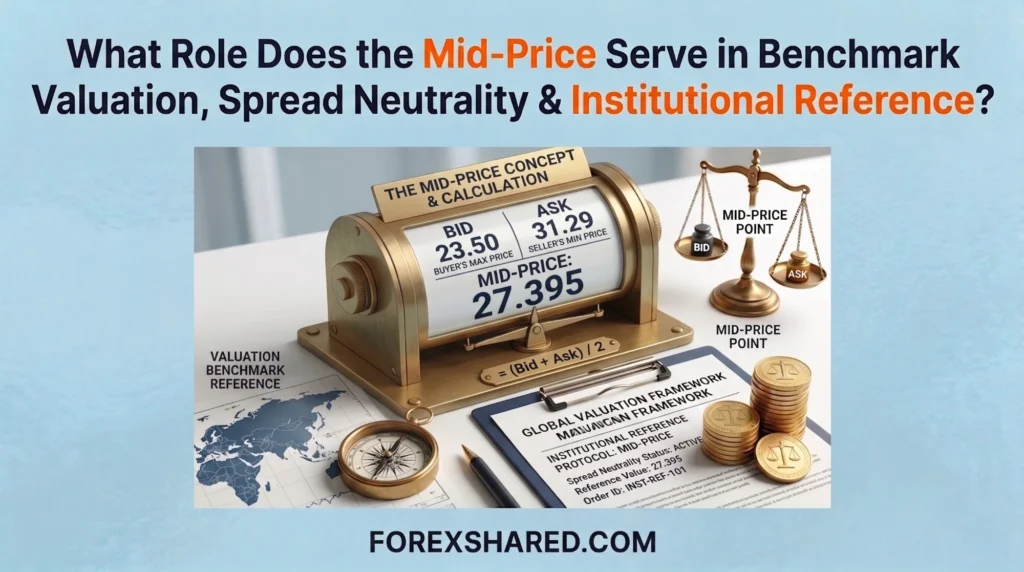
What Role Does the Mid-Price Serve in Benchmark Valuation, Spread Neutrality & Institutional Reference? | FOREXSHARED What Role Does the Mid-Price Serve in Benchmark Valuation, Spread Neutrality & Institutional Reference? The Mid-Price is best understood as a neutral reference derived from the two-sided market rather than as an automatically tradable execution level. Many readers assume the mid-price is simply “the real price in the middle,” but that intuition is incomplete. The midpoint fundamentally exists as a neutral analytical reference derived precisely from bid and ask rather than operating as a guaranteed execution gateway. This article will define the mid-price through three connected jobs: benchmark valuation, spread-neutral reference, and task-specific institutional reference in contexts such as comparison, reporting, and execution-quality review. Midpoint usefulness is immense in modern finance, but this usefulness does not make midpoint execution automatic for end users (FXC and FMLG, 2012)(GFXC, 2024)(GFXC, 2025). EDUCATIONAL DISCLAIMER This page is educational only. It is not trading advice, not signal content, not a platform recommendation, and not execution coaching. The article must explain structural midpoint meaning, not promise execution outcomes. Why Do So Many Readers Misunderstand What the Mid-Price Actually Does? Many readers misunderstand the Mid-Price, the midpoint between bid and ask used as a derived market reference, because they treat it as the market’s true price rather than as a derived reference sitting between two executable sides. Integrating this inside the Exchange-rate quote structure repairs major analytical errors. Why Does the Mid-Price Look More “Fair” Than the Bid or Ask? The mid-price looks more fair than the bid or ask because the middle number feels balanced and side-neutral to readers at first glance. Since the bid and ask firmly surround the midpoint, the midpoint intuitively appears balanced, leading readers to improperly infer total market fairness (FXC and FMLG, 2012). Why Do Beginners Mistake Neutrality for Executability? Beginners mistake neutrality for executability when they assume that a balanced reference point must also be the price they can automatically trade at. When the midpoint is smoothly read as balanced, automatic execution is disastrously assumed, causing quote-side reality to disappear (GFXC, 2024). Why Does This Misread Create Bigger Problems Later? This misread creates bigger problems later because it distorts valuation reading, spread neutrality, execution expectations, and transaction-cost interpretation. The midpoint is balanced, not automatically buyable. If the midpoint is persistently over-trusted, benchmark logic and execution reality collapse together, meaning later analysis unequivocally fails (FXC and FMLG, 2012)(GFXC, 2024). Proof Asset: Mid-Price Misread Snapshot The Mid-Price Misread Snapshot should show how a balanced-looking number can still be misread as a tradable price. What the Reader Assumes What the Mid-Price Actually Does Why It Matters It is the exact, zero-spread price they will get filled at. It calculates a mathematical average between the actual executable sides. Mistaking mid for execution destroys accurate risk and cost modeling. It represents a perfectly frictionless market structure. It serves as a neutral comparative benchmark, not a clearing gateway. Traders calculating P&L on Mid assume profits that do not exist. EXECUTION ILLUSION 1.1050 “I can buy or sell exactly here” Assumes Mid is perfectly tradable CORRECTION BENCHMARK REALITY BID: .48 .50 ASK: .52 THE DERIVED CENTER Used to measure, not to execute FOREXSHARED.COM Figure 1.0: Mid-Price Balance Scale. The Midpoint is an invisible fulcrum dynamically balanced by actual bid and ask liquidity. What Is the Mid-Price, and What Is It Not? The Mid-Price is the midpoint between bid and ask in a two-sided market, and it is a derived reference rather than a standalone market side. It is the mathematical ghost that haunts every spread-based transaction. What Is the Mid-Price in Plain English? In plain English, the Mid-Price is the halfway point between the bid and the ask. Knowing exactly How mid-price forms from bid and ask reveals that once bid and ask are observed, the midpoint is explicitly calculated, and the neutral reference appears (BIS, 2023). What Is the Mid-Price Not? The mid-price is not automatically the price at which a trader can buy or sell, not the same thing as the bid or ask, and not a guarantee of zero transaction cost. Bounding the midpoint correctly heavily reduces execution confusion, guaranteeing its benchmark role becomes infinitely clearer (FXC and FMLG, 2012)(GFXC, 2024). Why Does the Mid-Price Exist Only Because the Two-Sided Market Exists? The mid-price exists only because the two-sided market (market quoted with both bid and ask sides) exists, since the midpoint is derived from bid and ask rather than replacing them. Without the Bid price side of the quote, the mid cannot exist. As a two-sided quote is published, the midpoint becomes instantly computable, forcing the derived reference to powerfully emerge (BIS, 2023)(FXC and FMLG, 2012). Proof Asset: Mid-Price Definition Table The Mid-Price Definition Table should show what the midpoint defines and what it does not automatically mean. Quote Structure Mid-Price What It Defines What It Does Not Automatically Mean EUR/USD (Bid: 1.1048 / Ask: 1.1052) 1.1050 The mathematical dead-center of the quoted spread. It does not mean you can close your long at 1.1050 instead of 1.1048. GBP/JPY (Bid: 190.00 / Ask: 190.10) 190.05 A unified reference metric used for internal portfolio accounting. It does not mean a zero-spread market physically exists here. Why Does the Mid-Price Matter for Benchmark Valuation? The Mid-Price matters for benchmark valuation because it provides a spread-neutral comparison point that does not automatically favor either the bid side or the ask side. Utilizing the Mid-price as a valuation benchmark allows institutions to track wealth precisely. Why Is the Mid-Price Useful When the Goal Is Fair-Valuation Benchmarking? The mid-price is useful when the goal is benchmark valuation (comparison use that seeks a neutral quoted reference) because it removes immediate side bias from the quote itself. Since bid and ask rigidly bracket the quote, the midpoint eliminates immediate side tilt, meaning benchmark comparison naturally becomes easier (FXC and FMLG, 2012). Why Does Benchmark Valuation Often Prefer a Spread-Neutral Reference? Benchmark valuation often prefers a spread-neutral reference because it seeks a comparison
Why Does the Ask Price Set Buy-Side Execution, Dealer Selling & Entry Cost?

Why Does the Ask Price Set Buy-Side Execution, Dealer Selling & Entry Cost? | FOREXSHARED Why Does the Ask Price Set Buy-Side Execution, Dealer Selling & Entry Cost? The Ask Price matters because it is the side of the two-way market that becomes relevant when the client buys and the counterparty sells. Many readers know the ask as the “higher side” of the quote, but that description is too weak. In standard dealer-style FX reading, the ask is the explicit side that matters when the customer is actively buying and the dealer is selling. This article will define the ask through three connected jobs: it sets buy-side execution, reflects dealer selling in a two-way quote, and often provides the first reference for entry cost when a position is opened through a purchase. Displayed ask, firm executable ask, and realized fill are functionally related but not absolutely identical (BIS, 2025)(Foreign Exchange Committee, 2008)(Markets Committee, 2020). EDUCATIONAL DISCLAIMER This page is educational only. It is not trading advice, not signal content, not a platform recommendation, and not execution coaching. The article must explain structural ask-side meaning, not promise trading outcomes. Why Do So Many Readers Misunderstand What the Ask Price Actually Does? Many readers misunderstand the Ask Price because they memorize it as the right or higher number without linking it to actual buy-side execution. Divorcing the number from the physical action of purchasing currency ensures chronic analytical breakdown. Why Does the Ask Look Like a Passive Number Instead of an Execution Side? The ask looks like a passive number instead of an execution side because readers often memorize bid/ask labels without attaching them to the action of buying into the market. When the quote is memorized visually and the execution meaning is abruptly stripped out, the ask is fundamentally underread (BIS, 2025). Why Do Beginners Confuse “Higher Number” with “Just a Worse Number”? Beginners confuse “higher number” with “just a worse number” when they focus on quote position rather than on what side actually matters for buying and entering. If a simple number hierarchy is assumed, the execution hierarchy is inherently misread, causing ask importance to be vastly underestimated (BIS, 2025)(Markets Committee, 2020). Why Does This Misread Create Bigger Problems Later? This misread creates bigger problems later because it distorts the reader’s understanding of buying, dealer selling, entry cost, and spread cost before those topics even begin. The ask is where your purchase meets the market. Whenever the ask-side role is missed, buy-side and entry logic systematically fail later (BIS, 2025)(Foreign Exchange Committee, 2008). Proof Asset: Ask Price Misread Snapshot The Ask Price Misread Snapshot should show how a simple visual assumption about the higher side hides a much deeper execution role. What the Reader Assumes What the Ask Price Actually Does Why It Matters It is merely the “expensive” side of the quote. It is the exact execution gateway for initiating a long position. If you ignore the ask, you underestimate the true cost of entry. It is a static descriptor. It reflects the counterparty’s active willingness to sell to you. It defines the physical boundary of liquidity available for your purchase. THE NUMBER ILLUSION 1.1048 1.1052 Assumed merely as “the higher side” CORRECTION EXECUTION REALITY 1.1052 CLIENT BUYS HERE DEALER SELLS HERE The gateway for position entry FOREXSHARED.COM Figure 1.0: Ask Price Illusion vs Reality. The Ask is an actionable gateway where client buy-side flow meets dealer selling. What Is the Ask Price, and What Is It Not? The Ask Price is the price at which the customer buys and, in standard OTC dealer-style reading, the dealer sells in a two-way market. Reviewing the Exchange-rate quote structure reveals that the ask provides the requisite liquidity for market entry. What Is the Ask Price in Plain English? In plain English, the Ask Price is the dealer’s selling side and the customer’s buying side in standard two-way FX reading. Because a two-way quote continually exists, the ask identifies the buyer-facing execution side directly (BIS, 2025)(GFXC, 2024). What Is the Ask Price Not? The ask price is not just the right-hand quote, not automatically the final realized entry outcome, and not interchangeable with the mid price or the bid price. Ensure you understand the Bid price for sell-side execution to avoid conflating the two. If the ask is defined narrowly, category confusion is reliably reduced, and execution meaning cleanly sharpens (BIS, 2025)(Foreign Exchange Committee, 2008). Why Does the Ask Price Exist as Part of a Two-Way Market Rather Than as a Standalone Number? The ask price exists as part of a two-way market because it only makes full sense against the bid side that completes executable market structure. When a two-sided market is constantly quoted, the ask mathematically gains meaning only against the bid (BIS, 2025)(FXC and FMLG, 2012). EUR/USD QUOTE BID 1.1048 YOU SELL AT ASK / OFFER 1.1052 YOU BUY AT CLIENT BUYS EUR FOREXSHARED.COM Figure 2.0: Ask Price Structure. Within a two-way quote, buying activity is strictly funneled into the Ask side of the spread. Proof Asset: Ask Price Definition Table The Ask Price Definition Table should show what the ask defines and what it does not automatically mean. Quote Ask Price What It Defines What It Does Not Automatically Mean EUR/USD 1.1048 / 1.1052 1.1052 The executable benchmark for opening long EUR positions. It does not mean 1.1052 holds infinite liquidity for massive orders. GBP/JPY 190.00 / 190.05 190.05 The dealer’s stated selling threshold for the Pound. It does not mean a Buy Stop placed at 190.05 is guaranteed zero slippage. How Does the Ask Price Set Buy-Side Execution? The Ask Price sets buy-side execution, the execution logic that applies when the user is buying into the market, because it is the relevant quote side when the trader or client is buying into the market. Tracing the Ask execution role uncovers the mechanics of initiating a long position. Why Is the Ask the Relevant Side When the Trader or Client Is Buying? The ask is the relevant