Why Does Notional Value Measure Contract Exposure, Position Size & Leverage Base?

Why Does Notional Value Measure Contract Exposure, Position Size & Leverage Base? – FOREXSHARED Why Does Notional Value Measure Contract Exposure, Position Size & Leverage Base? Notional Value measures contract exposure because it shows the full value controlled by a trading position, not just the smaller amount of money used to open it. It stands as the absolute starting point for judging trade size, position scale, and leverage accurately before risk enters the live market. Margin can dangerously hide this full exposure. Because brokers only require a fractional collateral deposit to maintain an active trade, it is incredibly easy for traders to look at a small margin requirement and falsely believe the underlying position they control is equally small. This article maps out the path to understanding Notional Value. We will dissect its meaning, explore how position size dictates it, analyze why margin causes systemic confusion, and explain how it directly shapes leverage. We will also compare metrics, review simple examples, tackle common mistakes, offer exposure fixes, and conclude with an understanding validation checklist. EDUCATIONAL DISCLAIMER This article is educational only and does not constitute financial advice. Trading foreign exchange on margin carries a high level of risk. Why Does Notional Value Matter Before a Trader Judges Trade Size? Notional Value matters before a trader judges trade size because it reveals the full value controlled by the position before margin, leverage, or risk is interpreted. It is a fundamental scale-awareness concept first and foremost. A trader cannot accurately judge the proportionate safety of their trade size strictly by glancing at the margin deposit, as this metric belongs securely inside the broader Forex pricing and exposure framework. Notional Value shows the full value controlled by the trade, fundamentally preventing trade size from being evaluated solely by access cost. It explains why a tiny deposit can still command a massive market position, and it provides the indispensable mathematical context necessary to evaluate leverage usage and pip sensitivity accurately. Layer What It Shows Position size How large the trade is in units or lots Notional Value The full exposure controlled by those units Margin The collateral required to access that exposure Leverage The relationship between deposit and controlled exposure Pip sensitivity How strongly price movement can affect the position Position Size Trade Units Notional Value Full Market Weight The Exposure Base Margin Context Deposit vs Exposure Pip Sensitivity Movement Effect FOREXSHARED.COM Figure 1.0: The Exposure Awareness Map demonstrating how Notional Value is the central bridge between lot size and downstream risk interpretation. Key Takeaway Notional Value matters because it reveals the trade’s true size before the trader judges margin, leverage, or risk. What Does Notional Value Actually Represent in a Trading Position? Notional Value represents the face value of a trading position by showing the total market value controlled by the trader. Ascertaining What notional value represents confirms that it acts as the raw scale of market participation, completely distinct from collateral requirements, floating profits, accumulated losses, or planned cash risk (Investopedia). How Does Notional Value Act as the Face Value of the Trade? Notional Value acts as the face value of the trade because it describes the full position behind the order. The moment a position opens, this face value is established as the absolute sum exposed to the momentum of price movement. It is the raw, unadjusted scale of the asset you are operating with in the market. Why Is Notional Value Different From the Money Deposited? Notional Value is different from the money deposited because the deposit is usually margin, while Notional Value is the larger exposure being controlled. Margin operates merely as good-faith collateral required by the broker to keep the trade open; the deposit does not equal the full volume of the transaction occurring in the underlying market. CALCULATION BASE Lot Size × Contract Size (BASE CURRENCY) MARKET VALUE Spot Price (QUOTE CURRENCY) NOTIONAL VALUE Total Exposure (ACCOUNT CURRENCY) FOREXSHARED.COM Figure 2.0: The mechanical flow demonstrating how base units progress through market value to determine final account-denominated Notional Value. Key Takeaway Notional Value represents the full controlled value of the trade, while the deposit only represents the amount required to access that exposure. How Does Position Size Create Notional Value? Position size creates Notional Value because the number of units traded determines how much market value the trader controls. By choosing a specific standardized unit count—such as standard, mini, micro, or nano lots—you are directly dictating the baseline scale of your market involvement. Reviewing Lot size and position units reveals that the number of units forms the absolute base multiplier for your total exposure footprint (IG). Lot Size Base Units Controlled Exposure Meaning Standard lot 100,000 units Larger exposure base Mini lot 10,000 units Medium exposure base Micro lot 1,000 units Smaller exposure base Nano lot 100 units Very small exposure base Why Does Lot Size Matter for Notional Value? Lot size matters for Notional Value because it controls the unit scale of the trade. Larger lots inherently command vast numbers of units, systematically building massive market exposure, whereas smaller lots command fewer units. As a result, two trades executed on the exact same currency pair will possess entirely different exposure levels simply because their lot sizes differ. Why Does Reducing Position Size Reduce Exposure? Reducing position size reduces exposure because fewer controlled units lower the total value exposed to market movement. Slashing your unit count instantly suppresses the Notional Value, which subsequently reduces overall margin pressure and softens pip sensitivity. While smaller size does not automatically guarantee safety, it grants the trader a much more manageable operational footprint. 100,000 Units STANDARD 10,000 Units MINI 1,000 Units MICRO 100 Units NANO FOREXSHARED.COM Figure 3.0: Visualizing how position size drives exponential shifts in the total number of controlled units, creating the base for Notional Value. Key Takeaway Position size creates Notional Value because the number of units traded determines how much market value the trader controls. Why Can Margin Make Notional Exposure Look Smaller Than It Really Is?
What Makes Lot Size Control Position Units, Exposure Scale & Pip-Value Risk?
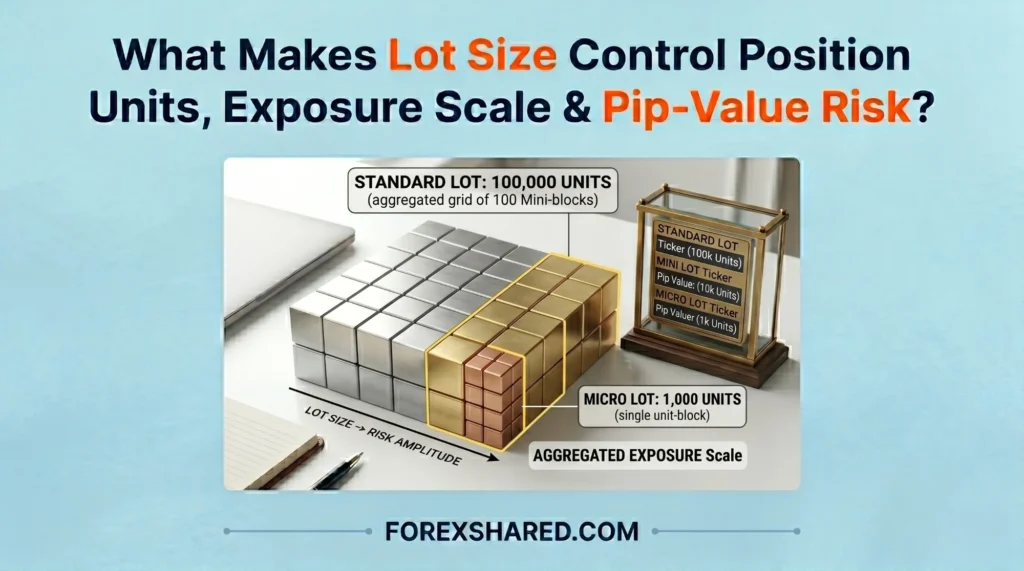
What Makes Lot Size Control Position Units, Exposure Scale & Pip-Value Risk? | FOREXSHARED What Makes Lot Size Control Position Units, Exposure Scale & Pip-Value Risk? The Lot Size is best understood as the position-sizing unit that determines how many currency units a trade actually carries, how large the resulting exposure becomes, and how expensive each pip movement can be. Many readers know lot size means “how big the trade is,” but that description is too weak. In practice, lot size is the strict mathematical unit system that determines exactly how many base-currency units are fundamentally locked inside the position. This article will define lot size through three connected jobs: position-unit control, exposure scaling, and pip-value risk. It is imperative to realize that lot size does not act alone; pair structure, exchange rate, account currency, and execution conditions dynamically shape the final money outcome (IG, 2023)(OANDA, 2023). EDUCATIONAL DISCLAIMER This article is educational only. It is not trading advice, not signal content, not a platform recommendation, and not execution coaching. The article must explain trade-size structure and risk translation, not promise returns. Why Do So Many Readers Misunderstand What Lot Size Actually Does? Many readers misunderstand the Lot Size, the standardized trade-size unit used to express how many currency units are controlled, because they treat it as just a platform setting instead of a structural variable that controls unit count, exposure scale, and pip-value risk. Aligning it with the Forex pricing and exposure framework corrects this analytical deficit. Why Does Lot Size Look Like Just a Drop-Down Menu Instead of a Structural Risk Variable? The Lot Size looks like just a drop-down menu because the interface often hides the unit logic that sits behind the selection. When a user clicks an arbitrary volume setting on a screen, the complex backend measurement role is violently stripped away, leaving an interface shell (OANDA Help, n.d.). Why Do Beginners Confuse “Bigger Lot” with Only “Bigger Profit Potential”? Beginners confuse bigger Lot Size with only bigger profit potential when they ignore the fact that larger size also means larger exposure and larger pip-value risk. By obsessing strictly over the profit upside, traders universally blind themselves to the exponential damage inflicted by heightened pip-value sensitivity (IG, 2023). Why Does This Misread Create Bigger Problems Later? This misread creates bigger problems later because it distorts the reader’s understanding of unit size, pip value, and stop-loss risk. Lot size is where trade size becomes risk size. If the core position-sizing unit is profoundly misunderstood at entry, devastating miscalculations of total exposure logically persist across the entire trade lifecycle (OANDA, n.d.). Proof Asset: Lot Size Misread Snapshot The Lot Size Misread Snapshot should show how a simple trade-size label actually controls deeper unit, exposure, and risk logic. What the Reader Assumes What Lot Size Actually Controls Why It Matters It’s just a slider determining how much margin to spend. It dictates the exact quantity of base-currency units controlled. If unit count is miscalculated, real pip value exposure becomes wildly unpredictable. A 1.00 lot is standard across all platforms and assets. It is an OTC convention; standard lots differ radically from exchange-traded futures. Applying spot lot logic blindly to other instruments destroys accurate sizing metrics. PLATFORM UI Volume: 1.00 Seems like a simple abstract label REVEALS STRUCTURAL REALITY 1 Standard Lot (1.00) 100,000 UNITS of the Base Currency Massive scale creates extreme Pip sensitivity FOREXSHARED.COM Figure 1.0: Platform UI vs Structural Reality. An innocuous dropdown input controls an enormous physical block of currency units. What Is Lot Size, and What Is It Not? The Lot Size is the standardized unit used to express how many currency units are being traded, and it is not the same thing as leverage, margin, or a vague risk slider. Establishing Forex lot size units structurally separates capital sizing from capital financing. What Is Lot Size in Plain English? In plain English, the Lot Size is the trade-size unit that tells you how many base-currency units are in the position. A standard lot is a typical 100,000-unit lot block, a mini lot is a 10,000-unit lot block, and a micro lot is a 1,000-unit lot block. Because it defines actual inventory, the position units (actual number of currency units) rigorously dictate market footprint (IG, 2023)(OANDA Help, n.d.). What Is Lot Size Not? The Lot Size is not the same thing as leverage, not the same thing as margin posted, and not just a risk-level slider without unit meaning. By meticulously excluding leverage and margin algorithms, the lot size definition profoundly remains focused strictly on exposure scaling (OANDA, n.d.)(OANDA, n.d.). Why Does Lot Size Exist as a Position Unit Rather Than a Trading Shortcut? The Lot Size exists as a position unit because FX markets need a standardized way to connect quote movement to actual exposure. As quote shifts register in decimal fractions, lot language acts as the definitive bridge seamlessly locking quote movement to actual realized exposure (IG, 2023). Proof Asset: Lot Size Definition Table The Lot Size Definition Table should show what each lot type defines and what it does not automatically mean. Lot Type Units Controlled What It Defines What It Does Not Automatically Mean Standard (1.0) 100,000 Base Units The baseline institutional benchmark for OTC pricing scaling. It does not mean you need $100,000 in cash to open the trade. Micro (0.01) 1,000 Base Units A fractional unit providing highly granular position control. It does not imply that execution slippage risks simply vanish. How Does Lot Size Control Position Units? The Lot Size controls position units because each lot convention corresponds to a specific block of currency units inside the trade. Every fractional adjustment to volume instantly re-weights the entire order payload. Why Is a Standard Lot Best Understood as a Unit Block Rather Than Just a Label? A standard Lot Size is best understood as a unit block rather than just a label because it fixes the number of base-currency units carried by the position. When a standard lot