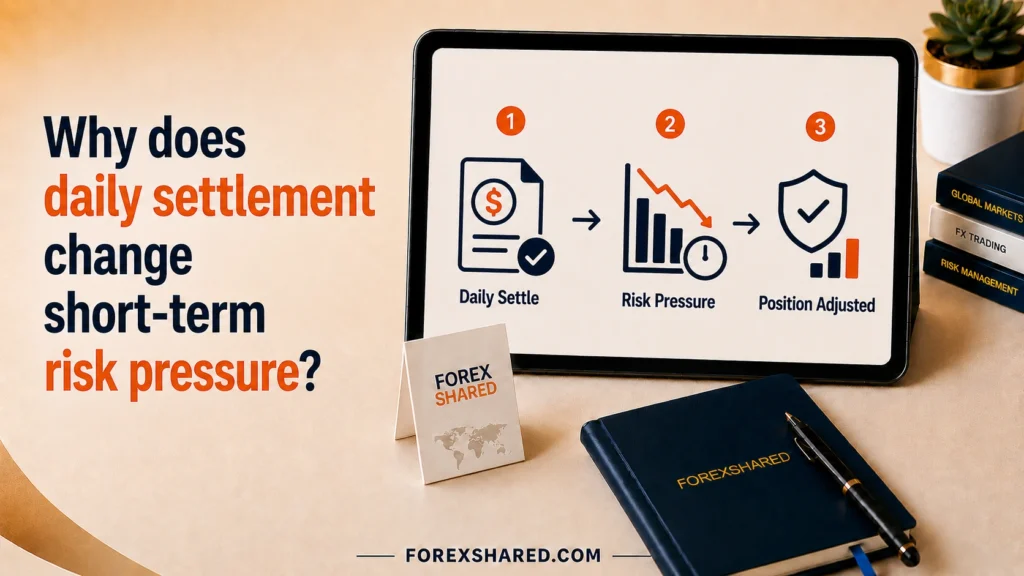
Why Does Daily Settlement Change Short-Term Risk Pressure?
Daily settlement changes short-term risk pressure because futures gains and losses are financially recognized through recurring mark-to-market rather than left unresolved until contract expiration, creating current funding requirements even for longer-term exposure.
A futures exposure can have a longer economic purpose while its funding obligations arrive on a much shorter cycle. The important distinction is between the economic horizon of the position and the funding horizon created by recurring settlement, account-equity changes and margin requirements.
This article traces the full causal path from market movement to settlement P&L, liquidity pressure, margin capacity and possible position adjustment. The parent settlement mechanism is covered in Mark-to-market settlement.
This content explains futures settlement and liquidity-risk mechanics for educational purposes and does not provide individualized financial or trading advice. Settlement arrangements, margin requirements and account procedures can change and should be verified for the relevant contract, clearing arrangement and account.
What Does Daily Settlement Change About the Timing of Futures Risk?
Daily settlement changes the timing of futures risk by converting price changes into current financial gains and losses through recurring mark-to-market rather than leaving them unresolved until expiration.
CME states that daily settlement prices are used to mark traders’ positions to market and determine profits or losses. The settlement process changes when the economic price movement becomes a financial account consequence; it does not create the underlying market move. CME
What happens when an open futures position is marked to market?
An open futures position is valued using the applicable official settlement price, and the resulting financial gain or loss enters the futures settlement process.
This valuation is recurring, not a one-time event at expiration. The valuation itself does not create the market movement. The settlement price is a valuation reference, not a forecast. CME
What changes compared with waiting until maturity?
Unlike waiting until maturity, daily settlement means the participant cannot treat adverse value movement as an unresolved amount that will be dealt with only at the final contract date.
The participant must deal with financial consequences along the path, not only at the endpoint. Recurring settlement realizes them financially along the way.
What exactly becomes more short-term?
What becomes more short-term is not necessarily the economic exposure itself but the timing of P&L recognition, cash-flow demand, account-equity pressure, margin sensitivity, and potential position-adjustment timing.
The economic exposure itself is not necessarily shortened. The exposure can remain open for its intended horizon; only the financial recognition timing shortens.
Does daily settlement increase the original market exposure?
No, daily settlement does not increase the original market exposure; market risk determines how much the position changes in value, while daily settlement determines when those value changes become financial consequences.
Market risk determines the size of value change; daily settlement determines the timing of financial recognition. The price movement exists independently of the settlement process.
| Stage | Mechanism | Short-Term Consequence |
|---|---|---|
| 1 | Open futures exposure | Economic exposure exists |
| 2 | Market price changes | Position value changes |
| 3 | Official settlement price applied | The recurring valuation point is established |
| 4 | Current P&L calculated | The settlement-cycle result becomes measurable |
| 5 | Gain or loss financially recognized | Current financial resources change |
| 6 | Liquidity and account equity change | Funding flexibility increases or decreases |
| 7 | Margin capacity tested | The account approaches or remains above applicable thresholds |
| 8 | Short-term risk pressure changes | Funding, reduction or other account action may become relevant |
How Does Daily Settlement Turn a Longer-Term Exposure Into a Shorter Funding Horizon?
Daily settlement turns a longer-term exposure into a shorter funding horizon because gains and losses are financially processed on a recurring cycle while the exposure itself is intended to last much longer.
The economic horizon describes how long the exposure is intended to remain useful, while the funding horizon describes how soon settlement obligations must be met. CME defines settlement variation as portfolio profit or loss between settlement cycles, which is why a longer-horizon exposure can still face recurring funding tests. CME
Why can the economic horizon and funding horizon differ?
The economic horizon and funding horizon can differ because a futures position can represent exposure intended to last for days, weeks, or months while gains and losses are financially processed on a much shorter recurring cycle.
The economic horizon is the intended holding period; the funding horizon is the period over which financial obligations must be met. The economic outcome still matters; the point is that funding must survive the path to reach it.
What is settlement variation?
Settlement variation is the profit or loss on a portfolio between settlement cycles.
Settlement variation is the current P&L recognized through the settlement process, distinct from initial margin. Settlement variation is current P&L while initial margin is collateral supporting the position. CME
Why does settlement variation shorten the effective funding horizon?
Settlement variation shortens the effective funding horizon because the participant must satisfy financial obligations generated during the position's path rather than only its final result.
The useful contrast is longer-term exposure but shorter-term funding test. The final economic outcome still determines whether the overall exposure was justified; the funding path determines whether the participant can reach it.
Why can a participant be economically right later but financially constrained earlier?
A participant can be economically right later but financially constrained earlier because an adverse sequence can produce current losses before the market later moves in the participant's favour.
The settlement system tests whether the participant has the resources to survive the path. The funding path determines whether the participant can reach the eventual outcome.
| Comparison Point | Economic Horizon | Funding Horizon |
|---|---|---|
| Primary question | How long is the exposure intended to remain useful? | When must current financial obligations be met? |
| Typical frame | Days, weeks or months depending on the exposure | Recurring settlement cycles during the holding period |
| Main driver | Overall price path and economic objective | Settlement P&L, liquidity and account requirements |
| Key dependency | Final or intended economic outcome | Ability to fund every relevant stage along the path |
| Failure mode | Exposure no longer serves the intended purpose | Funding capacity weakens before the economic horizon is reached |
Why Do Daily Settlement Losses Increase Immediate Liquidity Pressure?
Daily settlement losses increase immediate liquidity pressure because settled losses consume financial resources that would otherwise remain available to support the position, meet future margin requirements, and absorb further adverse settlement cycles.
CFTC describes mark-to-market as part of the daily cash-flow system in which gains and losses are added to or subtracted from futures account balances. Repeated debits therefore consume resources that might otherwise support later settlement losses, margin requirements or unrelated liquidity needs. CFTC
How do daily futures losses affect account resources?
Daily futures losses reduce account resources because mark-to-market adds gains to or subtracts losses from account balances as part of the daily cash-flow system.
Mark-to-market is the mechanism that converts price movement into account-balance changes. They represent current financial obligations through the settlement process. CFTC
Why does a settled loss reduce financial flexibility?
A settled loss reduces financial flexibility because once financial resources are consumed by adverse P&L, fewer resources remain available to support the current position, meet future margin requirements, absorb another adverse settlement cycle, or meet unrelated cash obligations.
Reduced resources affect supporting the current position, meeting future margin requirements, absorbing another adverse cycle, meeting unrelated cash obligations. The effect depends on the size of the loss relative to available resources and applicable thresholds.
Why can repeated moderate losses be more important than one isolated daily loss?
Repeated moderate losses can be more important than one isolated daily loss because each settlement loss cumulatively consumes financial capacity, progressively reducing the resources available to absorb the next adverse cycle.
The sequence is Settlement Loss 1 → remaining liquidity declines; Settlement Loss 2 → liquidity declines again; Settlement Loss 3 → account approaches a funding constraint. The compounding effect is on financial capacity, not on the underlying position size.
Do daily gains create the opposite liquidity effect?
Daily gains can improve available financial resources, but they do not remove future market or funding risk because a subsequent adverse settlement cycle can reverse the position.
Gains add to account resources; they do not guarantee future funding capacity. A subsequent adverse settlement cycle can reverse the position.
How Does Account Equity Turn Daily Settlement Pressure Into Margin Pressure?
Account equity turns daily settlement pressure into margin pressure because settlement losses reduce account equity, and when equity falls to or below the applicable maintenance-margin threshold, a margin call requires additional resources.
The threshold mechanism is separate from the settlement loss itself. CFTC states that maintenance margin is the amount that must remain on deposit and that an adverse move taking customer equity to or below that level produces a margin call that restores equity toward the initial level. CFTC
The downstream threshold and account-response mechanics are explained in Margin calls in futures.
Does every daily settlement loss create a margin call?
No, a daily settlement loss changes account equity, but a margin call requires the applicable account or maintenance-margin threshold to be breached.
Settlement loss changes equity; margin call requires threshold breach. The trigger depends on whether the applicable threshold is breached. CFTC
What is the maintenance-margin connection?
The maintenance-margin connection is that maintenance margin is the amount that must remain on deposit, and when customer equity falls to or below that level because of adverse price movement, a margin call restores equity toward the initial level.
Maintenance margin is the floor; a breach triggers a call to restore equity toward the initial level. It is a collateral threshold, not a cap on market loss. CFTC
Why does this increase short-term pressure?
A maintenance-margin breach increases short-term pressure because once the applicable threshold is breached, the participant must deal with the funding deficiency rather than simply continue waiting for the original market horizon.
The participant cannot simply wait; the deficiency must be addressed. The participant may have options including supplying additional resources or reducing exposure.
Which actions can follow?
Depending on applicable requirements and account procedures, a margin deficiency can be addressed by supplying additional resources, reducing exposure, or, where relevant, liquidation.
The appropriate action depends on applicable requirements and account procedures. The participant may have other options depending on account procedures.
Does margin cause the market loss?
No, margin does not cause the market loss; the causal order is market movement → settlement loss → account equity decline → margin consequence.
The causal chain is market movement → settlement loss → account equity decline → margin consequence; not margin requirement → market loss. Margin is a consequence of adverse price movement, not its cause.
How Can Repeated Settlement Cycles Compound Short-Term Risk Pressure?
Repeated settlement cycles compound short-term risk pressure because each adverse cycle consumes financial capacity, progressively reducing the participant's ability to absorb additional losses, meet higher margin requirements, and preserve the original contract quantity.
The compounding effect belongs to financial capacity, not automatically to market exposure. Several adverse settlement cycles before recovery can progressively reduce the liquidity buffer needed to carry the intended exposure through the next stage.
Why does the path of prices matter even if the final price eventually recovers?
The path of prices matters even if the final price eventually recovers because the participant must remain financially capable through every relevant settlement stage along the way.
The final price determines the ultimate outcome; the path determines whether the participant can reach it. The participant must remain funded through the interim path.
What happens when losses repeatedly reduce the liquidity buffer?
When losses repeatedly reduce the liquidity buffer, the participant becomes progressively less able to absorb additional losses, meet higher margin requirements, and preserve the original contract quantity.
The affected capacities include absorbing additional losses, meeting higher margin requirements, preserving contract quantity. The participant may have options including supplying additional resources.
Does the later recovery reverse earlier liquidity strain automatically?
No, later gains can improve account resources, but they do not retroactively remove the need to have funded earlier obligations when they arose.
Later gains improve resources; they do not retroactively fund earlier obligations. The participant had to satisfy obligations when they arose, not retroactively.
Why does this create path-dependent participation risk?
This creates path-dependent participation risk because two positions with the same entry price and eventual final price can create different liquidity experiences if the interim settlement paths differ materially.
The interim settlement path determines the funding experience, not just the endpoints. The interim funding path can differ materially.
| Stage | Settlement Path | Liquidity Effect | Participation Meaning |
|---|---|---|---|
| Cycle 1 | Moderate adverse settlement loss | Reserve declines | Less room remains for the next adverse cycle |
| Cycle 2 | Another adverse settlement loss | Reserve declines again | Funding flexibility becomes narrower |
| Cycle 3 | Another loss or higher requirement | Threshold becomes more relevant | Additional resources or exposure adjustment may be needed |
| Later recovery | Economic result improves | Resources can improve if the position survived | Recovery helps only after earlier obligations were funded |
Why Can Volatility Intensify Daily Settlement Pressure?
Volatility can intensify daily settlement pressure through two channels: larger settlement-price changes can create larger current P&L transfers, and higher measured risk can raise margin requirements.
Volatility can affect the funding path through two separate channels. Larger settlement-price movements can create larger current P&L transfers for an unchanged position, while CME also states that margins are adjusted with risk conditions and typically rise when daily price moves become more volatile. CME
For a separate product-model comparison outside this futures page, see Leverage margin risk in CFDs. That comparison should not be read as implying that futures margin mechanics and CFD leverage mechanics are identical.
How can higher price volatility increase settlement P&L?
Higher price volatility can increase settlement P&L because larger settlement-price changes can create larger monetary gains or losses for an unchanged futures position.
The position size is unchanged; the monetary effect scales with the price change. Volatility measures the size of price changes, not their direction.
Can required margin also change as risk conditions change?
Yes, margin levels are adjusted with risk conditions and typically rise when daily price moves become more volatile.
Margin typically rises when daily price moves become more volatile. They can change as risk and volatility conditions change. CME
Why does this create two possible liquidity channels?
This creates two possible liquidity channels because the settlement channel transfers larger current P&L while the margin channel can raise the resources required to maintain the position.
The channels operate through different mechanisms but can act simultaneously. They operate through different mechanisms: P&L transfers versus collateral requirements.
Why can this become especially important during market stress?
This becomes especially important during market stress because margin and collateral calls, while protecting against counterparty risk, can amplify liquidity demand when they spike during stressed conditions.
The protective mechanism can create a liquidity-amplification effect when calls spike. They serve a protective function; the issue is the liquidity-amplification effect during stress. FSB
Does volatility automatically increase every margin requirement by the same amount?
No, margin methodologies can incorporate volatility, liquidity, correlations, market conditions, and portfolio characteristics, so the actual requirement depends on the applicable methodology.
Margin methodologies can incorporate volatility, liquidity, correlations, market conditions, portfolio characteristics. Methodologies differ across clearing arrangements and incorporate multiple factors.
Why Can Daily Settlement Force Position Adjustment Before the Original Horizon?
Daily settlement can force position adjustment before the original horizon because if the account cannot satisfy applicable margin requirements, the participant may need to supply additional funds, reduce contract quantity, or face liquidation under relevant account procedures.
When funding capacity no longer satisfies the applicable account requirement, the preferred holding period stops being the only timing constraint. CME explains that a maintenance-margin deficiency can lead to additional funding, position reduction or liquidation depending on the resources and procedures involved. CME
Why might a participant add funds rather than change the position?
A participant might add funds rather than change the position because additional liquidity can preserve the intended contract exposure while satisfying current financial requirements.
Additional liquidity satisfies current requirements without altering the position. The decision depends on available resources and the participant’s assessment of the position.
Why might contract quantity need to be reduced instead?
Contract quantity might need to be reduced instead because if additional liquidity is unavailable or undesirable, reducing contracts can reduce the exposure and related financial resources that must be supported.
Fewer contracts mean less exposure and lower associated financial requirements. The decision depends on whether additional funding is available and desirable.
Why can liquidation occur earlier than the participant intended?
Liquidation can occur earlier than the participant intended because if the account cannot satisfy applicable margin requirements, position reduction or liquidation can follow under relevant account procedures.
The trigger is the inability to satisfy applicable margin requirements. It depends on account procedures and whether adequate resources are supplied. CME
Does early adjustment prove the market thesis failed?
No, early adjustment does not prove the market thesis failed; it can instead demonstrate that the economic holding horizon exceeded the available funding horizon.
Early adjustment can reflect a funding constraint, not a thesis failure. It can instead demonstrate that the funding horizon was shorter than the economic horizon.
Why Can a Futures Hedge Face Short-Term Settlement Pressure Even When the Hedge Works?
A futures hedge can face short-term settlement pressure even when the hedge works because the futures position and underlying commercial exposure are intended to offset economic price effects, but their cash flows do not necessarily occur at the same time.
A hedge can reduce the intended economic price exposure while still creating a timing mismatch between the futures account and the underlying commercial cash flow. The relevant risk is liquidity timing: the futures-side obligation can arrive before the offsetting economic benefit becomes cash.
How can a hedging futures leg generate a current loss while the overall hedge remains economically useful?
A hedging futures leg can generate a current loss while the overall hedge remains economically useful because the futures position and underlying commercial exposure are intended to offset economic price effects, but their cash flows do not necessarily occur at the same time.
The offset is economic; the cash flows occur at different times. The economic offset may still be working as intended.
Why can the futures account require resources first?
The futures account can require resources first because daily settlement can convert the futures-side loss into an immediate financial requirement before the offsetting benefit on the underlying exposure is realized in cash.
The offsetting benefit on the underlying exposure may not be realized in cash yet. It is economically relevant; the issue is the timing of cash realization.
What risk does this create?
The primary risk this creates is liquidity timing risk, not necessarily hedge failure.
The hedge may work economically while the funding timing creates pressure. The economic offset may still be functioning as intended.
Why should this distinction matter to the reader?
This distinction matters because it prevents the false conclusion that economic risk reduction automatically removes short-term funding needs.
Economic risk reduction and funding timing are separate dimensions. It can reduce price uncertainty while creating liquidity management requirements.
How Does Daily Settlement Reduce Clearing Risk While Increasing Participant Liquidity Pressure?
Daily settlement reduces clearing risk while increasing participant liquidity pressure because settlement variation prevents losses from accumulating within the clearing system, but the same mechanism requires losing participants to provide financial resources as losses arise.
CME states that settlement variation represents profit or loss between settlement cycles and prevents losses from accumulating in the clearing system. The same mechanism requires current losses to be funded sooner, creating a direct clearing-system versus participant-liquidity trade-off. CME
Why does the clearing system settle current P&L frequently?
The clearing system settles current P&L frequently because settlement variation represents gains and losses between settlement cycles and prevents losses from accumulating within the clearing system.
Settlement variation represents gains and losses between cycles; settling them prevents accumulation. Residual risk can remain from several sources. CME
What credit-risk benefit does this create?
The credit-risk benefit is that current adverse exposure is periodically financially resolved rather than being allowed to accumulate as a larger unpaid obligation over a long period.
Resolution prevents accumulation into a larger unpaid obligation. Residual risk can remain from several sources. CME
What does the same mechanism require from losing participants?
The same mechanism requires losing participants to provide financial resources as losses arise.
The requirement is immediate, not deferred. Recurring settlement requires funding as losses arise.
What is the central trade-off?
The central trade-off is that recurring settlement reduces accumulated unpaid exposure from the clearing-system perspective while creating more immediate liquidity demand from the participant perspective.
The same mechanism produces both effects. Both effects are inherent to the same mechanism.
Does recurring settlement eliminate all clearing risk?
No, residual risk can remain from exposure between settlement cycles, clearing-member default, liquidity failure, operational failure, and extreme market movement.
Residual risks can include exposure between settlement cycles, clearing-member default, liquidity failure, operational failure, extreme market movement. Residual risk can remain from multiple sources.
| Comparison Point | Clearing-System Perspective | Participant Perspective |
|---|---|---|
| Current loss treatment | Current adverse exposure is periodically resolved | Losses must be funded as they arise |
| Accumulation effect | Less unpaid current exposure accumulates | Less ability to defer adverse cash-flow impact |
| Risk-management benefit | Settlement variation reduces loss accumulation | Recurring account resources are tested |
| Liquidity consequence | More current exposure is financially resolved | More immediate liquidity may be required |
| Residual limitation | Clearing risk is reduced, not eliminated | Liquidity preparedness remains necessary |
How Should Short-Term Settlement Pressure Be Evaluated Before Holding Futures?
Short-term settlement pressure should be evaluated by determining the monetary sensitivity of the intended position, the liquidity remaining after entry, the effect of repeated adverse cycles, the applicable margin threshold, and the adjustment options available if funding capacity weakens.
The evaluation should combine contract sensitivity, quantity, remaining liquidity, repeated adverse-cycle capacity, current maintenance requirements, possible margin increases and realistic exposure-reduction options. The framework measures whether the funding path can support the intended economic horizon; it does not predict price direction.
What is the monetary sensitivity of the intended position?
The monetary sensitivity of the intended position is determined by identifying the value change per relevant price move, the number of contracts, and the total settlement-cycle sensitivity.
Value change per price move × number of contracts = total settlement-cycle sensitivity. It measures the effect of a given price move, not the likelihood of that move.
What liquidity remains after establishing the position?
The liquidity remaining after establishing the position should be evaluated by separating the resources supporting the initial position from the resources available for future settlement losses.
The distinction matters because resources consumed at entry are not available for future losses. Some resources are consumed supporting the initial position.
How would repeated adverse cycles affect that reserve?
Repeated adverse cycles should be tested against the reserve by simulating the funding path rather than only a single-day loss.
Repeated losses cumulatively consume the reserve. Repeated adverse cycles can consume the reserve cumulatively.
Where is the applicable margin threshold?
The applicable margin threshold should be determined by identifying how much account deterioration can occur before additional account action becomes necessary.
The threshold defines how much deterioration can occur before action is required. Margin requirements can change with risk conditions.
Could margin requirements rise during stress?
Yes, margin requirements can rise during stress, so the position should not be evaluated under the assumption that the current requirement is permanently fixed.
Margin levels adjust with risk conditions and typically rise with volatility. Margin levels can change with risk and volatility conditions. CME
What adjustment options remain if funding capacity weakens?
If funding capacity weakens, the participant should identify whether they can provide additional resources, reduce part of the exposure, or exit the position.
The appropriate option depends on available resources and account procedures. Additional resources or partial reduction may be available.
What is the correct evaluation sequence?
The correct evaluation sequence is to identify the futures contract, determine monetary exposure per contract, determine intended contract quantity, verify the recurring settlement process, estimate plausible adverse settlement-cycle P&L, measure available liquidity after entry, identify applicable margin thresholds, test repeated adverse settlement cycles, consider potential margin changes, and determine whether the short-term funding path supports the intended longer-term exposure.
Each step builds on the previous one. Each step contributes a necessary input to the funding decision.
How Can Futures Participants Avoid Misreading Daily Settlement Risk Pressure?
Futures participants can avoid misreading daily settlement risk pressure by keeping settlement losses distinct from margin calls, market risk distinct from funding risk, and daily settlement distinct from final settlement.
The most important discipline is to keep causal layers separate: market movement creates the value change, settlement makes the result financially current, account equity determines proximity to margin thresholds, and final settlement remains a different lifecycle process. CME’s final-settlement material confirms that expiration resolution is distinct from recurring daily settlement. CME
Why is focusing only on final P&L a mistake?
Focusing only on final P&L is a mistake because the participant must finance the position before reaching the final result.
The final P&L does not capture the funding path. The participant must survive the funding path to reach it.
Why is treating every settlement loss as a margin call incorrect?
Treating every settlement loss as a margin call is incorrect because a settlement loss changes account resources, while a margin call depends on whether an applicable margin threshold is breached.
Settlement loss changes resources; margin call requires threshold breach. They are distinct events with different triggers.
Why is saying daily settlement increases market risk incorrect?
Saying daily settlement increases market risk is incorrect because market price movement creates the underlying exposure change, while daily settlement changes when that change becomes financially binding.
Market movement creates the exposure change; settlement determines when it becomes financially binding. The price movement exists independently of the settlement process.
Why is assuming a successful hedge cannot create liquidity pressure incorrect?
Assuming a successful hedge cannot create liquidity pressure is incorrect because economic offset and cash-flow timing are separate dimensions.
Economic offset and cash-flow timing are separate. The futures leg can require resources before the offsetting benefit is realized.
Why is assuming current margin requirements will remain unchanged risky?
Assuming current margin requirements will remain unchanged is risky because margin requirements can change as risk and volatility conditions change.
Margin levels adjust with risk and volatility conditions. Margin levels can change with risk conditions. CME
Why is using nearly all available liquidity at entry a short-term risk problem?
Using nearly all available liquidity at entry is a short-term risk problem because it leaves less capacity for settlement losses, margin calls, and requirement increases.
Less remaining capacity affects settlement losses, margin calls, requirement increases. Future settlement obligations also require resources.
Why is confusing daily settlement with final settlement incorrect?
Confusing daily settlement with final settlement is incorrect because daily settlement manages recurring valuation and P&L while the contract remains open, while final settlement resolves the contract at expiration.
Daily settlement manages open-position P&L; final settlement resolves the contract at expiration. They are separate lifecycle processes with different functions. CME
What should be verified before carrying futures through recurring settlement cycles?
Before carrying futures through recurring settlement cycles, the participant should verify the settlement process, monetary P&L sensitivity, contract quantity, the distinction between settlement losses and margin calls, remaining liquidity, applicable maintenance requirements, repeated adverse cycles, potential margin increases, and exposure-reduction options.
Each item addresses a specific verification need. It is a verification framework, not a prediction tool.
- The applicable daily or recurring settlement process is understood.
- Monetary P&L sensitivity per contract is known.
- Total contract quantity is included in the funding analysis.
- Settlement losses are distinguished from margin calls.
- Adequate liquidity remains after the position is established.
- Applicable maintenance requirements are known.
- Repeated adverse settlement cycles are stress-tested.
- Potential margin increases are included in the assessment.
- Exposure-reduction options are understood before forced action becomes relevant.
- Daily settlement pressure is kept separate from final settlement and from the position’s ultimate economic result.
Conclusion Direction
Daily settlement changes short-term risk pressure because it converts futures price changes into current financial gains and losses instead of allowing those changes to remain unresolved until the contract reaches its final settlement date.
The central sequence is market movement, recurring valuation, current P&L recognition, liquidity or account-equity change, repeated margin-capacity testing and, when necessary, funding or exposure adjustment. CME confirms that daily settlement prices are used for mark-to-market and daily profit or loss, while settlement variation prevents losses from accumulating within the clearing system. CME CME
Five conclusions should not be drawn from that mechanism: daily settlement does not create the underlying market loss; not every settlement loss creates a margin call; a successful economic hedge can still face liquidity timing pressure; recurring settlement does not eliminate all clearing risk; and daily settlement is not the same as final settlement. The FSB also notes that margin and collateral calls are important counterparty-risk protections but can amplify liquidity demand when they spike during stressed conditions. FSB
FAQs
Why does daily settlement make futures risk more immediate?
Daily settlement makes futures risk more immediate because recurring mark-to-market converts current market-value changes into financial gains or losses rather than leaving them unresolved until expiration.
The mechanism makes current financial consequences arrive through recurring mark-to-market instead of leaving the full current value change unresolved until expiration. CME states that daily settlement prices are used to mark positions to market and determine profits or losses. CME
Does every daily futures loss cause a margin call?
No, settlement losses affect account resources, while a margin call depends on whether the applicable maintenance threshold is breached.
No. A settlement loss reduces account resources, while a margin call depends on whether the applicable maintenance or account threshold is reached or breached. CFTC’s glossary distinguishes the mark-to-market loss from the maintenance-margin trigger. CFTC
Why can daily settlement create liquidity pressure?
Daily settlement can create liquidity pressure because losing settlement cycles require current financial resources, and repeated or unexpected margin and collateral demands can strain liquidity.
Losing settlement cycles require current resources, and repeated demands can narrow available liquidity. The FSB states that spikes in margin and collateral calls can amplify liquidity demand during stressed market conditions. FSB
Can a longer-term futures hedge face short-term settlement pressure?
Yes, a longer-term futures hedge can face short-term settlement pressure because the economic hedge horizon and the timing of futures cash flows are separate dimensions.
Yes. The economic hedge horizon and the cash-flow timing of the futures account are separate. An economically useful hedge can therefore need funding before the offsetting commercial benefit is realized in cash.
Is daily futures settlement the same as final settlement?
No, recurring settlement manages open-position P&L, while final settlement resolves the contract at expiration.
No. Daily settlement manages recurring valuation and open-position P&L, while CME states that an expiring futures contract is marked to its final settlement price and then proceeds to the applicable cash-settlement or physical-delivery process. CME