How Do Contract Size and Maturity Remain Customizable in Forwards?
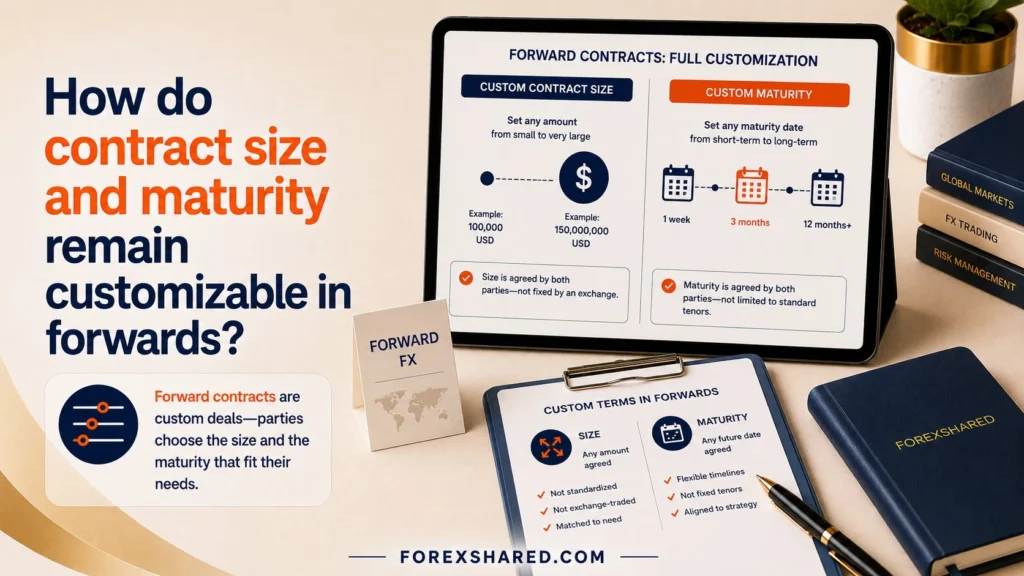
Contract size and maturity remain customizable in an OTC FX forward because the counterparties negotiate the two currency principals and the future value date for the individual transaction. This allows the contract to align more closely with a specific invoice, investment, funding need, or other future currency exposure than an exchange-defined futures contract.
The flexibility is not unlimited. The requested amount and date must fit the dealer’s product offering, market liquidity, credit limits, currency restrictions, business-day calendars, settlement access, and operational capability.
For the parent explanation of the obligations and value-date fields that create the product, see Forward contract structure.
This article is for general education only and does not constitute financial, investment, trading, legal, operational, or tax advice. Contract availability, pricing, enforceability, collateral, settlement, and regulatory treatment vary by counterparty, agreement, currency, jurisdiction, and market conditions.
- Size is negotiated: the confirmation records the agreed principal amount in each currency.
- Maturity is negotiated: a specific future value date can be selected within market and operational limits.
- Quote direction matters: the reciprocal amount may require multiplication or division.
- Broken dates are possible: the exact maturity is priced from the relevant FX and funding curves.
- Customization remains constrained: liquidity, credit, settlement, and documentation determine what is executable.
What Do Contract Size and Maturity Mean in an FX Forward?
Contract size is the agreed currency principal covered by the transaction. Maturity is the future contractual value date on which the deliverable currency exchange or cash-settled obligation becomes due.
The BIS describes a forward as a delayed-delivery contract whose instrument, future date, and price are agreed by the parties, and notes that forward contracts are generally not exchange-traded or standardized. BIS2026
Is Contract Size the Same as Notional?
In an outright FX forward, contract size is normally expressed through the two currency principals or notionals. For example, a client can agree to sell GBP 1,250,000 and buy the corresponding USD amount at the contracted GBP/USD forward rate.
The notional is not the amount of cash necessarily posted when the trade is executed. It defines the currency obligations and scales the trade’s market value, collateral exposure, and settlement amount. Forward points are quoted as a rate adjustment per unit; they are not calculated from the notional itself.
What Does Maturity Determine?
Maturity determines when contractual performance is due and how long the transaction’s pricing, valuation, and counterparty exposure can remain outstanding. Actual funding needs also depend on whether the trade is deliverable or cash-settled and on netting, collateral, margin, and settlement arrangements.
Are Maturity, Value Date, and Settlement Date Always Identical?
In a standard deliverable outright forward, the terms often refer to one common future date on which both currency obligations settle. Documentation standards can also support separate currency value dates in exceptional split-value arrangements. An NDF normally has a fixing date before its cash-settlement date.
FpML represents an FX spot or forward through two exchanged-currency components, an optional dealt currency, an exchange rate, and either one common value date or separate value dates for the two currencies. FpML2026
How Is the Custom Notional Written Into the Contract?
The confirmation records the two currencies, buy and sell direction, dealt currency, principal amounts, exchange rate, and value date. The negotiated amount becomes a contractual field through the executed trade and governing documentation; an electronic standard such as FpML provides a representation of those fields but does not itself create legal enforceability.
The broader reason that these terms are negotiated rather than selected from one universal exchange specification is explained in Bespoke forward contracts.
Can the Client Specify Only One Currency Amount?
Yes. The client can deal in either currency, and the agreed forward quotation determines the reciprocal amount. The confirmation can then record both principals explicitly.
Does the Calculation Always Use Multiplication?
No. The calculation depends on the quote convention and the dealt currency. In GBP/USD, GBP is the base currency and USD is the quote currency. A rate of 1.2640 means GBP 1 equals USD 1.2640. CME2026
- Base to quote: GBP 1,250,000 × 1.2640 = USD 1,580,000.
- Quote to base: USD 2,375,000 ÷ 1.2640 = approximately GBP 1,878,955.70.
Why Do Rounding Rules Matter?
The reciprocal calculation can produce more decimals than the payment currency supports. The confirmation or incorporated terms should therefore identify quotation precision, payable precision, rounding method, and the final principal amounts.
Why Do Real Cash Flows Need Custom Forward Amounts?
Invoices, debt payments, investments, and asset purchases rarely equal a fixed exchange lot. A forward can often align more closely with an irregular amount such as USD 2,375,000 or EUR 846,720, reducing the quantity mismatch created by rounding to whole futures contracts.
Does Exact Initial Size Create a Perfect Hedge?
No. Exact notional can reduce the initial amount mismatch, but the underlying exposure can later change, be delayed, be partly cancelled, or settle in a different amount. Timing mismatch, basis risk, credit risk, and settlement risk also remain.
Is the Full Principal Posted Upfront?
Not usually. The contract records the future currency principals, while collateral, initial margin, variation margin, and settlement prefunding are separate requirements governed by the product, counterparties, agreement, and jurisdiction.
What Limits the Custom Forward Amount?
A dealer does not have to accept every requested notional. Executable size can be constrained by:
- Market liquidity: depth varies by pair, direction, session, and market conditions.
- Maturity liquidity: common shorter tenors may be deeper for many pairs, but this is not universal.
- Credit limits: larger notionals and longer maturities can increase potential exposure.
- Settlement limits: principal-payment capacity and settlement method can cap size.
- Currency restrictions: local controls can restrict deliverability, tenor, or participant access.
- Operational capability: unusual settlement or confirmation terms may exceed the provider’s systems.
Actual replacement value can rise, fall, or change direction with exchange rates. Netting and collateral can materially reduce the exposure even when notional and maturity are large.
Can a Large Exposure Be Split?
Yes. It can be divided across counterparties, maturities, execution times, or settlement methods. Splitting can increase capacity but creates multiple rates, confirmations, credit relationships, and settlement obligations.
How Does Forward Maturity Remain Customizable?
An OTC forward can often use a specifically agreed future value date rather than requiring the user to select only an exchange-listed expiry. The date can therefore be aligned more closely with the underlying cash flow.
The relationship between negotiated maturity and practical settlement choices is covered further in Forward settlement flexibility.
Can the Parties Request an Exact Date?
Yes, subject to dealer acceptance and the business-day and settlement requirements for both currencies. The requested date must also fall within available liquidity, product, and credit horizons.
What Is a Broken-Date Forward?
A broken-date or odd-date forward matures on a date that does not match a commonly quoted tenor such as one month or three months. It is priced for the exact value date using the relevant FX and funding curves. Interpolation between quoted tenor points may form part of the dealer’s curve construction, but it is not a complete universal pricing formula.
How Do Business-Day Conventions Affect the Date?
If a requested date is not valid under the applicable business-centre or settlement-system requirements, the incorporated terms determine whether it moves forward, backward, or according to another convention. FpML defines conventions including Following, Modified Following, and Preceding. FpML2026
- Following: move to the first following valid business day.
- Modified Following: move forward unless that crosses into the next calendar month, in which case move to the first preceding valid business day.
- Preceding: move to the first preceding valid business day.
Can Size or Maturity Change After Execution?
Neither party can normally alter the contract unilaterally. Changes require the process permitted by the governing documentation and agreement of the relevant parties.
What Is a Forward Rollover?
A rollover changes the economic maturity through an agreed amendment, termination-and-replacement process, or FX swap structure. The treatment depends on the dealer’s process and the governing documentation.
The new economics reflect the original trade’s current market value and the current pricing for the extension period. They should not be described simply as the original rate plus or minus one universal swap-point adjustment.
Can an Offsetting Trade Close the Original Contract?
An opposite trade can neutralize much of the economic exposure, but it does not automatically terminate the original legal contract. Unless the parties formally terminate, amend, or net the transactions under an applicable process, both contracts can remain outstanding.
How Is Early-Termination Value Determined?
The close-out amount can depend on current spot and forward rates, remaining maturity, quotation direction, discounting, notional, settlement currency, spreads, and the governing valuation terms.
How Do Custom Forwards Differ From Currency Futures?
A forward permits negotiated terms within market and counterparty constraints. A currency future uses an exchange-defined contract specification and listed maturity. The user can still choose the number of futures contracts, a standard or micro contract, and an available listed expiry.
CME currently lists standard Euro FX futures at EUR 125,000 and Japanese Yen futures at JPY 12,500,000, alongside smaller micro variants. CME2026
| Feature | OTC FX Forward | Currency Future |
|---|---|---|
| Contract size | Negotiated within dealer, liquidity, credit, and operational constraints. | Exchange-defined unit; user selects the number and available contract variant. |
| Maturity | A specific valid future value date can often be agreed. | User selects from listed expiries. |
| Broken-date exposure | Can be priced for an individually negotiated date. | Usually approximated using listed contracts, spreads, or another instrument. |
| Execution | OTC negotiation or electronic OTC execution. | Exchange-traded under standard rules. |
| Clearing | Can remain bilateral or be centrally cleared when eligible. | Centrally cleared under exchange and clearing-house rules. |
| Margin and collateral | Depends on clearing status, agreement, entity, product, and jurisdiction. | Governed by exchange and clearing-house margin rules. |
Are All OTC Forwards Uncleared and Unmargined?
No. ForexClear currently supports selected NDFs and deliverable spot, forward, and option pairs. Non-centrally cleared derivatives can also be subject to bilateral collateral or regulatory margin frameworks. Physically settled FX forwards and swaps receive specific treatment under the international framework: they are exempt from its initial-margin requirement, while variation-margin treatment is addressed separately. LCH2026 BCBS-IOSCO2013 BCBS-IOSCO2025
Which Risks Increase With Custom Size and Maturity?
- Liquidity risk: unusual sizes or dates can be harder or more expensive to offset.
- Replacement-cost risk: market value can become positive before maturity and may be lost after counterparty default.
- Settlement risk: a deliverable forward can expose principal when the two currency payments are not protected by PvP.
- Operational risk: more individually negotiated fields create more details to capture, match, and reconcile.
- Hedge mismatch: the underlying exposure can change after the fixed contract has been executed.
Custom terms do not require manual processing. They can be represented and confirmed electronically, although unusual terms can create more exceptions or manual intervention.
What Should Be Validated in the Confirmation?
- Product type: confirm that the transaction is an outright forward, NDF, or another stated structure.
- Currency principals: verify both amounts, dealt currency, and buy/sell direction.
- Quotation convention: confirm base currency, quote currency, and whether multiplication or division applies.
- Rounding: verify the final payable amounts and currency precision.
- Value date: confirm the exact future date and any split-value treatment.
- Business-day rules: identify the relevant business centres and adjustment convention.
- Settlement form: confirm deliverable or cash-settled mechanics and any fixing formula.
- Credit and collateral: review limits, margin, clearing, and settlement requirements.
- Lifecycle terms: confirm amendment, rollover, early-termination, and close-out procedures.
Conclusion
Contract size and maturity remain customizable in FX forwards because the transaction is negotiated around a specific future currency exposure rather than selected from one universal exchange contract.
The confirmation can record an irregular notional and a specific future value date, but quotation direction, rounding, business-day rules, liquidity, credit, and settlement capability determine the terms that can actually be executed.
Customization improves exposure alignment; it does not create unlimited choice or remove risk. The final trade can remain bilateral or be centrally cleared when eligible, and later amendments or close-outs require the agreed legal and operational process.
Frequently Asked Questions
Can an FX forward use any notional amount?
No. The notional can often be tailored more closely than an exchange contract, but the available amount remains subject to dealer minimums, market liquidity, credit limits, settlement capacity, currency controls, and operational capability.
Can I select any calendar date as the forward maturity?
A specific future date can often be requested, but the contractual value date must satisfy the business-day and settlement requirements for both currencies and must fall within the dealer’s available product and credit horizon.
How is the reciprocal currency amount calculated?
The calculation depends on the quotation convention and which currency is dealt. For a pair quoted as quote currency per unit of base currency, converting a base-currency amount into quote currency uses multiplication, while converting a quote-currency amount into base currency uses division.
Can a forward maturity be changed after execution?
Only through an agreed process. The parties may amend the trade, terminate and replace it, use an FX swap, or enter an offsetting transaction. An offsetting trade can neutralize economic exposure but does not automatically terminate the original legal contract.
How does a custom forward differ from a currency future?
A forward allows negotiated terms within counterparty and market constraints. A currency future uses exchange-defined contract sizes and listed maturities, although the user can choose the number of contracts, contract variant, and listed expiry.