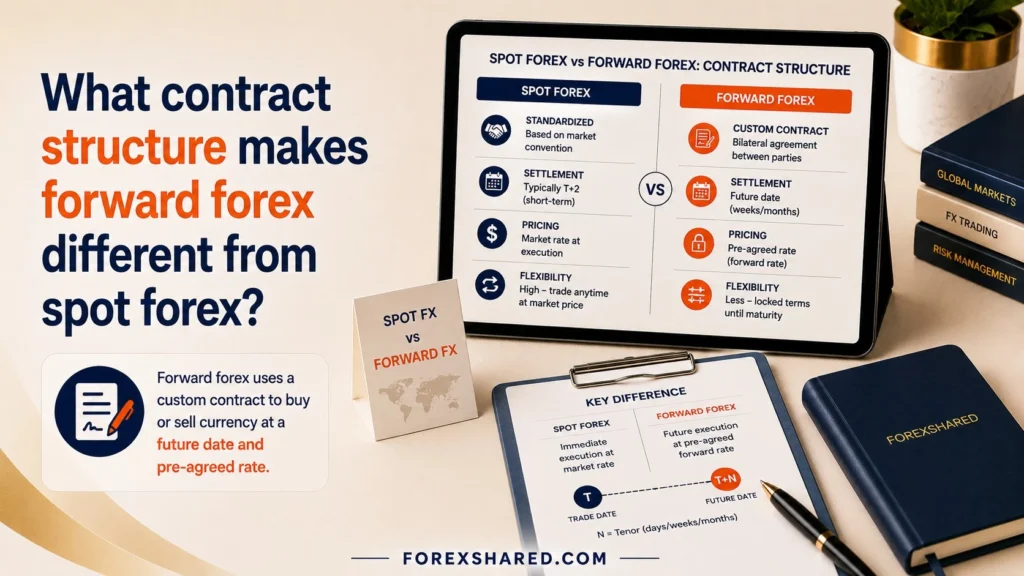
What Contract Structure Makes Forward Forex Different From Spot Forex?
An outright FX forward and deliverable institutional spot FX are both binding bilateral agreements to exchange currencies at an agreed rate. Their primary structural boundary is the contractual value date: spot settles within the applicable near-term spot window, while an outright forward settles on a deliberately selected future date beyond that window.
That later maturity creates additional structural consequences. A forward can use bespoke size and dates, its rate includes the economics of carrying two currencies to maturity, and its counterparty, valuation, funding, collateral and settlement exposure can continue for much longer than a spot trade.
For the parent explanation of outright forwards, pricing and settlement mechanics, see Forward forex mechanics.
This article is for general education only and does not constitute financial, investment, trading, legal, operational or tax advice. Product classification, enforceability, settlement conventions, pricing, collateral and regulatory treatment vary by agreement, counterparty, currency, product and jurisdiction.
- Scope matters: this comparison concerns outright deliverable institutional spot FX and outright FX forwards.
- Value date is the primary boundary: spot settles within the applicable spot window; an outright forward settles beyond it.
- Both sides are obligated: neither ordinary spot nor an ordinary forward gives one side an option-style walkaway right.
- Forward terms can be bespoke: notional, maturity, settlement form and other terms can be negotiated.
- Forward pricing is not a forecast: the forward–spot difference primarily reflects relative funding over the tenor, plus market adjustments.
What Is the Core Contract Boundary Between Spot and Forward Forex?
For a single outright institutional FX transaction, the contractual value date is the primary structural field distinguishing spot from an outright forward. The BIS defines spot as an outright exchange for value or delivery within two business days, while an outright forward settles more than two business days after the contract date. BIS-Spot2026 BIS-Forward2026
The field should not be interpreted in isolation. Pair conventions, valid business days, calendar adjustments, settlement form, product definition and whether the transaction is a single outright or one leg of a multi-leg structure also matter.
Are Both Contracts Agreed on the Trade Date?
Yes. Both contracts establish the currencies, direction, principal amounts, exchange rate, counterparties and settlement terms when the trade is executed. The difference is when performance becomes due, not when the agreement is formed.
Are Both Contracts Binding?
Yes, a validly executed spot trade and a validly executed forward create bilateral obligations, subject to the governing documentation and applicable law. Each party must deliver what it sold and receive what it bought unless the transaction is closed, amended, offset, novated or terminated under the agreement.
Is an Ordinary Forward Optional?
No. An ordinary forward does not give the buyer an option-style unilateral right to exercise or abandon the trade. A currency option instead gives its buyer the right, but not the obligation, to buy or sell a currency at an agreed rate by a specified date. BIS-Option2026
How Is a Deliverable Spot Forex Contract Structured?
A deliverable institutional spot trade obligates one party to deliver the currency it sold and the other party to deliver the reciprocal currency under the applicable near-term value-date convention. Each party is simultaneously the buyer of one currency and seller of the other.
What Is the Spot Value Date?
Spot is not universally T+2. The BIS definition covers outright exchanges for value within two business days, so T+0, T+1 and T+2 can fall within the statistical spot category. The normal contractual date still depends on the pair convention and valid business-day calendars. BIS-Spot2026
Can a Spot Date Be More Than Two Calendar Days Away?
Yes. A Friday trade with a Tuesday value date can still be T+2 because the weekend is not counted as two business days. Currency holidays can extend the calendar interval further without converting the trade into a forward.
However, an outright exchange deliberately scheduled more than two valid business days after the contract date is classified as an outright forward under the BIS statistical definition.
Does Spot Always Mean Physical Delivery?
No across every product marketed as “spot forex.” This article concerns outright deliverable institutional spot. Retail rolling spot contracts, CFDs and similar products may use book-entry, cash-settled or continuously rolled mechanics rather than actual delivery of both currency principals.
When Does the Outright Spot Contract End?
Once both deliverable currency obligations settle with finality, the outright spot contract is complete. Continuing economic exposure may remain because a participant retains the purchased currency, but that is not a continuing obligation under the original settled trade.
How Is an Outright Forward Forex Contract Structured?
An outright FX forward obligates the counterparties to exchange specified currency amounts on an agreed future value date at a rate fixed when the contract is formed. Its maturity falls beyond the applicable spot-value window.
Why Is the Future Date Part of the Contract?
The maturity determines when the exchange becomes due and allows the contract to align with a future invoice, asset purchase, investment, financing need, dividend, forecast cash flow or other exposure.
Are Forward Terms Standardised?
OTC forwards are generally not traded on organised exchanges and their contractual terms are not standardised. The parties can negotiate the currency pair, amount, maturity and settlement terms. BIS-Contract2026
This negotiated structure is examined further in Bespoke forward contracts.
Does a Forward Require an Option Premium?
An ordinary forward does not require an option-style premium for discretionary exercise rights because neither side has that discretion. The agreed forward rate contains the transaction’s core pricing economics, while bid–ask spread, dealer markup, credit charges, collateral, margin or termination costs may still apply.
How Does the Value Date Classify the Transaction?
The final confirmation should be used to determine whether the trade is a single outright spot transaction, an outright forward, an NDF, an FX swap leg or another product. Value date is the primary structural field for distinguishing spot from an outright forward, but it should be read with the product type and settlement terms.
Can T+0 or T+1 Still Be Spot?
Yes. A shorter value date remains within the broader spot category when it settles within two valid business days and is supported by the applicable market and provider arrangements.
Does Every Date Labelled T+3 Prove a Forward?
A label such as T+3 must be interpreted carefully. If it means three valid business days after the contract date, the outright transaction falls outside the BIS spot window. If the third calendar day merely reflects a weekend or holiday while the date is still within two valid business days, it may remain spot.
Which Confirmation Fields Matter?
- Product type: spot, outright forward, NDF, FX swap or another structure.
- Trade date: when the agreement and rate were fixed.
- Contractual spot date: the normal near-term value date for the pair.
- Value date or maturity: when the settlement obligation becomes due.
- Business-day convention: how non-business days affect the date.
- Settlement form: deliverable exchange, cash settlement or another method.
- Leg structure: whether the confirmation describes one outright exchange or two linked swap legs.
Why Can the Forward Rate Differ From the Spot Rate?
The forward rate is the contracted exchange rate for the future value date. Its relationship to spot is driven primarily by relative funding rates over the tenor. Covered interest parity links the returns on comparable assets denominated in two currencies, while observed deviations can reflect market frictions and balance-sheet constraints. BIS-CIP2024
What Are Forward Points?
Forward points are the quoted adjustment added to or subtracted from the spot rate to obtain the outright forward rate under the pair’s quotation convention. They are not a separate brokerage fee; they represent the forward–spot rate difference associated with tenor, relative funding and market conditions.
What Drives Forward Points?
The main inputs are the spot rate, relative interest or funding rates and time to maturity. Cross-currency basis, liquidity, credit, balance-sheet costs and transaction spreads can also affect executable pricing.
When Is the Base Currency at a Forward Discount?
When a pair is quoted as units of quote currency per unit of base currency, a higher base-currency interest rate normally implies a forward discount for the base currency, all else equal. An inverse quotation reverses the displayed direction, so the quote convention must be checked.
Is the Forward Rate a Forecast?
No. It is the contractual rate at which the counterparties agree to exchange or cash-settle the currencies on the future date. It is not a promise that the future spot rate will equal the forward rate.
How Does Customisation Make a Forward Structurally Different?
Standard spot uses the applicable near-term value convention for the pair, although shorter recognised values such as T+0 or T+1 may be available. A forward extends beyond that window and can be tailored to a future commercial or financial exposure.
Which Forward Terms Can Be Negotiated?
Depending on the market and counterparty, the parties may negotiate:
- Currency pair and quotation convention.
- Notional amount in each currency.
- Exact maturity or broken date.
- Deliverable or non-deliverable settlement.
- Fixing source and fixing date for an NDF.
- Business-day adjustment and settlement instructions.
- Collateral, credit and early-termination terms under the governing agreement.
The two most visible dimensions are examined in Custom forward size and maturity.
Does Bespoke Mean Risk-Free Flexibility?
No. Tailoring can improve hedge alignment, but it can also reduce transferability and create more confirmation, valuation, credit, collateral and operational requirements than a standardised exchange contract.
How Do NDFs and FX Swaps Fit Into the Structure?
How Does an NDF Differ From a Deliverable Forward?
A non-deliverable forward is a forward whose maturity obligation is cash-settled, often in US dollars or another agreed currency, without physical delivery of the two underlying currencies. The settlement amount is calculated using the contracted NDF rate, the agreed fixing or reference rate and the notional under the contract methodology. BIS-NDF2026
How Is an Outright Forward Different From an FX Swap?
An outright forward contains one future-dated currency exchange. An FX swap contains two linked exchanges: a near-date exchange and a reverse exchange on a later date, with both rates agreed when the swap is contracted. The two legs together form one FX swap rather than an outright forward plus a separate spot trade for reporting purposes. BIS-Swap2026
How Is a Bespoke Forward Different From Futures and Options?
A currency future is a standardised exchange-traded contract. The exchange specifies contract size, delivery or settlement terms, minimum price movement and listed maturity structure, while central clearing and margining govern the lifecycle. CME describes futures as legally binding, standardised and facilitated through an exchange. CME-Futures2026
The detailed contrast is covered in Standardized futures contracts.
Can an OTC Forward Still Require Margin or Collateral?
Yes. “Not exchange-margined” does not mean “never margined.” An OTC forward may be subject to bilateral collateral, regulatory margin, clearing, a credit-support annex or dealer-specific margin requirements.
How Does an Option Differ From Spot and Forward?
Spot and forward create mutual performance obligations. An option creates asymmetry: the buyer has the right, but not the obligation, to exercise, while the writer has an obligation if exercise occurs under the contract. The buyer normally pays a premium for that right.
Which Terms Prove the Contract Structure?
| Contract | Core Obligation | Timing | Settlement Form | Standardisation |
|---|---|---|---|---|
| Deliverable spot | Mutual exchange of two currencies. | Within two valid business days under the applicable convention. | Delivery of both currency legs. | Standard near-term value convention, subject to pair and provider arrangements. |
| Outright forward | Mutual future exchange at the contracted rate. | Deliberately selected date beyond the spot window. | Usually deliverable, depending on contract. | Bespoke OTC terms are common. |
| NDF | Binding future obligation settled by a calculated difference. | Future fixing and settlement dates. | Cash settlement in an agreed currency. | Bespoke fixing, notional and maturity. |
| FX swap | Near exchange plus linked reverse exchange. | Two value dates. | Normally two principal exchanges. | OTC negotiated structure. |
| Currency future | Binding listed contract. | Exchange-listed maturity. | Physical or financial, according to specifications. | Standardised and centrally cleared. |
| Currency option | Buyer right; writer obligation if exercised. | Specified expiry or exercise window. | Depends on contract specifications. | OTC bespoke or exchange-listed. |
What Is the Final Validation Sequence?
- Identify whether the transaction is a single outright, an NDF, an FX swap or another multi-leg structure.
- Compare the contractual value date with the valid spot-value window.
- Apply the pair’s business-day and holiday conventions.
- Confirm whether settlement is deliverable or cash-settled.
- Review notional, maturity, fixing, margin, collateral and termination terms.
- Use the governing agreement and confirmation rather than relying only on a platform label.
Conclusion
The primary structural difference between outright deliverable spot FX and an outright forward is the contractual value date. Spot settles within the applicable near-term business-day window; a forward settles on a deliberately selected future date beyond it.
Both contracts create mutual obligations, but forward maturity changes more than timing. It introduces negotiated size and date flexibility, carry-based pricing, a longer valuation and credit lifecycle, and potentially different collateral and settlement terms.
Correct classification therefore requires the full confirmation: product type, number of legs, contractual spot date, value date, business-day adjustment and settlement form. Retail “spot” labels, calendar-day counts and product names alone are not sufficient evidence.
Frequently Asked Questions
What is the main contract difference between spot and forward forex?
For a single outright deliverable FX transaction, the primary structural difference is the contractual value date. Spot settles within the applicable near-term spot window, while an outright forward settles on a deliberately selected date beyond that window.
Can a spot trade settle more than two calendar days after execution?
Yes. Weekends and currency holidays can make the contractual spot date more than two calendar days after execution. The BIS statistical definition counts business days: an outright exchange for value within two business days is spot.
Is an FX forward optional?
No. An ordinary FX forward creates binding obligations for both counterparties, subject to the governing agreement. It does not give the buyer an option-style unilateral right to exercise or walk away.
Is the forward rate a forecast of the future spot rate?
No. The forward rate is the contracted exchange rate for the future value date. Its relationship to spot is driven primarily by relative funding rates over the tenor and can also reflect basis, liquidity, credit and balance-sheet conditions.
How is an outright forward different from an FX swap?
An outright forward contains one future-dated exchange. An FX swap contains two linked exchanges: a near-date exchange and a reverse exchange at a later date, with both rates agreed when the swap is contracted.