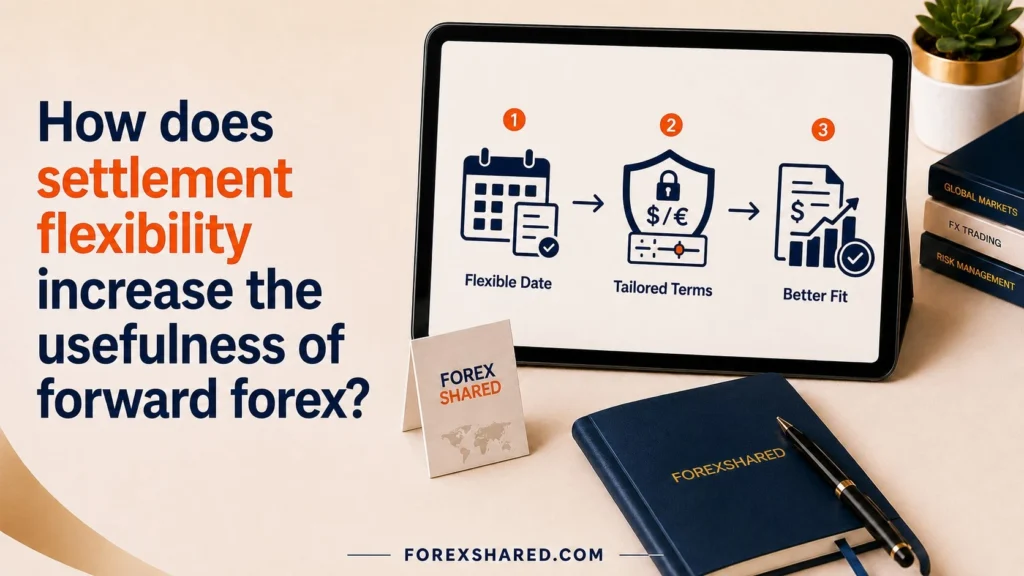
How Does Settlement Flexibility Increase the Usefulness of Forward Forex?
Settlement flexibility makes forward forex more useful by allowing the contractual value date or delivery schedule to follow the underlying commercial cash flow more closely. Exact dates, broken dates, agreed delivery windows and partial deliveries can reduce planned maturity mismatch and funding friction, while the forward remains a binding obligation with pricing and final-delivery rules fixed at inception.
The parent product and its core mechanics are explained in Forward forex settlement flexibility.
This article is for general education only and does not constitute financial, investment, legal, accounting, operational, regulatory or tax advice. Forward pricing, settlement windows, partial-delivery rights, credit terms and contractual treatment depend on the counterparty, documentation, currencies, jurisdiction and market conditions.
What does settlement flexibility mean in forward forex?
Settlement flexibility is the pre-agreed ability to select or divide delivery across clearly defined future dates without removing the forward’s binding exchange obligation. Forward contracts are generally traded outside organised exchanges and their contractual terms are not standardised, which permits negotiated structures within legal, credit, liquidity and operational limits. BIS2026
The broader design choices are covered in Custom forward terms.
Which elements can be flexible?
The contract may permit an exact non-standard value date, one or more identified delivery dates, a bounded settlement window, partial deliveries or a pre-agreed method for applying date-specific forward-point adjustments.
Which elements must remain clear?
The currency pair, aggregate amount, pricing basis, permitted dates, notice process, final settlement deadline and consequences of non-performance must be sufficiently defined at inception. Flexibility is not a later unilateral right to rewrite the trade.
Can settlement method be changed freely?
No. Deliverable or cash-settled treatment is a product-defining term. A deliverable forward cannot be assumed to convert into an NDF or another cash-settled product merely because its date or instalment schedule is flexible.
| Potentially Flexible | Contractually Defined |
|---|---|
| Value date | Permitted exact date, broken date or identified date range. |
| Delivery schedule | Eligible dates, notice requirements and final deadline. |
| Delivery amount per date | Aggregate contracted amount and remaining-balance rules. |
| Date-specific pricing adjustment | Rate, forward points or adjustment method agreed at inception. |
| Operational election | Who may elect, by which cut-off and through which confirmation process. |
Why does flexible settlement improve treasury planning?
Flexible settlement can reduce the planned date mismatch between a hedge and its commercial cash flow, lowering the need for temporary borrowing, deposits, spot trades or FX swaps. Its treasury value is explained further in Flexible settlement dates for treasury planning.
How does it reduce scheduled-date mismatch?
The forward can mature on the expected invoice, shipment, debt or investment date instead of the nearest standard tenor. When the underlying cash flow occurs as planned, less currency must be funded early or bridged after the hedge matures.
How does it change the funding profile?
A delivery window or staged schedule can divide one large funding event into smaller dated obligations. This may lower peak liquidity demand, but it does not remove the need to fund every elected delivery and the final outstanding balance.
Does alignment guarantee that no timing problem will occur?
No. A matching contractual date removes the intended maturity mismatch, but customer delays, payment cut-offs, holidays, settlement failures or changes to the commercial transaction can recreate a timing gap.
How do exact and broken-date forwards improve hedge matching?
An exact-date or broken-date forward selects the business day required by the underlying obligation instead of forcing the hedge into the nearest standard maturity. This complements the wider ability to negotiate Custom forward size and maturity.
What is the forward value date?
It is the contractual date on which the currency exchange or cash settlement becomes due. It differs from the trade date, when the parties agree the transaction.
What is a broken-date forward?
It is a forward with a specifically negotiated maturity that falls between commonly quoted standard tenors. The label refers to the irregular maturity, not to an incomplete or defective contract.
Why can the nearest standard tenor be inefficient?
A nearby standard date can require early funding, create an idle-currency balance or leave a short period that must be bridged with spot or swap transactions. The exact date can reduce that planned mismatch.
Does exact-date settlement create zero risk?
No. It can remove the scheduled maturity gap, but actual receipt timing, intraday funding, settlement finality, counterparty performance and changes to the underlying amount remain separate risks.
How does a window FX forward handle uncertain dates?
A window FX forward permits physical delivery on one or more clearly identified dates inside an agreed period, while requiring any remaining amount to be exchanged by the final specified date.
In April 2025, the CFTC’s Market Participants Division and Division of Market Oversight stated that Window FX Forwards matching the facts described in Letter 25-10 should be treated as foreign exchange forwards. The letter describes physical exchange on one or more pre-identified dates, partial deliveries, price terms established at inception and mandatory final delivery by the last date of the window. CFTC2025
Why is the window still sufficiently specific?
The eligible date or series of dates is clearly identified when the contract is entered into. The later election selects from those agreed outcomes rather than creating a new maturity outside the contract.
What happens if the hedger makes no earlier election?
Under the facts described in the CFTC letter, the remaining amount settles by the last specified date or last day of the window. The structure therefore retains a mandatory final exchange.
Is the CFTC interpretation universal law for every jurisdiction?
No. Letter 25-10 states the views of two CFTC divisions based on the described facts and does not necessarily represent the views of the full Commission or other agencies. Different facts, documentation or jurisdictions can produce a different treatment. CFTC2025
A window forward changes the permitted timing of delivery; it does not ordinarily give the hedger a right to abandon the currency exchange. Cancellation or restructuring requires a separate agreement and may create a gain, loss or charge.
How do partial deliveries support staged cash flows?
Partial delivery allows the aggregate forward amount to be fulfilled through several permitted deliveries. Each delivery reduces the outstanding balance, while the remaining amount continues under the original contract until later delivery or the final deadline.
| Delivery Date | Amount Delivered | Outstanding Balance |
|---|---|---|
| 15 March | EUR 250,000 | EUR 750,000 |
| 10 April | EUR 350,000 | EUR 400,000 |
| 30 April — final date | EUR 400,000 | EUR 0 |
Does partial delivery cancel the remaining balance?
No. The outstanding amount remains contractually due unless the parties separately amend, terminate or offset the trade.
Which cash flows suit partial delivery?
Examples include milestone payments, several invoices inside one period, staged project receipts and shipments delivered in batches. Widely separated quarterly debt payments may be clearer as a strip of separate forwards rather than one broad window.
How does the selected settlement date affect the forward rate?
The selected date changes the tenor and therefore the relevant forward points. The contract should establish at inception either the rates applicable to the permitted dates or a clear method for calculating the adjustment when a date is elected.
Why do forward points change with tenor?
The spot-to-forward difference is linked to the interest-rate relationship between the two currencies, but market forward pricing can also reflect yield-curve shape, day-count conventions, cross-currency basis, funding demand and liquidity. Forward points therefore need not change linearly with the number of days. BIS2016
Can the counterparty choose a new price later?
Not under a properly defined structure. CFTC Letter 25-10 describes price terms and the basis for any tenor adjustment as established when the parties enter the transaction.
Does a window forward require an option premium?
It does not ordinarily involve a separate option premium merely because delivery can occur on several permitted dates. However, flexibility, credit, liquidity and operational costs may be reflected in the contracted rate, spread or date-adjustment method.
Why is a window forward still different from an option?
A window forward gives bounded timing flexibility but retains a mandatory final exchange. An option gives its holder a right that may be left unexercised, subject to the option’s terms.
| Feature | Window Forward | FX Option |
|---|---|---|
| Date flexibility | Delivery may occur on permitted dates inside the agreed window. | Exercise follows the option style and expiry terms. |
| Final obligation | Remaining contracted currency must be exchanged by the final date. | The holder may allow the option to expire without exercise. |
| Price structure | Forward rate and date-adjustment basis agreed at inception. | Option premium and exercise terms apply. |
| Best fit | Cash flow is expected but its date is uncertain within a bounded period. | The cash flow itself may not occur or upside participation is required. |
How do commercial users apply settlement flexibility?
Importers, exporters and project treasuries use flexible settlement when the currency amount is expected but the operational date or delivery sequence may vary.
How can an importer use it?
A shipment payment expected between 10 and 20 July may be hedged with a window covering the approved period. The importer can select a permitted date after the invoice becomes payable, while remaining liable for the final amount even if the commercial purchase is delayed or cancelled.
How can an exporter use it?
An exporter expecting several customer receipts can use permitted partial deliveries to convert each receipt as it arrives. If a customer pays late or defaults, the remaining forward does not disappear automatically.
How can debt or project payments use it?
Several obligations inside a short defined period may suit partial deliveries. Quarterly or widely separated debt dates are often clearer as separate broken-date forwards or a forward strip because each maturity can then be priced and managed independently.
When may an option be more suitable?
An option may be more appropriate for a highly contingent acquisition, tender or project where the underlying currency need may never arise. Date flexibility cannot solve the risk that the transaction itself fails.
How does settlement flexibility compare with currency futures?
OTC forwards permit negotiated dates and amounts, while futures use listed contract sizes, expiries, exchange rules and central clearing. Neither market is universally more liquid or suitable; the result depends on the currency, tenor, contract, size and market conditions.
| Feature | Flexible OTC Forward | Currency Future |
|---|---|---|
| Amount | Negotiated, subject to dealer, credit and market constraints. | Built from one or more standard contract units. |
| Maturity | Exact, broken or window dates can be negotiated. | Listed expiry cycle defined by the contract. |
| Settlement | Deliverable or cash-settled product type agreed in the contract. | Depends on the listed contract; physical and cash settlement both exist. |
| Counterparty structure | Normally bilateral unless submitted to an eligible clearing arrangement. | Exchange-traded and centrally cleared. |
| Liquidity | Depends on pair, tenor, size, dealer access and market conditions. | Depends on contract, expiry, trading hours and market depth. |
| Main mismatch | Counterparty, legal, pricing and operational dependence. | Contract-size, expiry, quotation or settlement mismatch. |
CME’s 2026 FX Product Guide identifies major contracts such as EUR/USD, GBP/USD and JPY/USD futures as physically settled, while contracts including BRL/USD, CNY/USD and INR/USD are cash-settled. Futures therefore cannot be described as universally cash-settled. CME2026
What risks accompany flexible settlement?
Flexibility can improve hedge alignment while adding contractual and operational choices that must be controlled.
- Underlying-amount risk: the commercial exposure may fall below the remaining forward amount.
- Date risk: the cash flow may occur outside the permitted window.
- Pricing risk: different elected dates may use different pre-agreed forward-point adjustments.
- Operational risk: notices, confirmations and remaining balances can be recorded incorrectly.
- Liquidity risk: the final outstanding amount must still be funded by the contractual deadline.
- Counterparty and settlement risk: the parties remain dependent on performance, payment instructions and the chosen settlement method.
- Legal risk: unclear election rights or ambiguous date provisions can create disputes.
Settlement flexibility solves a date or delivery-pattern mismatch. It does not eliminate uncertainty in the underlying amount, counterparty performance, market pricing or whether a contingent commercial transaction will occur.
What should be validated before using a flexible forward?
The contract should be tested against the cash-flow pattern, funding plan, pricing method and operational capacity before execution.
- Confirm whether the exposure requires an exact date, broken date, window or separate forward strip.
- Define every permitted delivery date, notice cut-off and final settlement deadline.
- Confirm whether partial deliveries are allowed and how the remaining balance is recorded.
- Document the rate or forward-point adjustment method for every permitted date.
- Verify that deliverable or cash-settled product treatment is explicit.
- Stress-test a delayed, reduced or cancelled underlying cash flow.
- Assess funding requirements for each delivery and for the final outstanding amount.
- Review counterparty credit, settlement instructions and legal enforceability.
- Compare the total cost and basis risk with futures, separate forwards or an FX option.
Conclusion
Settlement flexibility increases the usefulness of forward forex by adapting a binding hedge to the timing pattern of a real commercial obligation. Exact and broken dates address known maturities, windows address bounded date uncertainty, and partial deliveries address staged payments or receipts.
The usefulness comes from better planned alignment—not from an unlimited right to change the trade. The currency pair, aggregate amount, product type, eligible dates, pricing method and final delivery obligation must remain clearly defined. Actual delays, funding needs, counterparty risk and changes to the underlying exposure can still create losses.
A flexible forward is therefore most effective when the future currency need is sufficiently certain to justify a binding obligation, while the date or delivery pattern requires more precision than a rigid standard maturity can provide.
Frequently Asked Questions
What is the difference between a window forward and an FX option?
A window forward remains a binding currency-exchange commitment. The permitted delivery date or dates may be selected within the agreed window, but any remaining amount must be exchanged by the final contractual date. An FX option gives its holder a right rather than the same mandatory final exchange obligation.
Can a deliverable forward be changed into cash settlement whenever the hedger chooses?
No. Deliverable or cash-settled treatment is a product-defining term agreed in the contract. Date or instalment flexibility does not create a unilateral right to switch a deliverable forward into an NDF or another cash-settled product.
Does an exact forward value date eliminate every timing risk?
No. It removes the planned maturity mismatch when the commercial cash flow occurs as expected, but payment delays, cut-off failures, holidays, settlement disruption and changes to the underlying cash flow can still create timing or liquidity problems.
Can partial delivery cancel the undelivered forward balance?
No. Each permitted partial delivery reduces the outstanding amount, but the remaining balance continues under the contract and must be delivered on later permitted dates or by the final contractual date unless the parties separately amend or close the trade.
Do all currency futures use cash settlement?
No. Settlement depends on the listed contract. CME’s 2026 product guide identifies many major and cross-currency futures as physically settled, while some emerging-market contracts are cash-settled.