How Do Multinationals Hedge Emerging-Market Currencies Through NDFs?
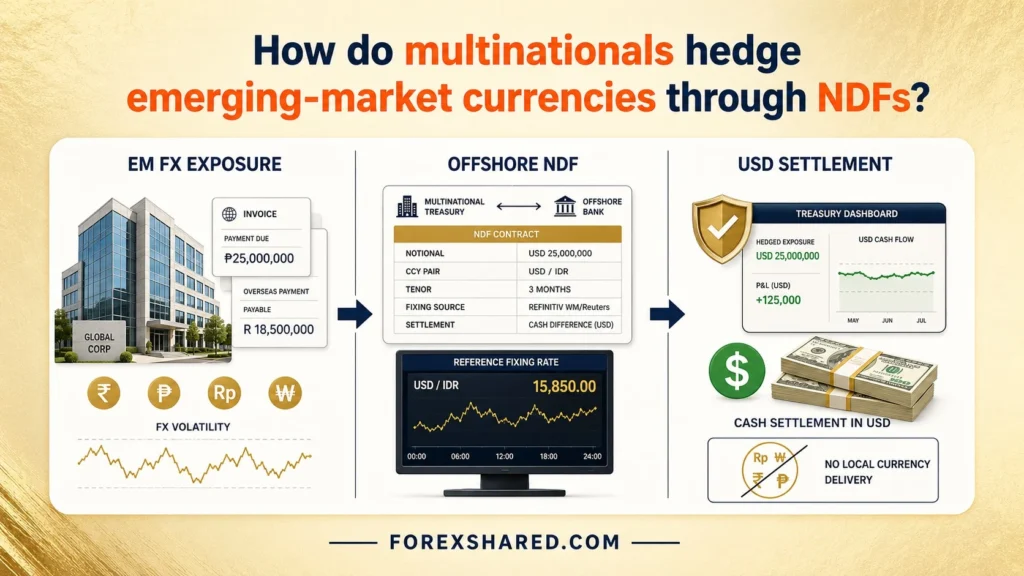
Multinationals hedge emerging-market currencies through NDFs by using a cash-settled forward contract that references the local currency’s exchange-rate movement without physically delivering that local currency. When treasury departments face strict global capital controls, they need a specialized mechanism to lock in exchange rates reliably.
The non-deliverable forward normally settles as a net cash payment based entirely on the mathematical difference between an agreed NDF rate and a later fixing or reference rate. This structure matters critically when the firm has real business exposure but highly limited access to deliverable offshore currency settlement. The Bank for International Settlements defines NDFs as cash-settled contracts that do not physically deliver the two underlying currencies at maturity.
Furthermore, the BIS explains that NDFs actively allow investors and corporate borrowers to securely take positions in currencies subject to official controls. However, retail off-exchange forex can routinely involve severe leverage and counterparty risk. The eCFR retail forex risk disclosure explicitly states that leveraged off-exchange foreign currency transactions can cause customers to lose all deposited funds and may easily lose more than deposited funds.
What emerging-market currency exposure does a multinational need to hedge?
A multinational needs to hedge emerging-market currency exposure when local revenues, operational costs, loans, dividends, royalties, intercompany payments, or planned investments are deeply sensitive to exchange-rate movement.
Emerging-market currency exposure functions as the measurable business sensitivity to a local currency’s value fluctuation. This exact exposure can aggressively affect reported corporate profit, raw cash-flow value, debt-service cost, or repatriated investment value. The firm may not functionally need physical offshore delivery of the local currency, but they desperately need price protection. NDF suitability heavily depends on whether the exposure is economic, rigorously measurable, and irrevocably tied to a restricted or hard-to-deliver currency.
Which cash flows create the NDF hedge need?
Future receivables, vendor payables, local operating income, intercompany capital charges, intellectual royalties, dividends, and localized investment exits naturally create emerging-market currency exposure. The active treasury team should meticulously identify whether the firm is directionally long or short the currency before safely interpreting the requisite hedge.
What makes emerging-market exposure harder to hedge with normal FX tools?
Some emerging-market currencies prominently feature stringent local banking restrictions, limited offshore liquidity, or rigid delivery barriers. A traditional deliverable forward may be entirely impractical or legally impossible if the currency cannot be freely delivered across offshore settlement channels.
Where does the multinational’s treasury objective shape the hedge?
A corporate treasury team may selectively hedge internal budget rates, forecast operational cash flows, massive balance-sheet exposures, transaction exposures, or major investment-exit values. The final hedge structure should seamlessly match the internal objective, because a mismatch between the hedge purpose and the actual contract terms can severely weaken the hedge’s ultimate usefulness.
Why are NDFs useful when an emerging-market currency is hard to deliver?
NDFs are useful when an emerging-market currency is hard to deliver because they completely separate exchange-rate exposure from physical currency transfer. This separation permits risk hedging even in heavily restricted zones.
The local currency powerfully remains the underlying economic reference. However, the final payment happens reliably in a settlement currency such as USD or another globally agreed currency. Controlled-currency hedging with NDFs operates fundamentally on this non-transfer premise. Because it replaces physical transfer with an offshore cash net-difference, the mechanism circumvents major local delivery restriction logic entirely. BIS defines NDFs as cash-settled instruments without physical delivery of the two underlying currencies at maturity [BIS, 2024].
The NDF solves the systemic delivery problem masterfully, but it absolutely does not remove all other operational hedge risks from the treasury pipeline.
Which delivery barrier does the NDF structure avoid?
The firm definitively does not need to physically receive or forcefully deliver the emerging-market currency offshore. The contract intelligently references the currency’s movement instead, making the hedge operationally possible when deliverable markets are frozen or heavily constrained.
What remains tied to the emerging-market currency?
The local currency still strictly drives the financial hedge result. Its exchange-rate movement conclusively determines whether the NDF creates an offsetting cash outcome. A non-delivery clause changes the settlement mechanics; it does not erase the underlying economic exposure.
Where does cash settlement replace physical currency transfer?
At maturity, the contract cleanly closes through a single net cash settlement. The settlement currency mechanically carries the payment while the emerging-market currency constantly remains the tracking reference.
How does a multinational structure an NDF hedge from exposure to settlement?
A multinational structures an NDF hedge by mapping the business exposure to a currency pair, notional amount, tenor, agreed NDF rate, fixing source, fixing date, and settlement currency.
| Stage | Treasury Question | NDF Contract Element |
|---|---|---|
| Exposure Identification | Which currency risk affects cash flow? | Emerging-market currency pair |
| Hedge Sizing | How much exposure should be hedged? | Notional amount |
| Hedge Timing | When will the exposure occur? | Tenor / maturity date |
| Price Reference | What rate anchors the hedge? | Agreed NDF rate |
| Settlement Reference | Which rate closes the hedge? | Fixing source and fixing date |
| Payment Route | Which currency carries settlement? | Settlement currency |
The hedge lifecycle moves sequentially: exposure identification, hedge sizing, hedge timing, agreed NDF rate, fixing source/date, and finally the settlement currency. IMF describes NDFs as FX forward contracts that do not require physical delivery and are cash-settled through net payments based on the difference between the maturity spot rate and the previously agreed forward rate [IMF, 2020].
Which contract element translates business exposure into hedge size?
The notional amount translates the business exposure directly into the hedge contract size. It should logically match the exposure amount closely enough to strictly avoid over-hedging or under-hedging. The notional acts as a fundamental risk-control input, not just a random speculative trade size.
What aligns the NDF with the cash-flow date?
The tenor or maturity date should align precisely with the timing of the expected operational exposure. A hedge that structurally settles prematurely too early or far too late can instantly leave a dangerous timing risk gap.
Where does the fixing rate complete the hedge?
The fixing rate supplies the final authoritative reference used for settlement. It firmly connects the agreed NDF rate to the true market reference at maturity, so the hedge result immediately becomes a net cash settlement instead of an impossible local-currency delivery.
How do notional and tenor make the NDF hedge fit the underlying exposure?
Notional and tenor make the NDF hedge fit the underlying exposure by firmly connecting contract size and maturity timing to the multinational’s real cash-flow risk.
The notional amount securely functions as the exposure-size translation layer, precisely dictating the volume of capital being hedged. The tenor operates as the timing alignment layer. Severe over-hedging, under-hedging, and massive timing gaps routinely occur when these elements are carelessly misaligned. Standard treasury policy carefully defines whether the firm systematically hedges all, part, or a rolling portion of exposure over specific financial periods.
Which exposure amount should guide the notional?
The notional should definitively be based on the rigorously forecast cash flow, committed vendor payment, future receivable amount, debt obligation, royalty stream, dividend expectation, or investment exposure. The overarching hedge should never be sized randomly.
What happens when tenor and cash-flow timing do not match?
If the NDF rapidly matures before the physical exposure executes, the firm may painfully need a replacement bridge hedge. If it matures long after the exposure, the firm may incorrectly carry unnecessary hedge exposure. Tenor mismatch can create dangerous residual risk even when the primary hedge direction is structurally correct.
Where does partial hedging fit multinational risk policy?
Some firms intentionally hedge only a specific percentage of forecast exposure to aggressively avoid over-committing against highly uncertain future cash flows. The designated hedge ratio should strongly reflect corporate forecast confidence, rigid treasury policy, and internal documentation discipline.
Why does the fixing source matter for multinational NDF hedging?
The fixing source matters for multinational NDF hedging because it heavily determines which reference rate mathematically settles the contract and how closely the hedge successfully tracks the firm’s real operational exposure.
The fixing source precisely determines the ultimate rate used for final financial comparison. The fixing date determines exactly when that specific rate is actively observed. When the fixing source misaligns with the company’s real functional conversion experience, fixing-source mismatch viciously injects basis risk directly into the balance sheet. Firms should absolutely not imply that the fixing rate effortlessly equals the firm’s true operational conversion rate.
Which fixing term controls the settlement reference?
The fixing source completely controls the final rate used for the cash-settled comparison, while the fixing date controls the exact observation point in time. Sequentially together, they systematically determine exactly how the hedge financially settles.
What makes fixing different from local currency conversion?
Fixing is fundamentally an abstract reference mechanism, while local currency conversion is an actual physical transaction executed in the local domestic market. A multinational should emphatically not casually assume the fixing rate will perfectly match its real operational conversion rate.
Where does basis risk enter the hedge?
Basis risk enters the hedge rapidly when the NDF fixing reference and the firm’s real physical cash-flow conversion simply do not move identically. The hedge can profoundly reduce macro risk but may completely fail to perfectly offset every fraction of the exposure.
How does the settlement currency separate hedge payment from local exposure?
The settlement currency separates hedge payment from local exposure because the emerging-market currency continually drives the risk while USD or another freely agreed currency efficiently carries the final net payment.
| Layer | Currency Role | Reader Interpretation |
|---|---|---|
| Exposure Layer | Emerging-market currency | Drives the hedge risk |
| Reference Layer | Fixing rate / reference rate | Determines settlement comparison |
| Payment Layer | USD or agreed settlement currency | Carries the final net payment |
BIS distinctly states that NDFs are often settled in US dollars or another pre-agreed currency [BIS, 2024]. It is absolutely critical to grasp that the settlement currency is decisively not the same as the exposure currency. Treating USD settlement as definitive proof that the hedge is merely a USD exposure is a catastrophic treasury misunderstanding.
Which currency creates the economic exposure?
The emerging-market currency definitively creates the economic exposure because its massive structural movement affects the firm’s cash flows, balance sheet, or translated valuation. This currency remains absolutely central even when it is physically not delivered.
Which currency carries the NDF settlement?
The settlement currency successfully carries the net payment execution. The payment currency is merely the logistical route for settlement, never the fundamental source of the underlying business exposure itself.
Where do readers confuse payment and exposure?
Readers routinely assume USD settlement magically means the hedge is primarily about USD valuation direction. In undeniable reality, USD may simply function as the settlement route while the restricted emerging-market currency forcefully drives all the hedge economics.
How do NDFs compare with deliverable forwards, spot FX, and natural hedges?
NDFs securely differ from deliverable forwards, spot FX, and natural hedges because they successfully hedge price exposure completely without physically delivering the restricted local currency.
| Hedge Method | Delivery Requirement | Best Fit | Main Limitation |
|---|---|---|---|
| NDF | No physical delivery of local currency | Restricted or hard-to-deliver EM currency exposure | Basis and fixing risk remain |
| Deliverable Forward | Full currency delivery at maturity | Freely transferable currency exposure | May be unavailable for controlled currencies |
| Spot FX | Immediate or near-term currency exchange | Current operational currency need | Does not solve future hedge timing alone |
| Natural Hedge | Uses matching revenues and costs | Operational offset inside the business | May not cover all exposures |
Deliverable forwards and rapid spot FX are exponentially more suitable when the firm desperately needs actual currency liquidity. Natural hedges efficiently use operational business offsets, not external derivative settlement. None of these mechanical structures imply that NDFs somehow replace necessary operational currency access.
Which hedge works best when currency delivery is required?
A deliverable forward or rapid spot transaction is vastly more suitable when the firm actually needs the tangible currency inside a local account. An NDF is functionally not designed to ever deliver the local currency physically.
What does the NDF do better than a natural hedge?
An NDF can flawlessly hedge exposure when the business currently has no internal natural offset. It uniquely creates a massive financial hedge completely outside the operating structure, but still depends heavily on rigid fixing and settlement terms.
Where does hedge selection change the treasury outcome?
The chosen hedge method definitively changes whether the firm physically receives currency, synthetically offsets price risk, or merely reduces accounting volatility. NDFs mainly solve exposure hedging issues specifically where physical delivery is highly constrained.
When do multinationals choose NDFs for emerging-market currency exposure?
Multinationals aggressively choose NDFs for emerging-market currency exposure when offshore hedge execution is heavily practical but direct local-currency delivery is restricted, expensive, fragmented, or strictly unavailable.
These global treasuries need to accurately forecast cash flows and execute securely despite severely restricted delivery parameters. A highly centralized offshore treasury access point actively bypasses extreme local-market constraints while fulfilling international settlement needs. IMF research robustly found that many Asian emerging-market NDF markets are large, rapidly growing, and often severely exceed onshore markets in raw transaction volume [IMF, 2020].
When does a multinational use an NDF for forecast cash flows?
A firm may rationally expect future robust sales, heavy operational costs, royalties, dividends, or intercompany payments locked in an emerging-market currency. The NDF effectively reduces uncertainty around the future exchange-rate impact, but the hedge must still strictly match the expected amount and exact timing.
Where does offshore treasury access make NDFs practical?
Centralized treasury teams may heavily manage global risk outside the fractured local market. The NDF gives them a legally binding contract that can securely settle offshore precisely when local market access is heavily restricted or deeply fragmented.
Which market condition makes NDFs more relevant?
NDFs intrinsically become drastically more relevant when onshore and offshore markets are intensely segmented by geopolitical or macro-regulatory walls.
What risks remain after a multinational uses an NDF hedge?
An NDF hedge can vastly reduce emerging-market currency exposure, but basis risk, forecast risk, liquidity risk, counterparty risk, policy risk, and reporting risk can still heavily remain.
| Remaining Risk | Why It Matters for Multinationals |
|---|---|
| Basis Risk | Fixing may not match the firm’s real conversion rate |
| Forecast Risk | Expected cash flow may change or not occur |
| Liquidity Risk | NDF pricing may widen during stress |
| Counterparty Risk | Settlement depends on counterparty performance |
| Policy Risk | Currency rules or market access can change |
| Accounting / Reporting Risk | Hedge treatment may depend on documentation and effectiveness assessment |
The NDF effectively curtails macro volatility but undeniably leaves institutional blind spots. IMF research definitively found that NDFs can violently price significant depreciation during market stress episodes, including devastating global shocks like COVID-19 [IMF, 2020]. Furthermore, accounting documentation and the required effectiveness-assessment heavily shape internal reporting risk [IFRS, 2019].
Which risk remains even when the hedge direction is correct?
Basis risk viciously remains even if the NDF successfully moves in the exact expected protective direction. The hedge may practically not perfectly offset the true operational exposure, which is specifically why fixing source, tenor, and notional alignment radically matter.
What happens if the forecast exposure changes?
A multinational may proactively hedge a projected cash flow that rapidly becomes much smaller, severely delayed, or fully cancelled. This catastrophic shift can leave the firm with massive excess hedge exposure, especially when aggressively hedging projected gross revenue or uncommitted costs.
Where does market stress affect the NDF hedge?
Market stress severely affects active liquidity, pricing spreads, and unpredictable offshore/onshore pricing gaps. The underlying spread behavior wildly mutates when macro panic hits the emerging ecosystem.
What examples make multinational NDF hedging easier to understand?
Examples make multinational NDF hedging vastly easier to understand by effectively showing how business exposure, notional, tenor, fixing, and settlement currency structurally work together.
| Example Type | What It Shows |
|---|---|
| Export Revenue Hedge | Protects future local-currency revenue value |
| Import Cost Hedge | Reduces uncertainty in future local-currency payments |
| Intercompany Loan Hedge | Manages currency movement on internal financing |
| Investment Exit Hedge | Protects expected repatriation value |
| Fixing Mismatch Example | Shows why basis risk can remain |
Utilizing strictly hypothetical scenarios keeps complex institutional treasury operations clean and educational, preventing the material from ever crossing into dangerous live trading advice.
What does an export revenue hedge reveal?
A multinational may heavily expect massive future revenue in an emerging-market currency. If the currency weakens severely, the translated value may fall catastrophically. An NDF can seamlessly offset part of that exchange-rate impact strictly through cash settlement.
How does an intercompany loan hedge clarify treasury use?
A parent company may maintain immense internal financing exposure heavily linked to a local subsidiary. Vicious currency movement can violently affect repayment value or reported exposure. An NDF can expertly reduce exchange-rate uncertainty without requiring local-currency delivery.
Where does a fixing mismatch example help?
The firm may settle their real physical cash flows at one localized market rate while the external NDF settles heavily against a specified, rigid offshore fixing source. If those two references diverge, the hedge may mathematically be imperfect.
How should readers interpret a multinational NDF hedge correctly?
Readers should interpret a multinational NDF hedge solely as cash-settled exposure protection, absolutely not as a promise of local-currency delivery or an illusion of perfect hedge accuracy.
| Interpretation Layer | Reader Question |
|---|---|
| Business Exposure | What cash flow, loan, dividend, royalty, or investment is being hedged? |
| Exposure Direction | Is the firm long or short the currency? |
| Hedge Size | Does notional match exposure amount? |
| Hedge Timing | Does tenor match the cash-flow date? |
| Settlement Reference | Which fixing source controls settlement? |
| Payment Layer | Which currency carries the final cash settlement? |
| Residual Risk | Could basis, forecast, or liquidity risk remain? |
Institutional treasuries rigorously treat the NDF strictly as an exposure hedge, securely matching the hedge parameters directly to the underlying business cash flow while cleanly separating the emerging-market exposure from the settlement payment.
Which layer should be read before the hedge price?
The exposure layer should actively be read first because it explicitly tells the reader what specific business risk the hedge is originally supposed to reduce. A hedge price has dangerously little meaning if the underlying exposure is completely undefined.
What does the NDF hedge not guarantee?
It absolutely does not guarantee physical delivery of the local currency, a flawless perfect offset, or reliably identical onshore and offshore prices.
Where should settlement currency sit in interpretation?
Settlement currency firmly belongs to the payment layer, while the volatile emerging-market currency permanently belongs to the exposure layer. The rigid fixing source simply connects those two layers at maturity.
What mistakes cause confusion about multinational NDF hedging?
Mistakes about multinational NDF hedging usually come from recklessly reading the contract as a physical currency-delivery tool instead of an abstract cash-settled hedge for emerging-market exposure.
Treating the NDF as if it delivers the local currency
The reader falsely assumes the multinational seamlessly receives or pays the emerging-market currency at physical maturity. The NDF actually settles the clean net difference exclusively in the highly tradable settlement currency.
Hedging before defining the business exposure
The firm chaotically focuses on the NDF quote long before defining the cash-flow amount, direction, and specific timing. Accurate exposure mapping must firmly precede contract selection.
Ignoring fixing-source mismatch
The reader dangerously assumes the official fixing rate perfectly matches the firm’s real operational conversion rate. The exact fixing source must be checked aggressively because basis risk can secretly remain.
Confusing settlement currency with hedge exposure
The reader wildly assumes USD settlement magically means the entire hedge is solely a USD transaction. USD may successfully carry the payment while the emerging-market currency definitively drives the core hedge result.
Which contract terms confirm that an NDF hedge fits multinational exposure?
Contract terms confirm that an NDF hedge powerfully fits multinational exposure by directly connecting the currency pair, notional, tenor, agreed rate, fixing terms, settlement currency, and non-delivery clause to the underlying business exposure.
| Contract Term | What It Confirms |
|---|---|
| Currency Pair | Exposure reference |
| Exposure Direction | Whether the hedge offsets long or short currency risk |
| Notional Amount | Hedge size |
| Tenor / Maturity Date | Timing fit |
| Agreed NDF Rate | Starting hedge reference |
| Fixing Date | When settlement reference is observed |
| Fixing Source | Which rate controls settlement |
| Settlement Currency | How payment is made |
| Non-Delivery Clause | No physical local-currency transfer |
Contract terms rigorously map the theoretical concepts into legal execution. The controlled currency identifies exposure, while fixing terms mechanically control precise settlement timing.
Which terms prove the hedge matches the business exposure?
The currency pair, exposure direction, notional, and tenor conclusively show whether the NDF securely aligns with the business exposure. These vital terms should flawlessly match exposure direction, absolute amount, and specific timing.
What terms separate reference from payment?
The fixing source strictly belongs to the reference layer, the settlement currency entirely belongs to the payment layer, and the robust non-delivery clause aggressively separates both from physical local-currency transfer.
Which terms distinguish treasury hedging from speculation?
A rigorously documented exposure, a defined hedge objective, notional match, and tenor match strongly support the true hedging purpose. A contract wandering without a clearly linked exposure can rapidly look vastly more like a rogue directional speculative position.
What should be validated before a multinational relies on an NDF hedge?
Before a multinational relies on an NDF hedge, it should validate the business exposure, hedge direction, notional, tenor, fixing source, fixing date, settlement currency, non-delivery language, and residual risk. Validating these parameters ensures the hedge is treated strictly as risk reduction rather than speculative off-exchange forex trading, which carries severe leverage and counterparty risks [eCFR, 2024].
| Validation Question | Pass Condition |
|---|---|
| Is there a real emerging-market currency exposure? | Business exposure is identifiable |
| Is the exposure direction clear? | Long/short currency sensitivity is known |
| Is the exposure amount measurable? | Notional can be linked to exposure |
| Does the NDF notional match the exposure size? | Hedge size is aligned |
| Does the tenor match the cash-flow date? | Hedge timing is aligned |
| Is the fixing source identified? | Settlement reference is known |
| Is the fixing date clear? | Observation timing is known |
| Is the settlement currency specified? | Payment route is clear |
| Does the contract confirm non-delivery? | Local currency is referenced, not transferred |
| Could basis risk remain? | Residual mismatch is considered |
| Could the forecast exposure change? | Forecast risk is acknowledged |
| Is the hedge being treated as risk reduction, not guaranteed profit? | YMYL safety is preserved |
Multinationals aggressively hedge emerging-market currencies through NDFs strictly because NDFs profoundly separate currency exposure protection from physical currency delivery. The volatile local currency fundamentally drives the hedge economics, the designated fixing source dictates settlement, and the offshore settlement currency fluidly carries the final cash payment.
Frequently Asked Questions
Why do multinationals use NDFs instead of regular forwards?
Regular deliverable forwards strictly mandate the physical exchange of both currencies. If a multinational operates in an emerging market with severe capital controls, physically delivering massive amounts of that currency offshore may be legally forbidden, forcing the use of cash-settled NDFs.
Does setting the notional perfectly guarantee hedge safety?
No. Even with a perfect notional match, the multinational still faces severe basis risk if the contract’s designated fixing source diverges heavily from the company’s real-world physical conversion rate on maturity day.
Can an NDF perfectly offset a canceled business invoice?
No. If the expected local-currency revenue is unexpectedly canceled by the client, the multinational is still legally bound to the NDF contract. This leaves the firm with massive unhedged speculative exposure, known broadly in treasury as extreme forecast risk.