How Do Standard, Mini, and Micro Lots Differ?
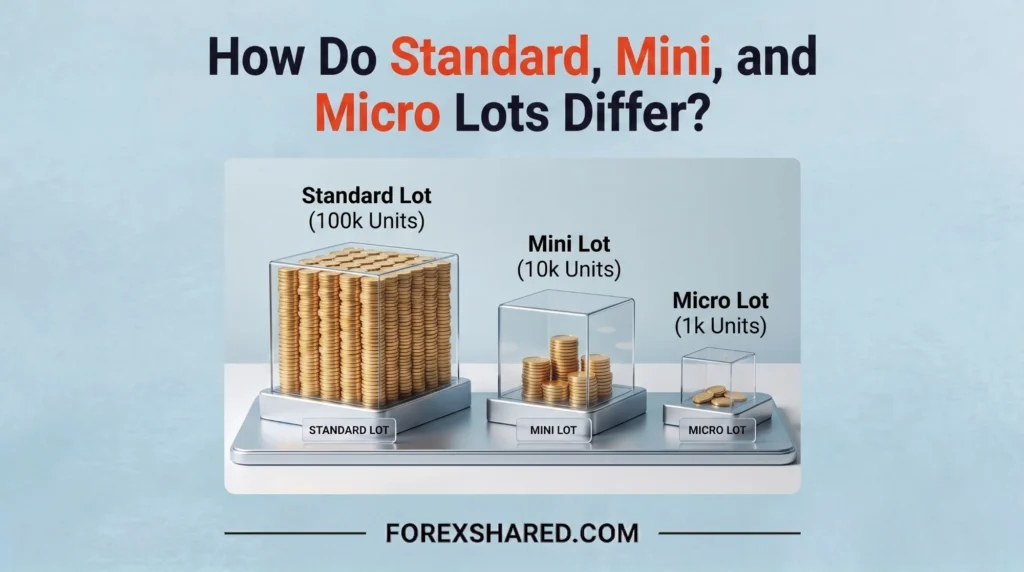
Standard, mini, and micro lots differ by the number of base-currency units they represent. The core unit ladder dictates that a standard lot equals 100,000 units, a mini lot equals 10,000 units, and a micro lot equals 1,000 units. These specific volume tiers establish the foundational baseline for all modern forex position sizing.
These lot categories create a forex position-unit ladder that structures the entire retail trading environment. Instead of navigating the market by inputting raw, complex numeric strings—like 43,250 Euros—traders universally use these standardized intervals to precisely manage trade execution and rigorously control capital exposure.
This article completely demystifies position sizing mechanics. We will examine unit comparisons, explore how different lot sizes manipulate exposure impact, and clarify platform display conventions. Furthermore, we will break down real-world examples, definitively separate lot size from margin and pip value, highlight frequent sizing mistakes, apply pre-trade fixes, and present a practical validation checklist.
This article is educational only and does not constitute financial advice. Trading foreign exchange on margin carries a high level of risk.
What Do Standard, Mini, and Micro Lots Mean in Forex?
Standard, mini, and micro lots are forex position-size categories that show how many currency units a trade controls. By grouping volume into predefined brackets, they strip away the complexity of raw numerical execution. It acts as a strict position-unit category, not a direct profit formula. When interpreting Forex lot size units, understand that the selected lot category sets the absolute starting scale of the position before any price movement ever occurs (BabyPips, IG).
Standard, mini, and micro lots are forex position-size categories that show how many currency units a trade controls.
Why Do These Lot Sizes Create Different Position Scales?
These lot sizes create different position scales because each lot category controls a different number of currency units. The physical volume deployed into the market expands or shrinks dynamically depending on the specific tier selected. Larger lots naturally inject greater volume, which usually creates larger exposure and a stronger price-movement impact on equity. Conversely, smaller lots give traders finer position-size control, allowing meticulous scaling.
Why Is a Standard Lot Considered Large?
A standard lot is considered large because it controls 100,000 base-currency units. It controls the largest unit amount among the three common categories. Due to this massive baseline, even very small market movements can feel immensely significant and rapidly exhaust available margin if unaccounted for.
Why Is a Mini Lot a Middle Position Size?
A mini lot is a middle position size because it controls fewer units than a standard lot but more units than a micro lot. Controlling exactly 10,000 units, the mini lot heavily reduces exposure compared to the standard tier, creating a stable intermediary step for active risk management.
Why Is a Micro Lot Useful for Smaller Position Control?
A micro lot is useful for smaller position control because it controls far fewer units than a standard or mini lot. Sitting at 1,000 units, micro lots proactively keep exposure small. They are exceptionally useful for learning environments, strategic testing, or strict smaller-account control.
The three lot sizes differ because each one changes the number of currency units controlled by the trade.
How Many Units Does Each Lot Size Control?
Each lot size controls a different number of base-currency units. This specific 10x geometric unit difference is the absolute core distinction separating the three primary lot sizes. Understanding this strict step-down hierarchy is mandatory, and traders must consistently confirm how their specific broker displays these exact lot entries on the execution terminal (BabyPips, IG).
| Lot Size | Common Unit Size | Relative Scale | Practical Meaning |
|---|---|---|---|
| Standard lot | 100,000 units | Largest of the three | High position scale |
| Mini lot | 10,000 units | One-tenth of standard | Moderate position scale |
| Micro lot | 1,000 units | One-tenth of mini | Smaller position scale |
The main difference is simple: standard lots control more units, mini lots control fewer, and micro lots control the smallest position size among the three.
How Does Each Lot Size Affect Exposure and Price Sensitivity?
Each lot size affects exposure and price sensitivity because the number of units controlled changes how strongly the trade responds to market movement. Assessing Lot size and trade exposure validates that the currency pair itself can remain fundamentally identical while the raw position scale dictates entirely divergent outcomes. Traders must stringently avoid judging trade safety solely by whether the margin platform algorithmically accepts the input order.
How Does a Standard Lot Affect Exposure?
A standard lot affects exposure by creating a larger controlled position than mini or micro lots. Placing 100,000 physical units directly into open market crosshairs ensures acute sensitivity to even minor trend fluctuations. Deploying standard lots amplifies profit velocity while simultaneously demanding highly developed risk awareness parameters to survive drawdown.
How Does a Mini Lot Reduce Exposure?
A mini lot reduces exposure by lowering the controlled unit amount compared with a standard lot. Controlling exactly 10,000 units, mini lots engineer a more robust operational cushion. This strategically bridges the hazardous gap between heavy interbank scale and basic fractional entry constraints.
How Does a Micro Lot Reduce Price Sensitivity?
A micro lot reduces price sensitivity by creating a smaller position-unit base. Price movement inherently generates a radially smaller account impact when vastly fewer units (1,000) absorb the hit. Micro lots heavily support algorithm verification and precise fractional sizing, but they absolutely do not render trading risk-free.
Each smaller lot size reduces the number of currency units controlled, which usually reduces exposure and price-movement impact.
When Should Traders Think Carefully About Lot-Size Choice?
Traders should think carefully about lot-size choice whenever position scale, account fit, or market volatility could change the practical risk of the trade. Mandatory evaluation must occur before entry, before proactively increasing lot size, before transitioning from demo to live capital, before switching from micro to mini lots, before volatile news strikes, and before comparing two distinct setups.
Why Does Lot-Size Choice Matter Before Entry?
Lot-size choice matters before entry because it sets the position’s starting scale before the trade begins. It intrinsically locks in your exposure tolerance prior to any market fluctuation manifesting on the chart, serving as the ultimate barrier against accidental oversizing.
Why Does Lot-Size Choice Matter When Scaling Up?
Lot-size choice matters when scaling up because moving from micro to mini or mini to standard increases unit exposure radically. The raw volumetric jump is exponential (10x per tier), and traders consistently underestimate this geometric leap. Scaling must remain structurally gradual and highly intentional.
Why Does Lot-Size Choice Matter in Volatile Markets?
Lot-size choice matters in volatile markets because fast movement can make larger position units harder to manage. Macroeconomic news events create massive spread gaps where standard lot footprints absorb punishing financial hits instantly. Smaller lots provide necessary psychological space to analyze erratic price behavior.
Traders should review lot-size choice whenever position scale, account fit, or market volatility could change the practical risk of the trade.
How Are Standard, Mini, and Micro Lots Shown on Trading Platforms?
Standard, mini, and micro lots may appear on trading platforms as whole lot entries, decimal lot entries, or actual currency-unit fields. Some legacy institutional terminals require explicit physical unit inputs, whereas the overwhelming majority of retail terminals operate on decimal-based lot nomenclature. Typically, standard lots are parsed as "1.00," mini lots strictly as "0.10," and micro lots inherently as "0.01" (OANDA Help).
Why Can Decimal Lot Entries Confuse Beginners?
Decimal lot entries can confuse beginners because they may look smaller than their real unit meaning. Inputting "0.10" visually feels negligible, but it forces exactly 10,000 base units into the market. Misreading these subtle decimal parameters consistently creates initial positions drastically larger than mathematically intended.
Why Should Traders Confirm Platform Display Rules?
Traders should confirm platform display rules because broker interfaces can show trade size differently. Inputting a clean "10" on a unit-based system buys ten physical coins; inputting "10" on a lot-based system engages a lethal 10-standard-lot order controlling 1,000,000 units. Verifying display protocols averts total capital destruction.
Lot sizes can appear differently across platforms, so traders should understand whether they are entering lots, decimal lots, or raw units.
How Do Standard, Mini, and Micro Lots Compare in Real Trading Examples?
Standard, mini, and micro lot examples show how the same forex position structure changes when the unit scale changes. Evaluating purely illustrative parameters crystalizes physical magnitude without demanding complicated trading risk formulas.
What Does a Standard Lot Example Show?
A standard lot example shows how one trade can control a large number of units. Opening exactly one standard lot dictates a fierce 100,000-unit operational foundation. In practical context, this guarantees highly elevated sensitivity where standard minor price drifts yield significant absolute dollar deviations.
Entering 1.00 on EUR/USD instantly commands 100,000 Euros, demanding a heavy collateral buffer to withstand ordinary session noise.
What Does a Mini Lot Example Show?
A mini lot example shows how traders can reduce position size without going extremely small. Registering a mini lot directly executes 10,000 units. It brilliantly serves as the tactical midpoint, allowing sophisticated position adjustments while largely avoiding the sheer financial gravity of the standard category.
Entering 0.10 on GBP/JPY engages 10,000 Pounds, suppressing positional risk by 90% when compared directly to the standard benchmark.
What Does a Micro Lot Example Show?
A micro lot example shows how smaller positions can make exposure easier to control. Triggering exactly one micro lot secures only 1,000 baseline units. Highly suited for entry-level modeling or granular algorithmic testing, micro lots provide ultimate dimensional flexibility—though they never technically eradicate market risk.
Entering 0.01 on AUD/USD commands precisely 1,000 Australian Dollars, allowing maximum scaling latitude on tighter budget accounts.
Examples show that the difference between standard, mini, and micro lots is mainly the difference in position-unit scale.
How Are Lot Sizes Different From Margin, Leverage, and Pip Value?
Lot sizes are different from margin, leverage, and pip value because lot size defines the number of units traded, while the other concepts explain effects around that position. Understanding how Pip value by position size operates dictates that changing standard, mini, and micro lots radically adjusts potential losses, yet the lot itself remains a strict unit measurement.
Why Is Lot Size Not the Same as Margin?
Lot size is not the same as margin because lot size tells the trader how many units are being traded, while margin tells the trader how much collateral is required. Margin is definitively the broker's specific security hold; identical lot sizes can compel totally separate margin requirements depending on your individual brokerage contract.
Why Is Lot Size Not the Same as Leverage?
Lot size is not the same as leverage because lot size is the trade quantity, while leverage describes exposure controlled relative to capital. Structurally reducing your lot size fundamentally lowers true exposure, completely irrespective of whether your broker grants a gigantic theoretical leverage ceiling.
Why Is Lot Size Not the Same as Pip Value?
Lot size is not the same as pip value because lot size affects trade quantity, while pip value describes the account impact of price movement. The two concepts act interdependently but are decisively distinct. The raw lot scale dictates the foundational size, which subsequently forces the pip value to scale up or down proportionally.
| Concept | Simple Meaning | What It Should Not Be Confused With |
|---|---|---|
| Lot Size | Number of currency units traded | Margin or pip value |
| Margin | Collateral required | Full trade size |
| Leverage | Exposure controlled relative to capital | Lot category itself |
| Pip Value | Money impact of one pip movement | Unit category |
| Position Size | The selected trade quantity | Broker permission |
Lot size defines position units, while pip value, margin, and leverage explain different effects created by that position size.
How Should Traders Choose Between Standard, Mini, and Micro Lots?
Traders should choose between standard, mini, and micro lots by matching the unit scale to account size, risk comfort, and the trade plan. Never select lot dimension based merely on theoretical margin affordability. Advancing along the lot-size ladder must be approached as a highly calibrated risk-control maneuver rather than a psychological milestone.
When Might a Micro Lot Fit Better?
A micro lot may fit better when the trader wants smaller exposure or needs more controlled position sizing. This category expertly facilitates precise scaling frameworks, enabling execution testing and strategic learning inside tighter equity constraints without inducing panic.
When Might a Mini Lot Fit Better?
A mini lot may fit better when the trader needs more size than a micro lot but less exposure than a standard lot. Operating perfectly as a moderate stepping stone, it yields significant enough movement to justify standard portfolio models while dodging institutional hazards.
When Might a Standard Lot Fit Better?
A standard lot may fit better only when the account and risk plan can support larger exposure. The trader must unequivocally accept that controlling 100,000 units generates aggressive monetary sway; this category forbids reckless margin exploitation and mandates vast structural equity backing.
The right lot size is the one that fits the account, trade plan, and ability to manage price movement—not the largest size the platform permits.
What Mistakes Cause Traders to Misuse Lot Categories?
Traders misuse lot categories when they confuse unit scale, platform input, and margin affordability. Identifying and systematically deleting these analytical deficiencies isolates portfolios from random liquidation events.
Why Is Treating Lot Labels as Harmless Terms a Mistake?
Treating lot labels as harmless terms is a mistake because every lot category still represents a real unit quantity. Dismissing a “mini” lot as an inherently safe construct ignores the 10,000 units operating actively beneath the hood.
Correction: Every lot category should be read by the number of units it controls.
Why Is Entering the Wrong Decimal Lot Size a Mistake?
Entering the wrong decimal lot size is a mistake because a small input difference can change the position by a large unit amount. Executing "1.00" instead of "0.10" inflicts ten times the modeled exposure instantaneously.
Correction: Confirm the platform’s lot-size field before placing the order.
Why Is Scaling From Micro to Mini Too Quickly a Mistake?
Scaling from micro to mini too quickly is a mistake because the exposure jump can be larger than the trader expects. The leap represents an extreme 1,000% volumetric expansion that can abruptly shatter stable portfolio parameters.
Correction: Increase size gradually and review how the larger unit scale changes exposure.
Why Is Judging Lot Size Only by Margin Requirement a Mistake?
Judging lot size only by margin requirement is a mistake because margin affordability does not prove that the position size fits the account. Equating collateral availability with safety ruthlessly ignores incoming pip sensitivity and exposure.
Correction: Lot size should be judged by unit exposure and risk comfort, not only by margin availability.
Most lot-size mistakes happen when traders confuse unit scale, platform input, and margin affordability.
How Can Traders Fix Lot-Size Confusion Before Entering a Trade?
Traders can fix lot-size confusion by confirming the selected lot category, unit quantity, platform display, and account fit before entering a trade. Slowing down to deliberately execute pre-trade validation creates a powerful shield against unforced execution errors.
Why Should Traders Confirm Units First?
Traders should confirm units first because unit size reveals the real quantity behind the trade. Confirming exact volumetric figures—like 1,000 or 10,000 units—neutralizes accidental oversizing. This absolute clarity drastically simplifies deciphering exposure and pip influence prior to capital deployment.
Why Is Starting Smaller Often Safer?
Starting smaller is often safer because smaller lots reduce the practical impact of order-entry mistakes and oversized exposure. Operating at a micro capacity affords practitioners invaluable breathing room to securely interpret platform displays and structural behavior without sustaining heavy financial wounds. It acts as an educational buffer.
The simplest fix for lot-size confusion is to confirm the unit scale before entering the order.
What Should Traders Validate Before Choosing a Lot Size?
Traders should validate a lot size by confirming the selected lot category, unit quantity, platform display, account fit, pip impact, and margin context.
- ☐ Is the selected lot category clear: standard, mini, or micro?
- ☐ Does the trader know how many units it represents?
- ☐ Is the platform showing lots, decimal lots, or raw units?
- ☐ Does the chosen lot size fit the account?
- ☐ Is the expected price-movement impact tolerable?
- ☐ Is margin being treated strictly as collateral, not trade size?
- ☐ Is the trader avoiding unnecessary scaling?
- ☐ Is the chosen lot size consistent with the trade plan?
The biggest mistake is treating lot size as a label instead of a unit scale. A better process starts by understanding how many currency units the trade controls. Standard, mini, and micro lots matter because they define the position-unit ladder that shapes exposure, pip sensitivity, margin context, and trade-size interpretation.
Lot Size FAQs
Does 1 standard lot equal the same amount of risk on every pair?
No. While 1 standard lot always equates to precisely 100,000 units of the base currency, the resulting cash risk fluctuates significantly depending on the specific pair's pip value and current quote currency conversion rate.
Why is my lot size input failing or generating unexpected exposure on my platform?
You must rigorously verify your interface's display protocol. If you input '1.00' on an institutional platform designed strictly for raw units, it executes exactly one unit. However, on MT4 or MT5, '1.00' executes a full 100,000-unit standard lot.
Can I execute a trade that is a fraction of a micro lot?
This capability is strictly dependent on individual broker offerings. Nano lots (100 units or 0.001 decimal inputs) allow this granular control, but the overwhelming majority of retail brokers enforce a strict minimum order parameter of 0.01 (micro lots).