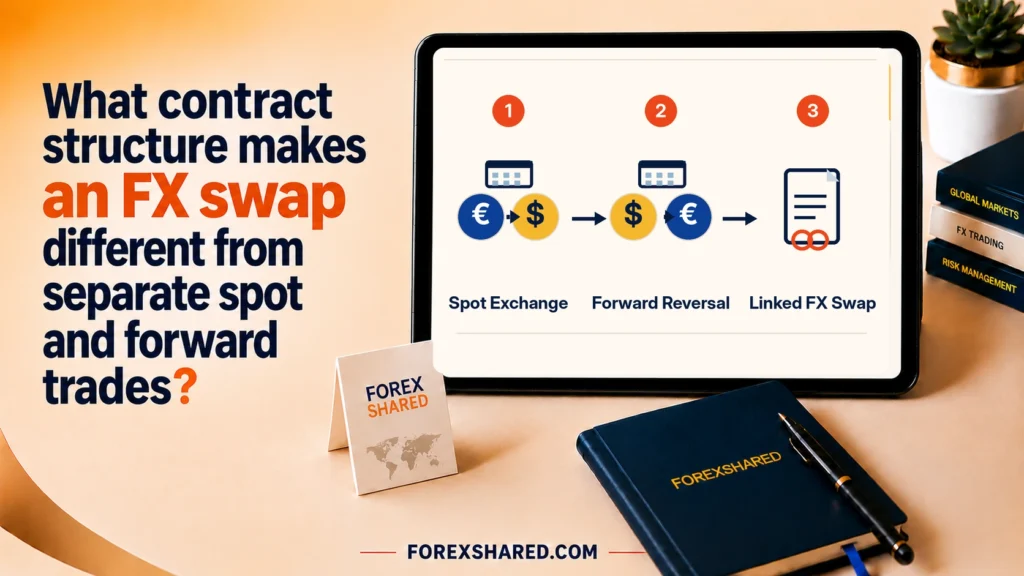
What contract structure makes an FX swap different from separate spot and forward trades?
An FX swap differs because its initial currency exchange and later reverse exchange are linked when the transaction is entered. The near leg and far leg belong to one coordinated arrangement: the same currency pair is exchanged in opposite directions on two dates, with the pricing terms established from inception.
A standalone spot transaction plus an opposite forward can reproduce very similar, and sometimes effectively identical, currency cash flows. That does not by itself create the same contract structure. Economic similarity is not contractual identity. Current industry usage also requires a further distinction between a single FX Swap contract and two component FX contracts negotiated together as one economic package.
This article explains the near leg, far leg, simultaneous agreement, same-currency reversal, counterparty linkage, economic replication, package structures, forward-forward variants, swap points, post-near-leg lifecycle, settlement, reporting and the classification tests needed to distinguish a genuine linked FX swap arrangement from independent spot and forward trades.
This article is for general education only and does not constitute financial, investment, trading, legal, regulatory, accounting or tax advice. FX contract classification can depend on actual execution, confirmation, documentation and reporting arrangements. Verify the governing contract and applicable rules before making operational or legal conclusions.
What Is the Core Contract Structure of an FX Swap?
The core structure is a linked near exchange and later reverse exchange established together as one coordinated FX arrangement. The parent mechanics are covered in Forex swap mechanics.
What does the near leg create?
The near leg creates the initial currency exchange. For example, one party may sell EUR and buy USD on the first settlement date.
The broad term is near leg rather than spot leg because not every FX swap starts on the conventional spot date. The first exchange can occur on another eligible date.
What does the far leg create?
The far leg creates the reverse currency exchange. If the near leg sells EUR and buys USD, the far leg sells USD and buys EUR.
The reversal is not an unrelated hedge added later. It is a contractual component of the original linked arrangement.
What connects the legs?
The legs are connected by common currencies, opposite directions, linked settlement dates, linked pricing and simultaneous negotiation as one economic arrangement.
The classic BIS definition describes parties that agree to exchange currencies and to resell or repurchase the same currency later with the same counterparty at an agreed rate. BIS FX Swap Structure
Why is the far leg not a later trading decision?
The far leg is a committed far leg because its reverse exchange already exists when the FX swap is entered.
If a trader executes the first currency exchange today and only later decides whether to enter an offsetting forward, that later discretionary decision is not the original FX swap structure.
Two currency exchanges alone do not define an FX swap; their pre-arranged linkage does.
How Does a Separate Spot Trade Differ From the Near Leg of an FX Swap?
A separate spot trade is an independently executed currency exchange, while the near leg of an FX swap is the first settlement event inside a larger arrangement that already includes a reverse far leg.
What does a standalone spot trade do?
A standalone spot trade exchanges one currency for another according to the applicable spot settlement convention.
Once that standalone spot contract settles, its contractual purpose is complete. It does not by itself create a later reversal obligation.
What does the near leg of an FX swap do?
The near leg can create the same immediate principal flows as a spot transaction, but it already carries a contractual or package link to the later reverse exchange.
That linkage gives an otherwise spot-like cash flow a different role inside the transaction lifecycle.
Why does that linkage matter?
The participant is not simply acquiring Currency B in exchange for Currency A. It is simultaneously committing to reverse that exchange later under the agreed far-leg terms.
The first cash flow therefore cannot be classified correctly without considering the linked second leg.
Is the near leg therefore economically identical to spot?
At the immediate cash-flow level, it can be. At the contract level, it is not an independent spot trade when it forms one leg of a linked FX swap arrangement.
This is the first example of the article’s governing rule: cash-flow similarity does not establish contract identity.
How Does a Separate Forward Differ From the Far Leg of an FX Swap?
An outright forward is a standalone agreement for one future currency exchange, while the far leg of an FX swap is the future exchange specifically created to reverse the swap’s near leg. See Forward forex contracts for the standalone instrument.
What does an outright forward create?
An outright forward creates one future exchange of Currency A against Currency B on a specified future date at a rate agreed when the forward is entered.
No linked near exchange is required for an outright forward to exist.
What does the FX swap far leg create?
The FX swap far leg creates a future exchange that reverses the currency direction established on the near leg.
Its meaning therefore depends partly on the first leg: the far leg closes the temporary currency exchange created earlier.
Why is that distinction important?
An outright forward has independent contractual existence, whereas the FX swap far leg originates as one component of a coordinated two-leg arrangement.
Two future cash flows may look identical at a given lifecycle point while having different contractual origins.
What happens after the near leg settles?
After the near leg settles, its settlement obligation is completed and only the far reverse exchange remains outstanding.
BIS notes that once the spot or near leg is complete, the remaining FX swap position is economically indistinguishable from an outright forward. BIS FX Swap Lifecycle Analysis
Does that mean the original instruments were identical?
No. At inception the FX swap contained two linked legs, while the outright forward contained one future exchange.
Remaining exposure after one leg has settled is a lifecycle question. It does not rewrite the original transaction structure.
| Stage | FX Swap | Outright Forward |
|---|---|---|
| Inception | Near + far | Future leg only |
| Before near settlement | Two obligations | One obligation |
| After near settlement | Far leg only | Forward leg |
| Remaining exposure | Forward-like | Forward |
| Original structure | Linked two-leg | Single-leg |
Why Must Both FX Swap Legs Be Agreed at Inception?
Both FX swap legs must be agreed at inception because the defining swap structure is a committed initial exchange plus a committed reverse exchange, not a first trade followed by a possible later hedge. The dedicated linkage is explained in Near leg and far leg agreement.
What terms are established when the swap is entered?
The transaction establishes the currency pair, near direction, reverse far direction, principal amounts, near date, far date, near pricing and far pricing or swap-point relationship.
The actual confirmation can express those elements in different formats, but the economic architecture requires both legs to be identifiable from inception.
Why can the far leg not be optional?
Without a committed reverse exchange, the first trade is only an outright currency exchange rather than a completed FX swap structure.
A possible future intention to hedge is not equivalent to a contractual far leg.
What happens if a trader buys spot today and independently decides next month to sell forward?
Those are two separate trading decisions and two separate contracts.
The later forward may economically offset the earlier spot position, but it does not retroactively transform the original spot transaction into an FX swap.
What if the spot and forward are negotiated together?
If the near and far exchanges are negotiated together, the actual construction must then be identified as either a single FX Swap contract or a linked two-contract package.
Execution records, confirmations, documentation and reporting treatment help determine which construction was actually concluded.
Why Must the Two Legs Reverse the Same Currency Exchange?
The two legs must reverse the same currency exchange because a conventional FX swap temporarily changes one currency position and later restores the opposite principal flow using the same currency pair.
What does reversal mean?
Reversal means the currency direction switches between the two dates. If the near leg sells EUR and buys USD, the far leg sells USD and buys EUR.
The second exchange therefore unwinds the first currency conversion rather than adding a second exposure in the same direction.
Can both legs buy USD?
Not in one conventional FX swap. Buying USD and selling EUR on both dates creates two same-direction currency exposures rather than an exchange followed by a reversal.
Two trades can share a currency pair without forming a swap if their economic directions do not reverse.
Can the currency pairs differ?
Not within one conventional FX swap. Both exchanges involve the same two currencies.
A EUR/USD transaction followed by GBP/USD is not the reverse leg of one EUR/USD FX swap, even if the dates or amounts happen to be related operationally.
Why does this matter economically?
The opposite direction makes the currency conversion temporary rather than permanent.
The near leg changes which currency is held for a period; the far leg restores the reverse principal flow under the linked arrangement.
Why Does the Classic FX Swap Use the Same Counterparty for Both Legs?
The classic single-contract FX swap uses the same counterparties on both legs because one bilateral arrangement binds the initial exchange and later reversal into one reciprocal two-date relationship.
Who is obligated on the near leg?
The same two swap counterparties owe the opposing currency principals on the near settlement date.
Each party is simultaneously buyer of one currency and seller of the other according to the agreed near-leg direction.
Who is obligated on the far leg?
The same pair of counterparties reverses the exchange on the far settlement date in the classic single-contract form.
The far-leg rights and obligations arise from the same bilateral arrangement that created the near leg.
Why does this matter?
Same-counterparty linkage creates one reciprocal two-date contractual relationship rather than two unrelated bilateral relationships.
This affects the classic structure of confirmation, counterparty exposure, amendment, closeout and lifecycle processing.
What if spot is with Bank A and forward is with Bank B?
The combined cash flows can still resemble an FX swap if the currencies, notionals, directions, dates and rates are aligned.
However, the counterparty structure differs, so the participant has not reproduced the same classic single-contract FX swap relationship.
What does BIS identify as the key difference?
BIS explains that a spot transaction plus a forward can create the same economics as an FX swap, while the classic swap combines the two transactions into one contract with the same counterparty.
This comparison is powerful but must be kept within its scope because current industry usage also recognises linked two-contract packages. BIS Missing Global Debt Analysis
Can Separate Spot and Forward Trades Replicate an FX Swap Economically?
Separate spot and opposite forward trades can replicate an FX swap economically when their currencies, notionals, directions, dates and prices are deliberately aligned, but replication does not make the contracts structurally identical. The dedicated comparison is Swap versus separate spot and forward contracts.
What trades would be required?
A spot/forward replication could buy USD and sell EUR on the spot transaction, then sell USD and buy EUR on the matching forward.
The directions must be opposite and the principal amounts and dates must be aligned with the intended swap cash flows.
What cash flows can this reproduce?
If currencies, notionals, directions, settlement dates and pricing are precisely matched, the separate contracts can reproduce cash flows closely resembling a spot/forward FX swap.
Economic exposure alone therefore cannot reliably determine whether the original arrangement was a swap or two trades.
Why are the contracts still different?
Separate transactions can have separate trade IDs, confirmations, counterparties, amendment rights, termination rights, operational workflows and reporting treatment.
Those differences can remain even when the economic principal flows happen to match exactly.
What is the correct principle?
The correct principle is: Same Economics ≠ Same Contract.
Instrument identity should be based on how the obligations were created and linked, not merely on the final pattern of currency payments.
| Feature | Single FX Swap | Separate Spot + Forward |
|---|---|---|
| Initial exchange | Yes | Yes |
| Future reversal | Yes | Yes |
| Cash flows can match | Yes | Yes |
| Negotiated together | Yes | Not necessarily |
| Same classic counterparty | Yes | Not required |
| Independent modification | Structurally linked | More possible |
| Contract identity | FX swap | Two FX contracts |
What Is the Difference Between a Single FX Swap Contract and a Two-Contract Package?
A single FX Swap contract contains the linked near and far exchanges inside one contract, while a two-contract package contains separate component contracts that were negotiated together as one economic agreement.
Can an FX swap be documented as one contract?
Yes. Current UK EMIR reporting guidance expressly recognises an FX Swap concluded as a single contract.
Where that construction applies, the FCA says the transaction is reported in a single FX Swap report. FCA UK EMIR FX Swap Reporting Guidance
Can two FX contracts be negotiated together as one economic package?
Yes. Industry usage can also call two component FX contracts an FX swap when the near and far legs were negotiated together as the product of one economic agreement.
Economic linkage can therefore exist even though the component contracts remain distinct for reporting and lifecycle purposes. FCA UK EMIR FX Swap Reporting Guidance
How can a spot/forward package be treated?
Under current UK EMIR guidance, reporting follows the actual component contracts and their reportability. In a spot/forward package, the reportable forward component is linked using package information where applicable.
The reporting detail supports the structural distinction but should not be turned into a general legal conclusion for every jurisdiction.
Why does this matter for the title?
The title requires three structural levels to remain separate: Single FX Swap Contract, Linked Two-Contract Package and Independent Spot + Forward Trades.
Calling every linked arrangement “one legal contract” would be too broad, while calling every spot-plus-forward pair an FX swap would also be wrong.
| Structure | Negotiated Together? | One Contract? | Economic Linkage? |
|---|---|---|---|
| Single FX Swap | Yes | Yes | Yes |
| Two-Contract Package | Yes | No | Yes |
| Independent Spot + Forward | Not necessarily | No | Only if deliberately created later |
| Standalone Forward | No near leg | Yes | No swap linkage |
The real distinction is the legal and operational linkage of the two legs, not merely the existence of two cash flows.
Does an FX Swap Always Mean Spot Plus Forward?
No. Spot/forward is the most intuitive FX swap example, but the general structure is a linked near exchange plus a later reverse exchange, so forward/forward and other short-date combinations can also qualify.
What is a spot/forward FX swap?
A spot/forward FX swap uses a spot settlement date for the near leg and a later forward settlement date for the reverse far leg.
This is the common textbook example, but it is only one timing configuration within the wider FX swap category.
What is a forward/forward FX swap?
A forward/forward FX swap uses a future date T₁ for the near exchange and a later future date T₂ for the reverse exchange, with T₂ later than T₁.
Both forward-dated legs are agreed when the swap is entered. BIS 2025 reporting guidelines explicitly include forward/forward swaps within the FX swap category. BIS Triennial Survey Guidelines, 2025
What other short structures can qualify?
Short-date structures can include overnight, tomorrow/next and spot/next arrangements when the two currency exchanges remain linked and opposite in direction.
BIS statistical guidance includes these short-term swap forms while preserving the same two-exchange structural definition. BIS Triennial Survey Guidelines, 2025
What remains constant across all variants?
The constant structure is an initial or near exchange, a pre-agreed reverse exchange and contractual or package linkage between the two.
The first date can change without changing the central identity test.
How Do Swap Points Link the Near and Far Legs Without Defining the Contract by Themselves?
Swap points link the pricing of the near and far legs by expressing the rate differential between them, but they do not determine whether two transactions are contractually an FX swap.
What do swap points represent?
In simplified form, Swap Points = Far Rate − Near Rate, subject to the currency pair’s quotation convention.
The numerical scaling of quoted points can vary, so the market convention must be known before converting points into the far exchange rate.
What role do they play in the contract?
Swap points express the pricing difference between the near and far legs.
They provide a compact way to relate the reversal rate to the initial exchange rate without changing the fact that both legs are separately identifiable settlement obligations.
Why are they useful operationally?
Dealers can quote a near or spot rate plus or minus swap points to derive the far rate under the relevant convention.
The sign convention must be interpreted for the specific pair and quote format.
Do swap points make two independent trades an FX swap?
No. Independent spot and forward transactions can imply exactly the same rate differential.
Swap points describe pricing between two dates; contract identity still depends on linkage, execution and documentation.
Pricing linkage supports the swap; contractual linkage defines its structure.
What Happens to the FX Swap Structure After the Near Leg Settles?
After the near leg settles, the first exchange obligation is complete and only the pre-agreed far reverse exchange remains outstanding, making the remaining economic exposure forward-like.
What exists before the near-leg settlement?
Before near-leg settlement, the transaction lifecycle contains two outstanding settlement obligations: the near exchange and the later reverse far exchange.
Both obligations originate from the linked arrangement entered at trade inception.
What happens when the near exchange is completed?
The first settlement obligation is satisfied when both near-leg currency principals are exchanged as required.
Completion of that leg reduces the outstanding lifecycle to the future reverse exchange.
What remains?
Only the far-leg reverse exchange remains outstanding.
The participant still has the obligation to perform that future currency exchange at the already established far-leg terms.
What does BIS say about this remaining position?
BIS describes the remaining position after the spot leg is complete as economically indistinguishable from an outright forward.
This statement concerns the residual economic exposure, not the original instrument identity. BIS FX Swap Lifecycle Analysis
Why does this not erase the original structural distinction?
The original transaction was created with two linked legs, so settlement of one leg does not rewrite the history or construction of the arrangement.
Instrument structure at inception and remaining economic exposure later in the lifecycle answer different questions.
How Do Settlement Obligations Differ Between a Linked Swap and Separate Trades?
A linked FX swap and separate spot-plus-forward trades can both produce two principal-exchange dates, but the settlement obligations differ in how they were created, coordinated and documented.
How many principal-exchange dates does an FX swap have?
A conventional deliverable FX swap normally has two principal-exchange dates: the near settlement date and the far reverse settlement date.
The exact dates depend on the timing structure, so near does not necessarily mean spot.
Can separate spot + forward trades also produce two exchange dates?
Yes. An independent spot transaction and an independent forward can also create two currency-exchange dates.
Therefore, two settlement dates by themselves do not define an FX swap.
What differs operationally?
In a linked swap or package, the payment obligations belong to one coordinated arrangement. In independent trades, each settlement belongs to its own independently created contract.
The difference can affect how the positions are confirmed, amended, terminated, novated, processed and reported.
Why does that distinction matter?
Contract construction can affect lifecycle rights and obligations even when payment counts and economic cash flows look similar.
Operational implications can include confirmation, amendment, termination, novation, reporting, counterparty exposure and closeout. Those implications should be assessed from the actual documentation rather than inferred universally.
Why Does Regulatory Reporting Help Reveal the Contract Structure?
Regulatory and statistical reporting can reveal how the transaction was actually constructed because reporting treatment often follows whether the arrangement is one swap, a linked package or separate component contracts.
How does BIS turnover reporting treat an FX swap?
BIS 2025 turnover guidelines treat an FX swap as one swap transaction for turnover reporting rather than separately counting the short leg as an independent spot transaction.
The guidelines explicitly include spot/forward, forward/forward and short-term swap variants, and instruct reporters to report the swap only once using the long leg as the basis. BIS Triennial Survey Guidelines, 2025
Why does that matter conceptually?
It matters because the near leg is treated as part of the swap rather than as an unrelated spot transaction for the survey’s turnover classification.
Statistical methodology is not itself the legal definition of every contract, but it reinforces the idea that a swap is a linked arrangement rather than merely two coincidentally matching payments.
How does current UK EMIR guidance add nuance?
Current UK EMIR guidance says reporting depends on how the transaction was actually concluded by the counterparties.
A single FX Swap contract is reported as one swap, while two component FX contracts negotiated together as one economic agreement are reported as separate component reports with package linkage where applicable. FCA UK EMIR FX Swap Reporting Guidance
What should the reader learn from this?
The reader should not classify a transaction from cash flows alone.
Where classification matters operationally, check execution, confirmation, documentation and reporting structure because those records can show whether the legs were concluded as one contract, a linked package or independent trades.
What EUR/USD Example Shows the Difference Most Clearly?
A EUR/USD example shows that identical-looking currency flows can arise from different contract structures, so the decisive question is whether the near and far exchanges were linked when the arrangement was created.
How would a single FX swap be structured?
Assume EUR/USD = 1.1000 on the near leg, a three-month far rate of 1.0950 and a EUR 10 million notional. At inception, both exchanges are agreed as one linked FX swap.
Near Leg: sell EUR 10 million and buy USD 11 million at 1.1000. Far Leg: three months later, reverse USD into EUR at the pre-agreed 1.0950 far rate. The exact far-leg currency amounts follow the agreed notional and contract convention.
How could separate trades replicate this?
The participant could instead execute a EUR/USD spot trade and a separate opposite three-month EUR/USD forward with matched currencies, dates, directions and pricing.
If the forward is sized and priced to match the intended reversal, the economic principal flows can closely reproduce the FX swap.
What cash-flow difference may exist?
Potentially none material if all relevant terms are precisely matched.
The fact that cash flows can match is exactly why cash-flow comparison alone is an insufficient classification test.
What structural difference remains?
The single FX swap is one linked arrangement, while the replication remains two independent contracts unless the trades were deliberately negotiated and documented as a package.
Contract linkage, not cash-flow resemblance, remains the structural distinction.
What if the spot is Bank A and forward is Bank B?
The currency cash-flow profile can still resemble the swap, but counterparty linkage differs.
The classic same-counterparty single-contract structure has not been reproduced because the first obligation is bilateral with Bank A and the second with Bank B.
| Item | Single FX Swap | Separate Replication |
|---|---|---|
| Initial EUR sold | EUR 10m | EUR 10m |
| Initial USD received | USD 11m | USD 11m |
| Future reversal | Yes | Yes |
| Pricing can match | Yes | Yes |
| Cash flows can match | Yes | Yes |
| One linked contract | Yes | No unless specifically packaged |
| Classic counterparty linkage | Same | May differ |
| Structural identity | FX swap | Spot + forward |
How Should You Classify a Transaction as an FX Swap Rather Than Separate Trades?
Classify the transaction by testing whether two opposite exchanges of the same currency pair were agreed together with linked dates and pricing, then determine whether they form one contract, a linked package or independent trades.
Are there two opposite currency exchanges?
If there are not two opposite currency exchanges, the transaction is not a conventional FX swap.
A one-leg forward or one spot conversion does not satisfy the two-leg structure.
Do both exchanges involve the same currency pair?
If the two exchanges do not involve the same currency pair, they do not form one conventional FX swap.
The far leg must reverse the same two currencies used on the near leg.
Is the second exchange the reversal of the first?
If the second exchange does not reverse the first, the pair of trades is not a conventional FX swap.
Same-direction trades increase or repeat the currency exposure rather than reverse the initial principal exchange.
Were both legs agreed together?
If both legs were agreed together, continue the classification analysis. If they were not, they are likely independent trades rather than one original FX swap arrangement.
Agreement together is the central timing test because the far leg must exist from inception.
Are near and far dates established from inception?
Verify both dates from the execution or confirmation record.
A later date chosen only after the first transaction has settled indicates a subsequent trading decision rather than the original linked swap structure.
Are the exchange rates or pricing terms established from inception?
Verify the near rate and the far rate, or the near rate plus the swap-point relationship used to establish the far rate.
The far pricing should arise from the original arrangement rather than from a future discretionary quote request.
Is there one contract or a two-contract package?
Check the execution record, confirmation, documentation, package identifiers and reporting treatment.
These records help distinguish a single FX Swap contract from two component contracts that were negotiated together as one economic package.
Are both legs with the same counterparty?
For the classic single-contract structure, yes: the same counterparties perform the near and far exchanges.
If the legs use different counterparties, the cash flows may still replicate swap economics, but the same classic bilateral contract has not been reproduced.
What is the correct classification sequence?
The correct sequence is: identify Currency A and Currency B; identify near and far legs; confirm the same pair and opposite directions; confirm both legs were agreed together; verify both dates and pricing; determine single contract versus package; verify counterparty structure; and check reporting or documentation where classification matters operationally.
This sequence prioritises contract construction before economic resemblance.
How Can Traders and Treasury Teams Avoid Misclassifying FX Swap Structure?
Traders and treasury teams can avoid misclassification by separating economic replication from contractual identity and checking whether the two opposite exchanges were actually linked at inception.
Why is “spot today + forward later = FX swap” incomplete?
It is incomplete because both legs must belong to the same pre-arranged economic structure.
A forward chosen later as an independent hedge does not retroactively transform the earlier spot transaction into an original FX swap.
Why is “same cash flows = same contract” incorrect?
It is incorrect because contract identity can depend on execution, documentation, counterparties, contractual linkage, modification rights and lifecycle mechanics.
Matched payments can arise from structurally different transactions.
Why is “every FX swap is one legal contract” too broad?
It is too broad because current UK EMIR guidance recognises both single FX Swap contracts and linked component contracts negotiated together as one economic package.
The actual construction must therefore be verified rather than assumed from the product label. FCA UK EMIR FX Swap Reporting Guidance
Why is “FX swap always equals spot + forward” incorrect?
It is incorrect because forward/forward, overnight, tomorrow/next and spot/next structures can also satisfy the linked two-exchange definition.
The structural rule is broader than the most familiar spot/forward example.
Why is “after the near leg settles it was always just a forward” incorrect?
It is incorrect because remaining exposure and original instrument structure are different concepts.
The residual far leg can be forward-like after settlement of the near leg even though the original transaction began as a linked two-leg FX swap.
Why is “swap points define instrument identity” incorrect?
It is incorrect because swap points describe the pricing difference between the near and far rates rather than whether the two obligations were contractually linked.
Independent spot and forward trades can imply the same rate differential without becoming the same contract.
What should be verified before calling two FX trades an FX swap?
Verify that two exchanges exist, the same currency pair is used, directions reverse, both legs were agreed together, near and far dates and pricing were established, and the transaction construction is identifiable as one FX Swap contract or a linked package.
Where relevant, also verify counterparties, confirmation, package identifiers, lifecycle treatment and reporting structure.
- Two currency exchanges exist.
- Both exchanges use the same currency pair.
- The second leg reverses the first.
- The near date is established.
- The far date is established.
- Both legs were agreed together.
- Near pricing is known.
- Far pricing or the swap-point relationship is known.
- Classic same-counterparty linkage is identified where relevant.
- Single contract versus linked package is identified.
- Independent trades are not mislabelled as the original swap.
- Forward/forward structures are not excluded.
- Swap points are not treated as the contract-identity test.
- Post-near-leg forward equivalence is treated as lifecycle evolution.
- Reporting statements follow the actual transaction construction.
Conclusion
The structure that distinguishes a classic FX swap is the pre-arranged linkage of two opposite exchanges of the same currencies from inception.
The near leg exchanges Currency A for Currency B, while the far leg later reverses Currency B into Currency A. The currencies, opposite directions, near and far dates, and near and far pricing are established together rather than being created by unrelated trading decisions.
A separate spot transaction plus an opposite forward may reproduce similar or even effectively identical economic cash flows. Economic Replication ≠ Contractual Identity. Industry usage also requires a distinction between a single FX Swap contract, a linked two-contract package and independent spot-plus-forward trades.
An FX swap is therefore distinguished by how its two opposite currency exchanges are linked from inception. Separate spot and forward trades can replicate the economics, but unless they are concluded as a single swap contract or deliberately linked package, they remain separate transactions. The defining issue is contractual linkage, not cash-flow resemblance alone.
FAQs
What makes an FX swap different from simply buying currency spot and selling it forward?
The defining difference is the pre-arranged linkage of the near and far exchanges. A separately executed spot trade and later forward can reproduce similar cash flows, but unless the trades were concluded as one FX Swap contract or deliberately linked package, they remain separate transactions.
Are both legs of an FX swap agreed at the same time?
Yes. In the FX swap structure, the near exchange and later reverse exchange are established when the arrangement is entered, subject to the actual execution, confirmation and documentation structure.
Does every FX swap have a spot leg?
No. FX swaps can be spot/forward, forward/forward or short-date structures such as overnight, tomorrow/next and spot/next. The defining feature is the linked initial exchange and later reverse exchange.
Can two separate contracts still be called an FX swap?
Yes. Current UK EMIR guidance recognises industry use of the term FX swap for both a single FX Swap contract and two component contracts negotiated together as one economic package. That package must remain distinct from two completely independent trades.
What happens to an FX swap after its near leg settles?
After the near leg settles, only the far reverse exchange remains outstanding. Its remaining economic exposure is forward-like, but that lifecycle state does not change the fact that the original transaction was created as a linked two-leg arrangement.
3 Responses