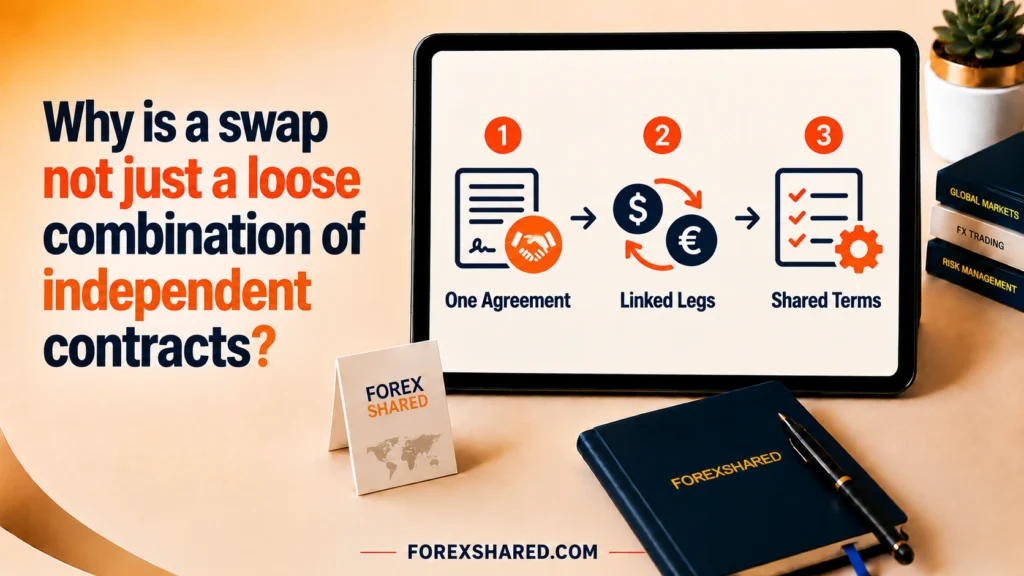
Why is a swap not just a loose combination of independent contracts?
An FX swap is not merely two independent FX contracts because its near and far legs are deliberately linked when the transaction is formed. The same currencies are exchanged in opposite directions across coordinated near and far dates, with related principal amounts, linked pricing and one reciprocal economic purpose.
Independent spot and forward trades can produce almost identical cash flows. That similarity does not prove the same original structure. Economic Similarity ≠ Original Linkage. The classic form expresses integration through one contract with the same counterparty, while current market and regulatory usage can also recognise two contracts negotiated together as one economic package.
This article explains ex-ante coordination, reciprocal direction, currency continuity, linked dates, linked pricing, principal relationships, counterparties, common purpose, confirmations, master agreements, package transactions, settlement lifecycle, novation, rollover and reporting. The controlling test is whether the linkage existed when the transaction or package was negotiated, not whether two later cash flows happen to offset.
This article is for general education only and does not constitute financial, investment, trading, legal, regulatory, accounting or tax advice. FX contract classification can depend on execution records, confirmations, documentation, counterparties and the applicable reporting framework.
What Would a “Loose Combination of Independent Contracts” Actually Look Like?
A loose combination consists of FX contracts that can be initiated, motivated, priced, timed, amended or terminated independently, without an original requirement linking one trade to the reversal of another.
What makes one FX contract independent?
An FX contract is independent when it can exist without requiring another contract. A standalone EUR/USD spot trade, for example, completes its own economic purpose without creating a compulsory future reversal.
What makes the second contract independent?
The second contract is independent when its trade date, direction, counterparty, notional, maturity and pricing can be selected later without being determined by the first trade. Its existence comes from a new trading decision rather than from the original transaction.
Can two independent contracts eventually offset?
Yes. A trader can buy USD and sell EUR in one transaction, then later sell USD and buy EUR forward. The later flows may offset part or all of the earlier currency exposure even though the trades were formed separately.
What is still missing?
What is missing is ex-ante coordination. If the later forward was not part of the original arrangement, there was no pre-existing obligation connecting Trade B to Trade A. Offsetting Trades ≠ Automatically an FX Swap.
What Makes the Two Legs of an FX Swap Integrated Instead?
The two legs are integrated when the far leg is deliberately formed as the reciprocal reversal of the near exchange, with coordinated currencies, directions, dates, principals, pricing and economic purpose. The parent structure is explained in FX swap contract structure.
What is the near leg?
The near leg is the initial currency exchange. In a EUR/USD example, one party can deliver EUR and receive USD on the first settlement date.
What is the far leg?
The far leg is the pre-arranged reciprocal exchange. In the same example, the participant later delivers USD and receives EUR according to the far-leg terms established when the arrangement was formed.
What makes them integrated?
The far leg is structured as the reversal of the near exchange rather than merely happening to use similar currencies. The same pair, opposite directions, coordinated tenor, related principal and linked pricing all point back to one original economic arrangement.
| Feature | Loose Trades | Linked FX Swap |
|---|---|---|
| Same currencies required | No | Yes |
| Reverse directions | No | Yes |
| Dates coordinated | Not necessarily | Yes |
| Pricing coordinated | Not necessarily | Yes |
| Negotiated together | No | Yes |
| Common economic purpose | Not required | Yes |
| Same classic counterparty | Not required | Yes |
| Far reverses near | Coincidental at most | Structural |
Designed reciprocity, not contract quantity, is the foundation of swap integration.
Why Does Ex-Ante Linkage Matter More Than Ex-Post Similarity?
Ex-ante linkage matters more because FX swap identity comes from the coordinated relationship created when the arrangement is negotiated, whereas ex-post similarity merely describes how independently formed cash flows look later. The contractual binding of both legs is developed in Near and far leg agreement.
What does ex-ante linkage mean?
Ex-ante linkage means that before either leg settles, the parties already know the near exchange, far reversal, settlement dates, pricing relationship and currency pair that form the coordinated arrangement.
What does ex-post similarity mean?
Ex-post similarity means two independently originated trades later generate offsetting or nearly identical cash flows. Similarity observed after formation does not establish that the second trade was required by the first.
Why are they different?
One structure was designed as a swap; the other was assembled through separate decisions. Ex-Ante Integration ≠ Ex-Post Similarity because transaction identity depends on formation, not only on eventual economic outcome.
Why does this matter operationally?
Original formation can affect confirmation, counterparty structure, package identifiers, lifecycle processing, amendments and reporting. Two positions with matching cash flows can therefore require different operational treatment because their contractual histories differ.
Why Must the Far Leg Reverse the Near Leg?
The far leg must reverse the near leg because reciprocity converts the first currency exchange into a temporary exchange cycle rather than an additional same-direction position.
What happens on the near leg?
A controlled example is Sell EUR / Buy USD. The participant exchanges EUR for USD on the near settlement date.
What happens on the far leg?
The direction reverses: Sell USD / Buy EUR. The far exchange restores the opposite currency principal flow at the later date.
Why is opposite direction essential?
Opposite direction transforms what would otherwise be a permanent currency conversion into a temporary reciprocal exchange. The second leg exists to reverse, not reinforce, the first leg.
What if both legs buy USD?
Then the second leg adds USD exposure instead of reversing the original USD receipt. That is not the conventional reciprocal structure of an FX swap.
Why Must the Same Currency Pair Continue Across Both Legs?
The same currency pair must continue because the far leg reverses the original principal relationship, so currency identity remains constant while transaction direction changes.
Which currencies exist on the near leg?
The near leg contains Currency A and Currency B. In the running example, the pair is EUR/USD.
Which currencies exist on the far leg?
The far leg contains the same two currencies, but the buy and sell directions reverse.
What if the second trade changes pair?
A EUR/USD near exchange followed by GBP/USD does not reverse the original EUR/USD principal relationship. The second transaction introduces a different currency identity.
Why is this structural?
Because the far leg must reverse the original currency principal relationship. Same Currency Pair + Opposite Direction is a combined structural test; neither condition alone is sufficient.
How Do Linked Dates Prevent the Legs From Being Arbitrary Contracts?
Linked dates prevent arbitrariness by forming one coordinated tenor from the near settlement date to the far settlement date, with both dates established as part of the original arrangement.
What does the near date define?
The near date defines when the first currency exchange is performed.
What does the far date define?
The far date defines when the reciprocal currency exchange is performed.
When are they linked?
They are linked when the transaction or package is formed, not when the second settlement date eventually arrives.
Why does this matter?
The interval from near date to far date defines the swap tenor. The two settlement events are therefore parts of one coordinated timing structure rather than unrelated maturities.
Does every swap begin spot?
No. The near leg can be spot, overnight, tomorrow/next or another near date, and forward-starting structures can also exist. The controlling rule is Near Date < Far Date with both dates belonging to the original arrangement.
How Does Pricing Link the Two Legs?
Pricing links the two legs because the near and far exchange rates are coordinated within the original arrangement, although pricing linkage by itself does not prove swap identity. The dedicated pricing mechanics are explained in Swap points and pricing.
What is the near rate?
The near rate is the exchange rate applied to the initial currency exchange on the near settlement date.
What is the far rate?
The far rate is the exchange rate applied to the reciprocal exchange on the later far date.
When are both economics established?
Both pricing relationships are established as part of the original linked arrangement. The far-side economics are not first invented when the far date arrives.
How are they often quoted?
For a conventional spot-starting swap, the far rate is commonly derived from the near or spot reference rate plus or minus swap points, subject to the currency pair’s quotation convention.
Why does this represent integrated pricing?
The far-side economics are quoted relative to the near reference rate for the same swap tenor. That pricing relationship supports the fact that the two exchanges are being managed as one coordinated arrangement.
Do matching rates alone prove a swap?
No. Independent transactions can be priced to reproduce the same near and far rates. Swap Points ≠ Proof of Swap Identity; coordinated formation remains the controlling evidence.
| Element | Near | Far | Relationship |
|---|---|---|---|
| Currency pair | A/B | A/B | Same |
| Direction | A→B | B→A | Reverse |
| Date | Near | Far | One tenor |
| Rate | Near | Far | Linked pricing |
| Formation | Negotiated | Negotiated | Coordinated |
Why Does the Same Counterparty Matter in the Classic Single-Contract Swap?
The same counterparty matters in the classic single-contract form because one reciprocal bilateral relationship covers the initial exchange and later reversal.
Who performs the near exchange?
Counterparty A and Counterparty B perform the near exchange, with each delivering one currency and receiving the other.
Who performs the reversal?
The same two counterparties perform the reciprocal far exchange in the classic form.
Why is this stronger linkage?
The same bilateral relationship determines what each party initially delivers and receives, and what each later returns and receives back. That is structurally stronger than two trades formed with unrelated counterparties.
What does BIS establish?
BIS explicitly notes that a spot transaction plus a forward can reproduce the same economics, while the classic FX swap combines those two transactions into one contract with the same counterparty. BIS FX Swap Contract Analysis
What if counterparties differ?
Similar market exposure can still be created, but the same classic bilateral single-contract structure has not been reproduced. The resulting arrangement may instead be independent trades or another package structure.
Why Does Common Economic Purpose Matter?
Common economic purpose matters because the near and far legs are designed as stages of one currency process rather than unrelated trades with separate objectives.
What purpose might both legs serve?
The linked pair can support temporary currency transformation, foreign-currency funding, liquidity management, a dated hedge or the rolling and adjustment of an FX exposure.
Does each leg have an unrelated objective?
Not within the integrated swap arrangement. The near leg starts the temporary exchange and the far leg terminates or reverses it according to the agreed structure.
Why does removing one leg matter?
Near only becomes an outright currency exchange; far only becomes a forward-like future exposure. Together, the two reciprocal legs create the temporary two-date currency structure.
A swap is an integrated economic process, not merely two trade tickets.
Does One Master Agreement Make Separate Contracts Into One Swap?
No. A shared master agreement can govern many transactions, but it does not by itself turn separate FX contracts into one swap.
What can a master agreement govern?
A master framework can govern numerous spots, forwards, swaps, options and other transactions between counterparties, including broader provisions on closeout, default, netting and other relationship terms.
Do those transactions automatically become one swap?
No. Sharing the same master framework does not merge separate transaction identities.
What creates swap linkage instead?
Swap linkage comes from the transaction-specific establishment of a near exchange plus a reciprocal far exchange as one coordinated arrangement.
What is the correct distinction?
Shared Legal Framework ≠ Shared Transaction Identity. The master agreement governs the relationship; the trade-specific near and far terms define the particular FX swap.
Can Separate Contracts Still Form a Genuine Linked FX Swap Package?
Yes. Separate contracts can form a genuine linked FX swap package when they are negotiated together as one economic agreement, so contract count alone does not determine whether the legs are integrated.
What does current UK EMIR guidance recognize?
Current FCA UK EMIR guidance recognises industry use of “FX swap” for both a single FX Swap contract and a combination of two FX contracts representing near and far legs that were negotiated together as the product of one economic agreement. FCA UK EMIR FX Swap Guidance
If there are two contracts, are they automatically independent?
No. They can remain separately reportable contracts while being economically linked from inception.
What can demonstrate package linkage?
Coordinated negotiation, the same currency pair, reciprocal directions, coordinated dates, a common economic purpose and a package identifier where applicable can demonstrate that the two contracts were formed as one economic package.
What distinguishes package from independent trades?
The distinguishing feature is Original Coordinated Formation. A package begins with deliberate linkage; independent trades begin with separate decisions even if their eventual cash flows later align.
| Structure | Contract Count | Negotiated Together | Economic Linkage |
|---|---|---|---|
| Classic single FX swap | 1 | Yes | Strong |
| Linked FX package | 2 | Yes | Strong |
| Independent trades | 2+ | No | Not inherent |
| Ex-post offsetting trades | 2+ | No | Cash-flow similarity only |
Contract count alone cannot determine whether the legs are linked.
Why Can Independent Spot and Forward Trades Still Replicate Swap Economics?
Independent spot and forward trades can replicate swap economics because the same currencies, directions, dates and notionals can be assembled separately to reproduce similar principal flows without reproducing the same original formation.
What independent trades can mimic a swap?
A participant can buy USD and sell EUR spot, then enter a separate forward that sells USD and buys EUR at a later date.
What could match?
The currencies, notionals, dates, exchange rates, cash flows and net FX exposure can potentially be aligned closely enough to resemble a conventional spot/forward swap.
What may still differ?
Formation, counterparties, confirmations, lifecycle processing, amendment rights, termination, reporting and operational handling can still differ even when the economic result is similar.
What is the correct principle?
Economic Equivalence ≠ Contractual Integration. BIS uses the same contrast when explaining that an FX swap and a separately assembled spot-plus-forward structure can be economically equivalent even though the classic swap combines them into one contract with the same counterparty. BIS FX Swap Contract Analysis
What Happens When the Near Leg Settles but the Far Leg Remains?
When the near leg settles, the first obligation is performed while the far obligation remains outstanding; this lifecycle change does not alter the original integrated formation.
What happened to the near obligation?
It was performed on the near settlement date.
What happened to the far obligation?
It remains outstanding under the terms already established at formation.
Is the far leg newly created?
No. It already existed as part of the original linked arrangement before the near leg settled.
Why does it now resemble a forward?
Once only one future currency exchange remains, the residual economic exposure becomes forward-like. BIS similarly notes that after the spot leg is completed, the remaining FX swap position is economically indistinguishable from an outright forward. BIS FX Swap Contract Analysis
Why does that matter?
Remaining exposure can change shape without altering the original contract or package formation. Forward-like residual exposure ≠ Original Far-Leg Independence.
Does Later Amendment or Novation Make the Original Legs Independent?
No. Later amendment or novation manages an existing obligation after formation and therefore does not prove that the near and far legs were independent when the swap was created.
Can the far leg later be changed?
Potentially, yes, subject to the applicable documentation and agreed lifecycle process.
Can it be novated?
Potentially, yes. A remaining far obligation can be transferred or replaced through novation under the applicable framework.
What does ECB guidance illustrate?
ECB MMSR Q&A version 3.7 provides an example in which Bank A first executes an FX swap with Bank X and one week later novates only the far leg to Bank Y. The same published Q&A also treats FX swaps as one deal containing two FX transactions for MMSR purposes. Version 3.7 was published in July 2026 and is scheduled to apply from 1 July 2027. ECB MMSR FX Swap Guidance
Does that prove original independence?
No. At that lifecycle stage the near leg is finished, the far leg remains outstanding and only the remaining obligation is being managed.
What is the correct rule?
Later Separability ≠ Original Independence. Lifecycle management can alter a remaining obligation without changing how the original transaction was formed.
Why Does Rollover Not Make the Swap an Open-Ended Collection of Contracts?
Rollover does not make the original swap open-ended because the original arrangement has a defined far date and any continuation requires replacement or modified contractual terms.
Does the swap have a defined far date?
Yes. The original transaction defines the date on which the reverse exchange is due.
What happens near maturity?
The existing far obligation must be performed or otherwise validly addressed under the applicable framework.
What if exposure should continue?
A replacement swap, new transaction or permitted extension arrangement may be required to continue the economic exposure beyond the original maturity.
Is that automatically the original swap continuing?
No. The continuation involves new or modified contractual terms rather than an automatic extension of an indefinitely open original transaction.
Why does this matter?
Each original swap has defined contractual boundaries. An indefinite sequence of rollovers is not one endless original swap.
How Does Reporting Distinguish Integrated Swaps From Independent Trades?
Reporting can corroborate how an arrangement was constructed by distinguishing recognised FX swap transactions and linked packages from independent trades, although reporting treatment does not itself create economic linkage.
How does BIS treat FX swaps statistically?
BIS statistical guidance classifies FX swaps as a distinct instrument category built from an initial exchange and reverse exchange of the same currencies, rather than treating the instrument simply as an unrelated spot transaction plus an unrelated later trade. BIS Triennial Survey Guidelines
How does UK EMIR treat a single FX swap contract?
Current FCA UK EMIR guidance says that where the transaction was concluded as a single FX Swap contract, it is reported within a single report.
How does it treat a package?
Where near and far FX contracts were negotiated together as the product of one economic agreement, the relevant contracts are reported separately with package information where applicable. That treatment preserves separate contract count while recognising economic linkage. FCA UK EMIR FX Swap Guidance
What would independent trades lack?
Independent trades lack original package linkage. They may share currencies or later offset, but they were not negotiated together as one economic arrangement.
What does this demonstrate?
Economic integration can survive separate contract and report counts. Reporting reflects actual construction; it does not create the integration.
What EUR/USD Example Shows the Difference Between an Integrated Swap and Loose Contracts?
A controlled EUR/USD example shows that nearly identical principal flows can arise from either an integrated swap or loose contracts, so formation remains the decisive distinction.
What does an integrated FX swap establish?
Assume a T+2 near date, a three-month far date, EUR/USD near rate 1.1000, far rate 1.0950 and EUR 10 million near principal. At one negotiation, the near leg sells EUR 10 million and receives USD 11 million, while the far leg establishes the reciprocal USD-to-EUR exchange at the three-month date under the pre-agreed far terms.
Why are these integrated?
Both legs were intended together, both dates were coordinated, both pricing terms were established, directions were reciprocal and the far leg existed from formation as the reversal of the near exchange.
What would the loose alternative look like?
On Day 1, the participant independently buys USD spot. Later, after a separate decision, it independently sells USD forward. The eventual flows may resemble the integrated swap, but the original spot trade contained no obligation requiring the later forward.
What if spot and forward were separate contracts but negotiated simultaneously?
That can indicate a Linked FX Swap Package rather than loose independent trades, provided the two contracts were deliberately negotiated together as one economic arrangement.
| Feature | Integrated Swap | Loose Spot + Forward |
|---|---|---|
| Near EUR→USD | Yes | Yes |
| Far USD→EUR | Yes | Possible |
| Intended together | Yes | Not required |
| Dates coordinated | Yes | Independent |
| Pricing coordinated | Yes | Independent |
| Classic same counterparty | Yes | Not required |
| Far reverses near by design | Yes | No requirement |
| Cash flows can match | Yes | Yes |
| Classification | FX swap/package | Separate trades |
How Should You Determine Whether Two FX Contracts Are Truly One Swap Arrangement?
Determine whether two FX contracts are truly one swap arrangement by testing original coordinated formation first, then checking the same currency pair, reciprocal directions, tenor, pricing, principal relationship, common purpose, counterparties and contract or package construction.
Were both trades negotiated together?
If not, that is a strong indication of independent formation. If yes, continue testing whether the coordinated terms form a reciprocal FX arrangement.
Same currency pair?
Verify that the same Currency A / Currency B pair appears on both legs.
Reciprocal directions?
Verify A → B on the near leg and B → A on the far leg. Same-direction trades do not form the conventional reciprocal structure.
Coordinated near/far dates?
Confirm that the near and far dates belong to one tenor relationship and were established when the arrangement was formed.
Is pricing coordinated?
Review the near rate, far rate, swap points and any package pricing to determine whether the two legs were priced as one coordinated arrangement.
Do principals correspond economically?
Verify economic principal reversal rather than demanding identical numeric amounts in every currency field. If near and far rates differ, one currency amount can differ across the two legs while the economic principal relationship remains reciprocal.
Is there a common economic purpose?
Verify that the two legs operate as one temporary exchange, funding, liquidity or hedge process rather than unrelated directional trades.
One contract or linked package?
Check execution records, confirmation, package identifiers, reporting and transaction documentation to distinguish a classic single contract from two contracts negotiated together as one package.
Are counterparties the same?
For the classic single-contract form, yes. Different counterparties can reproduce similar exposure, but they do not reproduce the same classic bilateral relationship.
Are later lifecycle events being confused with formation?
Separate original structure from amendment, novation, rollover and replacement. Later management of a remaining far obligation does not prove that it was independently formed.
Correct classification sequence
Identify both legs; identify the currency pair; verify opposite directions; verify near and far dates; determine whether the legs were negotiated together; verify pricing linkage; verify principal relationship; identify common economic purpose; identify counterparty structure; determine single contract versus package; then separate later lifecycle changes from original formation.
How Can Traders and Treasury Teams Avoid Treating a Swap as Loose Independent Contracts?
Traders and treasury teams can avoid misclassification by treating ex-ante integration as the primary test and keeping contract count, master documentation, matching cash flows and later lifecycle events in their proper analytical layers.
Why is “two contracts means independent” incorrect?
Because two contracts can be linked economically from inception when they were negotiated together as one package.
Why is “one master agreement means one swap” incorrect?
A master agreement can govern many distinct transactions. Swap identity comes from transaction-specific near and far linkage.
Why is “same currencies means swap” incorrect?
The same currencies are not enough. A conventional swap also requires reciprocal directions and original linkage.
Why is “matching cash flows prove linkage” incorrect?
Independent spot and forward trades can reproduce matching cash flows. Matching economics do not establish original formation.
Why is “later novation proves independence” incorrect?
Novation modifies a remaining existing obligation after formation. Later separability does not rewrite original linkage.
Why is “different settlement dates mean separate transactions” incorrect?
An FX swap is specifically designed around a near performance date and a later far performance date. Separate dates are part of the structure, not evidence of independence.
Why is “swap points create the swap” incorrect?
Swap points establish a pricing relationship between the two dates. They do not establish original transaction formation.
What should be checked before calling it integrated?
Verify original coordinated negotiation, the same currency pair, reciprocal directions, linked dates, economic principal reversal, coordinated pricing, common purpose, classic same-counterparty structure where applicable, single-contract versus package form, and later lifecycle events separately.
- Near and far legs were negotiated as one economic arrangement.
- The same currency pair appears on both legs.
- The far leg reverses the near direction.
- Near and far dates create one coordinated tenor.
- Principals form an economic reversal relationship.
- Near and far pricing is coordinated.
- A common economic purpose is identifiable.
- The classic single-contract form uses the same counterparties.
- Single-contract and package forms are distinguished.
- Shared master documentation is not mistaken for swap linkage.
- Independent replicated trades are not mistaken for original integration.
- Near settlement is separated from original formation.
- Later amendment is treated as lifecycle activity.
- Later novation is treated as lifecycle activity.
- Rollover is separated from automatic continuation.
Conclusion
An FX swap is not just a loose combination of independent contracts because its near and far legs are intentionally linked before either leg is completed. The arrangement creates an initial currency exchange plus a reciprocal future exchange around the same currency pair, opposite directions, coordinated dates, related principal amounts, linked pricing and a common economic purpose.
The classic form expresses the strongest integration through one contract with the same counterparty. Contract count alone, however, is not the complete test. Current UK EMIR guidance recognises that two FX contracts can also be negotiated together as one economic agreement, producing a linked package rather than loose independent trades.
Single Contract and Linked Package therefore both differ fundamentally from independent FX contracts formed through separate decisions. The controlling test is Ex-Ante Integration. Identical or offsetting cash flows, shared master documentation, matching swap points or later lifecycle modifications cannot substitute for evidence that the near and far obligations were coordinated when the arrangement was formed.
An FX swap is an integrated reciprocal transaction because its near and far legs are intentionally formed as one currency-exchange cycle. What separates that structure from loose independent trades is coordinated formation of currencies, directions, dates, pricing, principal relationships and economic purpose, not merely the fact that two FX cash flows later offset each other.
FAQs
Why are the two legs of an FX swap not unrelated transactions?
Because the far leg is deliberately established as the reversal of the near exchange within the same coordinated arrangement. The linkage exists from formation rather than arising only after cash flows are observed.
Does an FX swap always have to be one legal contract?
No. The classic form can be one contract, while current UK EMIR guidance also recognises linked two-contract packages negotiated together as one economic agreement.
Can separate spot and forward trades create the same cash flows?
Yes. Separate spot and forward contracts can reproduce very similar cash flows and net FX exposure, but matching economics do not establish original contractual or package linkage.
Does using the same master agreement make two FX trades one swap?
No. A master framework can govern many separate transactions. The swap relationship comes from transaction-specific linkage of the near exchange and reciprocal far exchange.
Can the far leg later be managed separately?
Potentially, yes. After the near leg settles, the remaining far obligation can undergo lifecycle actions such as amendment or novation under the applicable framework. That later separability does not mean it was originally independent.