How to Diagnose Forex Strategy Fit Using Session Volatility and the S5 Protocol
The Session-Volatility S5 Protocol diagnoses whether a forex strategy fits the market environment where it is being traded. It separates trades by session, volatility profile, and news proximity to identify where performance improves or breaks down.
The goal is to identify where performance improves or breaks down. The protocol tests strategy-environment mismatch, not trader talent, ensuring that systemic weaknesses are identified objectively.
This protocol serves strictly as an educational risk-analysis framework, not a guaranteed profit system or emotional recovery program. Retail forex can involve substantial risk, leverage can magnify both gains and losses, and retail foreign currency offers may also carry fraud risk.
What problem does the Session-Volatility S5 Protocol diagnose?
The Session-Volatility S5 Protocol diagnoses strategy-environment mismatch by testing whether a forex strategy performs differently across sessions, volatility profiles, and news conditions.
Inconsistent performance can happen even when entry rules stay the same. The suspected cause is market-environment mismatch, meaning the rules do not fit the current market state. This protocol tests when the strategy works, completely avoiding discipline diagnosis.
Which mismatch is the protocol trying to isolate?
The protocol is trying to isolate the gap between strategy rules and market condition. A trend setup can fail in slow chop, while a range setup can fail during aggressive expansion.
What makes this different from a discipline diagnosis?
This differs from a discipline diagnosis because a discipline diagnosis checks whether the trader followed the plan. Session-volatility diagnosis checks whether the plan fits the market window and movement condition.
Where does session timing become a performance variable?
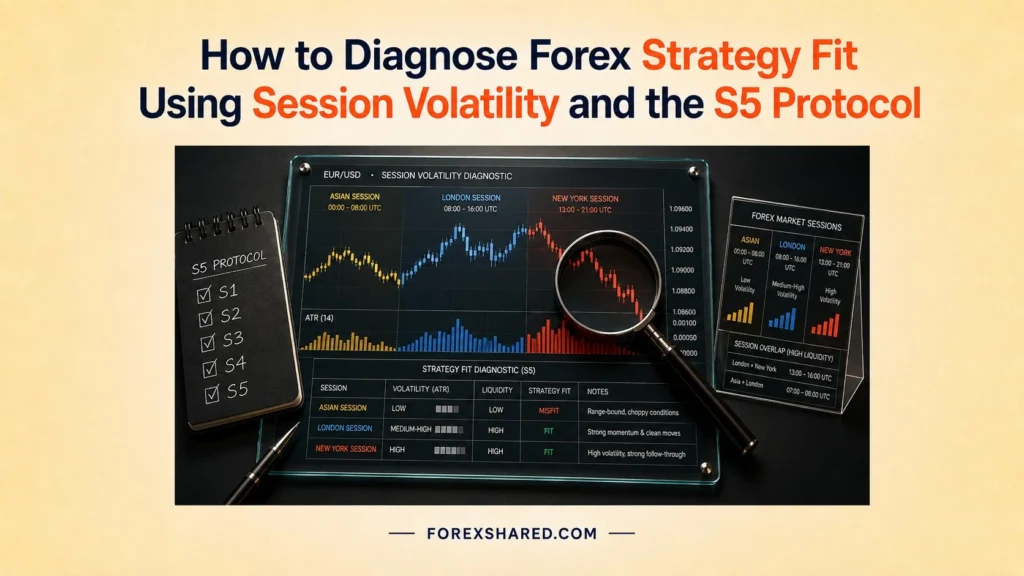
Session timing becomes a performance variable when positive or negative R clusters around repeated market windows such as Asian, London, New York, or overlap sessions. [Investopedia, 2025]
Which environment variables define the S5 test?
The Session-Volatility S5 Protocol defines the test through trading session, hourly volatility, news proximity, pair, strategy version, and timeframe. This matters because the global foreign exchange market is structurally large and multi-venue, so session and market-state analysis should be grounded in external market-structure context. [BIS, 2025]
| Variable Type | Variable | Diagnostic Role |
|---|---|---|
| Environment Variable | Trading Session | Shows which market window produced the trade |
| Environment Variable | Hourly Volatility | Shows whether the market was quiet, normal, fast, or extreme |
| Event Variable | News Proximity | Flags high-impact news near the trade |
| Control Variable | Currency Pair | Prevents pair behavior from contaminating the test |
| Control Variable | Strategy Version | Keeps entry and exit rules stable |
| Control Variable | Timeframe | Prevents scalping and swing data from mixing |
| Control Variable | Risk Rule | Keeps R-multiple comparison fair |
Trading session, hourly volatility, and news proximity act as environment variables, while pair, strategy version, and timeframe act as control variables. Maintaining stable risk-per-trade using a position size calculator keeps the evaluation structured.
Which variable identifies the market window?
Trading session identifies the market window where the trade happened. Consistent labels such as Asian, London, New York, and London-New York overlap must be used to group data accurately. [Investopedia, 2025]
What does hourly volatility reveal?
Hourly volatility reveals whether the trade occurred during slow, normal, fast, or unstable movement. The assigned label must remain consistent before the final result is interpreted.
Where do controls protect the diagnosis?
Controls protect the diagnosis by ensuring that pair, strategy version, timeframe, and risk rule stay completely stable. If these elements change, weak results may come from the control change rather than environment fit.
How should the S5 trade log capture session and volatility data?
The Session-Volatility S5 Protocol requires a controlled trade log that records UTC time, pair, session, volatility profile, news proximity, R result, and environment notes.
| Date/Time UTC | Pair | Session Active | Volatility Profile | News Proximity | Result | Notes |
|---|---|---|---|---|---|---|
Traders should use at least 30 trades as the starting diagnostic sample, requiring the same strategy, pair, and timeframe family. Historical backfilling is allowed only if the opening time and labels are applied consistently.
Which timestamp standard prevents session confusion?
The UTC timestamp standard prevents session confusion for every single logged trade. Session labels should be assigned from the exact same time reference to avoid local-time contamination.
What should the volatility label describe?
The volatility label should describe the movement at entry, distinguishing whether the market was slow, narrow, choppy, normal, expanded, directional, unstable, or shock-driven.
Where should qualitative notes stay useful?
Qualitative notes stay useful when they describe factual environment behavior instead of emotional storytelling. Useful notes explicitly record chop, impulse, spread expansion, news spike, failed breakout, slow fill, or sudden reversal.
How should volatility be classified inside the S5 Protocol?
The Session-Volatility S5 Protocol classifies volatility into low, normal, high, and extreme profiles so movement conditions can be compared consistently. Traders who want a more quantitative volatility proxy can reference Average True Range because ATR measures volatility by averaging true ranges over a defined period. [Fidelity, n.d.] [Investopedia, n.d.]
| Volatility Profile | Practical Meaning | Diagnostic Use |
|---|---|---|
| Low | Slow movement, narrow range, frequent chop | Tests whether the strategy fails in stagnant conditions |
| Normal | Usual movement for that pair and session | Creates the baseline comparison |
| High | Expanded movement, stronger directional impulse | Tests whether the strategy benefits from momentum |
| Extreme | News spike, disorderly move, unusually fast expansion | Tests shock or news-spike vulnerability |
The classification system must remain simple to avoid over-engineering the test. Traders must use the exact same labeling rule throughout the entire sample, ensuring extreme volatility stays separated from healthy high volatility.
Which volatility profile creates the cleanest baseline?
Normal volatility creates the cleanest baseline for performance tracking. It allows the reader to compare low, high, and extreme conditions without overreacting to one unusual, isolated session.
What does low volatility usually test?
Low volatility usually tests whether the strategy struggles in slow or choppy conditions. The protocol must rigorously confirm this weakness with actual trade data rather than mere assumption.
Where does extreme volatility need separate labeling?
Extreme volatility needs separate labeling and should not be merged casually with healthy high volatility. Shock moves, sudden news spikes, and emotionally charged market events can severely distort the standard high-volatility bucket. [CFTC, 2020]
How does R-multiple make session performance comparable?
The Session-Volatility S5 Protocol uses R-multiple to make session performance comparable because each trade result is measured against initial planned risk. This aligns with the risk-management principle that position sizing and trade outcomes should be evaluated relative to risk units. [Van Tharp Institute, n.d.]
| R Result | Meaning |
|---|---|
| -1R | Full planned risk lost |
| 0R | Break-even |
| +1R | Profit equal to planned risk |
| +2R | Profit twice planned risk |
| Worse than -1R | Risk-control issue or abnormal slippage warning |
R-multiple defines the trade outcome relative to initial planned risk, preventing raw money from distorting the session comparison. Using a pip and lot value calculator standardizes the required risk metrics accurately.
Which risk unit should be used for every session bucket?
Initial planned risk should be used as the base unit for every session bucket. It allows London, New York, Asian, and overlap trades to be compared fairly and consistently.
What does a negative R cluster reveal?
A negative R cluster reveal where the strategy may be losing its statistical expectancy. If the cluster routinely appears in one specific session or volatility profile, environment fit naturally becomes the first suspect.
How should session results be segmented for diagnosis?
The Session-Volatility S5 Protocol segments session results into Asian, London, New York, and overlap buckets to identify where expectancy changes. This follows the practical reality that forex activity is commonly analyzed through major session windows and overlap periods. [Investopedia, 2025]
| Session Bucket | Total Trades | Win Rate | Total R | Diagnostic Meaning |
|---|---|---|---|---|
| Asian | [#] | [%] | [R] | Tests slow or range-heavy fit |
| London | [#] | [%] | [R] | Tests expansion and open-volatility fit |
| New York | [#] | [%] | [R] | Tests US-session momentum or reversal behavior |
| London-NY Overlap | [#] | [%] | [R] | Tests high-liquidity overlap fit |
Total Trades, Win Rate, and Total R provide the metric foundation for the test. Analysts must never declare a session optimal from one isolated trade, and overlap periods should always be treated separately.
Which session bucket shows the strongest fit?
The session bucket that shows the strongest fit is the one with the clearest positive R and enough total trades to actively avoid overreading one random outlier result.
Which session bucket signals strategy-environment mismatch?
The session bucket that signals strategy-environment mismatch is the one demonstrating repeated negative R. If the exact same rules lose mainly in one session, timing immediately becomes a filter candidate.
Where can overlap trades distort the session comparison?
Overlap trades can distort the session comparison because they routinely behave differently from pure London or pure New York trades. They should be meticulously labeled separately whenever possible. [Investopedia, 2025]
How should volatility results be segmented for diagnosis?
The Session-Volatility S5 Protocol segments volatility results into low, normal, high, and extreme buckets to identify whether movement conditions change expectancy. ATR can support this segmentation as a volatility proxy, but it should not be treated as a directional signal. [Fidelity, n.d.]
| Volatility Bucket | Total Trades | Win Rate | Total R | Diagnostic Meaning |
|---|---|---|---|---|
| Low Volatility | [#] | [%] | [R] | Tests chop or stagnation vulnerability |
| Normal Volatility | [#] | [%] | [R] | Baseline strategy condition |
| High Volatility | [#] | [%] | [R] | Tests momentum or expansion fit |
| Extreme Volatility | [#] | [%] | [R] | Tests shock or news-spike vulnerability |
Analysts must compare volatility buckets strictly after the entire trade log is stabilized. Evaluating Total Trades, Win Rate, and Total R prevents data blending, while normal volatility firmly acts as the control baseline.
Which volatility bucket reveals chop sensitivity?
The low-volatility bucket reveals chop sensitivity, showing that the strategy severely struggles without enough market movement. The likely correction is a specialized volatility filter rather than immediate strategy redesign.
Which bucket reveals shock sensitivity?
The extreme-volatility bucket reveals shock sensitivity, demonstrating vulnerability to rapid spikes, unexpected news, or disorderly movement. The likely correction is a strict no-trade news window or protective shock-volatility filter. [CFTC, 2020]
Where does normal volatility protect the baseline?
Normal volatility protects the baseline by defining expected performance. If normal volatility remains profitable while low and extreme conditions fail, the strategy clearly needs new operational boundary filters.
Which diagnosis appears from session and volatility comparison?
The Session-Volatility S5 Protocol converts session and volatility bucket results into a diagnosis by naming the environment where expectancy breaks down.
| Session Result | Volatility Result | Likely Diagnosis | Meaning |
|---|---|---|---|
| One session strongly negative | Mixed volatility | Session Mismatch | Time window is damaging expectancy |
| Low volatility strongly negative | Session results mixed | Chop Sensitivity | Strategy needs movement filter |
| Extreme volatility strongly negative | News proximity common | Shock Sensitivity | Strategy needs news/no-trade filter |
| London positive, Asian negative | Low-volatility losses common | Expansion Dependency | Strategy may require active-market movement |
| All buckets negative | All profiles weak | System Issue Beyond Session Fit | Environment filter alone may not fix it |
When does the data point to session mismatch?
The data points to session mismatch when one specific session repeatedly produces highly negative R while the other active trading sessions perform significantly better.
When does the data point to volatility mismatch?
The data points to volatility mismatch when losing results densely cluster around low, high, or extreme volatility profiles. The applied filter must directly match the diagnosed losing profile.
Where does the diagnosis stay inconclusive?
The diagnosis stays strictly inconclusive when dealing with small, mixed, or heavily contaminated data samples. If all buckets show negative returns, the strategy may critically require a separate system-level review.
What insight statement should summarize the S5 result?
The Session-Volatility S5 Protocol should summarize the result with one statement that names the weak environment, compares R evidence, and states the next filter hypothesis.
Required Statement Format
“The data suggests that my strategy has negative expectancy in [session / volatility profile]. My [best environment] trades produced [X]R, while my [weak environment] trades produced [Y]R. The next corrective action is to test a [time filter / volatility filter / news filter] before changing the entire strategy.”
Which environment should be named first?
The weakest environment should be named first and clearly identified. Traders must aggressively avoid vague phrasing like “bad conditions” or “the market was weird” to maintain rigorous diagnostic clarity.
What evidence must support the statement?
The required evidence must support the statement by including best-environment R, weak-environment R, and a targeted, proposed filter matching the specific data pattern observed.
Which filter hypothesis should follow a session-mismatch diagnosis?
The Session-Volatility S5 Protocol should follow a session-mismatch diagnosis with a time-filter hypothesis that removes or reduces the weakest session first.
| Component | Required Detail |
|---|---|
| Problem | One session produces repeated negative R |
| Suspected Cause | Poor liquidity, chop, unsuitable timing, spread behavior, or failed follow-through |
| Filter Rule | Avoid or reduce trades during the weak session |
| Retest Sample | Next controlled sample after the filter is applied |
| Success Signal | Improved total R without the weak-session trades |
Which session should be filtered first?
The session that should be filtered first is the specific window with the strongest repeated negative R cluster, explicitly overriding the trader’s personal scheduling preference.
What makes a time filter testable?
A time filter becomes testable when it rigidly names the exact no-trade window, properly defines the next evaluation sample, and specifically states what statistical improvement counts as definitive evidence.
Where should the trader avoid over-filtering?
The trader should avoid over-filtering by never attempting to remove every difficult session all at once. Extreme over-filtering easily makes historical results look superior only because far too few trades ultimately remain.
Which filter hypothesis should follow a volatility-mismatch diagnosis?
The Session-Volatility S5 Protocol should follow a volatility-mismatch diagnosis with a filter that targets the specific volatility profile where repeated negative R appears.
| Component | Required Detail |
|---|---|
| Problem | One volatility profile produces repeated negative R |
| Suspected Cause | Chop, insufficient movement, unstable spikes, or news-driven expansion |
| Filter Rule | Trade only inside the strategy’s preferred volatility profile |
| Retest Sample | Next controlled sample after the filter is applied |
| Success Signal | Fewer weak-environment losses and improved total R |
Which volatility condition should be excluded first?
The volatility condition that should be excluded first is the one actively holding the highest repeated negative R. Trend strategies may confidently exclude low-volatility chop, while mean-reversion strategies may exclude extreme expansion.
What makes an ATR filter useful but not magical?
An ATR filter proves useful but not magical because it mathematically describes recent movement without guaranteeing trend quality or future trade success. Analysts must treat it as a testable boundary condition, not a profit switch. [Fidelity, n.d.]
Where should news proximity affect the filter?
News proximity should severely affect the filter if a high percentage of losses randomly occur near high-impact events. A mandatory no-trade news window is frequently more useful than applying a pure mathematical volatility filter. [CFTC, 2020]
What mistakes can corrupt the Session-Volatility diagnosis?
The Session-Volatility S5 Protocol becomes unreliable when the trader mixes pairs, changes strategy rules, rewrites labels, or trusts a weak sample.
Mixing multiple currency pairs in one test
The diagnosis fails when a trader carelessly combines EURUSD, GBPJPY, XAUUSD, and other markets together in one unified sample. The necessary correction is to rigidly run the protocol on exactly one pair first because each distinct instrument can behave very differently by session.
Changing the strategy while testing the environment
The diagnosis fails when a trader impulsively changes entry rules halfway through the measured sample. The necessary correction is to maintain the exact same strategy version so the test cleanly measures true environment fit, not reactive rule changes.
Labeling volatility after seeing the result
The diagnosis fails when a trader subjectively calls a losing trade “bad volatility” only after it officially loses capital. The necessary correction is to strictly label volatility at entry or rigidly through a consistent pre-trade mathematical rule.
Treating one winning session as proof of edge
The diagnosis fails when a trader mathematically overreacts to a remarkably small or lucky sample size. The necessary correction is to systematically use enough total trades and properly retest everything before permanently changing the overall strategy schedule.
Which protocol controls confirm the S5 result is usable?
The Session-Volatility S5 Protocol is usable only when the same pair, same strategy, same timeframe, consistent environment labels, and stable R measurement are maintained.
| Control | Why It Matters |
|---|---|
| Same pair across the test | Prevents instrument-behavior contamination |
| Same strategy version | Prevents rule-change contamination |
| Same timeframe family | Prevents style-mixing |
| Session recorded in UTC | Prevents timezone confusion |
| Volatility label recorded consistently | Makes bucket comparison usable |
| News proximity recorded before interpretation | Prevents hindsight explanation |
| R-multiple measured from initial planned risk | Standardizes outcomes |
| No major rule changes during sample | Keeps the test clean |
| Retest planned before live-risk escalation | Protects against overreaction |
Which control confirms the pair did not distort the result?
A strictly isolated single-pair test explicitly confirms that instrument behavior stayed completely stable. Different pairs can inherently behave differently across overlapping sessions, so rigid pair control aggressively protects against false session-related conclusions.
What confirms volatility labels are honest?
Volatility labels are confirmed honest when they are systematically assigned using the exact same rule each time. They must never be rewritten or modified simply after the logged trade inevitably wins or loses.
Which signals distinguish clean environment testing from random review?
Clean environment testing rigidly uses formal UTC timestamps, fixed strategy rules, and strict R-multiple segmentation. In sharp contrast, random review heavily relies on flawed human memory and emotionally cherry-picked historical examples.
What validate before applying a session or volatility filter?
Before applying a session or volatility filter, the Session-Volatility S5 Protocol should validate sample quality, controls, R measurement, underperformance pattern, and retest conditions. Skipping this final validation check risks amplifying the drawdown through misaligned or premature strategy adjustment. [SEC, 2011] [CFTC, 2020]
| Validation Question | Pass Condition |
|---|---|
| Was the same pair used throughout the test? | One instrument was tested |
| Was the same strategy version used? | One rule set was tested |
| Was the same timeframe family used? | Style contamination is reduced |
| Were all trades timestamped in UTC? | Session labels are consistent |
| Was session labeling consistent? | Time buckets are reliable |
| Was volatility labeling assigned consistently? | Movement buckets are reliable |
| Was news proximity recorded before interpretation? | Hindsight bias is reduced |
| Were results measured in R-multiple? | Outcomes are comparable |
| Did one session or volatility profile clearly underperform? | Diagnosis has a target |
| Does the proposed filter match the weakest environment? | Correction fits the evidence |
| Will the filter be retested before trusting it? | Change is validated first |
| Is the article avoiding guaranteed-profit claims? | YMYL safety is preserved |
The Session-Volatility S5 Protocol turns inconsistent performance into a controlled environment-fit question: does the strategy fail because the session or volatility profile does not fit the setup? The answer should come from logged trades, stable controls, R-based segmentation, and a retested filter hypothesis.
Frequently Asked Questions
What is a strategy-environment mismatch?
A strategy-environment mismatch occurs when a set of trading rules is actively executed in a market condition it was not designed for, such as applying a strong trend strategy in a low-volatility Asian session range.
Why is UTC time required for session testing?
Using strict UTC time completely prevents session-label confusion that routinely occurs when traders improperly mix their local timezone with broker server time and global market open hours.
Can I filter out multiple weak sessions at the same time?
No. You should systematically target and filter the single weakest session or volatility profile first. Over-filtering too many environments at once can dangerously shrink your sample size and create an illusion of strategy improvement.