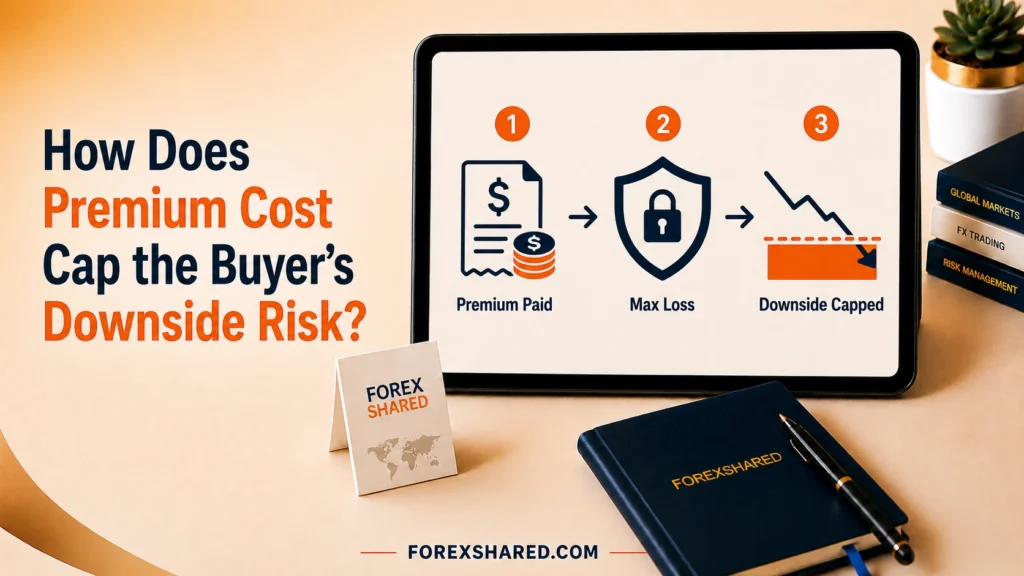
How Does Premium Cost Cap the Buyer’s Downside Risk?
Premium cost caps an option buyer’s downside because the buyer pays a fixed amount for a contractual right; if the option becomes worthless, its value reaches zero, and the long option cannot lose more than the premium paid.
The cap belongs to the fully paid purchased option position itself. It does not mean the buyer cannot lose the entire premium, it does not automatically include transaction costs, and it does not carry forward to a futures position created by exercise.
This article traces the mechanism from premium payment to the zero-value floor, then separates call and put applications, breakeven, expiration, transaction costs, seller risk, futures margin and post-exercise exposure before ending with a verification sequence.
This article explains forex option risk mechanics for educational purposes and does not provide individualized financial or trading advice. Contract specifications, fees, payment arrangements, liquidity and expiration procedures can vary, so current product and account documentation should be checked before relying on a specific option-risk outcome.
What Does the Option Premium Represent for the Buyer?
The option premium is the fixed payment the buyer makes to acquire the option right, and that payment defines the maximum amount the long option position itself can lose.
CFTC defines premium as the payment an option buyer makes to the option writer for granting the option contract. CFTC CME further states that a call or put buyer pays the premium in full, that the premium is nonrefundable, and that remaining option value can potentially be recovered by selling the option before expiry. CME
The broader parent context is covered in Forex options downside control.
What is an option premium?
An option premium is the payment the option buyer makes to the option writer for granting the option contract. CFTC
Premium is the purchase price of the contractual right, not a refundable deposit. Premium is the purchase price of the option right and is not returned merely because the option is not exercised.
What does the buyer receive for paying it?
The buyer receives a call right or a put right without entering the same unconditional underlying obligation imposed by a futures position.
The right is conditional: the buyer may exercise or let the option expire. The buyer’s obligation is limited to the premium paid, but transaction costs and post-exercise positions can create additional cash requirements.
Why is the premium a real cash cost rather than collateral?
The premium is the price of purchasing the option, not a security deposit that is automatically returned later.
Premium is paid to acquire optionality; it is not collateral posted to support an open futures obligation. Premium is the cost of purchasing optionality while margin is performance collateral supporting a futures obligation.
Is the premium refundable if the option expires worthless?
No, the premium paid by a call or put buyer is nonrefundable. CME
The premium pays for the option right itself, so non-exercise or worthless expiration does not turn it into a refundable deposit. The premium is the price of the right itself, not a deposit contingent on exercise.
Why Does the Premium Become the Maximum Loss on a Long Option?
The premium becomes the maximum loss on a long option because the option’s market value has a floor at zero, and the buyer owns a finite-cost right rather than an open-ended obligation.
CME states that long calls and long puts must be paid for and that maximum buyer loss is limited to the premium paid on purchase, regardless of how far the underlying moves against the option. CME The mechanical explanation is the zero-value floor: once a purchased option has no remaining market value, further adverse underlying movement cannot make that long option worth less than zero.
The dedicated loss-boundary explanation is developed in Maximum loss limited to premium.
What is the lowest market value a purchased option can reach?
The lowest market value a purchased option can reach is zero.
The buyer owns a contractual right whose market value can fall to zero but cannot become a negative-value long-option obligation. The buyer owns a right, not an obligation whose losses expand with the underlying.
What happens when option value reaches zero?
When option value reaches zero, the buyer has lost the value originally paid for the option.
The arithmetic is Initial Premium minus Ending Option Value of Zero equals Full Premium Loss. The formula defines maximum loss, not expected outcome.
Why can a larger adverse underlying move not create additional long-option loss?
A larger adverse underlying move cannot create additional long-option loss because once the option has no remaining value, further unfavorable movement cannot make the purchased option worth less than zero.
The buyer did not sell an expanding obligation, so adverse underlying movement cannot extend long-option loss once option value is already zero. The buyer can lose the entire premium; the cap limits the loss to the premium, it does not eliminate loss.
How does CME describe the maximum loss?
CME states that the maximum loss for a long call or long put is limited to the premium paid on purchase. CME
The CME maximum-loss rule applies to the purchased option position itself. The CME statement applies to the long option position itself.
| Stage | Mechanism |
|---|---|
| 1. Option purchased | Buyer acquires a finite-cost contractual right |
| 2. Premium paid = $X | The premium is the buyer’s option acquisition cost |
| 3. Underlying moves unfavorably | Purchased option loses market value |
| 4. Option premium declines | Remaining market value approaches zero |
| 5. Option reaches $0 value | No further long-option value remains to lose |
| Result | Maximum long-option loss = $X before separate transaction-cost qualifications |
The visual comparison below restates the same section mechanics without adding a separate risk rule.
How Does Premium Cap the Downside of a Long Call?
The premium caps a long call’s downside because the call buyer pays a fixed amount for the right to obtain defined long-side exposure, and the call’s value cannot fall below zero.
A long call converts open-ended unfavorable underlying movement into a finite option-position loss because the buyer purchased a right rather than a short obligation. CME’s call-option education states that the maximum risk of a purchased call is the premium paid. CME
What does the call buyer pay for?
The call buyer pays premium for the right to obtain the defined long-side exposure under the contract terms.
The purchased right is conditional and finite-cost. The premium is a real cost that reduces net profit.
What happens if the underlying falls far below the call strike?
If the underlying falls far below the call strike, the call can lose most or all of its value, but the buyer does not owe additional money simply because the underlying keeps falling.
The buyer owns a right rather than a short obligation whose loss expands as the market moves. The buyer can lose the full premium even though the loss stops there.
What is the maximum call-option loss?
The maximum risk of a purchased call is the premium paid. CME
The statement to CME precisely. The CME statement applies to the purchased call itself.
Can the full premium be lost even if the underlying does not collapse?
Yes, the call can expire without sufficient value to recover the premium even if the underlying decline is modest or the market simply fails to rise enough.
A call can expire worthless or with insufficient value even if the market is merely flat or only mildly adverse. Time decay and insufficient favorable movement can also eliminate the premium.
How Does Premium Cap the Downside of a Long Put?
The premium caps a long put’s downside because the put buyer pays a fixed amount for the defined right associated with downside exposure, and the put’s value cannot fall below zero.
The same buyer-side architecture applies to a purchased put. Its directional right differs from a call, but the long-option loss boundary remains the paid premium because the option can become worthless without becoming a negative-value obligation. CME’s general options framework applies the same maximum-loss rule to long calls and long puts. CME
What does the put buyer pay for?
The put buyer pays premium for the defined right associated with downside exposure.
The purchased right is conditional and finite-cost. The premium must be recovered before net profit exists.
What happens if the underlying rises strongly instead?
If the underlying rises strongly, the put can lose value and eventually become worthless, but the buyer still does not acquire an expanding short-option obligation simply because the underlying continues rising.
The buyer owns a right rather than an expanding obligation. The buyer can lose the full premium even though the loss stops there.
What is the maximum purchased-put loss?
The maximum purchased-put loss is the fully paid premium. CME
The statement to CME’s general options-on-futures framework. The CME statement applies to the purchased put itself.
Why do call and put buyers share the same maximum-loss architecture?
Call and put buyers share the same maximum-loss architecture because their directional rights differ but their buyer-side structure does not.
Show the shared sequence: Buyer Pays Premium to Buyer Owns Right to Option Can Expire Worthless to Maximum Option Loss = Premium. Their directional exposure differs even though their loss architecture is the same.
| Risk Feature | Long Call | Long Put |
|---|---|---|
| What the buyer pays | Premium | Premium |
| What the buyer owns | Call right | Put right |
| Adverse move | Underlying falls or fails to rise enough | Underlying rises or fails to fall enough |
| Maximum option loss | Premium paid | Premium paid |
| At worthless expiration | Option right ends; premium can be fully lost | Option right ends; premium can be fully lost |
The visual comparison below restates the same section mechanics without adding a separate risk rule.
Why Does Limited Downside Not Mean the Buyer Cannot Lose the Entire Investment?
Limited downside does not mean the buyer cannot lose the entire investment because the premium itself can be fully lost when the option expires worthless.
A defined maximum loss does not make that loss small or unlikely. The buyer can lose the entire premium when the purchased option expires worthless, so the precise description is that maximum option loss is predefined rather than that the instrument is low risk.
Can the option buyer lose 100% of the premium?
Yes, an option that expires worthless can result in the buyer losing the entire amount invested in the option.
Expiration without value means the premium is fully lost. The cap defines the maximum, not the probability.
Why can a capped loss still be economically significant?
A capped loss can still be economically significant because the premium itself can be large relative to account capital, intended risk budget, or expected payoff.
The cap fixes the ceiling; it does not make that ceiling economically small. The premium amount depends on the contract, strike, volatility, and market conditions.
Does a smaller maximum loss automatically make an option low risk?
No, a capped loss defines the maximum amount of the long-option investment that can be lost, but it does not state that losing that amount is unlikely.
Maximum possible loss and likelihood of loss answer different questions. The cap defines the ceiling, not the odds.
Why should “limited risk” be phrased precisely?
“Limited risk” should be phrased precisely because the accurate statement is that maximum option loss is predefined, not that the option is low risk.
Precise language keeps a predefined loss ceiling separate from the probability and economic significance of loss. The cap defines the maximum, not the likelihood or magnitude of that maximum.
Why Is Maximum Loss Different From the Buyer’s Breakeven?
Maximum loss differs from the buyer’s breakeven because maximum loss defines how much can be lost while breakeven defines how far the outcome must improve before the premium is recovered.
Maximum loss answers the downside-ceiling question, while breakeven answers the premium-recovery question. CME illustrates a straightforward long-call breakeven at strike plus premium paid and notes that the underlying must rise far enough to cover the original premium before the call trade becomes profitable. CME
The recovery threshold created by the acquisition cost is developed further in Premium size and break-even logic.
Does a favorable underlying move immediately create net profit?
Not necessarily, the option first needs to overcome the premium cost and any other relevant transaction costs.
Premium is a real acquisition cost that must be recovered before net profit exists. The premium cost must be recovered first.
How does CME illustrate call breakeven?
For a straightforward long call held to expiry, CME illustrates breakeven as strike plus premium paid. CME
For a straightforward long call held to expiry, the recovery point is the strike plus premium paid. Breakeven is the recovery point, not the loss limit.
Why can a call be in the money but still produce a net loss at expiration?
A call can be in the money but still produce a net loss at expiration because its intrinsic value can be smaller than the premium originally paid. CME
An in-the-money call can still have intrinsic value smaller than the premium originally paid. The premium cost must be recovered before net profit exists.
What is the key distinction?
The key distinction is that maximum loss answers how much can be lost while breakeven answers how far the outcome must improve before the premium is recovered.
Maximum loss asks how much can be lost; breakeven asks how far the outcome must improve before the premium is recovered. Breakeven is the recovery point, not the downside floor.
| Comparison Point | Maximum Loss | Breakeven |
|---|---|---|
| Question answered | How much can the purchased option itself lose? | How far must the outcome improve before premium is recovered? |
| Definition | Premium paid on the fully paid long option | Recovery point for the premium cost |
| Risk role | Defines the loss ceiling | Does not define the loss ceiling |
| Profit role | Does not guarantee profit | Marks the recovery threshold for the stated expiry framework |
The visual comparison below restates the same section mechanics without adding a separate risk rule.
How Does Expiration Turn the Premium Cap Into a Final Loss?
Expiration turns the premium cap into a final loss because when the option expires without value, the buyer’s option right ends and the premium invested is lost.
If a purchased option ends without value, the buyer’s contractual right ends and the premium invested in that option is lost. CME also states that an option buyer can sell the option before expiration if it still has value, which can recover part or all of the premium rather than waiting for a worthless expiry. CME
What happens when an option expires without value?
When an option expires without value, the buyer’s option right ends, and if no value is recovered, the premium invested in the option is lost.
Expiration ends the option right. Expiration ends the option right while exercise creates an underlying position.
What does CME show in its expiration examples?
CME demonstrates that when purchased calls expire out of the money, the buyer’s loss is capped at the full premium paid. CME
The cited CME call example applies to the purchased call’s own expiration outcome. The CME example applies to the purchased call’s expiration.
Must the buyer wait until expiration to limit the loss?
No, a long option can potentially be sold or offset before expiration if it retains market value. CME
Selling or offsetting before expiration can recover remaining market value if a buyer is available. Market liquidity and time value affect the sale price.
Why can an earlier sale produce a smaller loss?
An earlier sale can produce a smaller loss because the option may still retain market value that can be recovered before expiration.
Illustratively, a $1,000 premium followed by a $400 sale leaves a $600 option trading loss rather than the full $1,000 premium loss. Market conditions determine the actual offset value.
Why Must Transaction Costs Be Kept Outside the Headline Premium Cap?
Transaction costs must be kept outside the headline premium cap because the premium defines the option-contract loss while commissions, fees, and other charges can increase the buyer’s total cash loss beyond the quoted premium.
The option-contract cap and the buyer’s all-in cash loss are different measures. The current FIA risk disclosure hosted by CME states that if purchased options expire worthless, the loss consists of the option premium plus transaction costs. FIA
Does premium necessarily equal every dollar the buyer can spend on the transaction?
No, additional costs can include commissions, exchange fees, brokerage charges, and other transaction expenses.
Additional costs can include commissions, exchange fees, brokerage charges and other transaction expenses. Transaction costs are separate from the option premium.
How does the risk disclosure describe worthless purchased options?
The risk disclosure states that if purchased options expire worthless, the buyer can lose the option premium plus transaction costs. FIA
The risk disclosure separates the option premium from transaction costs in the buyer’s total loss. The disclosure addresses total cash loss while the premium cap addresses option-contract loss.
What is the precise statement the article should use?
For a fully paid long option, the maximum option-contract loss equals the premium paid, while the total transaction cash loss equals the premium plus applicable transaction costs.
For a fully paid long option, maximum option-contract loss equals premium paid; total transaction cash loss can also include applicable transaction costs. Both statements are accurate and serve different purposes.
Why does this distinction matter?
This distinction matters because it preserves both truths: the premium caps the long option’s market loss, but the premium may not equal the buyer’s complete all-in transaction cost.
The premium cap remains valid for the option contract even when separate transaction costs increase the buyer’s all-in cash loss. Both statements are accurate and serve different purposes.
Why Is the Buyer’s Premium Cap Different From the Writer’s Risk?
The buyer’s premium cap differs from the writer’s risk because the buyer owns a contractual right while the writer accepts a contingent obligation that can produce losses exceeding the premium received.
CFTC defines the option writer as the party that originates the option by promising performance in return for the option price or premium. CFTC CME distinguishes that contingent seller obligation from the buyer’s finite-cost right and states that seller risk can exceed the premium received. CME
The opposite-side exposure created by that asymmetry is compared in Seller versus buyer risk.
What does the buyer own?
The buyer owns a contractual right.
The purchased right is conditional and finite-cost. The buyer’s obligation is limited to the premium and applicable transaction costs.
What does the writer accept?
The writer accepts the obligation to perform under the option contract in return for receiving the premium. CFTC
The writer is the party that accepts the contingent performance obligation in return for premium. The writer accepts performance obligations that can exceed the premium.
Is the writer’s maximum loss also limited to premium?
No, CME distinguishes sharply between the option buyer, whose maximum loss is limited to the premium paid, and the option seller, whose risk can materially exceed the premium received. CME
The buyer and writer have asymmetric risk structures because only the buyer’s purchased-option loss is capped by premium. The writer accepts a contingent obligation whose risk can exceed the premium received.
Why is this asymmetry central to the premium cap?
This asymmetry is central to the premium cap because the buyer pays a known cost to acquire optionality while the writer receives that cost while accepting the contingent obligation.
The buyer’s known acquisition cost creates the cap; the writer’s contingent performance obligation does not. The writer’s obligation structure is fundamentally different.
How Does the Premium Cap Differ From Futures Margin?
The premium cap differs from futures margin because premium is the purchase price of optionality while margin is performance collateral supporting a futures obligation that can lose more than the amount posted.
Premium buys optionality; margin supports performance of an existing futures obligation. The FIA risk disclosure notes that options on futures can create futures positions with associated margin liabilities when exercised, illustrating why margin is not itself a maximum-loss boundary. FIA
Is option premium a margin deposit?
No, premium is the purchase price of optionality, not a margin deposit.
Premium buys a right, while margin supports performance of an existing obligation. They serve different economic functions and have different loss implications.
What does a futures participant face instead?
A futures participant faces underlying exposure supported by margin and subject to ongoing mark-to-market, and the participant’s loss is not capped merely by the amount initially posted as margin.
Margin is performance collateral and does not itself cap futures market loss. Margin is collateral supporting an obligation, not a cap on market loss.
Why is this contrast important?
This contrast is important because the same dollar amount can mean different risk exposure depending on whether it is premium or margin.
Illustratively, $2,000 paid as long-option premium sets a $2,000 option-position loss ceiling, while $2,000 posted as futures margin does not limit the futures position’s market loss to $2,000. They are illustrative examples.
What is the structural distinction?
The structural distinction is that option premium is the cost of purchasing a right and defines long-option downside, while futures margin is a financial resource supporting an obligation and does not define maximum futures loss.
The structural contrast is cost of a purchased right versus collateral supporting an open obligation. They serve different economic functions with different loss implications.
Why Does Exercise Create a New Risk Boundary?
Exercise creates a new risk boundary because exercising an option on futures creates an underlying futures position with its own market, margin, and mark-to-market obligations that the original premium cap does not automatically cover.
Exercise ends the premium-only risk analysis for the option position when it creates an underlying futures position. The risk disclosure states that exercise of an option on a future gives the purchaser a futures position with associated margin liabilities. FIA Current CME FX specifications state that listed FX options are European style and deliver into the underlying future when in the money at expiry. CME
What happens before exercise?
Before exercise, the buyer owns the option, and downside on that fully paid long option remains limited to the premium.
Before exercise, the purchased option retains its premium-limited downside structure. Exercise creates a new underlying position.
What happens if an option on futures is exercised?
If an option on futures is exercised, the purchaser acquires the relevant underlying futures position with associated margin liabilities. FIA
The risk disclosure treats exercise as the point at which an option on futures can create a futures position with margin liabilities. The futures position has its own risk structure.
Does the original option premium cap losses on the resulting futures position?
No, once a futures position exists, futures prices can continue moving, mark-to-market applies, margin requirements apply, and additional loss can occur.
The resulting futures position is exposed to continuing price movement, mark-to-market and margin requirements. The futures position has its own risk structure and margin obligations.
Why is this especially relevant to current CME FX options?
This is especially relevant to current CME FX options because CME’s current FX specifications state that qualifying in-the-money options can exercise into the underlying FX future at expiry. CME
Current CME FX specifications govern the European-style expiry and the delivery of in-the-money options into underlying FX futures. Product-specific expiration procedures matter and must be verified.
What is the correct risk sequence?
The correct risk sequence is: option purchased with premium-limited risk; if the option expires without exercise, no underlying futures position is created; if the option exercises, an underlying futures position is created and futures risk rules begin.
The lifecycle branches from a premium-limited option into either expiration without a futures position or exercise that creates a new futures position. Exercise creates a new underlying position with separate risk rules.
| Risk Feature | Purchased Long Option | Futures Position After Exercise |
|---|---|---|
| Position type | Contractual option right | Underlying futures position |
| Risk cap | Option loss limited to premium paid | Original option premium does not cap futures market loss |
| Margin requirement | Long premium paid; no futures margin solely from holding the purchased option | Futures margin obligations apply |
| Mark-to-market exposure | Option value changes | Futures position is subject to mark-to-market |
| Loss potential | Premium-limited on the purchased option itself | Can extend beyond the original premium as the futures market moves |
The visual comparison below restates the same section mechanics without adding a separate risk rule.
What Example Shows Premium Limiting the Buyer’s Downside?
An illustrative FX call example shows the premium cap in action: a $1,500 premium defines the maximum option loss even if the underlying moves sharply against the buyer.
The supplied $1,500 call example isolates the premium-cap mechanism without treating the example as a real market recommendation. Whether the underlying rises strongly, barely moves, or moves dramatically against the call, the purchased option itself cannot create more than the $1,500 option-value loss before the separate transaction-cost qualification.
What happens if the market rises strongly?
If the market rises strongly, the option may increase in value, but the exact gain depends on underlying movement, strike, volatility, time, and exit or expiry value.
The option’s gain depends on the underlying move, strike, volatility, time and exit or expiry value. The premium must be recovered and multiple factors affect the option’s value.
What happens if the market barely moves?
If the market barely moves, the option may lose some or all of its premium depending on remaining value and expiration.
Time passage and insufficient favorable movement can reduce option value even when the market does not move sharply against the buyer. The option can lose value through time decay even without adverse movement.
What happens if the market moves dramatically against the call?
If the market moves dramatically against the call, the call can fall toward zero, but the maximum long-option loss is the $1,500 premium before transaction-cost qualifications.
Once the call’s value reaches zero, additional adverse movement cannot extend the purchased-option loss beyond the premium. The option value cannot fall below zero.
What if the market falls twice as far?
If the market falls twice as far, the option cannot become worth negative $1,500 and create another $1,500 option loss.
Once value reaches zero, a further adverse move cannot create another layer of long-option loss. The buyer owns a right, not an obligation whose losses expand.
What does the example prove?
The example proves that the premium transforms uncertain adverse underlying movement into a predefined maximum option-value loss.
Restate the core mechanism: premium to right to zero floor to defined loss. The example illustrates the option position only.
How Should the Premium Risk Cap Be Evaluated Before Buying a Forex Option?
The premium risk cap should be evaluated by identifying the quoted premium, converting it into the actual monetary commitment, verifying payment structure, identifying transaction costs, and confirming expiration and exercise rules.
Evaluation should move from quoted terms to the actual cash commitment and then to lifecycle boundaries: identify the option, call or put side, premium quote, contract size, payment structure, transaction costs, full-premium loss potential, exit route, expiration procedure and any futures position created by exercise.
What is the quoted option premium?
The quoted option premium is the premium per quote unit that must be identified before calculating the actual monetary commitment.
The per-unit quote must be converted into the option’s actual monetary commitment. Contract size and transaction costs affect the total commitment.
What is the contract size or notional?
The contract size or notional must be identified to convert the quoted premium into the actual monetary amount committed.
Quoted premium multiplied by the relevant contract units determines the monetary premium commitment. Contract specifications vary by product and venue.
Is the entire premium paid upfront?
The buyer must verify whether the entire premium is paid upfront because not all jurisdictions or structures process premium identically.
Deferred or unpaid premium arrangements require separate treatment because the buyer may retain an unpaid premium obligation. Product and account arrangements can differ.
What additional transaction costs apply?
The buyer must identify commissions, fees, and other charges that apply in addition to the premium.
Commissions, fees and similar charges sit outside the headline premium-only option-loss cap. Commissions, fees, and other charges can increase total cash loss.
Can the entire premium be lost?
The buyer should treat the premium paid as genuinely at risk because the entire premium can be lost if the option expires worthless.
Expiration without value can realize the full premium loss. The premium is nonrefundable and can be fully lost.
Can the option be sold before expiration?
The buyer should identify the available exit mechanism and actual market liquidity to determine whether the option can be sold before expiration.
Offset availability and market liquidity affect whether remaining option value can be recovered before expiry. Market liquidity affects the sale price.
What happens at expiration?
The buyer must verify whether the option expires, automatically exercises, or follows another defined procedure at expiration.
Product-specific rules determine whether the contract expires, auto-exercises or follows another defined expiration procedure. Product-specific procedures can include automatic exercise.
What does exercise create?
For an option on FX futures, exercise creates a resulting futures position with its own margin obligations.
A futures position created by exercise has its own margin and market-risk obligations. The futures position has its own risk structure.
What is the correct premium-risk sequence?
The correct premium-risk sequence is: identify the exact option, confirm call or put, determine quoted premium, convert premium into total contract cost, add relevant transaction costs separately, treat the full premium as potentially loseable, verify offset opportunities, verify expiration rules, verify what exercise creates, and keep post-exercise futures risk outside the original premium cap.
The checks should proceed from contract identity and premium amount through costs, exit, expiration and post-exercise exposure. Each step addresses a distinct risk element.
How Can Forex Option Buyers Avoid Misreading the Premium Loss Cap?
Forex option buyers can avoid misreading the premium loss cap by correcting the main errors: limited loss does not mean no risk, premium is not refundable, correct direction does not guarantee recovery, premium is not margin, fees are not included in the headline cap, the cap does not survive exercise, and the seller does not share the same cap.
The premium cap is easy to overstate unless each boundary is kept separate. The buyer can lose the full premium; premium is nonrefundable; correct direction does not guarantee recovery; premium is not margin; transaction costs are outside the headline contract-loss cap; exercise can create new futures risk; and the seller does not share the buyer’s loss cap.
Why is “limited loss means no risk” incorrect?
“Limited loss means no risk” is incorrect because the buyer can lose 100% of the premium invested.
The full premium remains genuinely at risk. The cap defines the maximum loss, not the absence of loss.
Why is “premium is refundable” incorrect?
“Premium is refundable” is incorrect because the premium is the cost paid for the option right and is nonrefundable merely because the option is not exercised. CME
Premium is the purchase price of the option right. The premium is the price of the right itself.
Why is “correct direction guarantees premium recovery” incorrect?
“Correct direction guarantees premium recovery” is incorrect because the favorable move can be too small, too late, offset by time decay, or offset by volatility changes.
A favorable move may be too small, too late, offset by time decay or offset by volatility changes. The premium must be recovered and multiple factors affect the option’s value.
Why is “premium and margin are the same thing” incorrect?
“Premium and margin are the same thing” is incorrect because premium buys optionality while margin supports a futures obligation.
Premium and margin perform different economic functions. They serve different economic functions with different loss implications.
Why is “fees are included in the maximum premium loss” incomplete?
“Fees are included in the maximum premium loss” is incomplete because transaction costs can increase the buyer’s total cash loss beyond the quoted option premium. FIA
The premium cap applies to option-contract loss while transaction costs are separate cash outflows. Transaction costs can increase total cash loss.
Why is “the premium cap still applies after exercise” incorrect?
“The premium cap still applies after exercise” is incorrect because exercise of an option on futures can create a futures position with separate margin and market-loss exposure. FIA
A futures position created through exercise has its own market and margin risk. The futures position has separate margin and market-loss exposure.
Why is “the seller has the same premium cap” incorrect?
“The seller has the same premium cap” is incorrect because the seller receives premium while accepting a contingent obligation, and seller risk can exceed the premium received. CME
The buyer pays for a right; the seller receives premium while accepting a contingent obligation. The seller accepts a contingent obligation whose risk can exceed the premium received.
What should be verified before describing a currency option as premium-limited risk?
Before describing a currency option as premium-limited risk, the buyer should verify the position is a purchased option, the full monetary premium is calculated correctly, the premium is treated as fully at risk, maximum loss is distinguished from breakeven, transaction costs are kept separate, premium is distinguished from margin, the option can expire worthless, offset value is understood, expiration and automatic-exercise rules are verified, and any futures position created by exercise is treated as a new risk exposure.
Each verification item addresses a separate element of the buyer’s risk understanding. It verifies risk understanding, not which option to buy.
- Confirm the position is a purchased option rather than an option sale.
- Calculate the full monetary premium correctly from the quoted premium and contract units.
- Treat the full premium as genuinely at risk.
- Keep maximum option loss separate from breakeven.
- Keep commissions and transaction costs outside the headline premium-only cap.
- Keep option premium separate from futures margin.
- Confirm that the option can expire worthless and realize the full premium loss.
- Understand whether pre-expiry offset is available and what market liquidity means for recoverable value.
- Verify current expiration and automatic-exercise rules for the specific product.
- Treat any futures position created through exercise as a new risk exposure outside the original premium cap.
Conclusion Direction
Premium cost caps the buyer’s downside risk because a purchased option is a finite-cost contractual right rather than an open-ended obligation to the underlying market.
CME states that long-call and long-put buyers pay premium in full and that maximum purchased-option loss is limited to the premium paid. CME The same source states that the premium is nonrefundable, while remaining option value can potentially be recovered by selling the option before expiration.
The risk disclosure keeps the all-in cash-loss boundary separate by stating that worthless purchased options can result in loss of premium plus transaction costs and that exercise of an option on futures can create a futures position with margin liabilities. FIA Current CME FX specifications also state that listed FX options are European style and deliver into the underlying future when in the money at expiry. CME
The article therefore does not conclude that premium is refundable, that limited downside means low risk, that a correct directional view guarantees recovery, that futures margin and premium are interchangeable, that seller risk shares the buyer cap, or that the original premium cap survives the creation of a futures position through exercise.
FAQs
The FAQs answer the most common follow-up questions about the premium loss cap, including maximum loss, call and put loss limits, full-premium loss, and post-exercise risk.
What is the maximum loss for a forex option buyer?
Can a call buyer lose more than the premium if the currency pair crashes?
Not on the purchased call itself: once the option reaches zero value, further unfavorable movement does not create additional long-option loss. CME
The zero-value floor. The FAQ addresses the purchased call itself.
Can a put buyer lose more than the premium if the currency pair rises sharply?
Not on the fully paid purchased put itself: its maximum option loss remains the premium committed. CME
The zero-value floor. The FAQ addresses the purchased put itself.
Does limited downside mean the option buyer cannot lose the entire investment?
No, the entire premium can be lost if the option expires worthless or otherwise loses all market value. CME
The cap defines the maximum, not the absence of loss. The cap defines the maximum loss, which can be the full premium.