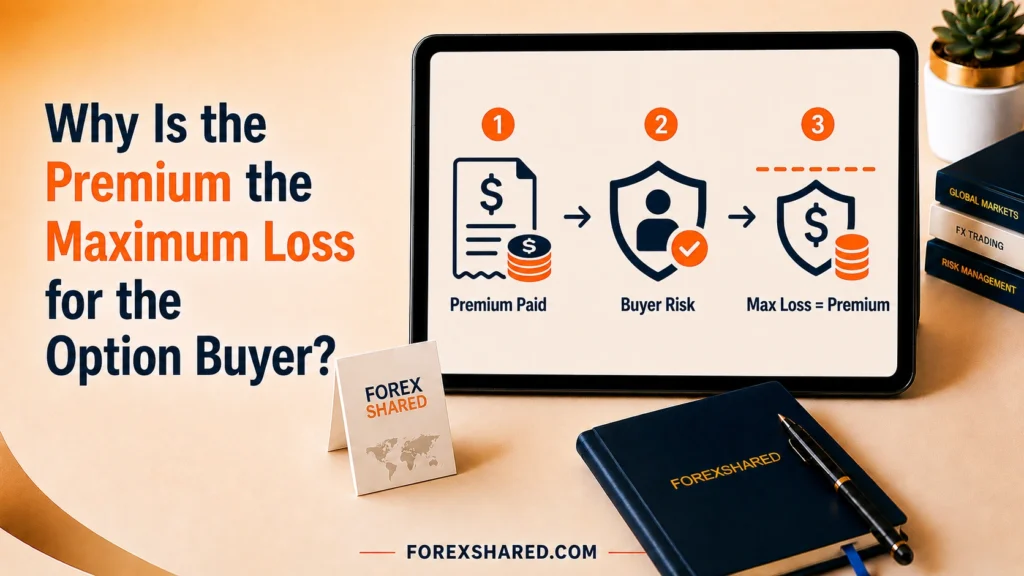
Why Is the Premium the Maximum Loss for the Option Buyer?
The premium is the maximum loss for a fully paid option buyer because the buyer purchases a contractual right with a fixed acquisition cost rather than assuming an open-ended underlying obligation. The option can lose all of its value, but its value cannot fall below zero.
The mechanism is simple: Initial Option Investment = Premium Paid, while the purchased option’s minimum market value is zero. If ending option value reaches zero, Long-Option P&L = 0 – Premium Paid.
The rest of the article keeps that option-position boundary separate from breakeven, transaction costs, writer exposure, futures margin and any new futures position created after exercise.
This article explains option and futures risk mechanics for educational purposes and does not provide individualized financial or trading advice. Contract terms, premium-payment conventions, transaction costs, liquidity and expiration procedures can vary, so current product and account documentation should be checked before relying on a specific loss calculation.
What Does the Premium Represent in an Option Purchase?
The premium is the fixed amount the option buyer pays to acquire the option contract, and that amount becomes the maximum value the long option itself can lose.
CFTC defines premium as the payment an option buyer makes to the option writer for granting the option contract and defines an option as a right, not an obligation, to buy or sell the specified instrument at specified terms. CFTC CME further states that premium paid by call or put buyers is nonrefundable, although remaining market value may be recovered by selling the option before expiration. CME
For the parent category context, see Forex options downside control.
What is an option premium?
An option premium is the payment the option buyer makes to the option writer for granting the option contract. CFTC
Premium is the purchase price of the option contract itself, not a refundable deposit or performance collateral.
What does the buyer receive for paying premium?
The buyer receives a contractual right, not an obligation, to buy or sell the specified underlying instrument at the specified price within the specified period. CFTC
The right is discretionary: the buyer can exercise under the contract terms or allow the option to expire.
Why is premium different from a refundable deposit?
The premium is the purchase price of the option, and for call and put buyers the premium paid is nonrefundable. CME
Selling the option can recover remaining market value, but that recovery is a market sale rather than a refund of the original premium.
Why does this matter to maximum loss?
Because the buyer begins with a known amount committed, the premium paid, that amount becomes the maximum value the long option itself can lose.
Because the premium is the known amount committed to acquire the long option, it is the starting amount at risk.
Why Can a Purchased Option Not Lose More Than Its Premium?
A purchased option cannot lose more than its premium because the option’s value can fall to zero but cannot fall below zero.
The loss boundary follows from two fixed elements: the buyer’s acquisition cost is the premium and the purchased option cannot have a market value below zero. CME states that long calls and long puts must be paid for in full and that the buyer’s maximum loss is limited to premium paid. CME
The dedicated loss-boundary explanation is covered in Maximum loss limited to premium.
What is the worst possible value of a long option?
The worst possible value of a long option is zero.
A purchased option may become worthless, but its market value does not become a negative-value long-option asset.
What happens when ending option value reaches zero?
When the ending option value reaches zero, the long-option P&L equals the negative of the premium paid.
If the ending option value is zero, Long-Option P&L = 0 – Premium Paid, so the full premium is lost.
Why does further adverse underlying movement stop increasing the option loss?
Further adverse underlying movement stops increasing the option loss because once the option has no value left, its value cannot fall below zero.
The underlying can keep moving adversely after the option reaches zero, but the purchased option has no remaining market value to lose.
How does CME state this rule?
CME states that for option buyers, whether calls or puts, the maximum loss is limited to the premium paid on purchase regardless of how far the underlying moves adversely. CME
The same premium-limited buyer rule applies to long calls and long puts.
| Stage | Result |
|---|---|
| Buyer Pays Premium = P | Initial Option Investment = P |
| Option Market Value Declines | Remaining option value becomes smaller |
| Option Value Reaches 0 | No remaining long-option market value |
| No Additional Long-Option Value Exists to Lose | Further adverse underlying movement cannot push the option below zero |
| Maximum Long-Option Loss = P | Long-Option P&L = 0 – P = -P |
The diagram below visualizes the same section mechanism without introducing a new rule.
Why Does the Same Maximum-Loss Rule Apply to Both Calls and Puts?
The same maximum-loss rule applies to both calls and puts because both buyers pay a premium, acquire a right, and can end with an option value of zero.
Calls and puts express opposite directional rights, but both purchased positions share the same buyer-side architecture: premium paid, contractual right acquired, value can fall to zero, and the option-position loss stops at the premium. CME applies the premium-limited maximum-loss rule to both long calls and long puts. CME
What can a long call lose?
A long call can lose the full premium if the underlying fails to rise sufficiently or the option expires worthless. CME
A long call can lose the full premium when the underlying does not rise enough to preserve value or the option expires worthless.
What can a long put lose?
A long put can lose the premium if the underlying fails to fall sufficiently or the option expires worthless. CME
A long put can lose the full premium when the underlying does not fall enough to preserve value or the option expires worthless.
Why do opposite directional rights produce the same downside cap?
Opposite directional rights produce the same downside cap because both buyers pay premium, acquire a right, and can end with an option value of zero.
The zero-value floor is direction-independent, so opposite call and put rights do not change the buyer-side loss ceiling.
What differs between calls and puts?
What differs between calls and puts is the favorable underlying direction, not the maximum-loss architecture.
Calls benefit from a rising underlier and puts from a falling underlier, but both purchased positions retain the same premium-based maximum-loss structure.
| Risk Feature | Long Call | Long Put |
|---|---|---|
| Directional Right | Right to obtain long exposure | Right to obtain short exposure |
| Favorable Underlying Move | Underlying rises | Underlying falls |
| Maximum Loss | Premium paid | Premium paid |
| Condition for Full Loss | Call ends worthless or without recoverable value | Put ends worthless or without recoverable value |
The diagram below visualizes the same section mechanism without introducing a new rule.
Why Does a Larger Adverse Market Move Not Increase the Buyer’s Maximum Option Loss?
A larger adverse market move does not increase the buyer’s maximum option loss because once the option reaches zero value, further adverse movement cannot push it below zero.
The underlying can keep moving against the buyer after the option has already lost all market value, but the long option itself has no remaining value to lose. This is the structural difference from direct futures exposure, where the position continues changing value with the underlying market.
What happens when a call’s underlying keeps falling?
When a call’s underlying keeps falling, the call can progressively lose value until its market value approaches zero.
As a call’s underlier moves against it, the call can progressively lose market value until that value approaches zero.
What happens after the call has effectively reached zero value?
After the call has effectively reached zero value, a further decline in the underlying does not push the purchased call below zero.
Once option value is zero, there is no remaining purchased-option value that can be lost.
What is the equivalent put case?
If the underlying keeps rising against a long put, the put can lose its remaining value, and once worthless, further upward movement cannot create additional purchased-put loss.
Once a purchased put is worthless, further upward movement in the underlier cannot create additional put-position loss.
Why is this different from directly holding futures?
This is different from directly holding futures because a futures position remains exposed to continuing underlying price movement, while the long option owns a finite-cost right.
Futures margin is not a maximum-loss boundary, while the long option is a finite-cost right with a zero-value floor.
| Scenario | Option Ending Value | Option Loss |
|---|---|---|
| Scenario A: Moderate adverse move | $400 | $600 |
| Scenario B: Much farther adverse move | $0 | $1,000 |
| Scenario C: Dramatically farther adverse move | $0 | $1,000 |
The diagram below visualizes the same section mechanism without introducing a new rule.
Why Can the Buyer Still Lose 100% of the Premium?
The buyer can still lose 100% of the premium because a purchased option can expire worthless, and limited risk means the maximum amount is known, not that the loss must be small.
A known maximum does not guarantee any residual value. If the purchased option ends worthless, the buyer can lose the entire premium, so limited risk means a predefined ceiling rather than a promise that the realized loss will be small.
Does the premium cap guarantee some residual value?
No, the premium cap does not guarantee any residual value because a purchased option can expire worthless.
The option can expire worthless, so the loss cap does not guarantee residual value.
What happens if the option ends with zero value?
If the option ends with zero value, the buyer loses the full premium committed to that option.
With premium P and ending option value of zero, Long-Option P&L = 0 – P = -P.
Is losing the full premium consistent with “limited risk”?
Yes, losing the full premium is consistent with limited risk because the risk is limited by the known maximum amount, not by a guarantee of small loss.
Limited risk means the maximum is predefined; it does not mean the possible loss is economically small.
Why should the article avoid saying options are automatically low risk?
The article should avoid saying options are automatically low risk because a predefined maximum loss can still equal 100% of the option investment.
The word limited describes the existence of a ceiling, not whether that ceiling is small relative to the buyer’s capital.
Why Is Maximum Loss Different From Breakeven?
Maximum loss is different from breakeven because maximum loss answers how much the long option can lose, while breakeven answers what expiration outcome is needed to recover the premium cost.
Maximum loss answers the downside question; breakeven answers the cost-recovery question. CME’s straightforward long-call illustration places expiry breakeven at strike plus premium, which is separate from the premium-defined loss ceiling. CME
The recovery threshold created by premium cost is developed further in Premium size and break-even logic.
What question does maximum loss answer?
Maximum loss answers the question: how much can the long option lose? The answer is the premium paid.
For a fully paid long option, the downside answer is the premium paid.
What question does breakeven answer?
Breakeven answers the question: what expiration outcome is needed for the option’s intrinsic value to recover the premium cost?
Breakeven measures the favorable expiry outcome needed to recover the premium cost.
What is the simple long-call expiration relationship?
For a straightforward call held to expiry, the breakeven relationship is: Call Breakeven = Strike + Premium. CME
For the stated straightforward long-call expiry framework, the underlying must exceed strike by the premium amount to recover the premium cost.
Can an option be in the money and still produce a net loss?
Yes, an option can be in the money and still produce a net loss if the intrinsic value is smaller than the premium paid.
If expiry intrinsic value is smaller than the premium paid, an in-the-money option can still leave the buyer with a net loss.
Why does this matter to the H1?
This matters to the H1 because the premium performs two different functions: it is the risk boundary, meaning the maximum amount the option can lose, and the cost hurdle, meaning the amount the option must recover before net profitability.
Premium has two separate functions: it is the long-option risk boundary and also the cost hurdle that must be recovered before net profitability.
| Comparison Point | Maximum Loss | Breakeven |
|---|---|---|
| Question Answered | How much can the long option lose? | What expiry outcome is needed to recover premium cost? |
| Definition | Premium-defined downside ceiling | Premium-recovery threshold |
| Relationship to Premium | Premium is the maximum option loss | Premium must be recovered before net profitability |
| Role | Risk boundary | Cost-recovery hurdle |
Why Can Selling the Option Before Expiration Reduce the Actual Loss?
Selling the option before expiration can reduce the actual loss because if the option retains market value, the buyer may sell it and recover part of the premium.
CME states that a long option may be offset before expiration and that an option buyer can potentially recover some or all remaining premium value by selling the option while it still has market value. The maximum loss is therefore a worst-case boundary, not an inevitable outcome. CME
Must the buyer lose the full premium after an unfavorable move?
No, the buyer does not have to lose the full premium after an unfavorable move because if the option retains market value, the buyer may potentially sell it before expiration.
If the option still has market value, an offsetting sale can recover part of the original cash outlay.
What does CME say about recovering premium value?
CME states that although the purchase premium is nonrefundable, an option buyer can potentially recover some or all of it by selling the option in the marketplace while it retains value. CME
Nonrefundable and unrecoverable are different ideas: the premium is not refunded, but remaining option value may be sold.
What example shows the difference?
If the buyer pays a $1,000 premium and later sells the option for $350, the actual option loss is $650, while the maximum possible option loss remains $1,000.
The maximum defines the worst contractual case, while actual loss depends on the option’s exit or ending value.
Why is maximum loss not the same as expected loss?
Maximum loss is not the same as expected loss because maximum loss defines the worst contractual outcome, while expected loss reflects the most likely realized outcome.
Maximum loss is a boundary, not a forecast of the most likely realized loss.
Why Must Transaction Costs Be Separated From the Premium Maximum-Loss Rule?
Transaction costs must be separated from the premium maximum-loss rule because the quoted premium is not necessarily the buyer’s total cash outlay.
The current FIA risk disclosure distinguishes the purchased option’s premium from transaction costs and warns that a worthless purchased option can produce a total loss consisting of the premium plus transaction costs. FIA
Is the quoted premium necessarily the buyer’s total cash outlay?
No, the quoted premium is not necessarily the buyer’s total cash outlay because additional costs may include commissions, exchange fees, brokerage fees, and other transaction charges.
Additional cash costs can include commissions, exchange fees, brokerage charges and other transaction expenses.
What does the current risk disclosure state?
The current risk disclosure warns that a purchased option that expires worthless can result in loss of the premium and transaction costs. FIA
The disclosure treats premium and transaction costs as separate components of the buyer’s all-in loss.
What is the precise formulation?
For a standard fully paid long option, the maximum option market loss equals the premium paid, while the maximum all-in transaction loss can include the premium plus applicable costs.
Maximum Option Market Loss = Premium Paid. Maximum All-In Transaction Loss can include Premium + Applicable Costs.
Why should those two amounts not be collapsed?
Those two amounts should not be collapsed because transaction costs are separate costs of executing and maintaining the transaction, not additional losses generated by the option falling below zero.
The zero floor limits option-value loss, while transaction costs are separate execution or carrying costs rather than negative option value.
Why Is the Premium Maximum-Loss Rule Specific to the Option Buyer?
The premium maximum-loss rule is specific to the option buyer because the buyer owns a right, while the writer accepts a contingent obligation.
CFTC distinguishes the buyer, who purchases the option right, from the writer, who promises performance in return for premium. CFTC The FIA disclosure separately warns that an option seller can sustain losses well in excess of the premium received. FIA
The seller-side contrast is developed further in Seller versus buyer risk.
What contractual position does the buyer hold?
The buyer holds the contractual position of owning the right, as the option itself is a right rather than an obligation. CFTC
CFTC defines the option buyer as the person who purchases calls or puts, while the option itself gives a right rather than an obligation.
What position does the writer hold?
The writer holds the position of promising performance in exchange for the option premium. CFTC
CFTC defines the writer as the person who promises performance in return for the option price or premium.
Does premium received cap the writer’s loss?
No, the premium received does not cap the writer’s loss because the premium is the writer’s compensation, not a universal maximum-loss boundary. FIA
The current FIA disclosure states that an option seller may sustain losses well in excess of the premium received.
What creates the asymmetry?
The asymmetry is created by the buyer paying a fixed premium for a discretionary right, while the writer receives a fixed premium but accepts a contingent obligation.
The buyer pays a fixed premium for a discretionary right, while the writer receives a fixed premium for accepting a contingent obligation whose loss can exceed the premium.
The diagram below visualizes the same section mechanism without introducing a new rule.
Why Is Option Premium Different From Futures Margin?
Option premium is different from futures margin because premium is the purchase price of optionality, while margin is financial collateral supporting an existing futures obligation.
Premium is the cost of acquiring optionality; futures margin is performance support for an existing futures obligation. The same dollar amount can therefore represent a capped long-option acquisition cost in one case and collateral for an uncapped futures market exposure in the other.
What does option premium represent?
Option premium represents the purchase price of optionality.
Premium buys the option right rather than serving as collateral for an open futures obligation.
What does futures margin represent?
Futures margin represents financial collateral or performance resources supporting an existing futures obligation.
Futures margin supports performance of the futures obligation; it is not the purchase price of a limited-loss right.
Why does posting $2,000 of futures margin not cap futures losses at $2,000?
Posting $2,000 of futures margin does not cap futures losses at $2,000 because the futures position continues changing value with the underlying market, and margin is not the purchase price of a limited-loss right.
The futures position continues changing value with the underlying market, so the amount initially posted as margin is not a loss ceiling.
Why does paying $2,000 for a long option create a different outcome?
Paying $2,000 for a long option creates a different outcome because the premium is the acquisition cost and the option value floor is zero, so the maximum option loss equals the premium paid.
For the purchased option, the zero-value floor converts the acquisition cost into the maximum option-position loss.
What is the structural distinction?
The structural distinction is that premium is an acquisition cost and option-value loss boundary, while margin is performance support and not a maximum-loss boundary.
Premium is an acquisition cost and long-option value-loss boundary; margin is performance support and not a maximum-loss boundary.
Why Does Exercise End the Original Premium-Limited Risk Boundary?
Exercise ends the original premium-limited risk boundary because exercising an option on futures creates an underlying futures position with its own separate market-risk and margin framework.
Current CME FX specifications state that listed FX options are European style and that in-the-money options deliver into the corresponding underlying futures at expiry, which creates a separate futures exposure after exercise. CME
What happens while the buyer only holds the option?
While the buyer only holds the option, the long-option downside remains limited to the premium.
While only the purchased option is held, the zero-value floor continues to define the option-position loss boundary.
What happens when a call option on futures is exercised?
When a call option on futures is exercised, the exercise creates a long underlying futures position. CME
Exercise converts the option right into the relevant underlying futures position, which has its own continuing obligations.
What happens when a put option on futures is exercised?
When a put option on futures is exercised, the exercise creates a short underlying futures position. CME
Exercise converts the option right into the relevant underlying futures position, which has its own continuing obligations.
Is the new futures position still protected by the original premium cap?
No, the new futures position is not protected by the original premium cap because it becomes a separate futures exposure subject to underlying price changes, margin, mark-to-market, and futures settlement rules.
The resulting futures position has its own market risk, margin, mark-to-market and settlement framework.
Why is this relevant for current CME FX options?
This is relevant for current CME FX options because CME’s current FX specifications state that its listed FX options are European style and that in-the-money options deliver into the corresponding underlying futures at expiry. CME
Current CME FX specifications identify the listed FX options as European style and state that in-the-money options deliver into the underlying future at expiry.
| Risk Feature | Long Option Position | Post-Exercise Futures Position |
|---|---|---|
| Risk Boundary | Premium-limited on the fully paid purchased option | Original premium does not cap the new futures exposure |
| Margin Requirement | Premium paid for the long option | Futures margin requirements apply |
| Mark-to-Market | Option market value changes | Futures mark-to-market applies |
| Settlement Framework | Option contract rules | Futures settlement rules |
| Premium Cap Applies? | Yes, to the purchased option itself | No |
The diagram below visualizes the same section mechanism without introducing a new rule.
What Example Proves That Premium Is the Buyer’s Maximum Option Loss?
An illustrative FX put with a $1,250 premium proves that premium is the buyer’s maximum option loss because the put can fall to zero but cannot fall below zero.
The supplied $1,250 put example isolates the zero-floor mechanism. A favorable move can increase the put’s value, an adverse move can reduce it to zero, and an even larger adverse move cannot push the purchased put below zero, so the option loss remains capped at the $1,250 premium before separate costs.
What happens if the underlying falls as expected?
If the underlying falls as expected, the put can gain market or intrinsic value, though the actual result depends on the magnitude and timing of the move.
The favorable put outcome depends on the magnitude and timing of the underlying move.
What happens if the underlying instead rises?
If the underlying instead rises, the put can lose value.
As the underlier rises against the put, the put can keep losing value until its market value reaches zero.
What if the underlying rises enough that the put becomes worthless?
If the underlying rises enough that the put becomes worthless, the ending option value is $0 and the buyer P&L is $0 − $1,250.
At an ending option value of zero, the full illustrative premium is lost.
What if the underlying rises much farther afterward?
If the underlying rises much farther afterward, the purchased put cannot fall below zero, so the maximum option loss remains $1,250.
After the purchased put reaches zero, further upward movement cannot extend the put-position loss.
What does the example establish?
The example establishes that the adverse underlying move can be theoretically much larger than the buyer’s option loss because underlying exposure is not the same as owning the option right.
Direct underlying exposure and ownership of a finite-cost option right have different downside structures.
How Should the Buyer Verify the True Maximum-Loss Amount?
The buyer should verify the true maximum-loss amount by confirming the position is a purchased option, identifying the quoted premium, converting it into monetary cost, and checking the payment convention, transaction costs, offset route, and expiration behavior.
Verification should move from position identity to monetary commitment and then to lifecycle boundaries: confirm the option is long, identify the premium quote, convert it into cash cost, check payment convention and transaction costs, verify offset and expiration rules, and identify any futures position created by exercise.
Is the position actually a long option?
The buyer must confirm the position is actually a long option, specifically a purchased call or purchased put, and must not apply the premium-loss rule automatically to short options.
The premium maximum-loss rule belongs to purchased calls and puts and must not be applied automatically to short options.
What is the quoted premium?
The buyer must identify the quoted premium, which is the per-unit or per-contract quotation for the option.
The premium quote may be expressed per unit or per contract, depending on the product and venue.
What contract size or notional converts it into monetary cost?
The buyer must identify the contract size or notional that converts the quoted premium into the actual monetary cost committed.
The quoted premium must be converted into the actual monetary commitment using the relevant contract units or notional.
Is premium paid in full or subject to another payment convention?
The buyer must verify whether the premium is paid in full or subject to another payment convention, because the standard headline rule assumes a fully paid long option.
The standard headline rule assumes a fully paid long option; deferred-premium arrangements can leave unpaid premium obligations.
What transaction costs apply?
The buyer must identify transaction costs outside the premium, including commissions, fees, and other charges.
Transaction costs are separate from the option’s own market-value loss.
Can the option be offset before expiration?
The buyer must verify the available exit route, specifically whether the option can be offset before expiration.
An offsetting sale can recover remaining market value before expiration if an executable market exists.
What happens at expiration?
The buyer must check what happens at expiration, including exercise, automatic exercise, or expiration and abandonment.
Expiration handling can involve exercise, automatic exercise, expiration or abandonment depending on the product rules.
What does exercise create?
For options on futures, exercise creates an underlying futures position: a long position from a call exercise and a short position from a put exercise. CME
For options on futures, call exercise creates long futures exposure and put exercise creates short futures exposure.
What is the correct verification sequence?
The correct verification sequence is: confirm the position is a purchased option, identify call or put, determine the quoted premium, convert premium into total monetary cost, confirm the payment convention, treat the premium as fully loseable, add transaction costs separately, verify pre-expiry offset mechanics, verify expiration and exercise rules, and treat any post-exercise underlying exposure as a new risk position.
Each verification step builds on the previous one so the buyer does not confuse contract identity, monetary premium, costs and post-exercise exposure.
How Can Option Buyers Avoid Misunderstanding the Premium Maximum-Loss Rule?
Option buyers can avoid misunderstanding the premium maximum-loss rule by correcting the most common errors: the premium can be fully lost, it is nonrefundable, the option cannot fall below zero, transaction costs sit outside the premium, breakeven differs from maximum loss, writer risk differs from buyer risk, premium differs from margin, and exercise creates a new risk position.
The rule is accurate only when its boundaries stay visible: a fully paid purchased option can lose 100% of premium, premium is nonrefundable, the option itself cannot fall below zero, fees remain separate, breakeven is not maximum loss, writer risk is different, margin is different, and exercise can create a new futures exposure.
Why is “maximum loss equals premium, so the buyer cannot lose 100%” incorrect?
This statement is incorrect because the entire premium can be lost.
The premium cap defines the maximum possible option loss, not a guaranteed amount of value that must remain.
Why is “premium is returned if the option is not exercised” incorrect?
This statement is incorrect because CME states that premium paid by a call or put buyer is nonrefundable. CME
The buyer may recover remaining market value through sale, but that does not make the original premium refundable.
Why is “a larger adverse market move creates losses beyond premium” incorrect for the purchased option?
This statement is incorrect for the purchased option because the option’s own value cannot fall below zero.
Further adverse movement cannot create additional purchased-option market loss once its value is already zero.
Why is “premium equals total transaction loss” incomplete?
This statement is incomplete because fees and commissions can sit outside the premium.
The premium cap applies to the option’s market loss, while transaction costs remain separate cash outflows.
Why is “maximum loss and breakeven are the same concept” incorrect?
This statement is incorrect because maximum loss measures the downside floor, while breakeven measures the favorable outcome required to recover the premium.
Maximum loss is a downside boundary; breakeven is a cost-recovery hurdle.
Why is “writer risk is also capped at premium” incorrect?
This statement is incorrect because the writer receives premium while accepting a contingent obligation and can suffer losses beyond that amount. FIA
The writer receives premium while accepting a contingent obligation, so the buyer’s loss cap does not transfer to the seller.
Why is “premium is like futures margin” incorrect?
This statement is incorrect because premium purchases a right, while margin supports a futures obligation.
Premium purchases an option right, while futures margin supports performance of a futures obligation.
Why is “premium still caps losses after exercise” incorrect?
This statement is incorrect because exercise can create an underlying futures position with its own separate risk and margin framework.
A futures position created through exercise has its own market-risk and margin framework.
What should be verified before stating that premium is the option buyer’s maximum loss?
Before stating that premium is the option buyer’s maximum loss, the buyer should verify the position is a purchased long option, the monetary premium is calculated correctly, the zero-value floor is understood, maximum loss is distinguished from breakeven, transaction costs are kept separate, buyer risk is not generalized to the writer, premium is distinguished from margin, and any post-exercise futures position is treated as a new risk exposure.
Each checklist item confirms that the premium-loss rule is being applied to the correct position and boundary.
- The position is a purchased long option.
- The monetary premium paid is calculated correctly.
- The option’s zero-value floor is understood.
- Maximum option loss is identified as the fully paid premium.
- A 100% premium loss is recognized as possible.
- Maximum loss is distinguished from breakeven.
- Transaction costs are kept outside the headline option-loss cap.
- Buyer risk is not generalized to the writer.
- Premium is distinguished from futures margin.
- Any underlying futures position created through exercise is treated as a new risk exposure.
Conclusion Direction
The premium is the maximum loss for a fully paid option buyer because the option is a finite-cost contractual right with a zero-value floor.
CFTC defines an option as a right rather than an obligation, which is the contractual foundation of the buyer-side asymmetry. CFTC CME states that the buyer’s maximum loss on long calls and long puts is limited to premium paid. CME
The arithmetic remains Long-Option P&L = Ending Option Value – Premium Paid. At an ending value of zero, the minimum option-position P&L is -Premium Paid. The FIA disclosure adds the all-in cash-loss caveat that transaction costs can sit outside that option-position loss boundary. FIA
That premium cap ends with the option position itself. If exercise creates an underlying futures position, the new exposure follows its own market-risk and margin framework. Current CME FX specifications state that listed FX options are European style and deliver into the underlying future when in the money at expiry. CME
FAQs
The FAQs answer the most common follow-up questions about the premium maximum-loss rule.
What is an option premium?
An option premium is the payment the option buyer makes to the option writer for granting the option contract. CFTC
Premium is the purchase price of the option contract itself, not a refundable deposit or performance collateral.
What is the worst possible value of a long option?
The worst possible value of a long option is zero.
A purchased option may become worthless, but its market value does not become a negative-value long-option asset.
Can an option be in the money and still produce a net loss?
Yes, an option can be in the money and still produce a net loss if the intrinsic value is smaller than the premium paid.
If expiry intrinsic value is smaller than the premium paid, an in-the-money option can still leave the buyer with a net loss.
Does premium received cap the writer’s loss?
No, the premium received does not cap the writer’s loss because the premium is the writer’s compensation, not a universal maximum-loss boundary. FIA
The current FIA disclosure states that an option seller may sustain losses well in excess of the premium received.
Is the new futures position still protected by the original premium cap?
No, the new futures position is not protected by the original premium cap because it becomes a separate futures exposure subject to underlying price changes, margin, mark-to-market, and futures settlement rules.
The resulting futures position has its own market risk, margin, mark-to-market and settlement framework.