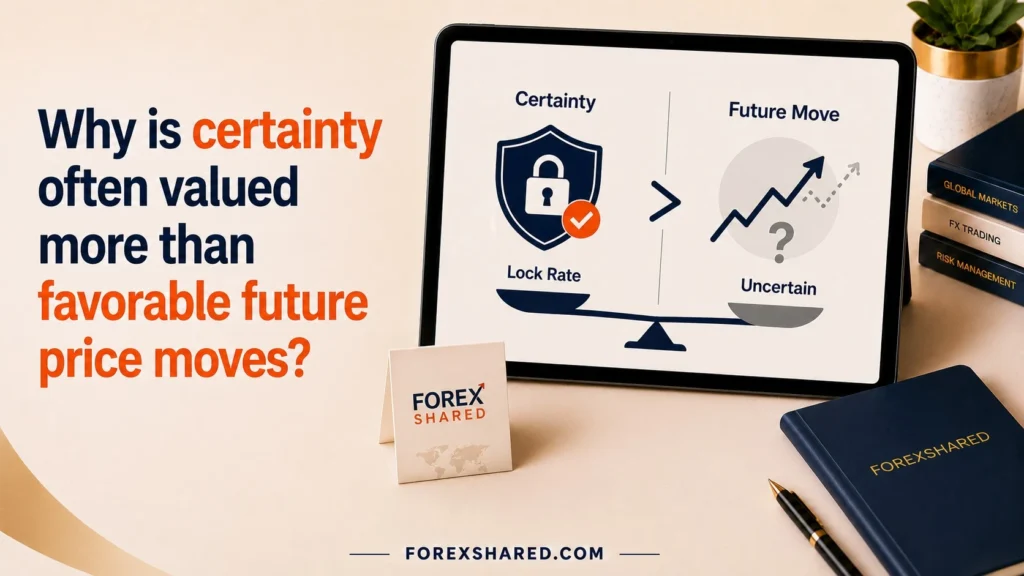
Why is certainty often valued more than favorable future price moves?
Certainty is often valued more than a favorable future exchange-rate move when an adverse outcome could threaten margins, liquidity, covenants or the organization’s ability to meet a committed payment. A forward replaces an unknown future conversion rate with a contracted rate for a defined amount and value date, allowing management to protect a minimum viable cash-flow outcome rather than depend on uncertain upside.
The underlying payable-and-receivable mechanics are explained in Forward hedging for future obligations.
This article is for general education only and does not constitute financial, investment, accounting, legal, operational or tax advice. Forward and option terms, premiums, collateral, settlement, accounting eligibility and close-out treatment vary by agreement, counterparty, jurisdiction and market conditions.
What does certainty mean in forward forex hedging?
Certainty means that the two currencies, transaction direction, contractual amounts, exchange rate and value date are agreed for the hedged portion before settlement. It does not mean that every commercial or financial outcome connected to the underlying transaction is guaranteed.
What does the forward contract make certain?
An outright forward fixes the contractual currency exchange or cash-settlement terms for a future date. BIS defines an outright forward as a contract to exchange two currencies at a rate agreed on the contract date for value, delivery or cash settlement at a later date. BIS2026
For a matched deliverable hedge, treasury can calculate the amount of one currency to be delivered and the amount of the other currency to be received. For a cash-settled structure, the contract specifies how the settlement amount will be determined.
What remains uncertain?
Customer payment, supplier delivery, transaction completion, sales volume, investment performance, funding availability, counterparty performance and overall business profitability can remain uncertain. The forward controls the currency-conversion term; it does not transfer those separate risks to the dealer.
Why is this boundary important?
The boundary prevents a company from treating exchange-rate certainty as total transaction certainty. A receivable hedge can fix the conversion rate for the expected receipt, but it cannot guarantee that the customer pays or that the receipt arrives on the forecast date.
Is the certainty based on a prediction of future spot?
No. The certainty comes from the contract, not from forecasting the settlement-date spot rate. The forward rate is linked to current spot, maturity-specific currency carrying conditions and the exact value date; an executable quote may also reflect cross-currency basis, liquidity, credit, collateral, balance-sheet constraints and bid-offer spread. BIS2016
An ordinary at-market forward generally does not require an option-style upfront premium. The forward rate can differ from spot through forward points, while the executable quote may incorporate market and counterparty conditions. Off-market terms, collateral, restructuring or early termination can still create cash flows or costs.
What is a favorable future price move?
A favorable move is an exchange-rate change that improves the functional-currency outcome of the specific payable or receivable. The direction cannot be judged without identifying which currency will be paid or received and how the pair is quoted.
What is favorable for a future payable?
A future payable benefits when the payment currency becomes cheaper in the payer’s functional currency. A US importer that must pay pounds benefits when GBP/USD falls because each pound costs fewer US dollars.
What is favorable for a future receivable?
A future receivable benefits when the receipt currency becomes more valuable in the recipient’s functional currency. A US exporter expecting pounds benefits when GBP/USD rises because each pound converts into more US dollars.
How does a stronger US dollar affect these examples?
A stronger US dollar generally reduces the USD value of a foreign-currency receivable, which can hurt a US exporter, while reducing the USD cost of a foreign-currency payable, which can help a US importer. A weaker US dollar normally produces the opposite effects.
Why can a favorable move not be relied upon?
The future spot rate is unknown when the budget, price, investment or payment decision must be made. Exchange-rate valuation effects can influence profits, liquidity, credit conditions, investment and hiring, so waiting for a favorable move can expose the business to consequences beyond the direct currency difference. BIS2025
What trade-off does a forward create?
A forward exchanges uncertain upside and downside for a known contracted rate. The hedger gains protection from an adverse move but gives up the benefit of a more favorable spot rate for the hedged amount.
What does the hedger obtain?
The hedger obtains a predictable currency-conversion amount for the matched notional and date. This can support pricing, funding, margin planning and the wider process of Corporate cash-flow stabilization.
What does the hedger surrender?
The hedger surrenders favorable spot participation on the hedged amount because both parties remain bound to the contracted terms. This surrendered upside is normally an opportunity cost, not an upfront cash fee.
Why can the hedger not choose the best rate at maturity?
An ordinary forward is a bilateral obligation rather than a one-sided right. The hedger cannot ignore the contract merely because settlement-date spot is more attractive, although the governing agreement may permit amendment, termination, novation or an economic offset under specified conditions.
| Approach | Adverse-Move Protection | Favorable Participation | Typical Upfront Premium | Main Limitation |
|---|---|---|---|---|
| Remain unhedged | None | Full | None | Full exposure to adverse spot movement |
| Ordinary at-market forward | Contracted-rate protection for the matched amount | None on the hedged amount | Generally no option-style premium | Binding exchange or settlement obligation |
| Purchased currency option | Protection defined by the strike and option terms | Retained, subject to structure | Premium paid by the buyer | Premium and option-design complexity |
Why can adverse currency moves matter more than favorable ones?
Adverse moves can matter more when losses interact with thin margins, limited liquidity, debt covenants or expensive external finance. The asymmetry is conditional, not universal: it depends on the exposure’s size and the organization’s financial resilience.
Why are equal market moves not always equal business outcomes?
An equal favorable and adverse exchange-rate move can have different consequences when the company is close to a funding, margin or covenant threshold. Additional profit may create discretionary headroom, while an adverse shortfall may force borrowing, spending cuts, renegotiation or delayed investment.
How can exchange-rate shocks affect firm value?
Corporate risk-management research evaluates hedging as a way to reduce the effect of cash-flow volatility on firm value. Recent BIS evidence also shows that many firms offset foreign-currency debt exposure with foreign revenues, assets or other business exposures rather than viewing each currency position in isolation. BIS2025
What secondary effects can an FX shortfall create?
A material shortfall can contribute to a liquidity squeeze, higher financing needs, weaker credit metrics, reduced investment or delayed hiring. These effects explain why management may protect a minimum outcome even when the expected average spot outcome appears attractive.
When can certainty be overvalued?
Certainty can be overvalued when the underlying transaction is uncertain, the organization can absorb exchange-rate variability, the hedge would consume valuable flexibility or the cost of preserving upside is acceptable.
Why can a full forward be inappropriate for an uncertain transaction?
A full forward can be inappropriate when a bid, acquisition, forecast sale or other contingent cash flow may not occur. If the exposure disappears, the unmatched portion of the forward becomes a net open currency position rather than a supported hedge.
A forward can be directionally correct yet still create risk when the commercial amount, timing or occurrence differs from the contract. Treasury should monitor the unmatched portion and apply the governing amendment, termination, novation or offset process where necessary.
When can partial hedging offer a better balance?
Partial hedging can protect a minimum acceptable outcome while leaving a controlled portion exposed to favorable and adverse movement. The ratio should reflect forecast confidence, risk capacity, liquidity, policy limits and the financial consequences of an uncovered shortfall—not a generic percentage applied to every exposure.
Why can currency options be preferred?
A purchased currency option can be preferred when the hedger wants a defined adverse-rate limit without accepting the same obligation to exchange currency if the market moves favorably or the underlying transaction does not occur.
How does an option change the trade-off?
The option buyer pays a premium for a right rather than the same obligation to transact at the protected rate. The option can provide downside protection while preserving favorable participation, subject to its strike, expiry, settlement and exercise terms. CME2026
Why does the premium matter?
The premium is an explicit upfront cost paid for flexibility. Its value depends on the protection required, strike, expiry, volatility, interest rates and product structure. The comparison with forward certainty is developed further in Premium cost and capped downside in options.
How should hedge success be measured?
Hedge success should be measured against the documented risk-management objective, the matched exposure and the combined result of the commercial cash flow and derivative—not solely against the settlement-date spot rate.
Can a forward loss accompany a successful hedge?
Yes. A forward can have negative value relative to settlement-date spot while the combined payable-and-forward or receivable-and-forward result still meets the planned cash-flow objective. Looking at the derivative alone can therefore misrepresent the hedge relationship.
What benchmarks can be relevant?
A budget rate, contemporaneous forward quote, approved risk limit or no-hedge outcome may be relevant under a documented policy. The eventual spot rate can reveal opportunity cost, but none of these is automatically the sole universal benchmark.
Does a better future spot rate prove the hedge failed?
No. A better future spot rate shows that remaining unhedged would have produced a more favorable ex-post currency outcome. It does not show that accepting the original uncertainty was consistent with the organization’s risk capacity when the decision was made.
How do counterparty and settlement risks limit certainty?
The certainty of a forward is contractual rather than absolute because it depends on counterparty performance, funding, legal enforceability and reliable settlement operations.
Basel guidance distinguishes principal, replacement-cost, liquidity, operational and legal risks in FX settlement. It promotes payment-versus-payment arrangements where practicable to reduce principal risk, while recognizing that other risks can remain. BCBS2013
When is a full forward hedge most defensible?
A full forward is most defensible when the underlying amount and value date are highly certain, the exposure is material, the organization has limited capacity to absorb an adverse move and retaining favorable participation is less important than protecting the minimum funding or margin outcome.
Full coverage is not automatically correct. Counterparty limits, liquidity, natural offsets, forecast error, transaction cancellation and alternative hedge structures must still be considered.
What should be validated before certainty is prioritized?
Before prioritizing certainty, treasury should validate the exposure, transaction confidence, amount, timing, currency direction, natural offsets, funding capacity, downside tolerance, counterparty arrangements and the relative suitability of a forward, partial hedge or option.
- Exposure: Is the payable or receivable genuine and clearly identified?
- Occurrence: How likely is the cash flow to occur?
- Materiality: Could an adverse move impair margins, liquidity or covenants?
- Match: Can notional and value date be aligned closely?
- Flexibility: Is favorable participation strategically valuable?
- Cost: Are premium, pricing, collateral and operational costs acceptable?
- Residual risk: Are counterparty, settlement and commercial risks controlled?
Conclusion
Certainty is often valued more than a favorable future price move because corporate decisions must be funded and executed before the future spot rate is known. A forward protects a defined currency outcome for a matched amount and date, allowing the organization to control an adverse scenario that could have disproportionate financial consequences.
The trade-off is real: the hedger gives up favorable spot participation on the covered amount. That sacrifice is justified only when the value of protecting margins, liquidity or contractual obligations exceeds the value of retaining uncertain upside.
Full forwards, partial hedges and purchased options solve different problems. The appropriate choice depends on transaction certainty, risk capacity, price flexibility, premium tolerance and the consequences of an uncovered shortfall. Hedge success should therefore be assessed against the original risk-management objective and combined cash-flow outcome, not hindsight alone.
Frequently Asked Questions
What is the main trade-off when using a forward contract?
The hedger obtains a known exchange rate and protection from an adverse move, but gives up the benefit of a more favorable future spot rate for the hedged amount. The surrendered upside is normally an opportunity cost rather than an upfront option premium.
When might a full forward hedge be inappropriate?
A full forward may be inappropriate when the underlying cash flow is uncertain in amount, timing or occurrence, when the organization can tolerate some exchange-rate variability, or when retaining favorable participation is important. Partial hedging or an option may fit those conditions better.
How should hedge success be measured?
Hedge success should be measured against the documented risk-management objective, the matched exposure and the combined result of the commercial cash flow and derivative. The eventual spot rate can reveal opportunity cost, but it should not be the sole universal benchmark.
Why can a currency option preserve favorable participation?
A purchased currency option gives the buyer a right rather than the same obligation to transact at the protected rate. The buyer pays a premium for downside protection while retaining the ability to use a more favorable market rate, subject to the option terms.