What Makes Lot Size Control Position Units, Exposure Scale & Pip-Value Risk?
The Lot Size is best understood as the position-sizing unit that determines how many currency units a trade actually carries, how large the resulting exposure becomes, and how expensive each pip movement can be. Many readers know lot size means "how big the trade is," but that description is too weak. In practice, lot size is the strict mathematical unit system that determines exactly how many base-currency units are fundamentally locked inside the position.
This article will define lot size through three connected jobs: position-unit control, exposure scaling, and pip-value risk. It is imperative to realize that lot size does not act alone; pair structure, exchange rate, account currency, and execution conditions dynamically shape the final money outcome (IG, 2023)(OANDA, 2023).
EDUCATIONAL DISCLAIMER
This article is educational only. It is not trading advice, not signal content, not a platform recommendation, and not execution coaching. The article must explain trade-size structure and risk translation, not promise returns.
Why Do So Many Readers Misunderstand What Lot Size Actually Does?
Many readers misunderstand the Lot Size, the standardized trade-size unit used to express how many currency units are controlled, because they treat it as just a platform setting instead of a structural variable that controls unit count, exposure scale, and pip-value risk. Aligning it with the Forex pricing and exposure framework corrects this analytical deficit.
Why Does Lot Size Look Like Just a Drop-Down Menu Instead of a Structural Risk Variable?
The Lot Size looks like just a drop-down menu because the interface often hides the unit logic that sits behind the selection. When a user clicks an arbitrary volume setting on a screen, the complex backend measurement role is violently stripped away, leaving an interface shell (OANDA Help, n.d.).
Why Do Beginners Confuse “Bigger Lot” with Only “Bigger Profit Potential”?
Beginners confuse bigger Lot Size with only bigger profit potential when they ignore the fact that larger size also means larger exposure and larger pip-value risk. By obsessing strictly over the profit upside, traders universally blind themselves to the exponential damage inflicted by heightened pip-value sensitivity (IG, 2023).
Why Does This Misread Create Bigger Problems Later?
This misread creates bigger problems later because it distorts the reader’s understanding of unit size, pip value, and stop-loss risk. Lot size is where trade size becomes risk size. If the core position-sizing unit is profoundly misunderstood at entry, devastating miscalculations of total exposure logically persist across the entire trade lifecycle (OANDA, n.d.).
Proof Asset: Lot Size Misread Snapshot
The Lot Size Misread Snapshot should show how a simple trade-size label actually controls deeper unit, exposure, and risk logic.
| What the Reader Assumes | What Lot Size Actually Controls | Why It Matters |
|---|---|---|
| It's just a slider determining how much margin to spend. | It dictates the exact quantity of base-currency units controlled. | If unit count is miscalculated, real pip value exposure becomes wildly unpredictable. |
| A 1.00 lot is standard across all platforms and assets. | It is an OTC convention; standard lots differ radically from exchange-traded futures. | Applying spot lot logic blindly to other instruments destroys accurate sizing metrics. |
What Is Lot Size, and What Is It Not?
The Lot Size is the standardized unit used to express how many currency units are being traded, and it is not the same thing as leverage, margin, or a vague risk slider. Establishing Forex lot size units structurally separates capital sizing from capital financing.
What Is Lot Size in Plain English?
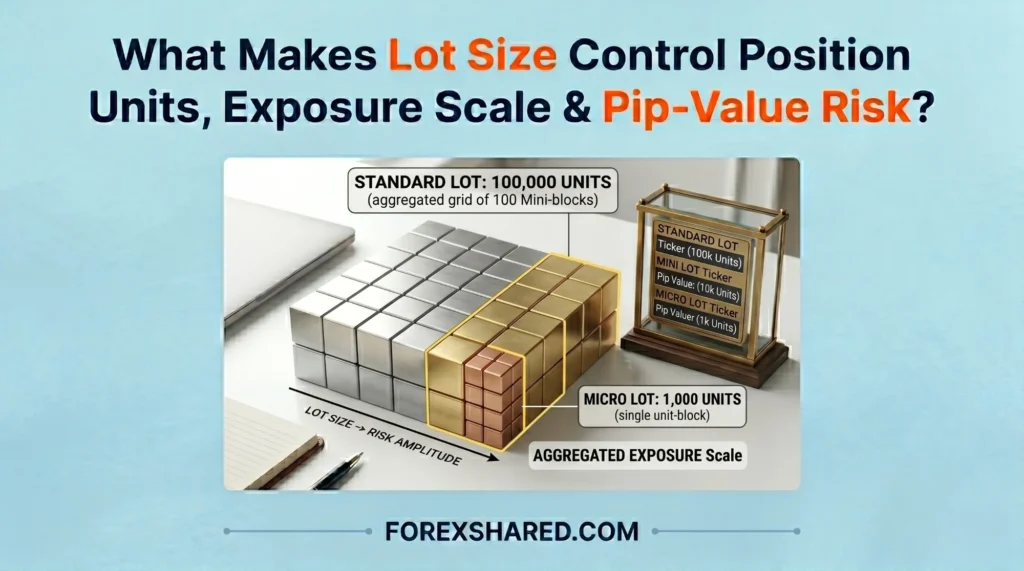
In plain English, the Lot Size is the trade-size unit that tells you how many base-currency units are in the position. A standard lot is a typical 100,000-unit lot block, a mini lot is a 10,000-unit lot block, and a micro lot is a 1,000-unit lot block. Because it defines actual inventory, the position units (actual number of currency units) rigorously dictate market footprint (IG, 2023)(OANDA Help, n.d.).
What Is Lot Size Not?
The Lot Size is not the same thing as leverage, not the same thing as margin posted, and not just a risk-level slider without unit meaning. By meticulously excluding leverage and margin algorithms, the lot size definition profoundly remains focused strictly on exposure scaling (OANDA, n.d.)(OANDA, n.d.).
Why Does Lot Size Exist as a Position Unit Rather Than a Trading Shortcut?
The Lot Size exists as a position unit because FX markets need a standardized way to connect quote movement to actual exposure. As quote shifts register in decimal fractions, lot language acts as the definitive bridge seamlessly locking quote movement to actual realized exposure (IG, 2023).
Proof Asset: Lot Size Definition Table
The Lot Size Definition Table should show what each lot type defines and what it does not automatically mean.
| Lot Type | Units Controlled | What It Defines | What It Does Not Automatically Mean |
|---|---|---|---|
| Standard (1.0) | 100,000 Base Units | The baseline institutional benchmark for OTC pricing scaling. | It does not mean you need $100,000 in cash to open the trade. |
| Micro (0.01) | 1,000 Base Units | A fractional unit providing highly granular position control. | It does not imply that execution slippage risks simply vanish. |
How Does Lot Size Control Position Units?
The Lot Size controls position units because each lot convention corresponds to a specific block of currency units inside the trade. Every fractional adjustment to volume instantly re-weights the entire order payload.
Why Is a Standard Lot Best Understood as a Unit Block Rather Than Just a Label?
A standard Lot Size is best understood as a unit block rather than just a label because it fixes the number of base-currency units carried by the position. When a standard lot is decisively deployed, exactly 100,000 base units are initiated, proving it functions as a highly rigid position block (IG, 2023).
How Do Mini and Micro Lots Change the Unit Count Without Changing the Core Pair?
Mini and micro Lot Size categories change the unit count without changing the core pair because the trade idea can stay the same while the number of units carried becomes smaller. The market idea can seamlessly stay the same while the unit size dynamically shifts, providing incredible flexibility for retail market operators (OANDA Help, n.d.).
Why Does This Make Lot Size the Core Position-Unit Control?
This makes the Lot Size the core position-unit control because it decides how many units the same market idea actually carries. The lot decides how many units your idea actually carries. Regardless of how accurate an entry signal may be, lot size independently acts as the unyielding core control for unit saturation (IG, 2023).
Proof Asset: Position Units Map
The Position Units Map should show how different lot types change unit count without changing the underlying pair.
| Lot Type | Unit Count | Relative Size | Why the Difference Matters |
|---|---|---|---|
| Standard (1.0) | 100,000 Units | 100x the Micro Lot | Requires institutional or highly capitalized retail risk parameters. |
| Micro (0.01) | 1,000 Units | 1/100th of Standard | Allows extreme flexibility in scaling into or out of positions safely. |
How Does Lot Size Scale Exposure?
The Lot Size scales exposure because once unit count rises, the amount of market participation represented by the trade rises with it. Analyzing Position scale and risk establishes that unit allocation defines financial mass. By reviewing Notional value and total exposure, traders visualize the true footprint of their trades.
Why Does More Lot Size Mean More Market Exposure?
More Lot Size means more market exposure because a larger unit count creates larger notional participation in the currency pair. As unit volume expands, notional exposure (market value represented by the position) brutally inflates, directly enlarging real-world market exposure (IG, 2023)(OANDA, 2023).
Why Can the Same Trade Idea Carry Different Exposure at Different Lot Sizes?
The same trade idea can carry different exposure at different Lot Size levels because direction can stay the same while the number of units changes. The overarching directional thesis smoothly stays the same while exposure scale changes, making risk completely modular (IG, 2023).
Why Does This Make Lot Size an Exposure Variable Rather Than Just a Volume Label?
This makes the Lot Size an exposure variable rather than just a volume label because it changes the economic size of the same position idea. Same setup, different exposure scale. Once the lot alters nominal depth, it flawlessly operates as a primary, foundational exposure variable (OANDA, 2023).
Proof Asset: Exposure Scale Table
The Exposure Scale Table should show how lot-size choice changes financial participation in the same pair.
| Lot Type | Units | Exposure Scale | What Changes Financially |
|---|---|---|---|
| Standard | 100,000 | Maximum Retail Baseline | The financial delta per fractional tick movement operates at maximum velocity. |
| Mini | 10,000 | Moderate | The exact same chart thesis yields 10x less financial sensitivity. |
How Does Lot Size Turn Pip Movement into Pip-Value Risk?
The Lot Size turns pip movement into pip-value risk because it determines how much money one standardized pip move is worth at that size. Unlocking this translation process is mandatory for portfolio longevity.
Why Is One Pip Not Worth the Same Amount at Every Lot Size?
One pip is not worth the same amount at every Lot Size because the movement unit stays constant while the number of units exposed to that movement changes. Pip movement is perfectly constant as a price unit, but its volatile money impact changes exponentially with lot size (IG, n.d.)(OANDA, n.d.).
How Does Lot Size Drive Pip Value?
The Lot Size drives pip value (money attached to a one-pip move) because pip value grows or shrinks with the number of units traded. Utilizing a Pip lot value calculator confirms that as unit counts vastly amplify, the pip value definitively scales in precise correlation (IG, n.d.).
Why Does This Make Lot Size Central to Risk Rather Than Just Position Description?
This makes the Lot Size central to risk because the same tiny pip movement becomes more or less financially expensive depending on how many units the trade carries. Pip movement stays tiny; lot size decides how expensive it is. By altering exactly how much money a single pip demands, lot size unquestionably drives real monetary hazard (OANDA, n.d.).
Proof Asset: Lot Size to Pip-Value Table
The Lot Size to Pip-Value Table should show how the same pip becomes more or less expensive as lot size changes.
| Lot Type | Typical Unit Count | One-Pip Value Logic | Why Risk Changes |
|---|---|---|---|
| Standard (1.0) | 100,000 | $10 per pip (e.g., EUR/USD) | An ordinary 30-pip daily swing equals a volatile $300 equity fluctuation. |
| Micro (0.01) | 1,000 | $0.10 per pip (e.g., EUR/USD) | That identical 30-pip market swing only impacts equity by an easily absorbable $3. |
How Do Lot Size, Leverage, and Margin Work Together Without Meaning the Same Thing?
The Lot Size, leverage, and margin work together inside one position structure, but they do not define the same layer of the trade. Conflating scale with financing produces catastrophic liquidation events.
What Does Lot Size Define That Leverage Does Not?
The Lot Size defines unit count, notional participation, and pip-value scale, which leverage does not define by itself. While leverage amplifies buying power, it is strictly the lot size that dictates absolute base-currency unit count (OANDA, n.d.).
What Does Leverage Define That Lot Size Does Not?
Leverage defines capital efficiency and financing intensity, not how many units are inside the position that the Lot Size expresses. Leverage brilliantly optimizes margin intensity and borrowed exposure, but never inherently modifies the final unit block geometry (OANDA, n.d.).
Why Does Margin Posted Not Tell You the Same Thing as Lot Size?
Margin posted does not tell you the same thing as Lot Size because margin is the capital requirement for carrying exposure, while lot size defines the exposure block itself. Lot size controls exposure; leverage and margin control financing structure. When margin is heavily relied upon, lot size still independently defines true exposure (OANDA, n.d.).
Proof Asset: Lot Size vs Leverage vs Margin Matrix
The Lot Size vs Leverage vs Margin Matrix should show how these related terms differ without competing for the same job.
| Control Layer | What It Defines | What It Changes | What It Should Not Be Confused With |
|---|---|---|---|
| Lot Size | The absolute scale of Base units held. | Pip value and Total Notional Risk. | The collateral requirement needed to open the trade. |
| Leverage | The ratio of borrowed capital vs equity. | The margin intensity required. | The ultimate pip-value sensitivity. |
| Margin | The frozen collateral deposit. | Available Free Equity. | The total market value actually exposed to volatility. |
How Do Standard, Mini, and Micro Lots Change the Same Trade Idea?
Standard, mini, and micro Lot Size choices can preserve the same trade idea while radically changing the economic pressure carried by that idea. Technical setups require proper scaling to survive.
Why Does a Standard Lot Make the Trade Feel Economically Larger?
A standard Lot Size makes the trade feel economically larger because each pip movement carries much more money sensitivity than it would at smaller sizes. Because the standard lot intensely forces a $10/pip consequence, the trade structurally asserts immense financial momentum (IG, 2023).
Why Do Mini and Micro Lots Make the Same Setup More Scalable?
Mini and micro Lot Size choices make the same setup more scalable because they reduce the unit count without changing the pair or the thesis. Finer position sizing fluently ensures risk remains tightly capped without demanding the overarching trade thesis be abandoned (OANDA Help, n.d.).
Why Does This Matter for Risk Control and Position Selection?
This matters for risk control and position selection because the same entry and stop can become manageable or excessive depending on the Lot Size attached to them. The setup stays the same; the lot decides the pressure. By scaling lot size perfectly, severe exposure risk is consistently brought under exact mathematical control (IG, 2023)(OANDA, n.d.).
Proof Asset: Lot Comparison Table
The Lot Comparison Table should show how the same idea changes economically as lot size changes.
| Lot Type | Units | Exposure Feel | Pip-Value Consequence |
|---|---|---|---|
| Standard Lot (1.00) | 100,000 | High-stakes, institutional depth. | Even minor drawdowns rapidly induce heavy margin pressure. |
| Micro Lot (0.01) | 1,000 | Conservative, fractional scaling. | Allows the trader to endure massive drawdowns safely. |
How Do Quote Currency, Exchange Rate, and Pair Structure Affect Lot-Size Risk?
Quote currency, exchange rate, and pair structure affect Lot Size risk because the unit count from the lot still needs a quoted relationship to turn into money meaning. Units are merely blocks until valued by an active cross.
Why Does the Same Lot Size Not Produce the Same Pip Value Across Every Pair?
The same Lot Size does not produce the same pip value across every pair because pip value depends on the currency pair, the trade size, and the exchange rate. When pair structure inevitably changes, the money meaning of the movement drastically recalibrates (IG, n.d.).
How Does Quote Currency Affect Pip-Value Expression?
Quote currency affects pip-value expression because the financial impact of movement is still denominated through the quoted relationship. As the financial impact dynamically materializes, it is strictly denominated through the exact parameters established by the underlying quoted relationship (IG, n.d.).
Why Does This Make Lot Size Only One Part of Real Risk Measurement?
This makes Lot Size only one part of real risk measurement because lot size sets the scale while the pair shapes the money meaning. Lot size sets the scale; the pair shapes the money meaning. Consequently, lot size independently acts only as a volume amplifier for the intrinsic pair volatility (OANDA, 2023).
Proof Asset: Pair Structure and Lot Risk Table
The Pair Structure and Lot Risk Table should show why the same lot can produce different money sensitivity across pairs.
| Pair | Lot Size | Pip Value Logic | Why the Same Lot Can Behave Differently |
|---|---|---|---|
| EUR/USD | 1 Standard (100k) | $10 USD per pip | The Quote currency is USD, establishing a fixed $10 payout. |
| EUR/GBP | 1 Standard (100k) | £10 GBP per pip | The P&L is denominated in GBP, making the USD risk highly variable based on GBP/USD rates. |
How Does Account Currency Change the Meaning of Lot-Based Pip Risk?
Account currency, the currency in which the account is measured, changes the meaning of Lot Size-based pip risk because pip value may first appear in pair terms before it is translated into the account’s home-currency context. The ledger forces ultimate reality onto nominal trade data.
Why Is Pip Value Not Always the Same as Account-Currency Risk?
Pip value is not always the same as account-currency risk because the money effect may need to be converted into the account’s home currency before it reflects actual account impact. Even if quote-currency value is high, account-currency impact definitively shifts upon final cross-rate translation (OANDA Europe, 2025).
How Does Account Currency Change the Way Traders Read the Same Lot Size?
Account currency changes the way traders read the same Lot Size because the same trade can feel different once its pip risk is translated into the currency the account actually uses. When account settings aggressively force a conversion, the identical sizing setup incredibly yields profoundly different native impacts (OANDA Europe, 2025)(OANDA, n.d.).
Why Does This Matter for Real Risk Measurement?
This matters for real risk measurement because Lot Size risk becomes practical only after size, pip value, and account-currency translation are all clear. Lot risk becomes real only after currency translation and size are clear. Without this crucial conversion bridge, isolated pip value tragically remains purely theoretical (OANDA Europe, 2025).
Proof Asset: Lot Risk vs Account Currency Table
The Lot Risk vs Account Currency Table should show why a clear lot size still does not complete the risk reading by itself.
| Trade Structure | Pip Value Basis | Account-Currency Translation Issue | Why It Matters |
|---|---|---|---|
| Short GBP/JPY (USD Account) | 1000 JPY per pip | The JPY profit/loss must be converted back to USD. | Total risk floats dynamically with USD/JPY rate instability. |
| Long AUD/CAD (CAD Account) | 10 CAD per pip | No conversion necessary. | Account capital perfectly mirrors quote-side value generation. |
How Do Spot-FX Lot Logic and Standardized Contract/Tick Logic Relate Without Meaning the Same Thing?
Spot-FX Lot Size logic and standardized contract/tick logic relate because both describe exposure scale, but they do not use the same sizing language. Mixing OTC vocabulary with rigid exchange mandates invites execution catastrophe.
Why Is Lot Language Strongest in Spot/Broker FX Reading?
Lot Size language is strongest in spot/broker FX reading because brokers commonly use lot labels to express trade size in unit blocks. Because the convention-based trade-size unit heavily defines OTC operation, lot language fundamentally anchors spot interpretation (OANDA, 2023)(OANDA Help, n.d.).
Why Do Standardized Products Speak More Naturally in Contract Size and Tick Value?
Standardized products speak more naturally in contract size (exchange-defined size unit) and tick value because the exchange publishes both the size block and the minimum price fluctuation directly. By mandating a fixed exchange-set size, rigorous money mapping fiercely ensures zero elasticity in leverage parameters (CME Group, n.d.).
Why Should Readers Compare the Two Without Treating Them as Identical?
Readers should compare the two without treating them as identical because spot uses lot language while standardized products map size through contracts and ticks. Spot uses lot language; standardized products map size through contracts and ticks. Ensuring absolute separation prevents disastrous margin sizing errors (CME Group, n.d.)(IG, 2023).
Proof Asset: Spot Lot vs Standardized Contract Table
The Spot Lot vs Standardized Contract Table should show how both systems size exposure without using the same vocabulary.
| Context | Core Size Unit | How Money Sensitivity Is Attached | What It Should Not Be Confused With |
|---|---|---|---|
| Retail Spot Platform | Lot Input (e.g., 0.50) | Flexible mathematical calculation (Pip Value). | A rigid, non-divisible futures contract. |
| CME Globex Exchange | Standardized Contract Size | Hardcoded Tick Value explicitly stated by the clearinghouse. | Arbitrary, broker-derived scaling factors. |
How Do Displayed Lot Size, Theoretical Pip Value, and Realized Risk Differ?
Displayed Lot Size, theoretical pip value, and realized risk differ because they belong to separate layers of the trade. An input size is a promise; a realized fill is the market's execution truth.
Why Does Displayed Lot Size Not Fully Describe Realized Trade Risk?
Displayed Lot Size does not fully describe realized trade risk because size is necessary but not sufficient for understanding what actually happens after execution. Displayed size alone is fundamentally necessary but undeniably not sufficient for complete risk comprehension (OANDA, n.d.).
Why Is Theoretical Pip Value Not the Same as Final P&L?
Theoretical pip value is not the same as final P&L because spread, slippage, and execution conditions can change the realized outcome. If aggressive spread, severe slippage, and volatile execution conditions vividly emerge, actual payout aggressively shifts (OANDA, n.d.).
Why Can Realized Risk Still Differ from Clean Lot-Size Math?
Realized risk can still differ from clean Lot Size math because live execution adds spread, fill conditions, and market context on top of the structural size calculation. Even when lot math perfectly estimates impact, actual trade conditions profoundly alter final clearance values (OANDA, n.d.).
Proof Asset: Lot Size vs Realized Outcome Table
The Lot Size vs Realized Outcome Table should show why a correct size reading still does not equal a full trading result.
| Layer | What It Represents | What It Can Support | What It Should Not Be Mistaken For |
|---|---|---|---|
| Lot Size Entry | The intended inventory block requested. | Margin parameter calculations. | A guarantee of positive execution quality. |
| Realized P&L | The final financial extraction after clearing. | True account balance growth/decay. | The clean, theoretical pip-math outcome free of friction. |
How Do Stop Distance, Lot Size, and Pip Value Work Together in Risk Control?
Stop distance, Lot Size, and pip value work together in risk control because a stop only becomes money risk after size and one-pip value are added. Applying a Position size calculator unites these raw metrics into intelligent equity preservation.
Why Is Lot Size the Main Multiplier of Stop-Loss Risk?
The Lot Size is the main multiplier of stop-loss risk because the same stop distance becomes more or less expensive as the unit count changes. As the lot size aggressively scales, the monetary burn rate amplifies exponentially (IG, 2023)(OANDA, n.d.).
How Does the Same Pip Stop Produce Different Risk at Different Lot Sizes?
The same pip stop produces different risk at different Lot Size levels because stop distance alone says nothing about how many units are exposed to that move. If distance is noted but size is completely ignored, real exposure calculation totally fails. Running a Position size calculator safely converts that distance into size-appropriate monetary hazard (IG, 2023).
Why Does This Matter for Account Survival and Position Design?
This matters for account survival and position design because a stop that looks small in pips can still be too large in money terms at the wrong Lot Size. To ensure ruin is vigorously prevented, precise lot-size modulation is an absolute baseline requirement (OANDA, n.d.).
Proof Asset: Stop Distance and Lot Risk Table
The Stop Distance and Lot Risk Table should show how the same stop becomes more or less dangerous as lot size changes.
| Lot Size | Stop Distance | Pip Value Logic | Approximate Risk Meaning |
|---|---|---|---|
| 0.10 (Mini Lot) | 40 Pips | $1.00 / Pip | Creates a highly absorbable $40 hazard footprint. |
| 1.00 (Standard Lot) | 40 Pips | $10.00 / Pip | Magnifies identical volatility into a $400 margin exposure. |
How Does Lot Size Appear Differently in Spot Forex, Broker Platforms, and Standardized Products?
The Lot Size appears differently across spot forex, broker platforms, and standardized products because each context expresses size in a different operational language. Syntax changes, but bulk volume remains immutable.
How Does Lot Size Function in Standard Spot FX Reading?
In standard spot FX reading, the Lot Size functions as the unit-count language that connects trade size to pip-value scale. When unit count is firmly cemented, the pip-value scaling is impeccably formalized (IG, 2023)(OANDA, 2023).
How Do Broker Platforms Turn Lot Size into Practical Trade Inputs?
Broker platforms turn Lot Size into practical trade inputs by making unit size, order size, and risk consequences selectable at trade entry. Because order sizing and stop logic become flawlessly integrated, risk display instantly serves the live trader (OANDA Help, n.d.).
How Do Standardized Products Make Exposure Scale More Explicit Through Contract Size?
Standardized products make exposure scale more explicit through contract size because the exchange publishes the exact block size and minimum price movement together. Because the exchange perfectly dictates the comparison, spot logic safely contrasts with rigid futures logic (CME Group, n.d.).
Proof Asset: Market Context Comparison Table
The Market Context Comparison Table should show how size stays central while its operational expression changes by setting.
| Context | How Size Is Expressed | What It Anchors | What Can Look Different |
|---|---|---|---|
| Retail Spot Margin | Lot (1.00) Input | Mathematical Pip sensitivity scaler. | Can be highly fractionalized (e.g., 0.03 Lots). |
| Regulated Futures | Contract Block Size | Unbreakable execution and clearing value rules. | Tick sizing and outright contract denomination. |
How Do Position Units, Exposure Scale, and Pip-Value Risk Fit Together as One Lot-Size System?
Position units, exposure scale, and pip-value risk fit together as one Lot Size system rather than as isolated facts. Ignoring this synergy induces massive margin calls.
How Does Lot Size Anchor Position Units?
The Lot Size anchors position units because the selected lot convention determines how many base-currency units enter the trade. Since the lot definitively commands unit count, position block generation flawlessly proceeds (IG, 2023)(OANDA, 2023).
How Does That Unit Count Become Exposure Scale?
That unit count becomes exposure scale because more units create greater notional participation in the market. Consequently, as the unit count visibly inflates, notional exposure aggressively climbs (IG, 2023).
How Does That Exposure Scale Become Pip-Value Risk?
That exposure scale becomes pip-value risk because one pip movement acquires a larger or smaller money consequence as the trade carries more or fewer units. With exposure formally scaled, pip value attaches directly, guaranteeing intense money sensitivity is generated (IG, n.d.).
How Do Pair Structure, Account Currency, Leverage, and Execution Context Change the Outcome Without Replacing the Structure?
Pair structure, account currency, leverage, and execution context change the outcome without replacing Lot Size structure because they alter translation, financing, and realization rather than the unit block itself. When aggressive context changes occur, structural continuity impeccably survives, avoiding complete analytical erasure (OANDA Europe, 2025)(CME Group, n.d.).
Proof Asset: Lot Size Relationship Matrix
The Lot Size Relationship Matrix should show what lot size anchors, what context can alter, and what remains structurally true.
| Lot-Size Layer | What It Anchors | What Changes by Context | What Stays Structurally True | Main Misread |
|---|---|---|---|---|
| lot convention | The mathematical order of units | Broker-specific maximums | The 100k, 10k, 1k scaling rules | Assuming 1 lot is identical on all platforms globally |
| unit count | Base-currency mass | Quote-currency equivalence over time | The rigid number of units held | Believing lot size equals account capital |
| exposure scale | Total Notional Value | Exchange rate fluctuation | The physical market participation footprint | Assuming low margin guarantees low exposure |
| pip value | Sensitivity per tick | Current cross-rates | Value fluctuates proportionally to size | Assuming $10/pip works universally across all pairs |
| stop-distance risk | Hard financial drawdown boundary | Slippage and gap events | Distance multiplies against Pip Value | Using visual chart space to guess monetary loss |
| account-currency translation | Final ledger P&L state | Live pair-to-home-fiat exchange rates | Net account equity delta | Ignoring conversion decay on exotic crosses |
| leverage/margin interaction | Deposit efficiency | Broker risk controls and Tiered margin | Collateral requirements do not alter exposure scale | Assuming 1:500 leverage means a larger base unit |
| pair-structure effect | Denomination framework | Asset volatility parameters | The physical Quote extraction base | Ignoring Quote currency identity |
| realized execution outcome | The actual cleared bankable sum | Execution delays and liquidity voids | Theoretical math encounters reality | Assuming platform estimation equals final payout |
| standardized-product mapping | Exchange tick integration | CME contract mandates | Base units translate to Tick values | Failing to recognize CME micro contracts vs Spot micro lots |
What Do Readers Commonly Misread About Lot Size in Practice?
Readers commonly misread the Lot Size when they reduce it to a platform label and ignore its role in unit count, exposure, and pip-value risk. Remedying these illusions ensures mathematical survival.
“Lot Size Is Just a Platform Setting” — When Unit Logic Is Ignored
The statement ‘lot size is just a platform setting’ ignores that the Lot Size determines the actual number of currency units inside the position. By reframing lot size as actual position units, terrible conceptual errors are permanently eliminated (OANDA Help, n.d.).
“A Bigger Lot Only Means Bigger Profit Potential” — When Risk Scaling Is Ignored
The statement ‘a bigger lot only means bigger profit potential’ ignores that larger Lot Size also scales exposure and loss potential. When bigger exposure vividly equates to bigger pip-value risk, immense ruin is thoroughly prevented (IG, 2023)(OANDA, n.d.).
“If My Stop Is Small, My Risk Is Small” — When Lot Size Is Missing from the Equation
The statement ‘if my stop is small, my risk is small’ ignores that stop distance must still be multiplied by pip value at the chosen Lot Size. Because distance inherently relies on size interaction, risk calculation forcefully requires complete multiplication (OANDA, n.d.).
“Standard, Mini, and Micro Are Just Labels” — When Exposure Scale Is Being Underread
The statement ‘standard, mini, and micro are just labels’ ignores that those labels correspond to materially different unit and pip-risk blocks. When these labels are rightfully respected as real unit and risk differences, operational hazard disappears (IG, 2023).
Proof Asset: Misread vs Reality Table
The Misread vs Reality Table should translate common reader statements into correct lot-size interpretation.
| Common Reader Statement | What It Misses | Correct Interpretation |
|---|---|---|
| "I'll use a larger lot to make my target faster." | It ignores the reality that losing velocity increases identically. | "A larger lot amplifies risk sensitivity just as fiercely as it amplifies yield." |
| "Leverage determines my risk." | Leverage dictates margin frozen, but Lot Size controls actual equity burn per pip. | "Lot Size builds the risk matrix; leverage simply allows me to hold it." |
How Do You Read Lot Size Correctly from Start to Finish?
The Lot Size is read correctly only when the reader moves step by step from unit convention to actual units, pip value, risk translation, and market context. Methodical application obliterates impulsive sizing errors.
Step 1: Identify the Unit Convention
The first step is to identify whether the size is being expressed as standard, mini, micro, or another size format. Once the expressed size is confirmed, scaling logic seamlessly initiates (IG, 2023)(OANDA Help, n.d.).
Step 2: Identify the Actual Position Units
The second step is to identify how many currency units that lot size actually represents. Because the currency units are accurately known, immense leverage errors are systematically bypassed (OANDA, 2023).
Step 3: Read the Pip-Value Layer
The third step is to determine what one pip means financially at that size. When the financial sensitivity at size is deeply understood, precision trading safely emerges (IG, n.d.).
Step 4: Read the Risk Layer
The fourth step is to measure how stop distance interacts with this lot size and in which account currency that risk will ultimately matter. As distance interacts with lot size and the account currency dictates finality, true analytical mastery dominates (OANDA, n.d.)(OANDA Europe, 2025).
Step 5: Check the Market Context
The fifth step is to check whether the size is being read through spot-broker lot language, platform input language, or standardized contract sizing. When spot-broker sizing and standardized contract parameters are flawlessly checked, contextual misfires profoundly disappear (CME Group, n.d.).
Proof Asset: Lot Size Reading Checklist
The Lot Size Reading Checklist should give the reader a clean final framework from unit convention to context-aware risk interpretation.
| Question | Why It Matters | Common Mistake If Skipped |
|---|---|---|
| Did you calculate the dollar per pip cost of this lot size? | Bridges abstract lot language into hard financial reality. | Using a standard lot on a small account and hitting Margin Call instantly. |
| Is this a CME contract or an OTC Spot input? | Different exchanges define numerical block sizes drastically differently. | Applying MT4 lot sizing habits directly to an options derivatives platform. |
Final Checklist: Are You Interpreting Lot Size the Right Way?
The Lot Size is being interpreted correctly only when the reader validates unit role, exposure role, pip-risk role, and context layer together.
Validate the Unit Role
Validating the unit role means confirming how many currency units this lot size actually controls. When the currency units actually controlled are validated, unit conventions fundamentally stabilize (IG, 2023)(OANDA, 2023).
- Do you know how many units this lot size actually controls?
Validate the Exposure Role
Validating the exposure role means confirming how lot size scales notional market participation. If market participation scaling is validated, exposure scale elegantly solidifies (IG, 2023).
- Do you understand how lot size scales notional market participation?
Validate the Pip-Risk Role
Validating the pip-risk role means confirming how lot size changes pip value and stop-loss risk. As pip value and stop-loss risk changes are robustly validated, pip-risk calculation fiercely sharpens (IG, n.d.)(OANDA, n.d.).
- Do you know how lot size changes pip value and stop-loss risk?
Validate the Context Layer
Validating the context layer means separating lot size from leverage, margin, pair structure, account-currency translation, and realized execution effects. Once leverage, margin, and execution effects are thoroughly separated, context adjustment unequivocally preserves sanity (OANDA, n.d.)(OANDA, n.d.)(OANDA Europe, 2025)(CME Group, n.d.).
- Are you separating lot size from leverage, margin, pair structure, account-currency translation, and realized execution effects?
Final Reader Takeaway
The Lot Size matters because it is the trade-size unit that controls position units, scales market exposure, and determines how expensive each pip becomes in risk terms — while the final money impact of that lot still depends on pair structure, exchange rate, account currency, and execution context. Binding position units, exposure scaling, pip-value risk manipulation, and context calibration guarantees absolute lot-size mastery across any environment.
Frequently Asked Questions
What is Lot Size in Forex?
Lot Size is the standardized trade-size unit used to express how many base-currency units are controlled in an FX position.
How does Lot Size turn pip movement into pip-value risk?
The Lot Size turns pip movement into pip-value risk because it determines how much money one standardized pip move is worth at that size.
What is the difference between Lot Size, Leverage, and Margin?
Lot Size defines unit count and exposure scale. Leverage defines capital efficiency. Margin is the required capital to hold the position.