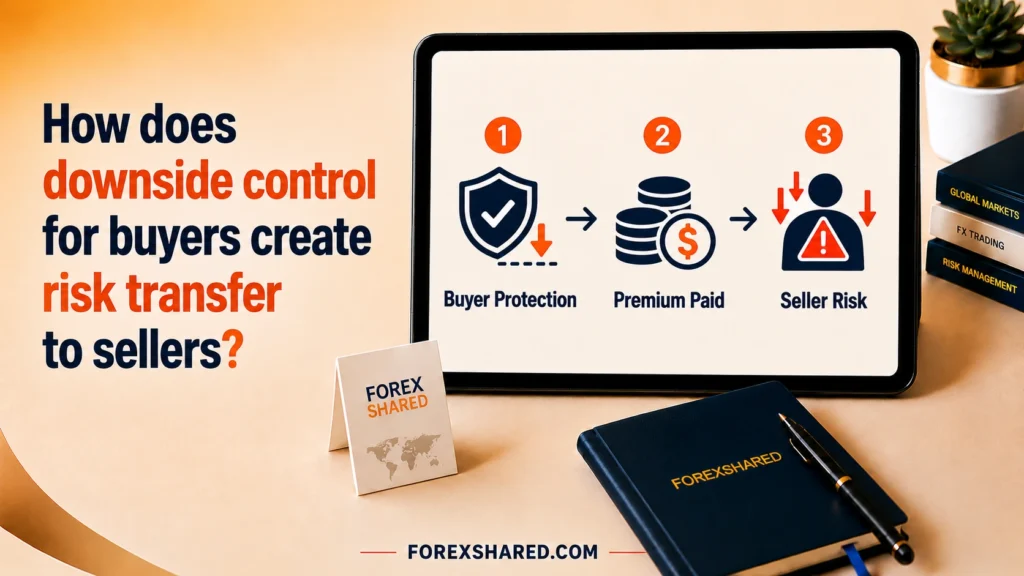
How does downside control for buyers create risk transfer to sellers?
The buyer pays premium for a contractual right while the writer receives premium for accepting the economically opposite obligation. That structure can cap the conventional fully paid buyer’s standalone option loss while shifting the opposite adverse contract exposure to the short side.
The option does not eliminate underlying market risk. It redistributes defined economic exposure to that movement. Calls and puts transfer different adverse directions, and seller loss boundaries differ by option type, coverage, and product mechanics.
This article connects premium, rights, obligations, P&L, exercise, assignment, margin, clearing, and hedging so the reader can trace risk transfer without confusing it with risk disappearance.
This article is for general education only and does not constitute financial, investment, trading, legal, or tax advice. Options can involve substantial risk, and product-specific exercise, settlement, margin, and assignment rules must be verified before live-market decisions.
What Does Downside Control Mean for an Option Buyer?
For a conventional fully paid long option, downside control refers primarily to the maximum loss on the standalone option contract.
What is the buyer actually limiting?
The buyer is primarily limiting standalone option-contract loss, not every economic risk surrounding the underlying exposure.
Commercial exposure, underlying position losses, portfolio losses, opportunity cost, repeated premium spending, and transaction costs can remain outside that standalone option boundary.
Why can the buyer’s loss stop at the premium?
The buyer pays for optionality rather than accepting the writer’s compulsory performance obligation, so an unfavorable option can expire without creating a negative exercise payoff beyond the premium already paid.
For a conventional fully paid long option, that makes premium the principal contract-level loss boundary before applicable transaction costs. The buyer-side mechanics are explained further in Premium-capped downside for buyers.
Can the buyer still lose the entire premium?
Yes. Maximum dollar loss can be limited while the percentage loss of premium can still reach 100%.
If the option expires without sufficient value to recover its cost, the buyer can lose the entire premium paid. Limited loss therefore means a defined absolute boundary, not a small percentage loss.
Does downside control remove other risks?
No. Downside control on the purchased option does not remove timing risk, basis mismatch, transaction costs, opportunity cost, or losses elsewhere in the buyer’s commercial or investment exposure.
The option changes one contractual payoff boundary. It does not guarantee that the wider portfolio or business exposure is protected from every adverse outcome.
| Buyer Attribute | Contract Effect | Boundary |
|---|---|---|
| Premium paid | Buys right | Known upfront option cost |
| Right without writer obligation | Creates asymmetry | Avoids symmetric contractual commitment |
| Worthless expiry | No beneficial intrinsic value | Premium may be fully lost |
| Favorable movement | Intrinsic value can increase | Gain can exceed premium |
| Standalone downside | Defined | Premium-based boundary |
Why Does Buyer Protection Require a Seller on the Opposite Side?
Buyer protection requires an opposite seller because an option right exists only when another contractual position accepts the corresponding obligation.
What does the buyer purchase from the writer?
The buyer purchases a contractual option right: the right to buy or sell the specified underlying exposure according to the contract terms.
The purchase should not be reduced to a simple price bet. The key asset is contractual optionality, meaning the holder can use the right when the contract conditions make it valuable.
What does the writer receive?
The writer receives the option premium as consideration for granting the option right and accepting contingent exposure.
Premium is not payment received without risk. It is the price transferred from holder to writer for the right embedded in the option. CFTC
What does the writer promise?
A call writer accepts the call-side performance obligation, while a put writer accepts the corresponding put-side obligation under the applicable contract terms.
For options on futures, CME describes short-call assignment as creating a short futures position and short-put assignment as creating a long futures position. Other products can settle differently. CME
Why can the buyer’s right not exist without an opposite obligation?
Buyer Right ↔ Writer Obligation: the holder’s enforceable contractual benefit is the writer’s corresponding contingent duty.
The long and short positions are therefore not unrelated return profiles. They are opposite sides of one contractual payoff, which is why the wider Seller versus buyer risk relationship must be analyzed together.
What is transferred at inception?
Contingent exposure is transferred at inception, not a realized future loss.
The writer accepts exposure to the future exercise-value outcome, but realized P&L still depends on subsequent market movement, premium, expiration conditions, exercise, assignment, hedging, and settlement mechanics.
| Contract Element | Buyer / Holder | Seller / Writer |
|---|---|---|
| Premium | Pays | Receives |
| Position | Right | Obligation |
| Exercise discretion | Holder controls according to terms | Must perform if assigned |
| Maximum standalone loss/gain | Loss generally premium-limited | Gain generally premium-limited |
| Deep favorable move for buyer | Option value rises | Writer liability rises |
How Does Premium Turn Buyer Downside Control Into Seller Risk Acceptance?
Premium connects the buyer’s purchased right to the seller’s accepted obligation: the buyer pays a fixed cost for optionality, and the seller receives that fixed payment for taking the opposite contingent exposure.
Why does the buyer pay premium?
The buyer pays premium for asymmetric participation, contractual optionality, and a defined standalone option-loss boundary.
The payment purchases a right rather than a symmetric obligation. It should be described as the option price, not automatically as insurance unless that is clearly presented only as an analogy.
Why does the seller receive premium?
The seller receives premium because the seller grants the right and accepts the contingent obligation created by the option.
That premium compensates risk acceptance. It is not free income and does not represent the seller’s maximum loss. CME
What happens if protection is never needed?
If the purchased option finishes without sufficient value, the buyer may lose the premium and the writer may retain the premium.
That outcome does not mean the writer accepted no risk while the contract was outstanding. The contingent obligation existed even if it never produced an adverse settlement result.
Why is premium the seller’s maximum standalone option income?
For the standalone short option, the best expiration outcome is generally retention of the premium collected.
Once the option creates no liability, there is no additional income source inside the written option itself. Hedge income or losses belong to the surrounding portfolio, not to the standalone short-option payoff.
Why can seller loss exceed premium?
Seller loss can exceed premium because premium is fixed at inception while adverse intrinsic value can grow after inception.
That fixed-premium versus variable-liability contrast is central to Asymmetric writer risk. For an uncovered call, the loss boundary can be theoretically open-ended; for a conventional short put on a nonnegative underlying, the terminal boundary is large but finite.
Premium is the bridge between the buyer’s purchased right and the writer’s accepted obligation. It caps buyer contract downside and writer standalone option income, but it does not cap writer loss.
How Do Buyer and Seller P&Ls Prove That Risk Has Been Transferred?
Buyer and seller P&Ls prove contractual risk transfer because the same option’s gross long and short P&Ls are mathematical negatives of each other before external costs.
What is the long-call expiration P&L?
Long Call P&L = max(Sₜ − K, 0) − P, where Sₜ is terminal underlying price, K is strike, and P is premium.
The formula shows a fixed premium cost plus positive intrinsic value only when the terminal price finishes above the strike. It is an expiration P&L identity, not a pre-expiration pricing model.
What is the corresponding short-call P&L?
Short Call P&L = P − max(Sₜ − K, 0). Therefore, before external costs, Short Call P&L = − Long Call P&L.
The seller receives the same premium that the buyer pays and bears the opposite intrinsic-value term. The mirror relation is the cleanest contract-level proof that the adverse exposure has been transferred rather than destroyed.
Does the same relation hold for puts?
Yes. Long Put P&L = max(K − Sₜ, 0) − P, while Short Put P&L = P − max(K − Sₜ, 0).
The short-put gross P&L is the negative of the long-put gross P&L for the same contract terms. Calls and puts differ in direction and tail boundary, but the long-short opposition remains.
What does this prove about downside control?
It proves that buyer favorable intrinsic value is economically opposite to writer adverse contract value on the same option.
Buyer protection therefore reallocates a defined portion of price exposure to the short side. This is a contractual payoff relation, not a claim that the original named seller operationally funds every eventual buyer gain.
What qualification applies?
The mirror relationship applies to gross contract economics before commissions, taxes, financing, collateral costs, hedge results, and margin funding.
Those external items can make account-level outcomes differ even though the long and short option contracts themselves remain economically opposite.
How Does a Call Buyer Transfer Upside-Price Risk to the Call Writer?
A call buyer transfers upside-price risk by paying a known premium for a right whose intrinsic value can expand as the underlying rises, while the uncovered call writer receives that premium and bears the opposite increasing liability.
What downside does the call buyer control?
For a conventional fully paid long call, the standalone maximum contract loss is generally the premium paid before applicable costs.
If the call expires without sufficient value, the buyer can lose the full premium, but the long-call exercise payoff itself does not create an additional negative liability.
What favorable exposure does the buyer retain?
The call buyer retains max(Sₜ − K, 0), so intrinsic value increases as the underlying rises beyond strike.
The favorable call-side exposure can keep growing as Sₜ rises. The buyer’s fixed premium cost therefore coexists with open favorable option value.
What happens to the call writer at the same prices?
At the same terminal prices, the call writer holds the exact opposite contract result: −max(Sₜ − K, 0) + premium.
Every additional unit of long-call intrinsic value is an additional unit of short-call liability before external costs.
Why can the uncovered call writer’s loss become theoretically unlimited?
If the underlying has no theoretical upper price boundary, uncovered short-call loss can continue increasing as price rises, so the loss has no theoretical upper cap.
The premium provides only a finite buffer. OIC likewise describes the potential loss on an uncovered short call as theoretically unlimited. OIC
What exactly has the buyer transferred?
The long-call buyer has exchanged open adverse option-side exposure for a known premium-based downside while retaining favorable convex exposure.
This statement applies to the option contract. It does not mean the buyer transferred every economic risk in a wider portfolio or business exposure.
| Attribute | Long Call Buyer | Uncovered Call Writer |
|---|---|---|
| Premium | Paid | Received |
| Maximum loss/gain | Loss = premium | Gain = premium |
| Favorable direction | Rise | Flat/fall relative to strike |
| Adverse tail | Premium-limited | Rising market |
| Large upside move | Increasing gain | Increasing loss |
| Theoretical boundary | Premium | No fixed ceiling where underlying upside is unbounded |
How Does a Put Buyer Transfer Downside-Price Risk to the Put Writer?
A put buyer transfers downside-price risk by paying premium for a right whose intrinsic value increases as the underlying falls below strike, while the put writer receives premium and bears the opposite downside liability.
What protection does the put buyer purchase?
The put holder purchases the contractual right associated with selling the underlying or receiving the contractually specified equivalent protection under the applicable terms.
The exact settlement consequence depends on the product. The general economic point is that the buyer owns the favorable put-side right while the writer carries the corresponding obligation.
What happens as the underlying falls below strike?
Put intrinsic value becomes max(K − Sₜ, 0), so value increases as the underlying declines below the strike.
The decline creates favorable intrinsic value for the long put and an equal-and-opposite intrinsic-value liability for the short put before external costs.
What happens to the put writer?
The put writer bears the mirror short-put payoff and receives premium as the fixed initial compensation.
Premium must remain separate from intrinsic-value liability. A large decline can make the writer’s adverse intrinsic value much larger than the premium received.
Why can put-writer loss be substantial?
Put-writer loss can be substantial because a large fall below strike can create intrinsic-value liability many times larger than the premium collected.
The writer’s maximum standalone option income remains the premium even when the adverse downside movement becomes much larger.
Why is the loss not normally theoretically unlimited?
For a standard nonnegative underlying, Sₜ ≥ 0, so the terminal short-put loss boundary is finite.
A simplified per-unit maximum is approximately K − Premium before applicable costs and contract multipliers. This is why short-call and short-put loss boundaries must never be conflated. OIC
| Attribute | Long Put Buyer | Short Put Writer |
|---|---|---|
| Premium | Paid | Received |
| Maximum loss/gain | Loss = premium | Gain = premium |
| Favorable direction | Fall | Flat/rise relative to strike |
| Adverse direction | Premium-limited | Falling market |
| Deep downside move | Increasing gain | Increasing loss |
| Theoretical boundary | Premium | Finite at expiration for a nonnegative underlying |
Why Is Risk Transfer Different From Risk Elimination?
Risk transfer is different from risk elimination because the option does not stop the underlying market from moving; it changes which contractual position bears which economic consequences of that movement.
Does the option stop the underlying market from moving?
No.
The underlying market risk already exists. The option does not create or destroy the market movement.
What does the option change?
The option changes who bears which contractual economic consequences of the movement.
The long side acquires a right with a defined premium cost, while the short side accepts the economically opposite contingent obligation.
Where does the buyer’s removed contract downside go?
The opposite short-option payoff carries the corresponding adverse contract exposure.
This is a contract-level statement. It does not imply that every element of the buyer’s total economic risk has moved to one seller.
Must the seller retain that risk?
No.
The seller can offset, hedge, cover, or re-transfer the exposure through other market positions where liquidity, contract terms, and market rules permit.
What happens when the seller hedges?
Risk is transformed or transferred again.
The original written-option payoff remains intact; the hedge changes the combined portfolio. Options redistribute exposure; they do not erase market uncertainty.
Underlying market uncertainty remains. The option changes who carries the contractual payoff exposure, and that exposure can later be redistributed again.
How Can a Seller Re-Transfer or Hedge the Risk Received From the Buyer?
A seller can re-transfer or hedge received option risk by closing the short option, using the underlying, buying another option, or combining other offsetting exposures, subject to market and product constraints.
Can the writer close the written option?
Yes, where the market and product rules permit, an offsetting closing transaction can eliminate the open short-option position.
This requires executable liquidity. Closing is not guaranteed at every desired price or time, but when completed it ends the open written position’s future assignment exposure.
Can the writer hedge with the underlying?
Yes, depending on the contract and exposure.
An underlying or futures position can offset some price sensitivity, but the resulting hedge can introduce basis, funding, timing, and quantity mismatch. This page keeps that hedge discussion conceptual.
Can another option limit seller risk?
Yes. Purchasing another option can transform the combined payoff into a spread or another bounded portfolio structure.
The second option changes the portfolio boundary, not the original short-option payoff formula. Detailed multi-leg strategy design belongs on a separate page.
Does hedging rewrite the original written-option payoff?
No.
Original contract payoff stays intact; combined portfolio P&L changes.
Why is this important?
It separates risk accepted from risk permanently retained.
The initial buyer-to-writer transfer can occur even when the writer later chooses to hedge or re-transfer some of the exposure.
Why Do Covered and Uncovered Sellers Carry Different Portfolio Risk?
Covered and uncovered sellers carry different portfolio risk because an offsetting position can transform the combined outcome even though the written-option contract itself remains unchanged.
What is an uncovered writer?
An uncovered writer is a writer without a sufficient offsetting exposure that transforms the relevant option tail.
Margin status alone does not define whether the option is covered. The key question is whether another position offsets or reshapes the relevant risk.
Why is an uncovered call especially exposed?
An uncovered call is especially exposed because the short-call loss tail remains directly open as the underlying rises.
Where the underlying has no theoretical upside ceiling, the uncovered short-call loss also has no theoretical upper boundary.
What is a covered call?
A covered call is a short call combined with ownership of the relevant underlying exposure.
The underlying can offset part of the short-call loss as price rises, but it also introduces its own downside and portfolio risks.
Does coverage eliminate the written-call obligation?
No.
Coverage changes the combined economic outcome; it does not cancel or rewrite the short-call contract.
Why must article claims specify contract risk or portfolio risk?
Because Standalone Short Call and Underlying + Short Call answer different questions.
The standalone contract keeps the same payoff formula, while the combined portfolio can have materially different boundaries. Contract risk ≠ final portfolio risk.
How Do Exercise and Assignment Convert Transferred Risk Into an Actual Obligation?
Exercise and assignment convert transferred contingent exposure into actual contractual performance under the applicable product rules.
What does exercise mean for the buyer?
Exercise means the buyer uses the option right according to the applicable contract rules.
Not every option can be voluntarily exercised at every time. Exercise timing depends on the contract’s style and specifications.
What does assignment mean for the writer?
Assignment identifies the short position required to perform the corresponding option obligation.
For CME options on futures, buyers exercise and sellers are assigned through the clearing process. CME
Why does this matter for risk transfer?
Before performance, exposure is contingent; after valid exercise, assignment, or automatic exercise under the applicable rules, performance or settlement follows.
The economic exposure becomes an actual settlement or underlying-position consequence according to the contract.
Does every option create physical delivery?
No.
Settlement can result in cash, physical delivery, a futures position, or another contract-specified result. The exact consequence must be verified for the actual product.
Why must exercise style be verified?
American-style and European-style options differ in exercise timing, so exercise style must be checked before describing assignment exposure.
Current CME-listed FX options are European style and CME states that in-the-money options deliver into the underlying future at expiry, with auto-exercise or expiry versus the relevant fixing. These mechanics should not be projected onto every OTC currency option. CME
Why Does Seller Margin Exist If the Buyer Has Already Paid Premium?
Seller margin exists because the buyer’s premium is consideration for the option right, while margin is separate performance and risk support for the writer’s continuing obligation.
Is premium enough to cover writer losses?
Not necessarily.
Premium is consideration received for the option. It is not the writer’s maximum-loss boundary and may be far smaller than an adverse short-option liability.
Why can a short-option position require margin?
A short-option position can require margin because the writer retains potential future performance exposure.
Margin is not a fee. It is collateral or performance support under the applicable margin methodology.
Can margin exceed premium received?
Yes.
Short-option margin can exceed the premium collected because the margin framework measures potential performance exposure rather than treating premium as a complete risk reserve. CME
Can margin requirements change?
Yes. Risk-based margin requirements can change as market price, volatility, portfolio offsets, clearing methodology, or broker requirements change.
The exact calculation is product and venue specific, so the article should not substitute a generic percentage for the actual applicable rules.
Does margin convert unlimited risk into limited risk?
No.
Margin supports performance; it does not cap economic loss. A collateral requirement and the option’s economic payoff boundary are different concepts.
Premium is compensation; margin is performance support. Neither concept should be used as a substitute for the writer’s actual economic loss boundary.
How Does Clearing Change Counterparty Mechanics Without Removing Risk Transfer?
Clearing changes counterparty architecture and performance management, but it does not remove the economic opposition between long-option and short-option positions.
Is the original buyer always dependent on the original seller?
No. In centrally cleared markets, the clearing architecture interposes itself between positions, so the permanent named bilateral relationship may not remain.
CME notes that assignment is handled by the central clearing house rather than by the original buyer selecting the original seller. CME
Does clearing eliminate long-short economic opposition?
No.
Long and short positions remain economically opposite even when the named counterparties are mediated through clearing.
What does clearing change?
Clearing changes counterparty intermediation, margin, performance management, assignment mechanics, and default architecture.
Those functions manage how obligations are supported and allocated. They do not rewrite the long and short option payoff formulas.
What does clearing not change?
Long option payoff remains economically opposed by short option payoff.
The gross contract economics stay opposite even though the operational counterparty chain is mediated.
Why is this important?
Because this page describes economic risk transfer rather than a permanent named buyer-to-named seller payment chain.
The correct statement is about opposed long and short contractual positions, not permanent bilateral dependence between two named traders.
What Simple Call Example Shows Buyer Downside Control Becoming Seller Risk?
A simplified call with strike 1.1000 and premium 0.0200 shows buyer downside control becoming seller risk through exact mirror P&L at each terminal price.
What happens if the underlying expires at 1.0500?
Intrinsic value = 0. Buyer P&L = −0.0200. Writer P&L = +0.0200.
The call finishes below strike, so the buyer loses the premium and the writer retains the premium in this simplified example.
What happens at 1.1200?
Intrinsic value = 0.0200. Buyer P&L = 0. Writer P&L = 0.
This is the simplified expiration breakeven because intrinsic value exactly offsets the premium.
What happens at 1.2000?
Intrinsic value = 0.1000. Buyer P&L = +0.0800. Writer P&L = −0.0800.
The buyer’s favorable intrinsic value and the writer’s adverse liability are equal and opposite before external costs.
What happened to the buyer’s downside?
Loss never exceeds 0.0200 premium in the simplified standalone example.
The downside boundary remains known even as the favorable long-call side expands.
What happened to the seller’s risk?
Maximum gain stayed at 0.0200 while loss expanded to 0.0800.
The fixed premium income did not expand when the underlying moved farther against the writer.
What does the example prove?
The example proves that the buyer’s downside boundary exists alongside the writer’s acceptance of the opposite nonlinear payoff.
The risk did not disappear. The same option transferred the adverse contract result to the short side.
| Expiry Price | Buyer P&L | Writer P&L | Meaning |
|---|---|---|---|
| 1.0500 | −0.0200 | +0.0200 | Buyer loses premium |
| 1.1000 | −0.0200 | +0.0200 | Same at strike |
| 1.1200 | 0 | 0 | Simplified breakeven |
| 1.2000 | +0.0800 | −0.0800 | Mirror P&L |
What Simple Put Example Shows Downside Protection Transfer?
A simplified put with strike 1.1000 and premium 0.0200 shows how a known premium cost can produce increasing downside protection for the buyer while the writer receives the opposite downside exposure.
What happens if the underlying stays above 1.1000?
Intrinsic value = 0. Buyer P&L = −0.0200. Writer P&L = +0.0200.
The put expires without intrinsic value, so the buyer loses the premium and the writer retains it in the simplified example.
What happens at 1.0800?
Intrinsic value = 0.0200. Buyer P&L = 0. Writer P&L = 0.
This is the simplified expiration breakeven for the put.
What happens at 1.0000?
Intrinsic value = 0.1000. Buyer P&L = +0.0800. Writer P&L = −0.0800.
The buyer’s growing put protection is the writer’s equal-and-opposite short-put liability before external costs.
What does the example prove?
Known premium cost can coexist with increasing put protection as price falls, while writer premium receipt creates the opposite downside exposure.
The example explains contract mechanics only and does not recommend purchasing puts or writing them.
When Does “Risk Transfer to the Seller” Need Qualification?
“Risk transfer to the seller” needs qualification whenever the statement could be mistaken for transfer of every economic risk, permanent retention by the writer, or universal unlimited loss.
Is all of the buyer’s economic risk transferred?
No.
The option transfers defined contractual exposure, while timing risk, basis risk, transaction costs, commercial exposure, repeated premium spending, and other portfolio risks can remain with the buyer.
Does the writer always retain transferred risk?
No.
The writer can hedge, offset, close, or re-transfer some or all of the received exposure, subject to market and product constraints.
Is seller loss always unlimited?
No.
An uncovered short call can have theoretically unlimited loss, while a conventional short put on a nonnegative underlying has a finite terminal boundary, and covered or spread portfolios can differ further.
Does clearing eliminate seller-side risk?
No.
Clearing changes architecture, margin, assignment, and performance management. It does not erase the short-option payoff.
Does buyer downside control prove that buying the option is economically attractive?
No.
Maximum-loss structure does not determine fair value, probability of profit, expected return, or suitability. A limited-loss payoff is not evidence of positive expected value.
What is the technically correct statement?
Options transfer defined portions of market exposure between long and short contractual positions while allowing participants to hedge or redistribute the resulting exposure further.
That wording preserves both facts: the initial contract redistributes exposure, and the short side does not necessarily retain it permanently.
How Should a Reader Trace Buyer-to-Seller Risk Transfer Correctly?
A reader should trace buyer-to-seller risk transfer by identifying the underlying risk, premium direction, purchased right, writer obligation, long-short payoff opposition, loss boundaries, and any subsequent hedge or re-transfer.
Who paid the premium?
The buyer or long holder paid the premium.
That payment purchases the contractual option right and establishes the buyer’s upfront option cost.
Who received the premium?
The seller or short writer received the premium.
Receipt of premium is consideration for granting the right and accepting the contingent obligation.
What right did the buyer purchase?
Identify the call right or put right written in the actual contract.
A call right and a put right transfer different adverse price directions to the writer.
What corresponding obligation did the writer accept?
Identify the exact call-side or put-side obligation under the contract terms.
For product-specific settlement, verify whether the obligation leads to cash, physical delivery, a futures position, or another specified result.
What is the buyer’s maximum standalone option loss?
For a conventional fully paid option, the buyer’s maximum standalone contract loss is generally premium paid plus applicable transaction costs.
That boundary applies to the option contract itself, not every risk in the buyer’s wider portfolio.
What is the writer’s maximum standalone option gain?
The writer’s maximum standalone option gain is normally the premium received before costs.
There is no second income source inside the standalone written option once the premium has been retained.
What adverse market direction creates writer liability?
For a call, writer liability grows as the underlying rises above strike; for a put, writer liability grows as the underlying falls below strike.
Those opposite adverse directions are why call and put seller boundaries must be analyzed separately.
Is the writer covered or hedged?
If the writer is covered or hedged, separate option P&L from portfolio P&L.
The original written-option payoff remains intact while the offsetting position changes the combined result.
What does exercise create?
Exercise creates the contract-specified performance consequence, which must be verified for the actual product.
Depending on contract rules, that consequence can involve cash settlement, delivery, a futures position, or another specified settlement mechanism.
What is the correct risk-transfer sequence?
The correct sequence is: identify underlying market risk; identify buyer; identify premium paid; identify right acquired; determine buyer maximum standalone loss; identify writer; identify premium received; identify writer obligation; determine adverse writer loss boundary; then determine whether the writer hedged or redistributed exposure.
Following this sequence prevents the common error of asking where risk “disappeared” instead of identifying which contractual position carries the adverse payoff now.
How Can Readers Avoid Misunderstanding Buyer Downside Control as Risk Elimination?
Readers can avoid confusing downside control with risk elimination by checking the market risk, long-short contract relation, premium direction, call/put boundary, portfolio hedge, margin, and settlement mechanics separately.
Why is “buyer protection destroys downside risk” incorrect?
It is incorrect because market uncertainty remains; contract exposure is reallocated.
The option changes the distribution of economic consequences without stopping the underlying market from moving.
Why is “the seller receives free premium” incorrect?
It is incorrect because premium compensates acceptance of contingent contractual exposure.
The seller receives premium because the seller grants the option right and remains exposed to the corresponding obligation.
Why is “limited buyer loss means no buyer risk” incorrect?
It is incorrect because the buyer can lose 100% of premium paid.
Limited maximum loss is a contract boundary, not a promise of a small percentage loss or favorable outcome.
Why is “seller loss is always unlimited” incorrect?
It is incorrect because short-call and short-put loss boundaries differ.
An uncovered short call can be theoretically unlimited, while a conventional short put on a nonnegative underlying is large but finite at expiration.
Why is “covered seller means no transferred risk” incorrect?
It is incorrect because a hedge changes portfolio P&L, not the original option payoff.
The transfer occurs in the option contract first. Coverage can then transform the portfolio consequence.
Why is “margin is the seller’s maximum loss” incorrect?
It is incorrect because margin is performance support, not the economic loss cap.
Margin can change independently of final P&L and can exceed premium received.
Why is “seller hedging means no risk was transferred” incorrect?
It is incorrect because the original transfer occurred first; the seller then redistributed the received exposure.
A second-stage hedge does not retroactively erase the first contractual transfer.
What should be verified before describing option downside control as risk transfer?
Verify the underlying market risk, buyer right, writer obligation, premium direction, buyer loss boundary, writer gain boundary, call and put tail differences, contract versus portfolio P&L, margin treatment, and actual exercise, assignment, clearing, and settlement mechanics.
Only after those checks should the article describe which side carries the adverse payoff and whether that exposure was subsequently redistributed.
- Underlying market risk identified.
- Buyer right separated from writer obligation.
- Premium direction correct.
- Buyer maximum standalone loss qualified correctly.
- Seller maximum standalone option income capped correctly.
- Short-call and short-put boundaries separated.
- Long and short P&Ls treated as mirror contract economics.
- Contract risk separated from portfolio risk.
- Margin separated from maximum loss.
- Exercise, assignment, clearing, and settlement verified against the actual product.
Conclusion
Downside control for option buyers creates risk transfer because the buyer pays premium for a contractual right while the seller receives premium for accepting the corresponding contingent obligation.
Buyer Maximum Standalone Contract Loss → Premium Paid, but underlying market risk does not disappear. Instead, the opposite short-option exposure appears on the writer side. An uncovered short-call loss can be theoretically unlimited where the underlying has no theoretical upper boundary, while short-put loss can be substantial but is generally finite at expiration where the underlying cannot fall below zero.
The writer may hedge, cover, offset, or re-transfer exposure. Option downside control is contractual risk reallocation, not risk destruction.
FAQs
Why is an option buyer’s loss usually limited to the premium?
For a conventional fully paid standalone option, the buyer purchases a right rather than accepting the writer’s corresponding performance obligation. If the option expires without sufficient value, the buyer can generally lose the premium paid plus applicable transaction costs, but the option itself does not create an additional negative exercise liability.
Where does the risk go when an option buyer limits downside?
The short-option position carries the economically opposite contractual payoff exposure. The writer does not have to retain that exposure unhedged and may subsequently close, hedge, cover, or re-transfer it.
Can an option seller transfer the risk again?
Yes. Depending on market access and product rules, the seller can close the written option, hedge with the underlying or futures, or use another option to reshape the combined portfolio risk.
Does every option seller have unlimited loss?
No. An uncovered short call can have theoretically unlimited loss when the underlying has no theoretical upside ceiling. A conventional short put on a nonnegative underlying has a large but finite terminal boundary, and covered or spread positions can have different portfolio limits.
Does clearing mean buyers no longer transfer risk to sellers?
No. Clearing changes counterparty architecture, assignment, margin, and performance management, while long and short option economics remain opposed. The analysis is about economic risk transfer between long and short positions, not a permanent named buyer-to-named seller payment chain.