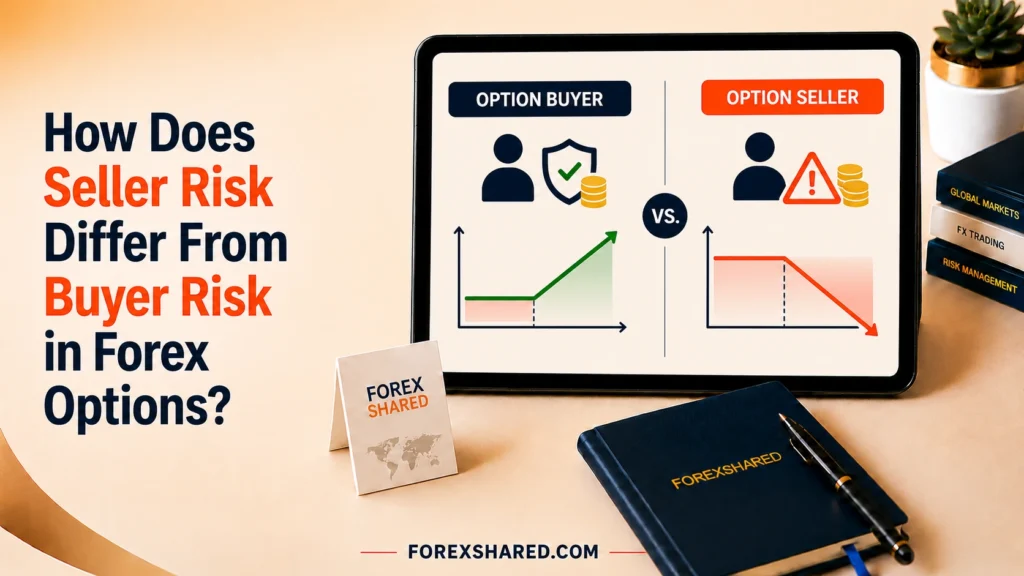
How Does Seller Risk Differ From Buyer Risk in Forex Options?
Seller risk differs from buyer risk because the buyer pays a premium for a contractual right, while the seller receives that premium in exchange for accepting a contingent obligation that can produce losses beyond the premium.
The comparison is contract-level: buyer and seller hold different rights, cash-flow directions and performance responsibilities. The article separates call and put risk, margin, assignment, covered status, expiration processing and the new futures exposure that can arise after exercise.
This article explains forex-option risk mechanics for educational purposes only. It does not provide individualized financial, hedging, treasury or trading advice. Contract specifications, margin and expiration procedures should be verified for the exact product and venue.
What Creates the Risk Asymmetry Between an Option Buyer and Seller?
The risk asymmetry between an option buyer and seller comes from the contract itself: the buyer pays a premium to own a right, while the seller receives that premium in exchange for accepting a contingent obligation.
The asymmetry is contractual rather than incidental. One side buys discretion; the other side receives premium for accepting performance risk, so the same option contract creates a bounded cost for the buyer and a potentially much larger obligation for the seller.
This contractual division is the foundation of Forex options risk structure.
What does the option buyer acquire?
The option buyer acquires a contractual right, but not an obligation, to buy or sell the specified underlying exposure. CFTC
The right is discretionary, the buyer may exercise it or let it expire. The right has a cost, the premium paid, which becomes the buyer’s maximum option loss.
What does the seller accept?
The option seller accepts a contingent obligation to perform if the option is exercised or processed as in the money at expiration. CFTC
The obligation is contingent, it activates only if the option is exercised or expires in the money. The obligation is the source of the seller’s potentially large downside.
What cash flow passes between the two sides?
The buyer pays the premium to the seller at the start of the transaction.
This single cash flow creates both the buyer’s known cost and the seller’s fixed income. The premium is the buyer’s maximum option loss and the seller’s maximum option income, but not the seller’s maximum loss.
Why does that create asymmetric risk?
The premium creates asymmetric risk because the buyer has purchased discretion while the seller has sold that discretion and accepted performance risk.
The buyer can choose whether to exercise, while the seller must perform if the option is exercised or processed as in the money. The seller’s performance risk is the direct counterpart of the buyer’s discretion.
| Attribute | Buyer / Long Option | Seller / Short Option |
|---|---|---|
| Premium | Pays premium | Receives premium |
| Contract position | Owns a contractual right | Accepts a contingent obligation |
| Maximum option loss | Generally premium paid, before transaction-cost nuance | Can exceed premium received; exact boundary depends on call/put and coverage |
| Maximum option income | Not capped by premium in the same way | Premium received |
| Margin exposure | Fully paid long option generally has no seller-style margin at option stage | Margin supports performance and can increase |
| Exercise / assignment | Buyer exercises | Seller is assigned |
| Adverse market move | Option can fall to zero | Liability can expand as the short option moves against the seller |
Structural takeaway: the buyer purchases discretion while the seller accepts performance risk.
Swipe or scroll horizontally to view the full diagram.
Figure 1. The premium transfers cash while the contract divides discretion and performance obligation.
Why Is the Buyer's Downside Limited to the Premium Paid?
The buyer’s downside is limited to the premium paid because the purchased option’s worst-case value is zero.
For a fully paid long option, the buyer can let an unfavorable contract expire with zero option value. That does not make the loss small: the entire premium can be lost, and transaction costs can increase the total cash loss beyond the quoted premium.
The buyer-side boundary is developed further in Maximum loss limited to premium.
What is the buyer's known cost at entry?
The buyer’s known cost at entry is the premium paid.
This cost is known at trade inception, unlike the seller’s potential future outflows. The known cost is also the maximum option loss.
What is the worst value of the purchased option?
The worst value of the purchased option is zero.
An option cannot have negative value to the holder, the buyer can simply let it expire. Zero value means 100% loss of the option investment.
How does CME describe buyer risk?
CME states that the maximum loss for a long call or long put is limited to the premium paid. CME
This is the exchange’s official description of long-option risk. The CME statement describes the option-stage risk, not post-exercise futures risk.
Can total cash loss include more than the quoted premium?
Yes, the FIA risk disclosure notes that transaction costs can also be lost. FIA
The premium is the option cost, but commissions and other costs can add to the total loss. The premium cap applies to the option premium itself, not to the total cash outlay including fees.
Does "limited loss" mean "small loss"?
No, “limited loss” means the loss is bounded, not that it is small.
“limited” describes the boundary, not the magnitude, a buyer can lose the entire premium. A “limited” loss can still be a total loss of the amount invested.
Why Can Seller Loss Exceed the Premium Received?
Seller loss can exceed the premium received because the seller remains exposed to the contractual obligation until the short option is offset, expires, or produces assignment.
The seller receives a fixed amount at inception, but the obligation remains alive until offset, expiration, or assignment. Premium therefore defines the seller’s maximum option income, not the seller’s maximum liability.
The open seller-side payoff is examined further under Asymmetric writer risk.
What does the seller receive at inception?
The seller receives a fixed premium at inception.
This is the seller’s maximum option income. The fixed income does not cap the seller’s liability.
Does receiving the premium end the seller's obligation?
No, receiving the premium does not end the seller’s obligation.
The three ways the obligation ends, offset, expiration, or assignment. The continuing obligation is the source of the seller’s expanding risk.
What does the FIA risk disclosure state?
The FIA risk disclosure states that option selling generally entails substantially greater risk than purchasing and that a seller may sustain losses well in excess of the premium received. FIA
The FIA language provides the official risk-disclosure framing. The FIA statement also covers additional margin requirements, which appear in a later section.
Why can loss continue expanding?
Seller loss can continue expanding because the obligation becomes increasingly unfavorable as the underlying moves through and beyond the strike.
The underlying can continue moving beyond the strike, increasing the seller’s liability. The premium received is fixed, but the adverse movement has no fixed boundary for a naked short call.
What is the key asymmetry?
The key asymmetry is that the buyer’s maximum option downside is the premium paid, while the seller’s maximum option income is the premium received, but the seller’s downside can exceed that premium substantially. CME FIA
Mirror-image structure, fixed cost versus fixed income, but asymmetric downside. The asymmetry is structural, not situational.
Swipe or scroll horizontally to view the full diagram.
Figure 2. Buyer option downside has a premium boundary while uncovered seller liability can move far beyond premium received.
Why Does a Short Call Have a Different Risk Profile From a Long Call?
A short call has a different risk profile from a long call because the call buyer owns the right to acquire long exposure while the call seller owes a corresponding short underlying futures position if assigned.
The two sides of a call face opposite contractual outcomes. The long call owns the right to acquire long futures exposure; the short call must accept short futures exposure if assigned, making uncovered upside movement especially dangerous for the seller.
What does the call buyer own?
The call buyer owns the right to acquire long exposure at the strike.
This right is discretionary, the buyer may exercise it or let it expire. The right costs the premium, which is the buyer’s maximum option loss.
What does the call seller owe?
If assigned, the call seller must take the corresponding short underlying futures position. CME
Assignment converts the option obligation into an actual futures position. The short futures position carries its own market and margin risk.
What is the long-call downside?
The long-call downside is the premium paid. CME
The call’s value cannot fall below zero. The premium can be lost entirely.
What is the naked short-call downside?
The naked short-call downside can be theoretically unlimited if the underlying futures price continues rising. CME
The underlying futures price has no upper bound, so the short call’s liability has no theoretical cap. “Theoretically unlimited” describes the structural boundary; actual losses depend on market movement.
Why does premium received not offset unlimited upside movement?
The premium received does not offset unlimited upside movement because the premium is fixed while the underlying’s adverse movement can continue.
The seller’s loss is the difference between the underlying’s movement and the premium received, and that difference can grow without bound. The premium provides a buffer, but the buffer is finite.
| Position | Cash at Entry | Favorable Underlying Direction | Main Downside |
|---|---|---|---|
| Long Call | Pays premium | Underlying rises | Premium paid can be lost |
| Short Call | Receives premium | Underlying stays below harmful call levels | Naked risk can be theoretically unlimited as underlying rises |
Why Does a Short Put Have a Different Risk Profile From a Long Put?
A short put has a different risk profile from a long put because the put buyer owns the right to obtain short-side exposure while the put seller receives a long underlying futures position if assigned.
A long put pays premium for short-side protection, while a short put accepts the obligation that can create long futures on assignment. Short-put downside can be very large, but its structural boundary differs from the naked short-call profile.
What does the put buyer own?
The put buyer owns the right to obtain short-side underlying exposure at the strike.
This right is discretionary. The right costs the premium, which is the buyer’s maximum option loss.
What happens to the seller if the put is assigned?
If the put is assigned, the seller receives a long underlying futures position. CME
Assignment converts the option obligation into an actual futures position. The long futures position carries its own market and margin risk.
What is the long-put downside?
The long-put downside is the premium paid. CME
The put’s value cannot fall below zero. The premium can be lost entirely.
What is the short-put downside?
The short-put downside can be very large if the underlying falls sharply, but it is structurally different from naked short-call unlimited risk. CME
The underlying can only fall toward its lower bound, so the put seller’s liability is structurally bounded even though it can be very large. “Bounded” does not mean “small”, the loss can still be very large.
Why should the article avoid saying all option sellers have unlimited loss?
The article should avoid saying all option sellers have unlimited loss because short-call risk and short-put risk have different structural boundaries. CME
The exact risk depends on the contract and underlying. Both can produce very large losses, but their structural boundaries differ.
| Position | Cash at Entry | Favorable Underlying Direction | Main Downside |
|---|---|---|---|
| Long Put | Pays premium | Underlying falls | Premium paid can be lost |
| Short Put | Receives premium | Underlying stays above harmful put levels | Loss can be very large as underlying falls, but structure differs from naked short call |
Why Is the Seller's Maximum Profit Limited While the Buyer's Loss Is Limited?
The seller’s maximum profit is limited to the premium received, while the buyer’s maximum loss is limited to the premium paid, the two sides are mirror images.
The premium creates a mirror with unequal open sides. The buyer starts with a fixed cost and variable potential value, while the seller starts with fixed income whose option-stage upside cannot grow beyond the premium received.
What is the maximum premium the seller can retain from the short option itself?
The maximum premium the seller can retain from the short option itself is the premium received.
This is the fixed income the seller received at inception. The profit ceiling is fixed even though the loss floor is not.
Can the seller earn more merely because the option expires farther OTM?
No, once the option liability reaches zero, the seller has already captured the maximum option premium.
The seller’s profit is fixed at inception; expiration outcomes only determine whether the seller keeps the full premium or loses some or all of it. The seller’s profit cannot improve beyond the premium; it can only deteriorate.
Why is this the mirror image of the buyer?
This is the mirror image of the buyer because the buyer pays a fixed amount with limited downside, while the seller receives a fixed amount with limited option upside.
Both sides have one fixed boundary, but the seller’s loss side remains open. The mirror is incomplete, the seller’s loss side has no fixed boundary.
What remains open-ended for the seller?
What remains open-ended for the seller is the liability created by adverse market movement. FIA
The premium is fixed but the liability is not. The open-ended liability is why seller margin requirements exist.
| Attribute | Buyer | Seller |
|---|---|---|
| Fixed Boundary | Fixed cost: premium paid | Fixed income: premium received |
| Upside | Variable option value if the contract becomes favorable | Limited option upside: premium received |
| Downside | Limited at option stage to premium, before transaction costs | Potentially large and not capped by premium received |
Why Do Option Sellers Face Margin Risk That Buyers Generally Do Not Face in the Same Way?
Option sellers face margin risk because they carry a performance obligation that may require resources to fulfill, while buyers generally do not carry that obligation.
Margin exists because the seller has promised future performance. It is collateral and funding support for that obligation, not a measure of the seller’s maximum loss, and adverse market movement can increase margin demands before assignment occurs.
This obligation is the economic counterpart of Risk transfer to option sellers.
Why does the seller need performance resources?
The seller needs performance resources because the seller may have to fulfill an assignment obligation.
Margin ensures the seller can meet the obligation if assignment occurs. Margin is a funding requirement, not a loss cap.
What does the FIA risk disclosure say?
The FIA risk disclosure states that the seller can be required to provide additional margin when the market moves unfavorably. FIA
The FIA language provides the official risk-disclosure framing. Additional margin is a funding pressure, not a loss measurement.
Why can margin requirements rise before assignment?
Margin requirements can rise before assignment because market losses and changing risk increase the resources required to support the short option position. FIA
Margin is calculated on current risk, which rises as the option moves against the seller. Margin pressure can occur before any assignment event.
Does premium received fund the entire seller obligation?
No, the premium received can be much smaller than the capital required to support adverse movements. FIA
The premium is fixed while the capital required to support adverse movements can be much larger. The seller may need to supply additional capital beyond the premium.
Why is this structurally different from the buyer?
This is structurally different from the buyer because the buyer has a known premium outlay while the seller has a premium inflow plus potential margin outflows. FIA
Funding asymmetry, the buyer’s cash flow is one-directional and known; the seller’s can be multi-directional and variable. The seller’s funding pressure is a direct consequence of the contingent obligation.
| Buyer | Seller |
|---|---|
| Premium flow | Premium Paid → Known Acquisition Cost |
| Seller flow | Premium Received → Obligation Remains → Margin Required → Additional Margin Possible → Assignment Possible |
How Does Assignment Create Additional Seller Risk?
Assignment creates additional seller risk because it converts the contingent option obligation into an actual underlying futures position with its own market and margin risk.
Assignment is a lifecycle transition rather than the end of risk. It converts a contingent short-option obligation into an actual futures position, so the seller moves from option risk into futures price, margin, and mark-to-market exposure.
Who exercises and who is assigned?
CME states that option buyers exercise while option sellers are assigned. CME
Exercise is the buyer’s right while assignment is the seller’s obligation. The division is contractual, not discretionary.
What happens to a short call seller upon assignment?
Upon assignment, a short call seller receives a short underlying futures position. CME
The option obligation becomes an actual short futures position. The short futures position carries its own market and margin risk.
What happens to a short put seller?
Upon assignment, a short put seller receives a long underlying futures position. CME
The option obligation becomes an actual long futures position. The long futures position carries its own market and margin risk.
Does the seller choose whether assignment occurs?
No, the seller does not choose whether assignment occurs. CME
Assignment follows the exercise process, not seller preference. The seller’s only control is closing the position before assignment.
What changes after assignment?
After assignment, the position moves from an option obligation to an underlying futures exposure with futures price risk, margin, and mark-to-market.
Three new risk components: futures price risk, margin, mark-to-market. The option-stage risk comparison no longer applies to the futures position.
Swipe or scroll horizontally to view the full diagram.
Figure 3. Exercise belongs to the buyer side, assignment to the seller side, and both can create new futures exposure.
How Do Current CME FX Expiration Rules Affect Seller Assignment Risk?
Current CME FX expiration rules affect seller assignment risk because they use European-style, fixing-based automatic exercise and abandonment that can create futures exposure without a discretionary buyer decision.
Current CME FX expiration processing is especially important because listed FX options are European style and use fixing-based automatic exercise or abandonment. Sellers therefore cannot assume that a holder must make an active discretionary exercise decision at expiry.
What exercise style applies to current CME FX options?
Current CME FX options are European style. CME
European style means exercise is processed at expiration, not throughout the option’s life. European style concentrates exercise/assignment outcomes at expiration.
What happens to ITM options at expiry?
In-the-money options are automatically exercised into the corresponding underlying FX futures at expiry. CME
The exercise is automatic, no buyer action required. Automatic exercise means sellers can be assigned without a discretionary buyer decision.
What happens to OTM options?
Out-of-the-money options are abandoned at expiry. CME
Abandonment means no futures position is created. For sellers, OTM expiration means the option liability ends with no assignment.
What happens exactly ATM?
Under current CME rules, ATM calls are exercised while ATM puts expire. CME
Specific CME rule, the ATM treatment differs by option type. The ATM rule can create assignment outcomes that a seller might not expect.
Can contrary instructions override these outcomes?
No, contrary instructions are not permitted for these FX options. CME
The fixing-based expiration process is mandatory. Sellers cannot rely on buyer discretion to avoid assignment.
Why does this matter to sellers?
This matters to sellers because a seller carrying an option through expiry must understand that assignment can arise automatically from the predefined fixing-based expiration process. CME
The seller’s assignment risk is not dependent on a buyer actively choosing to exercise. Sellers must verify the exact expiration rules for the specific FX option.
Swipe or scroll horizontally to view the full diagram.
Figure 4. Fixing-based expiration can create automatic seller assignment without relying on an active buyer instruction.
How Does Covered Seller Risk Differ From Uncovered Seller Risk?
Covered seller risk differs from uncovered seller risk because a corresponding underlying or hedge can reduce the net exposure created by assignment, though it does not eliminate all risk.
Coverage changes the net position. A corresponding futures or related hedge can reduce assignment exposure, but basis risk, hedge mismatch, execution effects, residual market exposure, and funding needs can remain.
What is an uncovered short call?
An uncovered short call is a short call without a corresponding position that offsets the delivery or market exposure.
“naked” means the seller has no corresponding underlying or hedge. The naked seller bears the full adverse movement of the underlying.
Why is naked short-call risk especially severe?
Naked short-call risk is especially severe because the writer is exposed to unlimited losses if the market rises sufficiently. CME
The underlying has no upper bound. “Theoretically unlimited” describes the structural boundary.
What does a covered position do?
A covered position uses a corresponding underlying or related hedge to reduce the net exposure created by assignment.
The offsetting position absorbs some or all of the market movement that would otherwise create loss. Coverage changes the risk profile but does not guarantee a specific outcome.
Does covered mean risk-free?
No, covered does not mean risk-free.
Each residual risk briefly, the hedge may not perfectly match the option obligation. The exact remaining risk depends on the underlying position, option strike, market movement, assignment, and basis/execution effects.
Why must seller risk be evaluated on a net-position basis?
Seller risk must be evaluated on a net-position basis because a short option alone and a short option plus offset exposure can create materially different total risk.
The offsetting position changes the total exposure. Net evaluation requires identifying all related positions.
How Does Buyer–Seller Risk Change After Exercise or Assignment?
Buyer–seller risk changes after exercise or assignment because the option position transforms into an underlying futures position with its own market and margin risk.
The premium-based option comparison has a clear settlement boundary. Once exercise or assignment creates futures, the resulting positions follow futures market, margin, and settlement rules rather than the original option-stage loss boundary.
What happens to the buyer after exercise?
After exercise, the buyer receives the corresponding futures position, long futures for a long call and short futures for a long put. CME
Exercise converts the option right into an actual futures position. The futures position carries its own risk rules.
What happens to the seller?
After assignment, the seller receives the opposite futures position, short futures for a short call and long futures for a short put. CME
Assignment converts the option obligation into an actual futures position. The futures position carries its own risk rules.
Does the buyer's original premium cap still apply to the resulting futures position?
No, the buyer’s original premium cap does not apply to the resulting futures position.
The premium cap described the option stage only. The futures position has its own market and margin risk.
Does the seller's short-option risk remain unchanged?
No, the seller’s short-option risk does not remain unchanged after assignment.
The risk type changes from option obligation to futures market risk. The futures position follows futures margin and settlement rules.
Why must these stages remain separate?
These stages must remain separate because the option stage, the exercise/assignment stage, and the futures stage follow different risk rules. CME
Each stage’s distinct risk rules. Mixing the stages produces incorrect risk conclusions.
| Stage | Buyer | Seller |
|---|---|---|
| Option Open | Long option right; premium paid | Short option obligation; premium received |
| Exercise / Assignment | Buyer exercises or qualifying expiry processing creates position | Seller is assigned |
| Futures Position | Long call → long futures; long put → short futures | Short call → short futures; short put → long futures |
| Later Settlement | Futures lifecycle, margin and settlement rules apply | Futures lifecycle, margin and settlement rules apply |
Lifecycle takeaway: assignment changes the risk framework rather than ending it.
Swipe or scroll horizontally to view the full diagram.
Figure 5. Option-stage risk rules stop when a futures position is created; the new position follows futures risk rules.
What Example Shows the Difference Between Buyer and Seller Risk?
An illustrative EUR/USD FX call with a $1,000 premium shows the buyer risking $1,000 while the seller receives $1,000 but faces a liability that can exceed that amount.
The hypothetical EUR/USD call uses a $1,000 premium only to isolate the asymmetry. The buyer’s option-stage loss is bounded by that premium before transaction costs, while the seller’s initial $1,000 income does not cap an adverse call obligation.
What is the buyer risking?
The long-call buyer is risking the $1,000 premium paid.
The maximum option loss as $1,000 before transaction costs. Transaction costs can add to the total loss.
What does the seller receive?
The seller receives the $1,000 premium.
This is the seller’s maximum option income. The $1,000 is income, not a liability cap.
What happens if the underlying stays below strike?
If the underlying stays below strike, the option may expire without value, the buyer loses the premium and the seller retains it.
The option expires worthless. This is the seller’s best-case scenario.
What happens if the underlying rises dramatically?
If the underlying rises dramatically, the call value can rise materially for the buyer while the call obligation becomes increasingly adverse for the seller.
The same market movement creates opposite outcomes. The seller’s loss can exceed the $1,000 premium.
Is the seller's loss capped at $1,000?
No, the seller’s loss is not capped at $1,000. FIA
The liability follows the underlying’s movement. The seller’s loss can substantially exceed the premium.
What happens if the option is carried into qualifying CME FX expiry?
If the call is processed as in the money at qualifying CME FX expiry, the buyer receives long FX futures and the assigned seller receives short FX futures. CME
The positions then follow futures risk rules. The futures positions carry their own margin and settlement risk.
How Should Buyer and Seller Risk Be Verified Before Interpreting a Forex Option?
Buyer and seller risk should be verified by identifying the position side, option type, premium, coverage, margin, exercise style, assignment outcome, and expiration rules.
A correct reading starts with contract identity before payoff interpretation. Position side, call or put type, premium, coverage, margin, exercise style, assignment outcome, expiration mechanics, and any resulting futures position must be separated in order.
Is the position long or short?
First identify whether the position is long or short.
This determines which risk rules apply. Misidentifying the side produces incorrect risk conclusions.
Is it a call or put?
Identify whether the option is a call or put.
Call and put have different assignment outcomes. Call and put seller risk structures differ.
What premium is paid or received?
Identify the premium paid or received.
The premium defines both boundaries. The premium does not cap seller loss.
Is the short position covered?
Identify whether the short position is covered.
Coverage changes the net exposure. Coverage reduces but does not eliminate risk.
What margin applies to the seller?
Verify the initial and ongoing margin requirements that apply to the seller. FIA
Margin can increase with adverse movement. Margin is not the seller’s maximum loss.
What exercise style applies?
Identify the exercise style, European, American, or product-specific procedure. CME
Exercise style affects when assignment can occur. Exercise style varies by product.
What happens upon exercise or assignment?
Determine the exact underlying position created upon exercise or assignment. CME
Call/put and buyer/seller outcomes. The futures position carries its own risk.
What happens at expiration?
Verify the expiration rules, automatic exercise, abandonment, and assignment mechanics. CME
Expiration processing can create futures positions automatically. Expiration rules vary by product.
What is the correct verification sequence?
The correct verification sequence has ten steps, from identifying the position side to separating option-stage risk from post-assignment futures risk.
The sequence moves from position identification to risk separation. Skipping steps produces incomplete risk analysis.
How Can Traders Avoid Misreading Buyer and Seller Risk?
Traders can avoid misreading buyer and seller risk by correcting eight specific misconceptions about symmetry, premium, unlimited risk, coverage, margin, assignment, post-exercise risk, and expiration processing.
Most errors come from collapsing distinct layers into one rule. Buyer and seller are not symmetric, short calls and short puts are not identical, covered does not mean risk-free, margin is not a loss cap, and post-assignment futures risk is a new stage.
Why is "buyer and seller risk are equal" incorrect?
“Buyer and seller risk are equal” is incorrect because they hold different contractual positions, the buyer owns a right while the seller carries an obligation. CFTC
A right and an obligation create different risk structures. Equal premium amounts do not mean equal risk.
Why is "seller can only lose the premium received" incorrect?
“Seller can only lose the premium received” is incorrect because the FIA risk disclosure states that seller losses can exceed premium received substantially. FIA
Premium is income, not a liability cap. The seller’s liability follows the underlying’s adverse movement.
Why is "every seller has unlimited risk" incorrect?
“Every seller has unlimited risk” is incorrect because naked short-call risk can be unlimited while short-put risk has a different downside structure. CME
The underlying’s upside is unbounded while its downside is bounded. Both can produce very large losses.
Why is "covered option sellers have no risk" incorrect?
“Covered option sellers have no risk” is incorrect because coverage can reduce risk without eliminating all residual exposure.
Residual risks, basis, hedge mismatch, execution, funding. The exact remaining risk depends on the position structure.
Why is "seller margin equals maximum seller loss" incorrect?
“Seller margin equals maximum seller loss” is incorrect because margin supports performance while losses can exceed margin. FIA
Margin responds to current risk while losses follow market movement. Margin requirements can rise as losses grow.
Why is "the seller chooses whether to be assigned" incorrect?
“The seller chooses whether to be assigned” is incorrect because sellers are assigned when the option exercise process requires performance. CME
The seller accepted the obligation at sale. The seller’s only control is closing the position before assignment.
Why is "buyer limited risk remains after exercise" incorrect?
“Buyer limited risk remains after exercise” is incorrect because exercise into futures creates a new underlying position with separate market and margin risk. CME
The futures position follows futures risk rules. The futures position carries its own market and margin risk.
Why is "current CME FX sellers can always rely on buyer discretion at expiry" incorrect?
“Current CME FX sellers can always rely on buyer discretion at expiry” is incorrect because current CME FX options use automatic fixing-based exercise and abandonment rules. CME
Contrary instructions are not permitted. Sellers cannot rely on buyer discretion to avoid assignment.
What should be verified before describing buyer and seller risk?
Before describing buyer and seller risk, verify the position side, option type, premium, coverage, margin, exercise and assignment mechanics, expiration processing, and any futures position created. CME
Each checklist item prevents a specific misconception. The checklist is a verification tool, not a trading strategy.
- Position side: long buyer or short seller
- Call or put type
- Premium paid or received
- Buyer loss boundary versus seller income boundary
- Short-call versus short-put downside structure
- Covered versus uncovered seller status
- Seller margin and potential additional margin
- Exercise and assignment mechanics
- Expiration processing for the specific FX option
- Any futures position created as a new risk exposure
FAQs
Why is the option buyer’s maximum option loss generally limited to the premium paid?
Can an option seller lose more than the premium received?
Yes. The premium is the seller’s initial income, not a liability cap. FIA’s risk disclosure states that an option seller may sustain losses well in excess of the premium received and may also face additional margin requirements when the market moves unfavorably. FIA
Does every forex option seller have unlimited risk?
No. An uncovered short call can have theoretically unlimited loss if the underlying futures price keeps rising, while short-put downside is structurally different because the underlying has a lower bound. Covered positions can also change the net risk profile. CME
What happens to seller risk when an option is assigned?
Assignment transforms the seller’s contingent option obligation into an underlying futures position. A short call assignment produces short futures, while a short put assignment produces long futures, after which the new position carries its own market and margin risk. CME
Does a covered option seller become risk-free?
No. A corresponding underlying or hedge can reduce the net exposure created by assignment, but coverage does not remove every source of risk. Basis differences, hedge mismatch, execution effects, residual price exposure, and funding requirements can still matter. CME
2 Responses