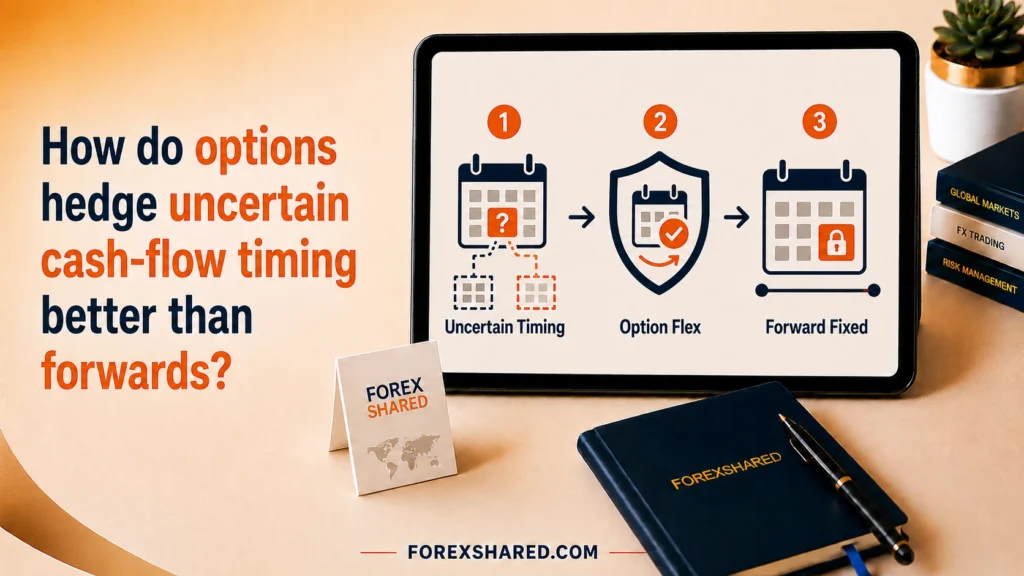
How Do Options Hedge Uncertain Cash-Flow Timing Better Than Forwards?
Options hedge uncertain cash-flow timing more flexibly than standard forwards because the option buyer acquires exchange-rate protection without accepting the same mandatory future currency-exchange commitment a forward creates.
The comparison turns on three questions: whether the cash flow will occur, how much will occur, and when it will settle. A standard forward, Window FX Forward and purchased option solve different combinations of those uncertainties.
This article explains FX hedging mechanics for educational purposes only. It does not provide individualized financial, accounting, treasury or trading advice. Product availability, documentation, pricing and settlement depend on the specific contract and counterparty.
What Makes an FX Cash Flow Uncertain Enough to Create Hedge-Timing Risk?
An FX cash flow creates hedge-timing risk when the expected payment or receipt is uncertain in timing, amount, or whether it will occur at all.
The instrument decision starts with the commercial cash flow rather than the derivative. Timing asks when the cash flow will settle, occurrence asks whether it will exist at all, and amount asks how large the final exposure will be.
What is cash-flow timing uncertainty?
Cash-flow timing uncertainty means the foreign-currency payment or receipt is expected, but the exact settlement date is not known.
The cash flow is expected; only the date is unclear. Timing uncertainty as distinct from occurrence uncertainty.
How is occurrence uncertainty different?
Occurrence uncertainty means the cash flow itself may occur, be cancelled, be reduced, or be postponed materially beyond the hedge horizon.
Occurrence uncertainty is the stronger mismatch problem for a binding forward. Occurrence uncertainty as distinct from timing uncertainty.
Why does amount uncertainty matter too?
Amount uncertainty matters because a hedge sized to the original forecast can become mismatched when the actual cash flow differs in magnitude. IFRS
The IFRS reference supports the existence of amount uncertainty; it does not establish hedge-accounting eligibility. Amount uncertainty as distinct from timing uncertainty.
What is the core hedge-selection question?
The core hedge-selection question asks whether the cash flow will occur, then how much, then when, before choosing the derivative.
The sequence applies before comparing instruments. Occurrence certainty is the first gate, amount certainty the second, and timing certainty the third.
| Attribute | Timing Uncertainty | Occurrence Uncertainty |
|---|---|---|
| Definition | Cash flow is expected, but exact settlement date is unclear. | Cash flow may occur, be cancelled, reduced, or move materially beyond the hedge horizon. |
| Examples | Shipment delay, collection-date uncertainty, project milestone delay. | Cancelled order, failed project, conditional transaction. |
| Is cash flow expected? | Yes, occurrence is relatively expected. | Not necessarily. |
| Instrument implication | Standard or Window Forward may fit if occurrence is sufficiently certain. | Purchased option gains structural value because buyer optionality matters. |
Swipe or scroll horizontally to view the full diagram.
Why Can a Standard FX Forward Create Timing Mismatch?
A standard FX forward creates timing mismatch because its contractual settlement date is fixed, while the underlying commercial cash flow can settle at a different time. BIS
A standard forward can be an efficient match when the amount and settlement date are sufficiently known. Its sensitivity to uncertainty comes from the fact that the future exchange remains tied to agreed contractual terms even if the commercial date moves or the business requirement changes.
Readers who need the baseline contract structure can review Forward forex contracts.
What does a forward require?
A forward requires the buyer to agree to purchase and the seller to agree to deliver the specified currency on an agreed future date at an agreed price. BIS
The definition establishes the commitment that creates timing sensitivity. Forward as a binding agreement, not a flexible arrangement.
Why does the agreed date matter?
The agreed date matters because the hedge maturity is tied to a contractual settlement date, and any difference between that date and the commercial cash-flow date creates misalignment.
The mismatch is a timing mismatch, not necessarily a loss. This section focuses on Commercial Date ≠ Forward Date condition and explain that the hedge is no longer perfectly aligned.
What happens if the payment arrives later than expected?
If the payment arrives later than expected, the forward can mature before the underlying commercial need arises, creating a temporary funding or currency-position mismatch.
The mismatch is temporary but real. This section focuses on temporary funding or currency-position mismatch that results.
What happens if the cash flow arrives earlier?
If the cash flow arrives earlier, the business may need currency before the forward's settlement date and may need additional transaction management to bridge the timing difference.
The mismatch is a timing gap, not necessarily a loss. This section focuses on need for bridging transactions to cover the gap between commercial need and forward settlement.
What if the underlying requirement disappears?
If the underlying requirement disappears, the forward obligation does not automatically disappear merely because the commercial exposure changes. Bank of Ireland
Cancellation cost depends on market rates at the time. The forward is separate from the commercial transaction.
Why Does an FX Option Absorb Timing Uncertainty Differently?
An FX option absorbs timing uncertainty differently because the buyer acquires a right to exchange currency at an agreed rate without accepting the same mandatory obligation a forward creates. BIS
A purchased option separates exchange-rate protection from the same unconditional underlying currency exchange commitment. That distinction is most valuable when uncertainty reaches beyond a small date shift and affects whether the commercial transaction will ultimately occur.
What does the option buyer acquire?
The option buyer acquires the right, but not the obligation, to buy or sell currency at an agreed exchange rate at or by a specified date. BIS
The definition establishes the structural contrast with the forward. Right-without-obligation as the defining option feature.
Why does the lack of mandatory exercise matter?
The lack of mandatory exercise matters because the hedge can provide protection against an adverse currency move without automatically imposing the same underlying currency exchange if the commercial need changes.
The separation applies when the commercial need changes. The buyer can retain protection without being forced into the underlying exchange.
What happens if the expected cash flow never occurs?
If the expected cash flow never occurs, the purchased option can expire without requiring the buyer to create the intended underlying currency transaction.
Subject to the exact product structure. Premium loss is the cost, not a refundable deposit.
What has the company effectively purchased?
The company has effectively purchased FX protection plus contingency flexibility in exchange for the option premium.
The advantage is strongest when occurrence is uncertain. The option is most valuable relative to a standard forward when uncertainty concerns whether the protected transaction will need to occur at all.
How Does a Cancelled Cash Flow Affect an Option Differently From a Forward?
A cancelled cash flow affects an option differently from a forward because the forward remains a binding contract while the option buyer is not automatically required to complete the underlying exchange.
Cancellation reveals the clearest structural contrast. A forward remains a separate derivative position that must be managed, while the option buyer retains a right whose premium cost remains even if the commercial need disappears.
What happens to a standard forward if the commercial transaction is cancelled?
If the commercial transaction is cancelled, the standard forward remains a binding contractual position unless it is cancelled, closed, modified, or otherwise settled.
The disappearance of the invoice does not terminate the derivative. The derivative is separate from the commercial transaction.
Why can that create an over-hedge?
A cancelled commercial transaction can create an over-hedge because the company retains a derivative amount with no corresponding commercial exposure.
The example is illustrative, not a market forecast. Over-hedge as notional mismatch, not automatic loss.
What happens with a purchased option?
With a purchased option, the company can retain the contractual protection until expiry without being automatically required to use the underlying exchange simply because it owns the option. BIS
Subject to the exact product structure. BIS option definition establishing the right-without-obligation structure.
What economic cost remains?
The economic cost that remains is the premium, which the option does not eliminate but converts from potential mandatory settlement mismatch into a known optionality cost.
The premium is the explicit price of flexibility. Premium as known cost, not refundable deposit.
Swipe or scroll horizontally to view the full diagram.
How Does a Delayed Cash Flow Affect an Option Differently From a Fixed-Date Forward?
A delayed cash flow affects an option differently from a fixed-date forward because the forward's mandatory maturity can arrive too early while the option's protection can expire too early.
Both structures can suffer timing mismatch, but in different ways. A forward can mature before the commercial cash flow, while an option can lose its protection if the delay extends beyond expiry.
What happens when a forward matures before the commercial cash flow?
When a forward matures before the commercial cash flow, the hedge settlement occurs at the contracted date even though the underlying receipt or payment has not yet occurred.
The mismatch is a timing gap. This section focuses on resulting timing mismatch.
Can the forward be adjusted?
The forward can potentially be adjusted through cancellation, extension, rollover, offsetting FX transactions, or another available restructuring mechanism.
Costs depend on market conditions. Adjustment mechanisms are available but not costless.
How can an option provide more flexibility?
An option provides more flexibility when the cash flow is delayed but still remains within the option's usable horizon, because the buyer retains protection without having committed to an earlier fixed currency settlement.
The flexibility applies within the option's contractual horizon. With the forward's fixed settlement date.
What if the cash flow is delayed beyond option expiry?
If the cash flow is delayed beyond option expiry, the option's protection can expire before the cash flow occurs, leaving the company with timing gap risk and the need for a new hedge.
The hedge may need to be replaced or restructured. Option flexibility does not equal unlimited timing flexibility.
What is the correct distinction?
The correct distinction is that forward timing risk means mandatory maturity may arrive too early, while option timing risk means protection may expire too early.
Both require appropriate horizon selection. Both instruments carry timing risk of different types.
| Issue | Fixed-Date Forward | Purchased Option |
|---|---|---|
| Cash flow delayed but still within hedge horizon | Forward may mature too early and require adjustment. | Protection can remain usable if still inside option horizon. |
| Cash flow delayed beyond protection | Original maturity already passed; new management may be required. | Option can expire before cash flow, requiring a new hedge. |
| Core timing risk | Mandatory maturity arrives too early. | Protection expires too early. |
Swipe or scroll horizontally to view the full diagram.
Why Are Options Particularly Useful When Both Timing and Occurrence Are Uncertain?
Options are particularly useful when both timing and occurrence are uncertain because the buyer preserves protection without making the same unconditional commitment to the underlying exchange.
Dual uncertainty makes commitment harder to match because the business does not fully know whether the cash flow will exist or when it will settle. Optionality can therefore reduce commitment mismatch, but the premium remains the explicit price of that flexibility.
This mechanism belongs under Options for contingent cash flows, where the broader contingent-exposure logic is developed.
What happens when both variables are uncertain?
When both variables are uncertain, the business does not fully know whether the cash flow will occur or when it will occur.
This is the clearest advantage scenario, not the only one. The business lacks both occurrence and timing certainty.
Why is a fixed forward difficult to match?
A fixed forward is difficult to match because it requires the business to commit to an amount, currency direction, and future settlement before the commercial exposure is completely known.
The forward's problem is commitment before certainty. These commitments are made before the exposure is fully known.
What does the option preserve?
The option preserves the buyer's ability to benefit from the protective rate if needed without making the same unconditional commitment to the underlying exchange.
The preservation applies within the option's horizon. With the forward's mandatory exchange.
What is being traded economically?
The buyer economically accepts premium cost in exchange for reducing commitment mismatch risk.
The trade is economic, not accounting. The premium is the explicit price of optionality.
Why Do Window FX Forwards Prevent Options From Being Universally Better?
Window FX Forwards prevent options from being universally better because they allow settlement on one or more dates within an agreed window while retaining the forward's mandatory final exchange.
Window FX Forwards matter because timing uncertainty does not always require cancellation flexibility. CFTC Letter 25-10 recognizes a forward structure that permits delivery across predetermined dates while retaining mandatory final delivery by the end of the window.
What is a Window FX Forward?
A Window FX Forward is a contract allowing currency delivery on one or more specified dates inside an agreed settlement window. CFTC
The window defines allowable settlement dates. Window Forward as a forward, not an option.
Why are they used commercially?
Window FX Forwards are used commercially when businesses know a foreign-currency requirement or receipt is coming but do not know the precise date. CFTC
The commercial use assumes the requirement will occur. Provide the supplied examples: shipment arrival, payment for overseas delivery.
Does a Window Forward remove settlement obligation?
A Window Forward does not remove settlement obligation because the currency exchange must occur by the final date of the window if no earlier settlement date is selected. CFTC
The exchange must occur by the final window date. Window Forward flexibility is date flexibility, not cancellation flexibility.
When can that make a Window Forward suitable?
A Window Forward is suitable when occurrence is sufficiently certain but the exact date is uncertain within a known range.
Suitability assumes the cash flow will occur. The Window Forward matches timing-only uncertainty.
When does the purchased option retain the stronger structural advantage?
The purchased option retains the stronger structural advantage when the exposure itself is genuinely contingent, such as when an order may be cancelled, a project may not close, a forecast sale may not happen, or an expected receipt amount may fall materially. CFTC
The advantage is structural, not guaranteed. Genuine contingency is where the option's right structure matters most.
| Feature | Standard Forward | Window FX Forward | Purchased Option |
|---|---|---|---|
| Settlement obligation | Mandatory on agreed date. | Mandatory by final date in the agreed window. | Buyer holds a right, not the same unconditional exchange obligation. |
| Date flexibility | Low unless adjusted. | Higher within the agreed window. | Depends on expiry and exercise terms. |
| Ability to abandon exchange | No automatic abandonment. | No; final delivery remains mandatory. | Buyer is not automatically required to complete the underlying exchange solely because the option was purchased. |
| Premium | No standard upfront option premium. | No standard option premium; product terms apply. | Explicit premium paid for the right. |
| Best-fit uncertainty | Firm amount and date. | Occurrence likely, date uncertain inside known window. | Material occurrence contingency or combined uncertainty. |
Swipe or scroll horizontally to view the full diagram.
How Does Cash-Flow Amount Uncertainty Affect the Option-versus-Forward Choice?
Cash-flow amount uncertainty affects the option-versus-forward choice because a hedge sized to the original forecast can become over- or under-sized when the actual amount differs.
Notional mismatch is separate from date mismatch. A lower final cash flow can leave a fixed forward over-sized, while a purchased option is more forgiving because unused protection does not create the same mandatory exchange, although the option notional itself remains fixed.
What happens if the forecast amount is lower than expected?
If the forecast amount is lower than expected, the hedge notional can exceed the remaining commercial exposure, creating an over-hedged amount.
The example is illustrative. The difference creates over-hedging.
What happens to a $1 million forward hedge?
A $1 million forward hedge can exceed the remaining commercial exposure by $350,000 when the actual receivable is $650,000, creating an over-hedged amount.
The example is illustrative. Over-hedge as notional mismatch, not automatic loss.
Why can an option be more forgiving?
An option can be more forgiving because the buyer has purchased a right rather than an unconditional obligation to use the entire underlying currency transaction.
The forgiveness depends on the exact option structure. With the forward's unconditional obligation.
Does an option automatically resize itself?
An option does not automatically resize itself because the option still has a defined notional.
The option's notional is contractually fixed. Amount flexibility does not mean automatic resizing.
| Item | Amount | Implication |
|---|---|---|
| Forecast receivable | USD 1,000,000 | Original hedge basis. |
| Actual receivable | USD 650,000 | Commercial exposure is smaller. |
| Fixed forward | USD 1,000,000 | USD 350,000 of over-hedged notional. |
| Purchased option | Defined contractual notional | Does not auto-resize, but unused rights do not create the same mandatory exchange. |
What Does the Option Premium Buy in an Uncertain Cash-Flow Hedge?
The option premium buys downside FX protection, buyer discretion, and contingency flexibility in exchange for a known upfront cost. CME
The premium is the contractual price of buyer optionality. Economically, it buys downside protection, discretion and contingency flexibility rather than a guaranteed better rate or a guaranteed superior hedge outcome.
The cost boundary is developed further in Premium cost and capped downside.
Why does the option buyer pay premium?
The option buyer pays premium because it is the contractual price for the option right. CME
The premium is paid at purchase. Premium as the price of the right, not a deposit.
What does the premium economically purchase?
The premium economically purchases downside FX protection, buyer discretion, and contingency flexibility.
The premium buys structural features, not outcomes. These elements are the economic return for the premium.
Why does a standard forward often avoid an upfront option premium?
A standard forward often avoids an upfront option premium because the forward exchanges flexibility for commitment, locking the future exchange terms instead of buying unilateral optionality.
The forward's cost is commitment risk. No upfront premium does not mean no cost.
What is the decision trade-off?
The decision trade-off is between the forward's stronger commitment with no standard upfront premium and the purchased option's upfront premium with greater buyer flexibility.
The trade depends on exposure certainty. Comparison: Forward → stronger commitment, no standard upfront option premium, greater certainty if exposure is certain; Purchased Option → upfront premium, greater buyer flexibility, better fit when exposure is contingent.
Does the premium guarantee the option is economically superior?
The premium does not guarantee the option is economically superior because if the cash flow becomes certain and occurs exactly as forecast, the premium paid for flexibility may turn out not to have been necessary economically.
The premium is the cost of insuring uncertainty. Premium as insurance cost, not investment return.
How Does Timing Uncertainty Create Over-Hedge and Under-Hedge Risk?
Timing uncertainty creates over-hedge and under-hedge risk because the hedge amount or duration can exceed or fall short of the actual underlying exposure.
Mismatch can occur in both directions. The hedge may exceed the commercial exposure, or the commercial exposure may outlast or exceed the hedge, so instrument flexibility reduces but does not eliminate sizing and horizon risk.
What is over-hedging?
Over-hedging occurs when the hedge amount or duration exceeds the actual underlying exposure.
Over-hedging is a notional or duration mismatch. Either amount or duration can exceed the exposure.
What can cause it?
Over-hedging can be caused by invoice cancellation, shipment reduction, lower customer payment, or a project closing at a smaller value.
These are common examples. Each cause reduces the commercial exposure below the hedge.
What is under-hedging?
Under-hedging occurs when the commercial exposure exceeds the hedge.
Under-hedging is a notional or duration mismatch. The exposure exceeds the hedge amount or duration.
What can cause it?
Under-hedging can be caused by an increased order size, additional invoices, a cash flow lasting longer than expected, or an option expiring before the exposure occurs.
These are common examples. Each cause increases the exposure beyond the hedge.
Why does option flexibility reduce but not eliminate mismatch?
Option flexibility reduces but does not eliminate mismatch because the buyer can avoid automatically creating the underlying transaction from unused optional protection, but the option notional remains fixed, expiry remains finite, and the forecast itself can still be wrong.
The option reduces but does not eliminate mismatch. The option's avoidance of mandatory exchange with its fixed structural limits.
What Example Shows Options Handling an Uncertain Supplier Payment Better Than a Standard Forward?
A company expecting to pay USD 500,000 for imported equipment with delivery uncertain within approximately three months shows how an option can handle an uncertain supplier payment more flexibly than a standard forward.
The supplier-payment example isolates a USD 500,000 exposure whose delivery date is uncertain within roughly three months. It shows why the answer depends on whether the purchase is merely delayed, cancelled, or almost certain within a narrow window.
What happens with a standard three-month forward?
With a standard three-month forward, the company commits to the future USD exchange on the agreed settlement date, creating strong alignment if delivery occurs as forecast but mismatch if delivery is delayed or cancelled.
The example is illustrative. Scenario: equipment arrives as forecast → strong hedge alignment; delivery delayed → forward can mature before payment; purchase cancelled → forward obligation can remain without corresponding USD payable.
What happens with a purchased FX option covering the expected period?
With a purchased FX option covering the expected period, the company pays premium for protection against an adverse currency movement and is not generically required to complete the underlying exchange if the purchase disappears.
The example is illustrative. Scenario: transaction remains necessary → protective right can be used; purchase disappears → buyer is not generically required to complete the underlying exchange.
What if delivery is only uncertain within a narrow one-month window but is almost certain to occur?
If delivery is only uncertain within a narrow one-month window but is almost certain to occur, a Window FX Forward may also provide an effective structural match. CFTC
The scenario assumes near-certain occurrence. Cite CFTC's description of these products addressing commercial payment dates uncertain within a specified period while retaining mandatory final settlement: Source required, no verified source supplied.
What does the example prove?
The example proves that a Window Forward may compete strongly when occurrence certainty is high and date flexibility is needed, while the purchased option gains structural advantage when occurrence certainty is low.
The rule is structural, not predictive. The example demonstrates both conditions.
Swipe or scroll horizontally to view the full diagram.
How Should a Business Choose Between an Option and a Forward for Timing-Uncertain Cash Flows?
A business should choose between an option and a forward by first classifying the cash flow's occurrence certainty, amount certainty, and timing certainty, then comparing the available structures against those classifications.
The selection sequence should match derivative commitment to exposure certainty. Occurrence certainty is the critical first gate, then amount and timing, followed by maturity fit, Window Forward availability, option expiry and premium cost.
Is the commercial transaction legally or operationally committed?
The first selection question asks whether the commercial transaction is legally or operationally committed, classifying the cash flow as firm, highly expected, forecast, or contingent.
This is the first of several selection gates. Commitment level determines the appropriate instrument.
How certain is the amount?
The second selection question asks how certain the amount is, identifying whether it is fixed, a range, or materially uncertain.
This is the second selection gate. Amount certainty affects notional matching.
How certain is the timing?
The third selection question asks how certain the timing is, classifying it as an exact date, narrow date window, broad date range, or unknown timing.
This is the third selection gate. Timing certainty determines whether a Window Forward can help.
Could the cash flow disappear entirely?
The critical occurrence test asks whether the cash flow could disappear entirely, because non-occurrence risk is where the option's structural advantage becomes material.
This is the critical selection gate. Material non-occurrence risk makes buyer optionality more valuable.
Does a standard forward maturity match closely?
If a standard forward maturity matches the cash-flow date closely, the fixed commitment may be efficient.
This is one of several selection gates. The forward's commitment is acceptable when the exposure is certain.
Would a Window Forward solve only the timing issue?
If the payment is expected to occur but the date is uncertain inside a known period, a Window Forward may solve the timing issue while retaining mandatory final exchange.
This evaluation assumes expected occurrence. The Window Forward retains mandatory final exchange.
Is non-occurrence risk material?
If non-occurrence risk is material, buyer optionality becomes more valuable because the option does not force the underlying exchange when the commercial transaction disappears.
This evaluation weighs the option's advantage. The option's right structure absorbs the contingency.
Does the option expiry cover the realistic cash-flow horizon?
The option expiry must cover the realistic cash-flow horizon because a short expiry can recreate timing mismatch.
This evaluation prevents post-expiry gaps. A short expiry recreates the timing mismatch the option was meant to solve.
What premium must be paid for that flexibility?
The premium must be treated as the explicit cost of removing the mandatory underlying exchange.
This evaluation weighs cost against flexibility. The premium must be weighed against the expected mismatch-management cost.
What is the correct selection sequence?
The correct selection sequence identifies the payable or receivable, estimates the amount, determines occurrence certainty, determines timing certainty, determines the realistic timing window, compares the standard-forward maturity, evaluates the Window Forward, assesses non-occurrence risk, compares the premium, and verifies residual risk.
The sequence is a decision framework, not a guarantee. Each step narrows the instrument choice.
How Can Hedgers Avoid Misreading Options as a Universal Solution to Timing Risk?
Hedgers can avoid misreading options as a universal solution by recognizing that instrument fit depends on occurrence, amount, and timing certainty, and that options have finite expiry and fixed notional.
The safest conclusion is conditional rather than absolute. Standard forwards, Window Forwards and purchased options solve different uncertainty patterns, and each leaves residual risks that still require verification and lifecycle management.
Why is "options are always better than forwards" incorrect?
"Options are always better than forwards" is incorrect because instrument fit depends on the certainty of occurrence, amount, and timing, and a firm, well-defined cash flow can be closely matched by a forward.
The correction applies to the universal-superiority claim. A firm cash flow can be closely matched by a forward.
Why is "forwards cannot handle timing uncertainty" incorrect?
"Forwards cannot handle timing uncertainty" is incorrect because CFTC-recognized Window FX Forwards can allow settlement over a predetermined period. CFTC
The correction applies to the no-timing-flexibility claim. Cite CFTC's recognition of Window Forwards: Source required, no verified source supplied.
Why is "Window Forward equals option" incorrect?
"Window Forward equals option" is incorrect because CFTC specifically states that a Window FX Forward is not an option since final currency exchange remains mandatory. CFTC
The correction applies to the equivalence claim. Window Forward flexibility is date flexibility, not abandonment flexibility.
Why is "options eliminate timing mismatch" incorrect?
"Options eliminate timing mismatch" is incorrect because options expire, and if the underlying cash flow moves beyond expiry, hedge protection can disappear before the commercial exposure.
The correction applies to the risk-elimination claim. Post-expiry delays recreate timing mismatch.
Why is "unused options have no cost" incorrect?
"Unused options have no cost" is incorrect because the premium is the price paid for the flexibility.
The correction applies to the no-cost claim. The premium is the price of the right.
Why is "a cancelled cash flow automatically cancels the forward" incorrect?
"A cancelled cash flow automatically cancels the forward" is incorrect because a forward is a separate binding derivative contract, and changing commercial requirements can require explicit cancellation or restructuring.
The correction applies to the automatic-cancellation claim. Cancellation or restructuring requires explicit action.
Why is "amount uncertainty does not matter if timing is hedged" incorrect?
"Amount uncertainty does not matter if timing is hedged" is incorrect because a hedge can still become over- or under-sized even when dates align.
The correction applies to the timing-only claim. Notional mismatch can occur even with perfect date alignment.
What should be verified before selecting the hedge?
Before selecting the hedge, the hedger should verify the cash-flow classification, occurrence uncertainty, amount range, timing window, forward mismatch, Window Forward availability, cancellation possibility, option expiry coverage, premium cost, and residual mismatch risk.
The checklist is a verification tool, not a guarantee. Each item verifies a different selection dimension.
Final hedge-selection verification
Classify the cash flow before selecting the derivative.
Separate occurrence uncertainty from date uncertainty.
Estimate the expected amount and plausible range.
Define the realistic payment or receipt window.
Test standard-forward settlement mismatch.
Check whether a Window or Flexible Forward is available and suitable.
Assess whether the commercial cash flow could be cancelled.
Verify that option expiry covers the realistic horizon.
Weigh premium cost against the flexibility gained.
Identify residual over-hedge, under-hedge and post-expiry exposure.
Conclusion
Options can hedge uncertain cash-flow timing better than standard fixed-date forwards because they separate exchange-rate protection from an unconditional requirement to complete the underlying currency transaction.
BIS definitions establish the core structural distinction: the forward is an agreed future-delivery commitment, while the currency option gives the buyer a right rather than the same obligation. CFTC Letter 25-10 adds the key qualification that Window FX Forwards can solve timing-only uncertainty while still requiring final delivery by the end of the agreed window. BIS BIS CFTC
The correct conclusion is conditional: standard forwards can fit firm dates, Window Forwards can fit near-certain occurrence with a date window, and purchased options gain their strongest structural advantage when non-occurrence or combined uncertainty is material. Premium, notional and expiry remain real constraints.
FAQs
Why can options suit uncertain FX cash flows better than standard forwards?
Options can suit uncertain FX cash flows better than standard forwards because the option buyer receives a currency-exchange right rather than the same mandatory future settlement commitment created by a standard forward.
What happens if the commercial cash flow is cancelled after a forward has been booked?
If the commercial cash flow is cancelled after a forward has been booked, the forward remains a separate binding contract unless it is cancelled, modified, or otherwise managed, and depending on market rates, cancellation can create a cost.
Are options always better when the payment date is uncertain?
Options are not always better when the payment date is uncertain because if the payment is expected to occur and only the exact date is uncertain, a Window FX Forward can allow settlement within an agreed date range.
Why is a Window FX Forward not the same as an option?
A Window FX Forward is not the same as an option because CFTC states that the currency exchange remains mandatory by the last specified date of the window, with no option to abandon the exchange entirely. CFTC
What remains uncertain even after an FX option is purchased?
Even after an FX option is purchased, the option still has a defined notional and expiry, so if the cash flow occurs later than the option's protection period or for a different amount, residual hedge mismatch can remain.