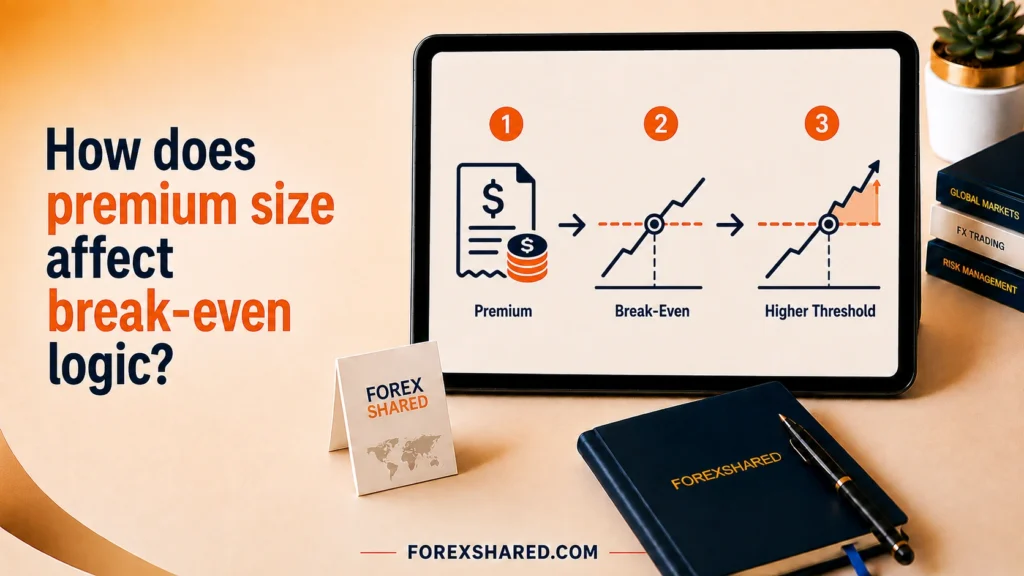
How Does Premium Size Affect Break-Even Logic?
Premium size affects break-even because the option buyer must recover the amount paid for the option before the position produces a net profit at expiration. A larger premium therefore pushes the break-even level farther away from the strike in the favorable direction.
At expiration, the formula direction is explicit: a long call uses Strike + Premium, while a long put uses Strike − Premium. The premium therefore determines how far the underlying must move beyond strike in the favorable direction before the buyer reaches zero net P&L.
This article separates strike from break-even, moneyness from profitability, expiration logic from pre-expiry valuation, and rate-unit premium from total cash premium so the calculation stays technically consistent for FX options.
This article explains option break-even mechanics for educational purposes and does not provide individualized financial or trading advice. Contract specifications, premium quotation conventions, transaction costs, liquidity and expiration procedures can vary, so current product and account documentation should be checked before relying on a specific break-even calculation.
What Does Break-Even Mean for an Option Buyer?
Break-even for an option buyer is the underlying price at expiration where the option's gain before premium exactly equals the premium cost, producing zero net P&L.
Break-even is a net P&L threshold, not the strike itself. CME defines call break-even as strike plus premium and put break-even as strike minus premium, which makes the premium the cost hurdle that must be recovered at expiration. CME
The parent risk context is covered in Premium cost and downside control.
What happens at break-even?
At break-even, the option's gain before premium equals the premium cost, so net P&L equals zero.
Equality: Option Gain Before Premium = Premium Cost → Net P&L = 0. This is a net-profit threshold, not a gross-value threshold.
Is break-even the same as the strike?
No, the strike is the contractual exercise price, while break-even incorporates the premium paid.
Strike determines the contractual exercise price; break-even adds the premium cost. CME
Why must premium be recovered?
Premium must be recovered because it is the buyer's acquisition cost, and a favorable underlying move can create option value without yet compensating the buyer for that original cost.
A favorable move creates intrinsic value, but the first portion of that value must recover the premium before net profit appears.
How does CME define option break-even?
CME defines call break-even as strike plus premium and put break-even as strike minus premium.
CME definitions: Call = Strike + Premium; Put = Strike − Premium [Source A]. The formulas are expiration break-even relationships. CME
| Stage | Economic meaning |
|---|---|
| Option Strike | Contractual exercise price |
| Buyer Pays Premium | Acquisition cost is created |
| Premium Creates Cost Hurdle | The buyer must recover the premium |
| Underlying Moves Beyond Strike | Intrinsic value begins to offset the cost |
| Intrinsic Value Recovers Premium | Net P&L approaches zero |
| Expiration Break-Even | Option gain before premium equals premium cost |
The visual below restates this section mechanism without introducing a separate rule.
Why Does Premium Push a Long Call Break-Even Above the Strike?
A long call's break-even sits above the strike because the underlying must rise far enough above the strike to recover the premium paid.
At expiration, a call can be in the money before it is profitable because intrinsic value first has to recover the premium. CME illustrates the same logic with a 1150 call purchased for 7.50 points, giving an expiration break-even of 1157.50. CME
Premium moves the profitability threshold above the strike.
What value does a long call generate at expiration?
At expiration, a long call's intrinsic value equals the underlying futures price minus the strike when the underlying is above the strike.
Call Intrinsic Value = Underlying − Strike when underlying > strike. CME defines a call as ITM when the underlying futures price exceeds the strike [Source D]. CME
Why is crossing the strike not enough for net profit?
Crossing the strike is not enough because the buyer has already paid premium, and the first portion of intrinsic value above the strike is used to recover that cost.
Intrinsic value above strike first offsets the premium paid.
What is the long-call break-even relationship?
At expiration, the long-call break-even equals the strike plus the premium.
Call Break-Even = Strike + Premium. Explain why the underlying must rise above the strike by the premium amount. CME
What happens below call break-even but above strike?
Below call break-even but above the strike, the call is in the money but still net losing because intrinsic value has not yet recovered the full premium.
Intrinsic value exists but remains smaller than the premium paid. Illustrative strike 1.1000 and premium 0.0100 example.
| Underlying at Expiration | Call Status | Net P&L |
|---|---|---|
| Underlying < 1.1000 | No intrinsic value | Negative, premium not recovered |
| 1.1000 < Underlying < 1.1100 | ITM | Net loss |
| Underlying = 1.1100 | ITM | Break-even |
| Underlying > 1.1100 | ITM | Positive expiration P&L before fees |
Why Does Premium Push a Long Put Break-Even Below the Strike?
A long put's break-even sits below the strike because the underlying must fall far enough below the strike to recover the premium paid.
For a long put, the direction reverses but the cost-recovery logic does not. CME illustrates a Swiss Franc put with strike 85 and premium 0.99, producing an expiration break-even of 84.01. CME
Premium moves the profitability threshold below the strike.
What value does a long put generate at expiration?
At expiration, a long put's intrinsic value equals the strike minus the underlying futures price when the underlying is below the strike.
Put Intrinsic Value = Strike − Underlying when underlying < strike. CME defines a put as ITM when the underlying futures price is below the strike [Source D]. CME
Why must the underlying fall below strike by more than zero?
The underlying must fall below the strike by more than zero because the put buyer must recover the premium paid before reaching net profitability.
Intrinsic value below strike first offsets the premium paid.
What is the long-put break-even relationship?
At expiration, the long-put break-even equals the strike minus the premium.
Put Break-Even = Strike − Premium. Explain why the underlying must fall below the strike by the premium amount. CME
What happens above put break-even but below strike?
Above put break-even but below the strike, the put is in the money but still net losing because its intrinsic value remains smaller than the premium paid.
Intrinsic value exists but remains smaller than the premium paid.
| Option Type | Formula Direction | Break-Even Location | Required Underlying Move |
|---|---|---|---|
| Long Call | Strike + Premium | Above strike | Underlying must rise |
| Long Put | Strike − Premium | Below strike | Underlying must fall |
The visual below restates this section mechanism without introducing a separate rule.
How Does a Larger Premium Move Break-Even Farther From the Strike?
A larger premium moves break-even farther from the strike because the buyer must recover a larger acquisition cost before reaching zero net P&L at expiration.
Holding strike constant, a larger premium increases the amount of intrinsic value required to recover the buyer's acquisition cost. Calls therefore move farther above strike and puts farther below strike, without implying that the larger premium is automatically better or worse.
Whether the required move is realistic also depends on the trader's Directional view in options.
Fixed strike + larger acquisition cost = greater break-even distance from strike. The numerical direction differs for calls and puts, but the distance effect is the same.
What happens if call strike stays fixed while premium increases?
With a fixed call strike, a larger premium pushes the expiration break-even higher because call break-even equals strike plus premium.
Fixed-strike comparison: Strike 1.1000; Premium A 0.0050 → Break-Even 1.1050; Premium B 0.0150 → Break-Even 1.1150.
What happens for a put?
With a fixed put strike, a larger premium pushes the expiration break-even lower because put break-even equals strike minus premium.
Fixed-strike comparison: Strike 1.1000; Premium A 0.0050 → Break-Even 1.0950; Premium B 0.0150 → Break-Even 1.0850.
What is the general relationship?
For a fixed strike, an increase in premium increases the break-even distance from the strike, while a decrease in premium reduces that distance.
This holds for both calls and puts, in opposite directions.
Is a larger premium necessarily worse?
No, a larger premium can reflect differences in intrinsic value, time value, volatility, expiration, or strike positioning, and this page explains the break-even consequence, not whether the premium is fair.
Premium contains intrinsic value plus time value [Source F]; differences can arise from strike, moneyness, expiration, volatility, and remaining time value. CME
| Premium | Break-Even | Cost Hurdle | Required Move |
|---|---|---|---|
| Low Premium 0.0050 | 1.1050 | Smaller cost hurdle | Smaller favorable move |
| High Premium 0.0150 | 1.1150 | Larger cost hurdle | Larger favorable move |
The visual below restates this section mechanism without introducing a separate rule.
Why Can an In-the-Money Option Still Be Below Break-Even?
An in-the-money option can still be below break-even because moneyness describes the option's relationship to the strike, while break-even also includes the premium cost.
Moneyness and profitability answer different questions. CME states that ITM, ATM and OTM describe the option contract relative to strike and do not by themselves determine whether the trade is profitable. CME
What does ITM describe?
ITM describes the option's relationship to the strike, not whether the trade is profitable.
CME explicitly states that ITM and OTM describe the option contract and do not represent whether the trade itself is profitable [Source D]. CME
What does break-even describe instead?
Break-even describes the strike relationship plus the premium cost, producing the level where net P&L equals zero.
Moneyness looks only at underlying vs. strike; break-even adds the acquisition cost.
What example shows the difference for a call?
A call with a 1.1000 strike and a 0.0100 premium is ITM at an underlying of 1.1050 but remains net losing because its intrinsic value of 0.0050 is smaller than the premium paid.
Illustrative example: Strike 1.1000, Premium 0.0100, Underlying at expiry 1.1050. The call is 0.0050 ITM but premium paid was 0.0100 → net result −0.0050.
What must happen to reach zero P&L?
To reach zero P&L, the underlying must reach 1.1100, where intrinsic value equals the 0.0100 premium paid.
At 1.1100, intrinsic value = 0.0100 = premium paid.
Why is this distinction central to premium-size logic?
This distinction is central because a larger premium widens the region where an option can be in the money but still below the buyer's break-even.
The gap between strike and break-even grows with premium, so more of the ITM zone remains below break-even.
| Concept | What It Describes | Includes Premium? | Example Value |
|---|---|---|---|
| ITM | Underlying versus strike | No | 1.1050, 0.0050 ITM |
| Break-Even | Strike plus premium | Yes | 1.1100 |
How Do Intrinsic Value and Time Value Affect the Meaning of Premium Size?
Premium size reflects both intrinsic value and time value, and regardless of why a premium is large, a larger premium means more cost must ultimately be recovered for expiration profitability.
Option premium consists of intrinsic value plus time value. CME explains that time value falls to zero at expiration, which is why the expiration break-even formula can compare intrinsic value directly with the premium originally paid. CME
At expiration, time value becomes zero. CME
What is option premium made of?
Option premium is made of intrinsic value plus time value.
Option Value = Intrinsic Value + Time Value [Source D]. Intrinsic value comes from moneyness; time value comes from remaining time and other factors. CME
Can two options have different premiums even with the same underlying?
Yes, two options on the same underlying can have different premiums because of differences in strike, moneyness, expiration, volatility, and remaining time value.
List the sources: strike, moneyness, expiration, volatility, remaining time value.
Why does premium composition matter to break-even?
Premium composition matters because regardless of why a premium is large, a larger premium means more cost must ultimately be recovered for expiration profitability.
Whatever the composition, the buyer must recover the full premium before net profit.
Does time value remain at expiration?
No, time value becomes zero at expiration, leaving option value equal to intrinsic value.
At expiration, option value = intrinsic value only. CME
Why is this why strike ± premium works cleanly at expiration?
Strike plus or minus premium works cleanly at expiration because option value equals intrinsic value, so break-even occurs where intrinsic value equals the original premium paid.
At expiration, option value = intrinsic value. Break-even occurs where intrinsic value = original premium paid.
Why Is Expiration Break-Even Different From Pre-Expiration Profitability?
Expiration break-even differs from pre-expiration profitability because before expiration the option can still contain time value, so the underlying does not need to cross the expiration break-even for the option to be sold at a gain.
Before expiration, time value can remain in the option, so a buyer may be able to sell above the original purchase premium even when the underlying has not crossed the expiration break-even. At expiration, time value is zero and the simple strike-plus-or-minus-premium relationship becomes exact. CME
Does the underlying need to cross strike plus premium before a call can be sold profitably before expiry?
No, before expiration, the option can still contain time value, so the underlying does not need to cross strike plus premium for a profitable pre-expiry sale.
Time value remains in the option before expiration.
Can a call remain below its expiration break-even but trade above the buyer's purchase premium?
Yes, a call can remain below its expiration break-even but trade above the buyer's purchase premium because of favorable underlying movement, remaining time value, or higher implied volatility.
Possible contributors: favorable underlying movement, remaining time value, higher implied volatility.
Why does the simple formula become exact at expiration?
The simple formula becomes exact at expiration because time value equals zero, leaving option value equal to intrinsic value.
At expiration, time value = 0, so option value = intrinsic value [Source D]. Net P&L = intrinsic value − original premium. CME
What terminology should the article use?
The article should use the term "expiration break-even" rather than implying a universal break-even at every point during the option's life.
Avoid implying a universal break-even at every point during the option's life.
| Timeframe | Option Value | Profitability Rule |
|---|---|---|
| Before Expiration | Intrinsic Value + Time Value | Profitability can change without underlying reaching expiration break-even |
| At Expiration | Time Value = 0 | Net P&L = Intrinsic Value − Original Premium |
The visual below restates this section mechanism without introducing a separate rule.
How Should Premium Units Be Converted for FX Option Break-Even?
Strike and premium must share compatible underlying-price units in the break-even formula, so a cash premium in dollars cannot be added directly to an FX exchange-rate strike without converting units.
For FX options, the premium used in the rate formula must be expressed in the same price units as the strike. CME's current EUR/USD options use a 125,000 EUR contract size and USD-per-EUR quotation units. CME
What units must strike and premium share in the break-even formula?
Strike and premium must share compatible underlying-price units in the break-even formula.
You cannot add a cash premium in dollars directly to an FX exchange-rate strike without converting units.
How are current CME EUR/USD FX option units structured?
Current CME EUR/USD options have a contract size of 125,000 EUR and use USD-per-EUR quotation units.
CME EUR/USD contract structure: Contract Size 125,000 EUR; Tick/Quotation Units USD per EUR [Source E]. Quotation units determine how the premium is expressed. CME
How does a quoted premium become a cash premium?
A quoted premium becomes a cash premium by multiplying the quoted premium per EUR by the contract size of 125,000 EUR.
Quoted Premium per EUR × 125,000 EUR = Cash Premium per Contract. This is a conceptual conversion, not the break-even-rate formula.
Which version belongs in the break-even-rate formula?
The quoted premium expressed in the same price units as the strike belongs in the break-even-rate formula, not the unconverted total cash premium.
The unconverted cash premium is not compatible with the FX strike.
What error occurs if contract cash premium is added directly to the FX strike?
Adding the contract cash premium directly to the FX strike mixes incompatible units and produces a meaningless break-even rate.
Cash premium is in dollars; FX strike is in USD per EUR, incompatible units.
| Item | Value | Units |
|---|---|---|
| Strike | 1.1000 | USD per EUR |
| Premium | 0.0080 | USD per EUR |
| Contract Size | 125,000 | EUR |
| Cash Premium | $1,000 | USD |
| Expiration Call Break-Even Rate | 1.1080 | USD per EUR |
| Do NOT | 1.1000 + $1,000 | Meaningless because units differ |
The visual below restates this section mechanism without introducing a separate rule.
How Do Transaction Costs Shift the All-In Break-Even?
Transaction costs shift the all-in break-even because strike plus or minus quoted premium does not always represent the exact all-in economic break-even when additional costs apply.
The basic expiration formula isolates strike and premium, while the all-in economic break-even can move once commissions, exchange fees or brokerage charges are included. CME's options guide specifically notes that commissions should be factored into break-even calculations and can differ by firm. CME
Calculate strike ± premium first. Then adjust for applicable costs using compatible units. Do not mix broker-specific cash fees directly into an FX rate unless they have been normalized.
Does strike ± quoted premium always represent exact all-in economic break-even?
Not if additional transaction costs apply, strike plus or minus quoted premium is the basic expiration break-even, not necessarily the all-in economic break-even.
Additional transaction costs must be included.
What additional costs can matter?
Additional costs that can matter include commissions, exchange fees, and brokerage charges.
These costs add to the buyer's total cost.
How does CME treat commissions in break-even examples?
CME's options-on-futures guide explicitly notes that commissions should also be factored into break-even calculations even though they differ by firm.
Commissions differ by firm, so they are not included in the basic formula. CME
What happens to a call's all-in break-even when costs increase?
A call's all-in break-even moves slightly higher when costs increase.
Call all-in break-even moves higher. Additional costs add to the total cost that must be recovered.
What happens to a put's all-in break-even?
A put's all-in break-even moves slightly lower when costs increase.
Put all-in break-even moves lower. Additional costs add to the total cost that must be recovered.
What is the correct hierarchy?
The correct hierarchy is: basic expiration break-even first (call: strike + premium; put: strike − premium), then adjust for applicable transaction costs in compatible units to reach the all-in break-even.
Basic break-even uses strike ± premium; all-in break-even adjusts for transaction costs in compatible units.
How Does Premium Size Affect Break-Even in an FX Option on Futures?
Premium size affects break-even in an FX option on futures the same way, but the strike and premium must be interpreted against the underlying FX futures price, not automatically against spot FX.
The immediate underlying for current CME FX options is the corresponding FX futures contract, not automatically spot FX. CME's 2026 guide states that listed FX options are European style and deliver into the underlying future when in the money at expiry. CME
The market-distance side of that threshold is examined separately through Underlying pair movement.
For current CME FX options, use the applicable FX futures price or fixing specified by the contract rules rather than automatically substituting spot FX. CME
What is the immediate underlying of current CME FX options?
The immediate underlying of current CME FX options is the corresponding FX futures contract.
In-the-money options deliver into those futures at expiry. CME
Which price should be compared with strike at option expiration?
The applicable underlying futures price or fixing under the option's contract rules should be compared with the strike at option expiration.
The contract rules define the exact price reference.
Why should spot FX not automatically replace the futures price?
Spot FX should not automatically replace the futures price because the option contract is written on the futures instrument, and spot and futures can be closely related without being identical before futures expiration.
This keeps why should spot FX not automatically replace the futures price? tied to the expiration break-even calculation rather than to a separate pricing or strategy question.
Does premium-size logic change?
No, the structural rule remains the same: long call break-even equals strike plus premium and long put break-even equals strike minus premium, but the strike and premium must be interpreted using the contract's actual quotation units.
This keeps does premium-size logic change? tied to the expiration break-even calculation rather than to a separate pricing or strategy question.
Does crossing buyer break-even automatically trigger exercise?
No, break-even measures buyer P&L, while exercise and expiration are governed by contract rules, and current CME FX options use predefined European-style expiration processing.
Exercise and expiration are governed by contract rules; current CME FX options use European-style expiration processing [Source E]. CME
What Example Shows Premium Size Changing Break-Even Without Changing the Strike?
Two illustrative EUR/USD calls with the same strike of 1.1000 and the same expiry show that a 0.0050 premium produces a break-even of 1.1050 while a 0.0150 premium produces a break-even of 1.1150.
With strike fixed at 1.1000, a 0.0050 premium gives a 1.1050 call break-even while a 0.0150 premium gives 1.1150. The 0.0100 difference in premium becomes a 0.0100 difference in required favorable movement.
What happens with a 0.0050 premium?
With a 0.0050 premium, the expiration break-even is 1.1000 plus 0.0050, which equals 1.1050.
Break-Even = 1.1000 + 0.0050 = 1.1050. The underlying must rise 0.0050 above strike to recover the premium.
What happens with a 0.0150 premium?
With a 0.0150 premium, the expiration break-even is 1.1000 plus 0.0150, which equals 1.1150.
Break-Even = 1.1000 + 0.0150 = 1.1150. The underlying must rise 0.0150 above strike to recover the premium.
How much farther must the underlying move?
The higher-premium option requires 0.0100 of additional favorable underlying movement relative to the lower-premium option before reaching expiration break-even.
Additional move = 0.0150 − 0.0050 = 0.0100. The difference in premium directly equals the difference in required favorable movement.
Did the strike change?
No, the strike remained 1.1000; only the acquisition cost changed.
Only the acquisition cost changed between the two options.
What does the example prove?
The example proves that premium size shifts the profitability threshold independently of the strike's contractual location.
Strike determines where intrinsic value begins; premium determines how much intrinsic value is required to recover the buyer's cost.
How Should Premium Size Be Evaluated When Calculating Option Break-Even?
Premium size should be evaluated by identifying the option type, strike, actual premium paid, unit compatibility, underlying contract, expiration intent, and applicable transaction costs before calculating the expiration break-even.
A reliable calculation separates contract identity, cost basis, unit normalization, expiration timing and transaction costs. The sequence below keeps those checks in order so the final number remains an expiration break-even rather than a mixed-unit or pre-expiry valuation estimate.
Is the option a call or put?
Determine whether the option is a call or put to select the correct formula direction.
Call uses strike + premium; put uses strike − premium.
What is the strike?
Use the exact contract strike in the break-even calculation.
The strike is the contractual exercise price.
What premium was actually paid?
Use the buyer's acquisition premium, not necessarily the current market premium, in the break-even calculation.
The current market premium is not the buyer's cost basis.
Are strike and premium expressed in compatible units?
Verify that strike and premium are expressed in compatible units before adding or subtracting.
Convert before adding or subtracting if units differ.
What is the underlying contract?
Determine whether the underlying is direct currency exposure or an FX futures contract.
Direct currency exposure vs. FX futures changes the price reference.
Is the calculation intended for expiration?
If the calculation is not intended for expiration, do not use strike plus or minus premium as a complete pre-expiry valuation rule.
If not, the simple formula is not a complete pre-expiry valuation rule.
Are transaction costs relevant?
Add transaction costs separately when calculating the all-in break-even.
Add them separately for all-in break-even.
Is current moneyness being confused with profitability?
Check moneyness and profitability independently, an ITM option can still be below break-even.
Moneyness describes the option relative to strike; profitability includes premium cost.
What is the correct break-even sequence?
The correct break-even sequence is: identify the exact option, confirm call or put, identify the strike, identify the original premium paid, normalize premium into strike-compatible units, calculate call strike plus premium or put strike minus premium, identify the correct underlying used at expiration, separate ITM status from net profitability, add transaction costs where relevant, and label the result as expiration break-even.
Provide the ten-step sequence. Each step prevents a specific error.
How Can Option Buyers Avoid Misreading Premium-Driven Break-Even?
Option buyers can avoid misreading premium-driven break-even by keeping strike, moneyness, and break-even separate, using the correct formula direction, and verifying premium units.
The most common errors come from collapsing different concepts into one number: strike is not break-even, ITM is not automatically profitable, cash premium is not directly additive to an FX rate strike, and expiration break-even is not a universal pre-expiry sale threshold. CME CME
Why is "strike equals break-even" incorrect?
"Strike equals break-even" is incorrect because the strike does not include the buyer's premium cost.
Break-even adds the premium to the strike.
Why is "ITM means profitable" incorrect?
"ITM means profitable" is incorrect because CME explicitly distinguishes moneyness from trade profitability.
CME states ITM and OTM describe the option contract and do not determine whether the trade is profitable [Source D]. CME
Why is "larger premium reduces the required move" incorrect?
"Larger premium reduces the required move" is incorrect because a larger acquisition cost requires more intrinsic value to recover at expiration.
More intrinsic value must be generated to recover the larger cost.
Why is "call and put premiums move break-even in the same direction" incorrect?
"Call and put premiums move break-even in the same direction" is incorrect because call break-even equals strike plus premium while put break-even equals strike minus premium.
Calls and puts move break-even in opposite directions. Call: Strike + Premium; Put: Strike − Premium [Source A]. CME
Why is "cash premium can be added directly to an FX strike" incorrect?
"Cash premium can be added directly to an FX strike" is incorrect because break-even arithmetic requires compatible price units.
This keeps why is "cash premium can be added directly to an FX strike" incorrect? tied to the expiration break-even calculation rather than to a separate pricing or strategy question.
Why is "expiration break-even is always required for a profitable pre-expiry sale" incorrect?
"Expiration break-even is always required for a profitable pre-expiry sale" is incorrect because before expiration the option can retain time value.
Time value remains before expiration [Source D]. CME
Why is "current premium determines original trade break-even" incomplete?
"Current premium determines original trade break-even" is incomplete because the relevant cost basis for the buyer's original position is the premium actually paid at entry, adjusted for applicable costs.
The current market premium is not the buyer's cost basis.
What should be verified before stating an FX option's break-even?
Before stating an FX option's break-even, verify the option type, strike, original premium, unit compatibility, formula direction, moneyness separation, expiration label, underlying contract, and applicable transaction costs.
Each item prevents a specific error.
- Call or put identified correctly.
- Exact strike confirmed.
- Original premium paid identified.
- Premium and strike use compatible price units.
- Call uses strike + premium.
- Put uses strike − premium.
- ITM/OTM status kept separate from profitability.
- Calculation explicitly treated as expiration break-even.
- Correct spot/futures underlying identified.
- Applicable transaction costs included separately when calculating all-in break-even.
Conclusion Direction
Premium size affects break-even because the option buyer must recover the acquisition cost before the option becomes profitable at expiration.
CME defines call break-even as strike plus premium and put break-even as strike minus premium. Moneyness remains separate from profitability, and time value reaches zero at expiration, which is why the simple formula is an expiration relationship. CME CME
For FX options, strike and premium must be in compatible quotation units, and the correct underlying or fixing must come from the contract structure. Current CME EUR/USD options use 125,000 EUR and USD-per-EUR quotation units, with European-style expiration into underlying futures when in the money. CME
FAQs
The FAQs answer the most common follow-up questions about premium size and break-even logic.
What is the expiration break-even for a long call?
For a long call, expiration break-even equals the strike plus the original premium paid, using compatible price units. CME defines call break-even this way. CME
What is the expiration break-even for a long put?
For a long put, expiration break-even equals the strike minus the original premium paid. CME's options guide illustrates the same direction with the Swiss Franc example 85 − 0.99 = 84.01. CME
Does an in-the-money option automatically mean the buyer is profitable?
No. CME states that ITM, ATM and OTM describe the option contract relative to strike and do not by themselves determine trade profitability. Premium cost still has to be recovered. CME
Can an option be sold profitably before expiration without the underlying crossing expiration break-even?
Yes, it can be possible because time value may remain before expiration, so the option's market value can exceed intrinsic value. The outcome depends on market conditions and is not guaranteed. CME
What units should be used for a CME EUR/USD option break-even calculation?
Strike and premium must be expressed in compatible price units. CME's current EUR/USD options use USD per EUR quotation and a standard contract size of 125,000 EUR. CME