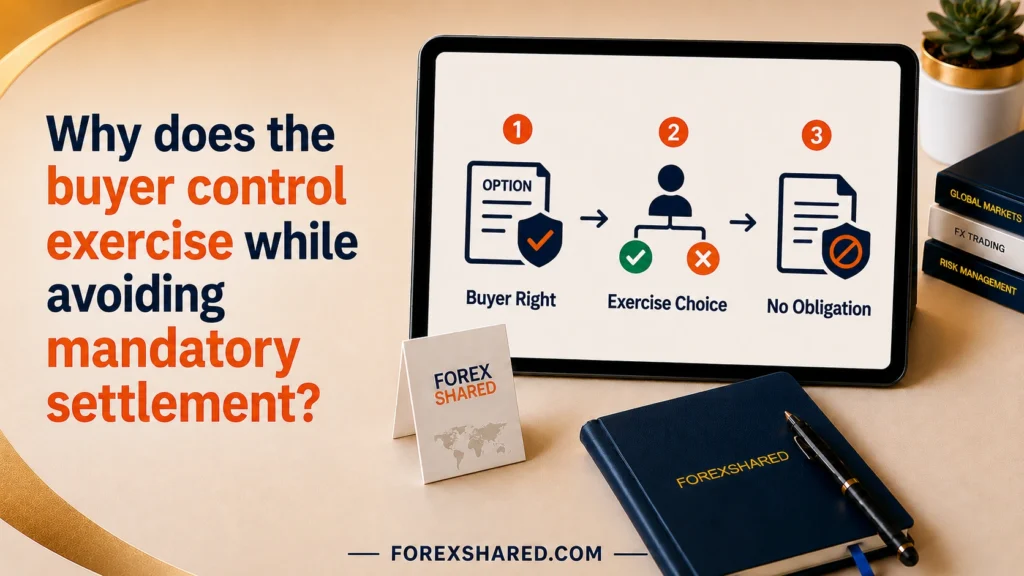
Why Does the Buyer Control Exercise While Avoiding Mandatory Settlement?
The option buyer controls exercise because the contract grants a defined right rather than an unconditional obligation to complete the underlying transaction, and the premium paid funds that optionality.
The writer sits on the opposite side of that structure: the writer receives the premium and accepts the contingent obligation, while the buyer owns the option right and can avoid creating the underlying exposure when the contract does not result in exercise.
The article below separates exercise from settlement, explains call and put direction, strike and expiration boundaries, exercise styles, current CME FX automatic-expiration rules, offset as a separate exit route, the contrast with direct futures entry, and the verification steps required before relying on buyer discretion.
This article explains forex option contract mechanics for educational purposes and does not provide individualized financial or trading advice. Exercise, expiration and settlement rules are contract-specific and should be verified against current product documentation.
What Contract Feature Gives the Buyer Control Over Exercise?
The option contract itself gives the buyer control over exercise because it sells the buyer a right while imposing no matching obligation to complete the underlying transaction.
CFTC defines an option as a contract that gives the buyer the right, but not the obligation, to buy or sell the specified underlying instrument. It separately defines the writer as the party that promises performance in return for the option price or premium. CFTC CME’s options-on-futures education makes the role split operational: option buyers exercise, while option sellers can be assigned. CME
The broader parent concept is covered in Option buyer rights.
Why does the buyer own the exercise decision?
The buyer owns the exercise decision because the option contract transfers the exercise right to the buyer while the writer accepts only the contingent obligation.
The right belongs to the buyer, while the writer accepts the corresponding contingent obligation. The right operates only within the contract’s defined boundaries. CFTC
What is exercise?
Exercise is the act of asserting the contractual right embedded in the option, and for options on futures it creates the corresponding underlying futures position.
For options on futures, call exercise creates a long underlying futures position; put exercise creates a short underlying futures position. Exercise creates the underlying position that then follows its own lifecycle. CME
Why does the buyer control exercise rather than the seller?
The buyer controls exercise because the buyer purchased the contractual right, while the seller accepted the contingent obligation associated with that right.
The premium exchange is what transfers discretion to the buyer and contingency to the writer. The contract assigns the right to one side and the obligation to the other.
What does "control" mean structurally?
Structurally, control means the buyer owns the contractual right while the seller owns the obligation if assigned, but it does not mean the buyer can disregard contract-specific timing or expiration rules.
The buyer owns the contractual right; the seller owns the obligation if assigned. The right operates only within the contract’s defined structure.
| Contract Position | Buyer | Writer |
|---|---|---|
| Core role | Owns the option exercise right | Accepts the contingent performance obligation |
| Premium | Pays premium | Receives premium |
| Lifecycle control | May retain, offset, exercise where permitted, or reach expiration processing | Can be assigned when the contract requires performance |
| Underlying exposure | Created only if exercise or expiration processing produces it | Opposite underlying exposure can be assigned |
| Control boundary | Subject to strike, expiration, exercise style and product rules | Does not own a matching buyer-style exercise right |
Why Does Paying Premium Allow the Buyer to Avoid a Mandatory Underlying Commitment?
Paying the premium allows the buyer to avoid a mandatory underlying commitment because the premium purchases optionality rather than an immediate underlying position.
CFTC defines premium as the payment the option buyer makes to the writer for granting the option contract. That payment purchases the option right itself rather than creating the underlying transaction at inception. CFTC
The buyer-side premium boundary is developed separately in Maximum loss limited to premium.
What does the option premium purchase?
The option premium purchases the option contract itself, and CFTC defines it as the payment the option buyer makes to the writer for granting that contract.
CFTC defines premium as the payment the buyer makes to the writer for granting the option. The premium is the price paid for optionality and is not returned when the option expires unused. CFTC
What does the buyer receive in return?
In return for the premium, the buyer receives contractual optionality defined by the underlying, call or put direction, strike, expiration, and applicable exercise rights.
The optionality includes the defined underlying, call or put direction, strike, expiration, and applicable exercise rights. The buyer receives a defined right whose value depends on market conditions and contract terms.
Why is this different from entering a futures position directly?
This differs from entering a futures position directly because a futures contract creates the underlying long or short commitment immediately, while an option buyer pays to obtain the right to create that exposure later under the contract rules.
A futures contract creates the underlying long or short position at inception; an option defers that decision to the buyer. The option’s flexibility carries a premium cost that futures do not require.
Does avoiding mandatory settlement mean the option has no cost?
No, avoiding mandatory settlement does not mean the option has no cost, because if the option expires without an economically useful outcome, the buyer can lose the premium paid.
The buyer avoids an unconditional underlying commitment but not the cost of purchasing optionality. The premium is the price of the right and is not refunded.
How Do Call and Put Rights Define the Buyer's Exercise Control?
Call and put rights define the direction of the buyer's exercise control: a call gives the right to buy or go long, while a put gives the right to sell or go short.
CFTC defines a call as a right to purchase the underlying or enter a long futures position at the specified price, while a put gives the holder the right to sell the underlying or enter a short futures position. CFTC
What does a call buyer control?
A call buyer controls the right,but not the obligation,to purchase the underlying asset or enter a long futures position at the specified strike within the applicable period.
CFTC defines a call as giving the buyer the right to purchase the underlying asset or enter a long futures position at the strike. The call grants a right, not an obligation. CFTC
What does a put buyer control?
A put buyer controls the right,but not the obligation,to sell the underlying asset or enter a short futures position at the strike under the applicable timing rules.
The put gives the holder the right to sell the underlying asset or enter a short futures position at the strike. The put grants a right, not an obligation.
Why are call and put buyers structurally similar?
Call and put buyers are structurally similar because both purchase optionality, and the only difference is the direction of the contractual right.
The difference is direction: call equals buy/long; put equals sell/short. They are the same contract structure with opposite directions.
| Contract Feature | Call Buyer | Put Buyer |
|---|---|---|
| Right direction | Buy or long right | Sell or short right |
| Options-on-futures exercise result | Long underlying futures position | Short underlying futures position |
| Writer assignment counterpart | Assigned call writer receives short futures | Assigned put writer receives long futures |
| Shared architecture | Pays premium for bounded optionality | Pays premium for bounded optionality |
Why Does the Writer Face an Obligation While the Buyer Does Not?
The writer faces an obligation while the buyer does not because the writer originates the option contract by accepting a contingent performance obligation in exchange for the premium.
The writer’s position is the contractual counterpart to buyer discretion. CFTC defines the writer as the person who originates the option by promising to perform the relevant obligation for the premium, while CME explains that option sellers are assigned when exercise requires performance. CFTC CME
The role asymmetry is compared further in Seller versus buyer risk.
What does the option writer agree to do?
The option writer agrees to originate the option contract by promising to perform a specified obligation in exchange for the option premium.
CFTC defines the writer as the party that originates the option contract by promising to perform in exchange for premium. The writer accepted the obligation, not a matching right. CFTC
What happens when a call buyer exercises an option on futures?
When a call buyer exercises an option on futures, the long call holder receives a long underlying futures position, and the assigned call writer receives the corresponding short futures position.
The exercise creates the underlying exposure for both sides simultaneously. The premium compensates the writer for accepting the contingent obligation. CME
What happens when a put buyer exercises?
When a put buyer exercises, the long put holder receives a short underlying futures position, and the assigned put writer receives the corresponding long futures position.
The exercise creates the underlying exposure for both sides simultaneously. The premium compensates the writer for accepting the contingent obligation.
Why can the writer not simply reject assignment?
The writer cannot reject assignment because the premium compensates the writer for accepting the contingent contractual obligation.
Buyer pays premium to acquires right; writer receives premium to accepts contingent obligation. The premium was accepted in exchange for the obligation.
How Do Strike and Expiration Limit the Buyer's Exercise Control?
Strike and expiration limit the buyer's exercise control because the strike fixes the contractual price and expiration defines the time boundary within which the right can operate.
The right is bounded by price and time. CFTC’s call and put definitions attach the right to a specified strike, while BIS defines a currency option around an agreed exchange rate and a specified date. CFTC BIS
What does the strike price control?
The strike price controls the contractual price at which the option right applies, and CFTC includes the specified strike directly in its definitions of calls and puts.
CFTC includes the strike in its definitions of calls and puts. The strike is a contractual term, not a forecast. CFTC
What does expiration control?
Expiration controls the time boundary within which or at which the option right can operate, and BIS defines a currency option around a right available at or by a specified date.
BIS defines a currency option around a right available at or by a specified date. The contract defines when the right ends or enters its expiration-processing rules. BIS
Does the buyer retain the option right indefinitely?
No, the buyer does not retain the option right indefinitely because the right expires according to the contract.
The contract defines the time boundary of the right. The contract terminates or processes the right according to its rules. BIS
Why does this matter to exercise control?
This matters to exercise control because buyer control exists only inside the defined underlying, strike, expiration, and exercise rules.
Buyer control exists only inside the defined underlying, strike, expiration and exercise rules. The contract defines the exact scope of the buyer’s discretion.
How Can Non-Exercise Prevent Mandatory Underlying Settlement?
Non-exercise prevents mandatory underlying settlement because the buyer does not create the underlying transaction merely by purchasing the option, and CFTC defines abandon as electing not to exercise or offset a long option position.
CFTC defines abandon as electing not to exercise or offset a long option position. At the generic option level, a buyer who reaches the applicable non-exercise outcome does not create the underlying exposure merely because the option was purchased, although the premium cost remains. CFTC
What happens in a generic option when the buyer does not exercise the right?
When the buyer does not exercise the right, the buyer does not create the underlying transaction merely because the option was purchased, and CFTC defines abandon as electing not to exercise or offset a long option position.
CFTC defines abandon as electing not to exercise or offset a long option position. The premium is the cost of the right, not a refundable deposit. CFTC
Why is that structurally different from a forward or futures obligation?
This is structurally different from a forward or futures obligation because the option buyer has acquired a contingent right, while a binding forward or futures position creates the underlying commitment from inception unless it is later offset or otherwise terminated.
The option buyer holds a contingent right; the forward or futures holder holds a binding position from inception. The option’s flexibility carries a cost and its exercise rules may limit discretion.
What settlement obligation is avoided through non-exercise?
Through non-exercise, the buyer can avoid creating the direct underlying purchase or sale, the long underlying futures position, or the short underlying futures position when the option expires or is abandoned without exercise under the applicable rules.
Depending on the option structure, the buyer avoids the direct purchase/sale, the long futures position, or the short futures position. The premium cost remains even when no underlying transaction occurs.
What does the buyer still lose if an option expires unused?
If an option expires unused, the buyer still loses the premium paid, because the premium remains the economic cost of purchasing the optionality.
No Mandatory Underlying Settlement is not the same as No Economic Cost. The premium was paid for the right regardless of whether it is exercised.
Why Does Exercise Not Always Mean Immediate Currency Settlement?
Exercise does not always mean immediate currency settlement because the option's exercise creates the underlying exposure, and for options on futures that exposure is a futures position that follows its own later settlement lifecycle.
BIS recognizes currency options whose right directly concerns buying or selling currency, but an option on futures has a different post-exercise outcome. CME states that exercising a call creates a long underlying futures position and exercising a put creates a short underlying futures position. BIS CME
What can happen in a direct currency option?
In a direct currency option, the option's exercise can invoke the currency purchase or sale mechanism specified by that contract, and BIS recognizes currency options whose contractual right directly concerns buying or selling currency.
BIS recognizes currency options whose right directly concerns buying or selling currency. Some FX options reference FX futures instead. BIS
What happens in an option on FX futures?
In an option on FX futures, exercise creates an underlying FX futures position, and it does not necessarily complete the final exchange of currencies at that same moment.
The exercise creates the underlying FX futures position; final currency exchange is a later event. The exercise creates the futures position first, and that position settles later. CME
What happens after the futures position is created?
After the futures position is created, that future follows its own lifecycle and may later be offset, rolled where applicable, or carried to final settlement.
The future may be offset, rolled where applicable, or carried to final settlement. The option and the underlying future are separate contracts with separate lifecycles.
Why must these stages stay separate?
These stages must stay separate because option ownership creates an exercise right, exercise creates the underlying exposure, and the underlying contract's lifecycle determines the later settlement obligation.
Option Ownership to exercise right exists; Exercise to underlying exposure is created; Underlying Contract Lifecycle to later settlement obligation determined. The option allows the buyer to control whether the next contractual layer is created, not whether that layer later settles.
How Does Exercise Style Limit Buyer Control?
Exercise style limits buyer control because the contract specifies when the right can become exercise, and American-style and European-style conventions define different timing boundaries.
Exercise style determines when the contractual right can be exercised. CME explains that European-style options can be exercised only at expiration, while American-style options can be exercised before expiration according to the applicable contract rules. CME
What does American-style exercise allow?
American-style exercise generally permits exercise before expiration according to the contract's rules.
The option can be exercised before expiration according to contract rules. Contract-specific terms still apply.
What does European-style exercise allow?
European-style exercise permits exercise only at expiration, and CME's current FX options are marketed with European-style expiries.
CME’s current FX options use European-style expiries. It describes exercise timing, not currency geography. CME
Does European-style mean the option relates only to European currencies?
No, European-style does not mean the option relates only to European currencies because it describes exercise timing, not currency geography.
The term refers to when exercise can occur, not which currencies are involved. The term is a timing convention with no geographic meaning.
Why does exercise style matter to buyer control?
Exercise style matters to buyer control because the buyer owns the right, but the contract specifies when that right can become exercise.
Exercise control is not the same as unlimited exercise timing. The contract’s exercise style defines when exercise is permitted.
How Do Current CME FX Expiration Rules Qualify Buyer Exercise Control?
Current CME FX expiration rules qualify buyer exercise control because they use European-style exercise with automatic fixing-based exercise and abandonment, and contrary instructions are not permitted.
Current CME FX specifications make the expiration boundary unusually explicit: the listed FX options are European style and are automatically exercised or expired against the fixing. CME CME’s fixing methodology states that in-the-money options are automatically exercised, out-of-the-money options are abandoned, at-the-money calls exercise, at-the-money puts are abandoned, and contrary instructions are not permitted. CME
Can current CME FX options be exercised early?
No, current CME FX options cannot be exercised early because CME states that the covered FX options feature European-style exercise only.
European-style exercise permits exercise only at expiration. Exercise style is contract-specific. CME
What happens to an in-the-money option at expiration?
At expiration, CME automatically exercises in-the-money FX options into the corresponding underlying FX futures contract.
The exercise creates the corresponding underlying FX futures position. CME’s automatic-exercise rules govern the outcome. CME
What happens to an out-of-the-money option?
An out-of-the-money option is automatically abandoned at expiration under CME's current FX option rules.
No underlying futures position is created. CME’s automatic-abandonment rules govern the outcome.
What happens exactly at the money?
Exactly at the money, CME's current process exercises at-the-money calls and abandons at-the-money puts.
The rule is asymmetric by option type. CME’s rule distinguishes calls from puts. CME
Can the holder override the expiration result with a contrary instruction?
No, the holder cannot override the expiration result with a contrary instruction because CME states that contrary instructions are not permitted and the auto-exercise/abandonment results are final.
The auto-exercise/abandonment results are final. CME states the automatic results are final. CME
Does that mean the buyer never had exercise control?
No, the buyer still had exercise control because the structural right remains different from entering the underlying futures position directly at inception, but control must be described accurately as rule-bounded.
Before expiration, the buyer controls whether to retain, offset, or carry the option; at expiration, the automatic rules govern the outcome. The structural right remains different from entering the underlying futures position directly at inception.
How Can the Buyer Exit the Option Without Exercising It?
The buyer can exit the option without exercising it by offsetting the option position before expiration where the market and contract permit.
Exercise is not the only lifecycle route. CFTC’s glossary distinguishes exercise from abandonment, and CME options education describes offsetting an option position as a separate way to close exposure where the market and contract permit. CFTC
Must the buyer exercise to close an option position?
No, the buyer does not have to exercise to close an option position because a long option position can generally be offset by selling the option before expiration where the market and contract permit.
CFTC’s glossary distinguishes exercising, offsetting, and abandoning a long option. Market liquidity and contract terms determine whether the buyer can close the position. CFTC
What does offsetting the option accomplish?
Offsetting the option closes the option position itself without invoking the underlying exercise right.
The buyer closes the option without creating underlying exposure. Offset ends the option while exercise creates the underlying exposure.
How is that different from exercising?
Offsetting differs from exercising because option offset ends the option position, while option exercise creates the underlying exposure.
Option Offset to option position ends; Option Exercise to underlying exposure is created. They produce different contractual outcomes.
Why does this strengthen buyer control before expiry?
This strengthens buyer control before expiry because the holder has more than one lifecycle route: maintain option exposure, offset it, exercise where permitted, or allow the contract to reach its applicable expiration process.
Maintain, offset, exercise, or carry to expiration. Market conditions and contract rules determine availability.
How Does Buyer Exercise Control Differ From a Mandatory Futures Commitment?
Buyer exercise control differs from a mandatory futures commitment because the option buyer first owns the right to create the futures position rather than the futures position itself.
The structural contrast is the decision point. A direct futures position creates the long or short futures exposure immediately, whereas an option on futures gives the buyer a separate option contract whose exercise can later create that futures position. CME
What happens when a trader opens a futures position directly?
When a trader opens a futures position directly, the trader enters a binding long or short futures position, and there is no option-holder decision separating ownership of the instrument from creation of the underlying futures exposure.
There is no decision point separating ownership from exposure creation. The futures position is created at inception without an option-holder decision.
How does an option on futures differ?
An option on futures differs because the buyer first owns the right to create the futures position rather than the futures position itself.
The buyer first owns the right to create the futures position rather than the futures position itself. The option is a separate contract with its own lifecycle. CME
Why does this matter for mandatory settlement?
This matters for mandatory settlement because if the option does not exercise under its rules, the underlying futures position is never created from that option, and therefore no later futures settlement obligation arises from that unexercised option.
The unexercised option never creates the underlying futures position. The premium can be lost even when no underlying transaction occurs.
What is the structural contrast?
The structural contrast is that an option buyer owns a right to create exposure, while a futures trader owns the exposure itself from inception.
The option buyer owns the right to create the futures position; the futures trader owns the position itself. The option’s flexibility carries a cost and its exercise rules may limit discretion.
| Comparison Point | Option on Futures | Direct Futures |
|---|---|---|
| What is owned at inception | A right to create the underlying futures exposure | The futures exposure itself |
| Decision point | Exercise or contract expiration rules determine whether underlying exposure is created | No option-holder exercise decision separates ownership from exposure creation |
| Funding mechanism | Buyer pays option premium | Futures position is supported by the applicable margin framework |
| If no option exercise occurs | No futures position is created from that unexercised option | Not applicable because the futures position already exists |
| Settlement path | Any created futures position follows its own later lifecycle | Settlement or offset follows the futures contract |
How Should Buyer Exercise Control Be Verified in a Forex Option Contract?
Buyer exercise control should be verified in a forex option contract by confirming the option type, the underlying, the strike, the expiration, the exercise style, and the automatic-exercise rules before relying on any exercise discretion.
Verification should follow the contract rather than a generic slogan about buyer choice. The exact option type, underlying, strike, expiration, exercise style, automatic processing, post-exercise result and offset availability all determine the usable scope of the right.
Who owns the option?
The long option holder owns the option, and the writer or seller is the counterparty who accepted the contingent obligation.
The holder owns the right; the writer owns the obligation. The contract assigns the right to one side and the obligation to the other.
Is the option a call or put?
Confirm whether the option is a call, which gives a buy or long right, or a put, which gives a sell or short right.
Call to buy/long right; Put to sell/short right. The contract explicitly defines the right.
What is the contractual underlying?
Determine whether exercise creates direct currency exposure, an FX futures position, or another contract-specific exposure.
Direct currency exposure, FX futures position, or another contract-specific exposure. Some FX options reference FX futures.
What is the strike?
Identify the contractual price attached to exercise, because the strike determines the price at which the right applies.
The strike is the contractual price for the exercise. The strike is a fixed contractual term.
What is the expiration date?
Determine when the option right ends or enters its expiration-processing rules, because expiration defines the time boundary of the right.
Expiration defines when the right ends or enters processing. The contract terminates or processes the right according to its rules.
What is the exercise style?
Verify whether the option uses European, American, or another contract-specific exercise convention, because the style defines when exercise is permitted.
European, American, or another contract-specific convention. Exercise style is product-specific.
Is exercise discretionary at expiration?
Do not infer exercise discretion at expiration from the generic option definition; instead check the automatic exercise rules, abandonment rules, contrary instructions, and moneyness thresholds.
Check automatic exercise rules, abandonment rules, contrary instructions, and moneyness thresholds. Product-specific expiration procedures govern the outcome.
What happens after exercise?
Identify whether exercise produces currency settlement, a futures position, cash settlement, or another contractual result, because the post-exercise outcome determines the settlement pathway.
Currency settlement, futures position, cash settlement, or another contractual result. Options on futures create the futures position first.
Can the option be offset before exercise?
Verify whether the buyer can close the option position without invoking the underlying exposure, because offset availability depends on market and contract conditions.
The buyer closes the option position without invoking the underlying exposure. Market and contract conditions determine whether the buyer can close the position.
What is the correct verification sequence?
The correct verification sequence is to identify the exact option contract, confirm buyer and writer roles, confirm call or put, identify the underlying, verify premium, verify strike, verify expiration, verify exercise style, verify automatic exercise and abandonment rules, and verify what exercise creates and how that underlying later settles.
Each step confirms one element of the exercise right. Product-specific rules govern the actual exercise outcome.
How Can Buyers Avoid Misunderstanding Exercise Control and Settlement?
Buyers can avoid misunderstanding exercise control and settlement by recognizing that the option right is rule-bounded, the premium is not refundable, exercise does not equal currency delivery, and the writer cannot reject assignment.
The safest classification rule is to separate contract ownership, exercise, assignment and final settlement. The buyer owns the option right, the writer carries the contingent obligation, product rules bound expiration behavior, and exercise can create a separate underlying position whose later lifecycle must then be managed.
Why is "the option buyer must settle the underlying at expiration" incorrect as a generic rule?
The statement is incorrect as a generic rule because the buyer owns an option right rather than a universal unconditional underlying obligation, and the applicable expiration rules determine whether underlying exposure is created.
The applicable expiration rules determine whether underlying exposure is created. The correct statement is that the buyer owns a right whose exercise outcome depends on contract rules.
Why is "the buyer controls everything at expiry" also incorrect?
The statement is incorrect because current CME FX options demonstrate that automatic exercise and abandonment can govern the expiration outcome.
Current CME FX options use automatic exercise and abandonment. The buyer retains structural control while the automatic rules govern the expiration outcome. CME
Why is "no mandatory settlement means no loss" incorrect?
The statement is incorrect because the premium can be lost even when no underlying transaction occurs.
The premium is the cost of optionality and is not refunded. The premium is the price of the right.
Why is "exercise equals currency delivery" incorrect?
The statement is incorrect because options on futures create the underlying futures position first, and that position follows its own later settlement lifecycle.
Options on futures create the futures position first. The option creates the underlying position that then follows its own lifecycle. CME
Why is "the seller chooses whether to perform" incorrect?
The statement is incorrect because the writer accepts an obligation and can be assigned when exercise requires performance.
The writer accepted the obligation in exchange for the premium. The premium compensates the writer for accepting the contingent obligation.
Why is "every FX option has the same exercise rules" incorrect?
The statement is incorrect because exercise style and expiration procedures are product-specific, and current CME FX options demonstrate this with their European-style automatic processing.
Exercise style and expiration procedures are contract-specific. Product-specific expiration procedures govern the actual outcome. CME
What should be verified before relying on buyer exercise control?
Before relying on buyer exercise control, verify that the instrument is an option, identify the roles, confirm the premium, distinguish call and put, verify strike and expiration, confirm exercise style, check early-exercise availability, verify automatic rules, distinguish exercise from settlement, and confirm offset availability.
Each item confirms one element of the exercise right. Product-specific rules govern the actual exercise outcome.
- Confirm the instrument is an option rather than a forward or future.
- Identify the buyer and writer roles.
- Recognize premium as the price of optionality.
- Distinguish call and put rights.
- Verify strike and expiration.
- Confirm the exercise style.
- Check whether early exercise is available.
- Verify automatic exercise, abandonment and contrary-instruction rules.
- Keep exercise separate from final underlying settlement.
- Confirm whether offset is available before exercise.
Conclusion
The buyer controls exercise while avoiding mandatory settlement because an option is built as an asymmetric rights contract rather than an unconditional underlying transaction.
CFTC’s generic option definition confirms the core asymmetry: the buyer owns a right without the matching obligation to transact, while the premium is the payment for that contract and the writer promises performance in return for the premium. CFTC BIS expresses the same buyer-side structure for currency options as a right, but not an obligation, to purchase or sell currency at the agreed rate by the specified date. BIS
For options on futures, exercise creates the underlying futures exposure and assignment creates the opposite writer exposure; that is a separate stage from the later lifecycle of the resulting futures contract. CME Current CME FX options further qualify buyer control because their European-style expiration is processed automatically against the fixing, including the stated in-the-money, out-of-the-money and at-the-money treatment, with no contrary instructions. CME
The correct conclusion is therefore bounded: the buyer controls a contractual right, not every expiration outcome; avoiding underlying settlement does not reverse the premium cost; exercise is not universally the same as immediate currency delivery; the writer cannot treat assignment as optional; and the exact exercise rules must be verified for the specific option product.
FAQs
The FAQs answer the most common follow-up questions about buyer exercise control, settlement avoidance, writer obligations, expiration discretion, and exercise outcomes.
Why does the buyer own the exercise decision?
Because the option contract places the exercise right with the buyer while the writer accepts the contingent obligation. The right is still bounded by the contract’s strike, expiration, exercise style and product rules.
What does the premium actually purchase?
The premium purchases the option contract and its bounded optionality. CFTC defines premium as the payment the option buyer makes to the writer for granting the option. CFTC
What happens if the buyer does not exercise?
If the option reaches an applicable non-exercise or abandonment outcome, no underlying exposure is created by that option, but the premium cost remains. CFTC defines abandon as electing not to exercise or offset a long option position. CFTC
Does exercise mean immediate currency delivery?
Can every option be exercised early?
No. Exercise timing depends on the contract. CME explains that European-style options are exercisable only at expiration, while American-style options can permit exercise before expiration. CME
What happens at expiration for CME FX options?
Current CME FX options use European-style fixing-based expiration processing: in-the-money options exercise automatically, out-of-the-money options are abandoned, exactly at-the-money calls exercise, exactly at-the-money puts are abandoned, and contrary instructions are not permitted. CME