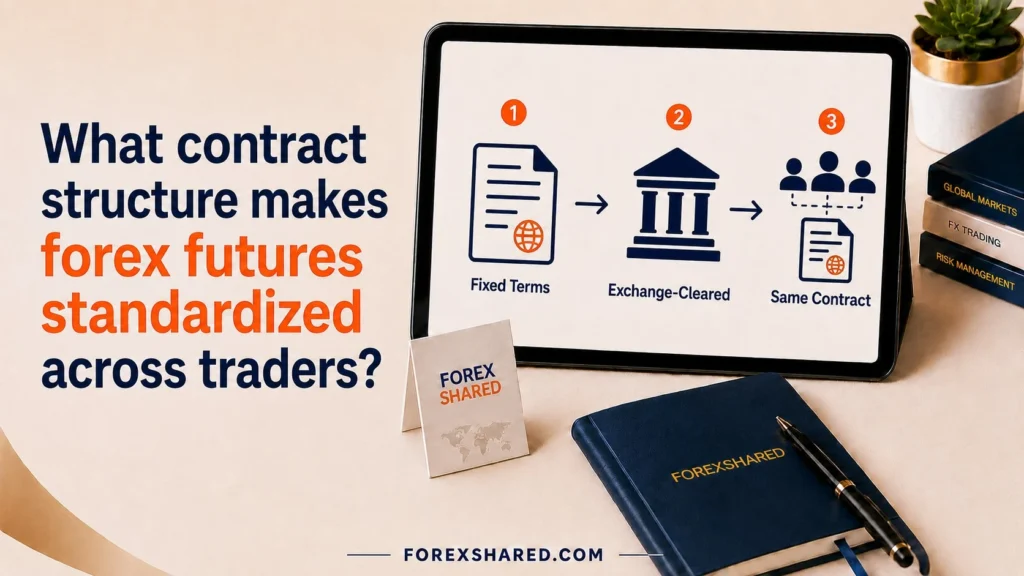
What contract structure makes forex futures standardized across traders?
Forex futures are standardised across traders because an exchange lists one product specification for each contract and expiry, fixing the underlying currency exposure, contract unit, quotation, minimum price fluctuation, listed maturity, final settlement and applicable trading and clearing framework. Traders can choose direction, whole-contract quantity, order timing and exit, but they cannot privately rewrite the listed contract.
The parent product and market mechanics are explained in Forex futures structure.
This article is for general education only and does not constitute financial, investment, trading, legal, regulatory or tax advice. Futures are leveraged instruments that use performance-bond margin and daily mark-to-market cash flows. Losses, margin calls, liquidation, delivery obligations and broker requirements depend on the product, account, exchange, clearing firm, jurisdiction and market conditions.
What does standardised mean in forex futures?
Standardised means that every position in the same listed product and expiry is governed by the same published contract specification. The market price changes continuously, and traders choose different position sizes and strategies, but the legal and economic unit being traded remains uniform.
CFTC educational material explains that futures are generally traded on organised exchanges that set standardised terms, allowing hedgers and speculators to use a common contract without negotiating a new agreement for every trade. CFTC2026
Which features are fixed by the listed contract?
The exact specification depends on the product, but seven categories normally identify the listed FX future:
- Underlying currency exposure: the currencies represented by the contract.
- Contract unit: the fixed amount of the trading-unit currency represented by one contract.
- Quotation convention: the currency units in which the futures price is expressed.
- Minimum price fluctuation: the smallest permitted price increment and its monetary value.
- Listed expiry: the contract month and the applicable termination-of-trading rule.
- Final settlement or delivery: the process applied to positions remaining open at expiry.
- Trading and clearing framework: the exchange, rulebook, clearing and margin arrangements governing the product.
Which choices remain with the trader?
The trader can choose whether to be long or short, how many whole contracts to hold, which listed expiry to use, the order type, entry and exit timing, broker or futures commission merchant, and whether the position is used for hedging or another permitted purpose. These choices operate inside the fixed specification rather than changing it.
| Contract layer | Fixed for the listed product | Chosen by the trader |
|---|---|---|
| Exposure | Underlying currency and unit per contract. | Long or short direction and number of whole contracts. |
| Price | Quotation format and minimum price fluctuation. | Limit price, market timing and accepted execution price. |
| Time | Listed expiries, trading termination and settlement rules. | Which available expiry to trade and when to close or roll. |
| Market access | Exchange and clearing framework. | Broker, account type and operational arrangements. |
The narrower mechanism is developed in Exchange-fixed contract size and expiration.
Who defines, supervises and operates the contract?
The exchange or designated contract market lists the product and publishes its trading specification, but the full market structure also includes a regulator, a clearinghouse and brokers or futures commission merchants. Each performs a different role; none should be described as doing all four jobs.
What does the exchange define?
The exchange defines the listed product, its contract unit, quotation, tick, available expiries, trading rules and other specifications. A U.S. designated contract market can list a new product through the applicable CFTC filing process, including self-certification or a request for Commission approval. The existence of a self-certification route means that the regulator does not affirmatively design or pre-approve every product term. CFTC2026
What does the clearinghouse do?
After a trade is executed and accepted for clearing, the clearinghouse becomes the central counterparty, manages performance-bond collateral, collects and pays mark-to-market amounts and applies default-management arrangements. CME Clearing describes itself as the buyer for every seller and the seller for every buyer; that clearing role is separate from order matching. CME2026
What does the regulator supervise?
The regulator supervises whether the exchange, clearing organisation and market participants comply with the applicable legal and regulatory framework. In the United States, designated contract markets can certify or seek approval for products and rule changes, while CFTC oversight includes market integrity, reporting, position-limit and other compliance responsibilities. The exact treatment can vary by participant and may include bona fide hedge exemptions rather than applying identically to every account.
What can a broker or futures commission merchant change?
A broker or futures commission merchant can control customer access, commissions, risk limits, liquidation policies and account-level margin requirements. It cannot alter the exchange-listed unit, tick, expiry or final settlement rules for one customer.
How does quotation standardise price interpretation?
The contract specification fixes which currency is the trading unit and which currency is used to express the price. This ensures that every quote, order, tick and profit-or-loss calculation refers to the same orientation for that product.
Why should base and price currency be stated explicitly?
When a price is written as base currency per quote currency or quote currency per base currency, the direction of a price move depends on that orientation. It is safer to identify the trading-unit currency and the price currency than to use “direct” or “indirect” without stating whose domestic-currency perspective is being used.
Can a futures quotation be inverted relative to OTC spot?
Yes. CME identifies several futures pairs that are quoted inversely to the corresponding OTC convention, including JPY/USD, CAD/USD, MXN/USD and CHF/USD. A trader comparing futures with OTC spot or forwards must therefore confirm whether inversion is required. CME2026
How should an inverse comparison be calculated?
The two quotations must represent the same economic rate. If EUR/USD rises from 1.1000 to 1.1200, the inverse USD/EUR quotation falls from approximately 0.9091 to 0.8929. EUR strengthens against USD in both descriptions; one price rises because EUR is the base, while the mathematically inverted price falls because USD is the base.
How do contract units and ticks standardise exposure?
The contract unit fixes the notional represented by one listed contract, while the minimum price fluctuation fixes the smallest permitted movement in the quoted price. Together they produce a consistent monetary tick value for every trader using that product.
What are the current Euro FX unit and tick examples?
CME’s standard Euro FX futures contract represents EUR 125,000. Its current CME Globex minimum price fluctuation is USD 0.00005 per euro, equal to USD 6.25 per standard contract. The Micro EUR/USD futures contract represents EUR 12,500 and has a USD 0.0001 minimum fluctuation, equal to USD 1.25 per contract. CME2026 CME2026
Can a trader use fractional contracts?
No. Listed futures positions are held in whole-contract quantities. A trader needing less exposure must use a smaller listed product where available, combine whole standard and Micro contracts, or use another instrument. The unit of an existing contract cannot be divided privately.
How is total notional calculated?
Total notional is the contract unit multiplied by the number of whole contracts. Five standard Euro FX contracts represent:
5 × EUR 125,000 = EUR 625,000
A EUR 510,000 commercial exposure does not align exactly with standard contracts: four standard contracts cover EUR 500,000 and leave EUR 10,000 unhedged. Adding one Micro contract produces EUR 512,500 and creates a EUR 2,500 over-hedge. Standard and Micro products can reduce the mismatch, but listed increments do not guarantee an exact fit.
| Product example | Contract unit | Minimum price fluctuation | Value of one minimum tick |
|---|---|---|---|
| Standard Euro FX futures | EUR 125,000 | USD 0.00005 per EUR | USD 6.25 |
| Micro EUR/USD futures | EUR 12,500 | USD 0.0001 per EUR | USD 1.25 |
How do expiry, daily settlement and final settlement standardise time?
The exchange publishes which contract months are available, when trading terminates and how remaining open positions are settled. Traders in the same expiry therefore face the same timeline even though they may enter and exit on different days.
Are FX futures limited to quarterly expiries?
No. Quarterly benchmark months remain important, but CME lists monthly and quarterly expiries for several major FX futures products. The available cycle is product-specific and should be checked in the current contract calendar rather than assumed from a general quarterly convention. CME2026
What is daily settlement?
Futures positions are marked to an official daily settlement price, and gains or losses produce cash adjustments under the clearing and account arrangements. CME explains that the difference between the previous settlement and the current settlement determines the daily profit or loss. CME2026
What is final settlement?
Final settlement is the contract-specific process applied at expiry. Many CME FX futures are physically delivered, while other products may use financial settlement. CME states that most major deliverable FX futures are traded and delivered across all twelve calendar months, subject to their published procedures. CME2026
Daily mark to market does not mean the contract has reached final expiry settlement. It manages the changing value of the open position during its life; final delivery or cash settlement follows the product’s expiry rules if the position remains open.
Why does standardisation create fungibility and easier offset?
Fungibility means that contracts of the same product and expiry are interchangeable. A trader who is long five contracts can normally offset that market position by selling five contracts of the same product and expiry, without locating the original seller.
CFTC terminology links fungibility to standardised futures because contracts with the same specifications can be bought and sold through the common market. The matching system executes the new sale, while the clearinghouse processes the resulting positions and obligations. CFTC2026
Does the clearinghouse match the offsetting order?
No. The exchange’s matching engine matches compatible buy and sell orders according to the applicable algorithm. CME educational material describes resting and aggressing orders being matched by CME Group algorithms; clearing occurs after execution. CME2026
When does novation occur?
Novation occurs when the trade is accepted for clearing under the applicable rules. The clearinghouse then becomes the central counterparty and manages margin, settlement and default risk. This acceptance boundary matters because execution and clearing are connected but legally distinct stages.
How do standardised futures differ from OTC forwards?
The main difference is where the contract terms come from. A listed future uses an exchange-published specification and whole-contract increments. An OTC forward is a bilateral contract whose amount, value date and other terms can be agreed between the counterparties, subject to market, legal, credit and operational limits.
BIS describes forward contracts as generally not traded on organised exchanges and as having non-standardised contractual terms. BIS2026
See Futures versus OTC forwards for the full market comparison and Forward contract structure for the bilateral contract mechanics.
| Attribute | Standardised FX future | OTC forward |
|---|---|---|
| Terms | Published exchange specification for each product and expiry. | Mutually agreed bilateral terms within market and documentation limits. |
| Amount | Whole multiples of a product-specific unit. | Negotiated principal amount. |
| Maturity | Listed contract months and termination rules. | Mutually agreed value date, including possible broken dates. |
| Offset | Opposite trade in the same listed product and expiry offsets the market position. | Opposite trade can offset market exposure, but may leave two separate legal contracts. |
| Credit framework | Central clearing, performance-bond margin and default-management arrangements. | Bilateral counterparty exposure, potentially reduced by collateral and enforceable netting. |
| Hedge fit | Depends on how closely listed units and expiries match the commercial exposure. | Can be structured more closely around a specific amount and date. |
How does standardisation affect hedge precision?
Standardisation improves market compatibility, transparent specification and ease of offset, but it can create quantity or timing mismatch when the commercial exposure is not an exact multiple of the listed unit or does not align with an available expiry.
When can futures match an exposure exactly?
An exact match is possible when both notional and timing align with the listed structure. A EUR 500,000 exposure can be matched by four standard Euro FX contracts of EUR 125,000 each, subject to the chosen expiry matching the hedge horizon closely enough.
When does residual exposure remain?
A EUR 510,000 exposure leaves EUR 10,000 unhedged when four standard contracts are used. Micro contracts can narrow the mismatch but may still create an over-hedge or under-hedge. The hedge can also develop basis and timing differences because the futures price, expiry and daily margin cash flows do not exactly reproduce every commercial cash flow.
Does standardisation automatically produce liquidity?
No. Standardisation supports fungibility and helps concentrate orders, but actual liquidity depends on the product, expiry, market conditions, participant activity and time of day. A standardised contract can still be thinly traded, while a major OTC forward market can be highly active.
The relevant comparison is not simply “standardised equals better” or “customised equals better”. Futures are practical when the listed structure fits closely enough and the organisation can support clearing and margin cash flows; a forward may be preferable when exact amount or date matching is more important.
How should a forex futures specification be validated?
A trader or hedger should verify the current official product page and rulebook rather than relying on a pair name or a third-party summary. Product units, ticks, listed months and settlement rules can differ materially across contracts.
- Product identity: confirm the exchange, product code, currency exposure and exact expiry.
- Contract unit: verify the amount represented by one whole contract.
- Quotation: identify the trading-unit currency, price currency and whether the futures pair is inverted relative to OTC convention.
- Tick: confirm the minimum price fluctuation and its monetary value for the relevant execution type.
- Expiry: check the listed calendar, last trading day and affected contract month.
- Settlement: determine whether the product is physically delivered or financially settled and what happens to open positions.
- Clearing: understand performance-bond margin, daily mark to market and broker-level requirements.
- Hedge fit: calculate quantity, timing and basis mismatch against the commercial exposure.
- Exit: use the same product and expiry when assessing an offsetting futures trade.
- Official source: recheck current exchange specifications and notices before execution.
Conclusion
Forex futures are standardised across traders because one exchange-published specification defines the product and expiry for everyone. The currency exposure, contract unit, quotation, minimum tick, maturity, settlement and market framework remain fixed, while traders choose direction, whole-contract quantity, order timing and exit.
This common structure creates fungibility and allows an opposite trade in the same contract to offset the market position without renegotiating the product. The matching system executes orders, and the clearinghouse then becomes the central counterparty for accepted trades, manages margin and processes settlement.
Standardisation improves compatibility and ease of offset, but it does not guarantee liquidity or a perfect hedge. Contract units, expiries, quotation conventions and settlement procedures must still be checked product by product, and a bespoke OTC forward may fit an irregular commercial amount or date more closely.
Frequently Asked Questions
Can a trader negotiate a different contract unit or tick size?
No. The exchange publishes the unit and minimum price fluctuation for each listed product, and they apply to every position in that product. A trader can choose a different listed product, such as a Micro contract where available, but cannot alter the unit or tick of the existing contract.
Can forex futures be traded in fractional contracts?
No. Listed futures positions are held in whole numbers of contracts. Traders seeking smaller exposure must use a smaller listed contract, such as a Micro FX future where available, combine whole contracts, or use another instrument.
Does the clearinghouse match buy and sell orders?
No. The exchange’s matching system executes compatible buy and sell orders. After execution, the trade is submitted for clearing, where the clearinghouse becomes the central counterparty, manages margin and processes settlement.
Is futures margin a deposit towards buying the currencies?
No. Futures margin is a performance bond rather than a down payment on the underlying currencies. Open positions are marked to market, and gains or losses create daily or intraday cash movements under the clearing and broker arrangements.
Does an opposite OTC forward cancel the original forward?
Not automatically. An opposite forward can offset the market exposure, but the original bilateral contract may remain legally outstanding unless it is terminated, amended, novated or otherwise dealt with under the governing agreement.