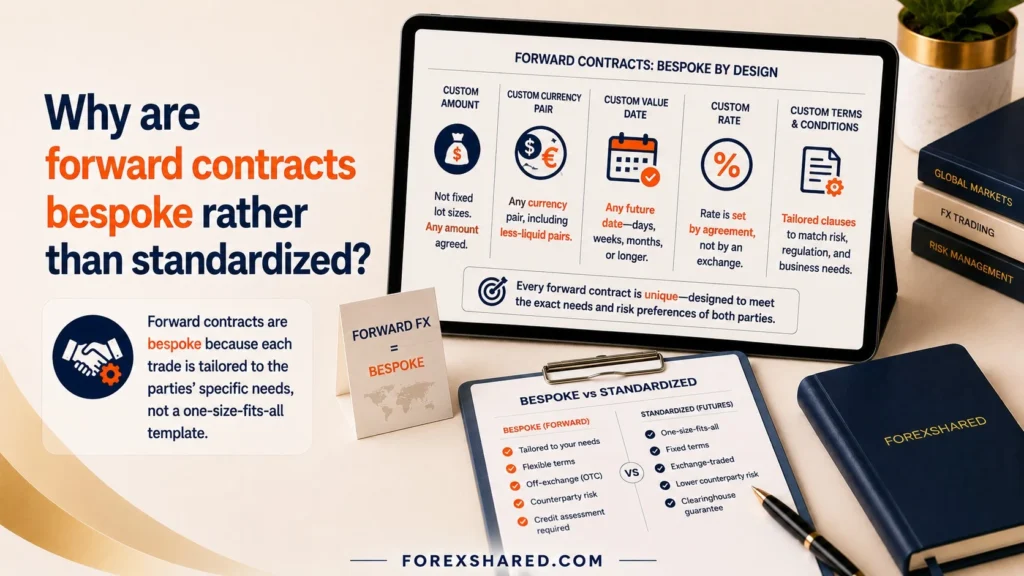
Why Are Forward Contracts Bespoke Rather Than Standardized?
OTC FX forwards are described as bespoke because the counterparties can negotiate the notional, maturity, settlement form and other contract terms to fit a specific future currency exposure. Standardised currency futures instead use exchange-defined contract sizes, listed maturities and clearing rules.
Bespoke does not mean unlimited. A forward can be tailored only within the dealer’s product offering, available liquidity, credit limits, currency controls, settlement access, operational capability and governing documentation.
For the parent explanation of how these obligations and value dates create the product, see Forward contract structure.
This article is for general education only and does not constitute financial, investment, trading, legal, operational or tax advice. Contract availability, pricing, enforceability, collateral, settlement and regulatory treatment vary by counterparty, agreement, currency, jurisdiction and market conditions.
- Terms are negotiated: amount, maturity and settlement details can be aligned with a specific exposure.
- Customisation is constrained: liquidity, credit, product eligibility and operations limit what can be offered.
- The contract remains binding: bespoke terms do not create an option-style right to walk away.
- Pricing follows the selected tenor: forward points reflect the forward–spot relationship for the agreed maturity.
- OTC does not always mean uncleared: eligible forwards can be centrally cleared, while uncleared trades may still be margined.
What Makes an FX Forward Bespoke?
A forward is a contract for delayed delivery in which the buyer agrees to purchase and the seller agrees to deliver a specified instrument or currency amount on an agreed future date at an agreed price. Unlike an exchange-listed future, the OTC contract is negotiated between the counterparties rather than drawn from one universal contract specification. BIS-Forward2026
Which Terms Can Be Negotiated?
Depending on the counterparty and market, negotiable terms can include:
- Currency pair: the two currencies and quotation convention.
- Notional amounts: the principal amount in each currency.
- Maturity: a standard tenor or an agreed broken date.
- Settlement form: deliverable exchange or non-deliverable cash settlement.
- Fixing terms: the fixing source, fixing date and calculation method for an NDF.
- Business-day treatment: holiday calendars and adjustment conventions.
- Credit and collateral: limits, margin and documentation under the governing agreement.
- Termination treatment: how early close-out, amendment or restructuring is handled.
Which Terms Are Not Freely Customisable?
The counterparties cannot assume that every pair, amount or maturity is available. Dealer willingness, market depth, hedgeability, local currency restrictions, settlement infrastructure, credit approval, minimum trade sizes and maximum tenors can all restrict the final contract.
Does Bespoke Mean Optional?
No. An ordinary forward remains a mutual obligation. Both parties must perform at maturity unless the trade is amended, offset, novated or terminated under the agreement. Optionality belongs to a currency option, whose buyer has a right rather than a duty to exercise.
How Do Custom Size and Maturity Express the Bespoke Structure?
Notional and maturity are the two most visible custom terms. A corporate can align a forward with an expected invoice amount, while an investor can select a maturity that corresponds to a planned asset sale or funding date.
The focused explanation is available in Custom size and maturity in forwards.
Why Can a Broken Date Matter?
A broken date is a negotiated maturity that does not match a standard monthly or quarterly tenor. It can improve hedge alignment by reducing the period between the derivative maturity and the underlying cash flow.
Can the Notional Match the Exposure Exactly?
It can often be set close to the expected exposure, but exact matching is not guaranteed. Forecast uncertainty, minimum trade sizes, credit limits, rounding, changing cash flows and dealer availability can leave over-hedging or under-hedging.
How Does Spot Differ?
The BIS defines spot as an outright exchange for value or delivery within two business days, while an outright forward settles more than two business days after the contract date. The selected future maturity therefore moves the contract beyond the spot-value window. BIS-Spot2026 BIS-Outright2026
How Is a Bespoke Forward Rate Constructed?
The forward rate is the contracted exchange rate for the selected future value date. Its relationship to spot is driven primarily by relative funding rates over the tenor. Covered interest parity links comparable returns in two currencies, while actual executable pricing can also reflect cross-currency basis, liquidity, credit, balance-sheet costs and bid–ask spread. BIS-CIP2024
What Are Forward Points?
Forward points are the quoted adjustment added to or subtracted from the spot rate under the pair’s quotation convention. They are not a universal “interest differential multiplied by time” formula and should not be treated as a forecast of the future spot rate.
Does a Bespoke Maturity Change the Points?
Yes. A different maturity changes the time over which the two currencies’ funding economics are compared. The rate must therefore be calculated for the actual value date rather than copied mechanically from a standard tenor.
Does a Forward Require an Option Premium?
An ordinary forward does not require an option-style premium because both parties are obligated. Its core pricing is embedded in the agreed rate, although dealer spread, credit adjustment, collateral, margin and termination costs may still apply.
Can Bespoke Forwards Use Different Settlement Forms?
What Is a Deliverable Forward?
A deliverable forward requires exchange of both currency principals on the maturity date, subject to the agreed settlement route and instructions.
What Is a Non-Deliverable Forward?
An NDF settles in cash, often in US dollars or another pre-agreed currency, without physical delivery of the two underlying currencies. The cash amount is determined from the contracted rate, agreed fixing rate, notional and calculation formula stated in the confirmation. BIS-NDF2026
Why Is the Settlement Formula Important?
NDF settlement cannot be reduced to one universal “rate difference multiplied by notional” rule. The quotation direction, notional currency, fixing source, settlement currency and contract formula determine the actual payment.
How Do Bespoke Forwards Differ From Standardized Futures?
A futures contract is a legal agreement to buy or sell a standardised asset on a specified date or during a specified month through a futures exchange. Exchange rules define the contract specifications, while central clearing and margining support the lifecycle. CME-Futures2026
The detailed structural comparison is covered in Standardized futures contracts.
Does OTC Mean the Forward Cannot Be Cleared?
No. An OTC forward can be negotiated bilaterally and then submitted for central clearing when the product, currency pair, tenor and participants are eligible. LCH ForexClear currently clears selected deliverable spot, forward and option currency pairs as well as a wider set of NDFs. LCH2026
Does an Uncleared Forward Avoid Margin?
Not necessarily. Non-centrally cleared derivatives can be subject to bilateral collateral and regulatory margin requirements depending on the covered entities, product and jurisdiction. The BCBS–IOSCO implementation review published in December 2025 found no material issues requiring changes to the international framework. BCBS-IOSCO2025
What Documentation Supports a Bespoke Forward?
Custom terms require precise documentation because there is no single exchange specification that supplies every field. The trade confirmation normally identifies the currencies, notional, trade date, maturity, rate, business-day treatment, settlement method and payment instructions.
What Does the Governing Agreement Control?
The governing agreement can address representations, events of default, close-out, netting, dispute resolution, collateral and valuation. The legal effect depends on the actual documentation and applicable law rather than the product label alone.
Can a Forward Be Closed Before Maturity?
It cannot normally be cancelled unilaterally without contractual authority. The parties can instead agree to terminate it, amend it, novate it or enter an offsetting transaction. Any close-out amount depends on the market value and governing terms at that time.
Why Does Bespoke Structure Increase Operational Work?
Each customised field must be captured, matched and settled correctly. Broken dates, unusual notionals, non-standard settlement instructions and fixing terms can increase confirmation, valuation, reconciliation and exception-management requirements.
Which Contract Features Distinguish the Main FX Structures?
| Structure | Timing | Custom Terms | Settlement | Clearing and Margin |
|---|---|---|---|---|
| Deliverable spot | Within two valid business days under the applicable convention. | Near-term market convention; amount and execution terms are still agreed. | Exchange of both currency principals. | Usually OTC; settlement and credit controls vary. |
| Bespoke outright forward | Selected future value date beyond the spot window. | Notional, maturity and settlement terms can be negotiated within constraints. | Usually deliverable unless structured otherwise. | May be bilateral or eligible for CCP clearing; collateral or margin can apply. |
| NDF | Future fixing and settlement dates. | Notional, maturity, fixing source and formula are agreed. | Cash settlement without delivery of both underlying currencies. | Can be bilateral or centrally cleared when eligible. |
| Currency future | Exchange-listed expiry cycle. | Contract specifications are standardised by the exchange. | Physical or financial according to the contract specification. | Centrally cleared with exchange and clearing-house margin requirements. |
What Should Be Validated Before Calling a Forward Bespoke?
- Product type: confirm that the transaction is an outright forward, NDF or another stated structure.
- Value date: verify that maturity is beyond the applicable spot-value window.
- Notional and maturity: confirm the exact negotiated amounts and dates.
- Settlement form: identify deliverable or cash-settled mechanics and any fixing formula.
- Constraints: document credit, liquidity, regulatory and operational limits.
- Clearing status: determine whether the trade remains bilateral or has been accepted by a CCP.
- Margin and collateral: review the applicable agreement and regulatory requirements.
- Termination terms: confirm close-out, amendment and dispute procedures.
Conclusion
Forward contracts are bespoke because their core economic and operational terms can be negotiated around a future currency exposure rather than selected from one exchange-defined contract specification.
The most visible custom terms are notional and maturity, but settlement form, fixing terms, business-day treatment, collateral and termination provisions can also matter. The flexibility remains bounded by liquidity, credit, regulation, settlement access and operational capability.
Bespoke does not mean optional, uncleared or unmargined. An ordinary forward remains binding; eligible trades can be centrally cleared, and non-centrally cleared trades may still be subject to collateral or regulatory margin requirements.
Frequently Asked Questions
Why are FX forwards described as bespoke?
OTC FX forwards are described as bespoke because counterparties can negotiate the notional, maturity, settlement form and other terms within the dealer’s product offering, credit limits, liquidity and operational constraints.
Can an FX forward use any amount or maturity?
No. Amount and maturity can often be tailored, but availability depends on dealer willingness, market liquidity, credit limits, currency controls, settlement access, operational capability and the governing agreement.
Does a bespoke forward require an option premium?
An ordinary forward does not require an option-style premium because both parties have binding obligations. The agreed rate can still include bid–ask spread, dealer markup, credit and funding adjustments, while collateral, margin or termination costs may also apply.
Can an OTC FX forward be centrally cleared or margined?
Yes. Some eligible OTC FX forwards can be submitted to central clearing, and non-centrally cleared derivatives can be subject to bilateral collateral or regulatory margin requirements depending on the counterparties, product and jurisdiction.
How is a bespoke forward different from a currency future?
A bespoke forward is negotiated bilaterally with tailored terms. A currency future is an exchange-traded standardised contract whose contract size, listed maturity and other specifications are set by the exchange and supported by central clearing and margining.