What Does the Standard T+2 Settlement Cycle Mean in Spot Forex?
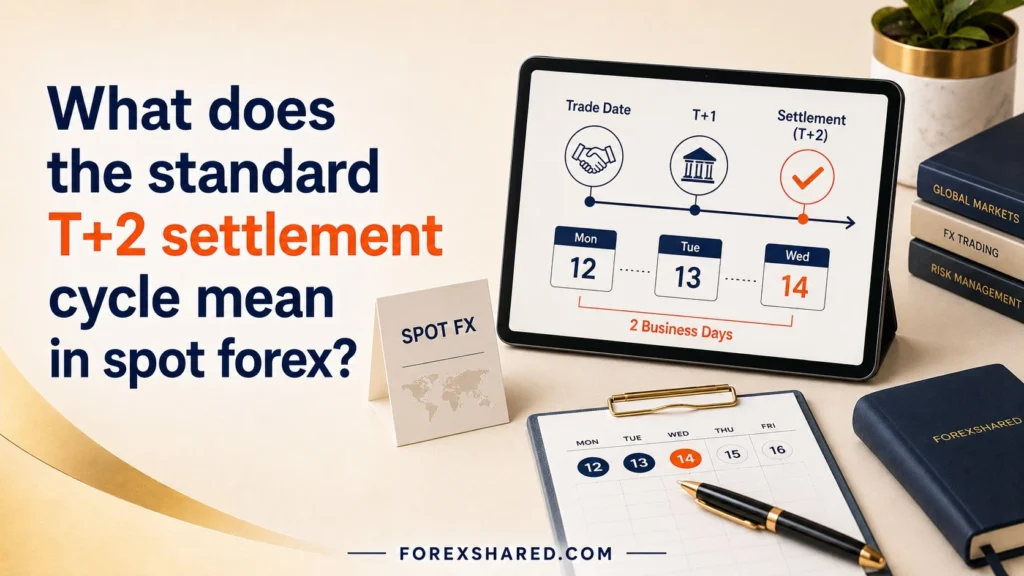
The standard T+2 settlement cycle in spot forex means that a spot FX trade is usually scheduled to settle two business days after the trade date.
The trade date determines when the deal is officially agreed upon, while the value date identifies exactly when the two currencies are actually scheduled to be exchanged. T+2 is an essential part of the broader spot forex settlement timing structure.
Spot forex is often described as immediate market exchange, but immediate pricing is emphatically not the same as instant settlement. The precise price may be firmly agreed today, while actual physical currency settlement is rigorously organized for the standard value date. We will cover T+2 meaning, trade date, value date, business days, holidays, pair exceptions, same-day and next-day settlement, forward comparison, securities settlement confusion, examples, mistakes, confirmation terms, and validation.
This article is for educational purposes only. It does not provide trading advice, investment advice, settlement advice, broker recommendations, leverage guidance, position-size guidance, order-type guidance, or live execution instructions.
What does T+2 mean in spot forex?
T+2 means the spot forex trade is agreed on the trade date and normally settles two business days later.
The “T” explicitly stands for the initial trade date. The “plus two” strictly represents exactly two valid business days actively counted immediately after the trade date. The resulting settlement date is universally called the designated value date. T+2 functions securely as a settlement convention, absolutely not a speculative price prediction. This rigid cycle perfectly explains precisely when final currency delivery is officially scheduled to occur, anchoring all spot forex settlement timing. Furthermore, T+2 flawlessly helps distinguish near-term spot settlement from highly deferred, future-dated forward settlement.
What does the T represent?
T represents the trade date. The trade date signifies exactly when the buyer and seller mutually agree on the specific currency pair, trade direction, notional amount, and execution price. It conclusively starts the overarching settlement timeline. This defining moment mathematically locks the exposure rate, giving both participants absolute pricing certainty immediately.
What does plus two represent?
Plus two represents two business days after the trade date. These are strictly defined as valid settlement business days, definitively not simply rolling calendar days. Weekends and sovereign banking holidays can aggressively affect the actual calculated value date. This vital distinction ensures that settlement exclusively occurs when banking systems are fully operational in both respective currency jurisdictions.
What is the value date in T+2?
The value date is the scheduled settlement date. It determines precisely when the physical currency exchange is fully expected to complete. In a standard T+2 spot trade, the value date normally securely falls exactly two valid business days immediately after the initial trade date. The value date represents the ultimate endpoint of the spot transaction lifecycle.
T+2 means the spot forex trade is agreed on the trade date and normally settles two business days later.
Why does spot forex use a settlement cycle instead of instant delivery?
Spot forex uses a settlement cycle because agreeing a price is faster than completing currency delivery.
Spot pricing can flawlessly happen immediately specifically when the initial trade is bilaterally agreed. However, physical settlement inherently requires complex currency movement, verified payment instructions, and secure banking operational processing. Because of these requirements, spot pricing can happen immediately while settlement still follows a short value-date cycle. Why spot is not same-day settlement requires careful consideration.
The involved parties explicitly need fully verified settlement instructions strictly before settlement completes. The paired currencies absolutely need mutually valid settlement days. Robust payment systems and exact account details absolutely need to adequately support delivery. Consequently, T+2 gives the decentralized market a highly predictable, standardized timing convention.
| Settlement Layer | Why It Matters |
|---|---|
| Trade Agreement | Confirms price, pair, amount, and direction. |
| Settlement Instructions | Confirm payment and delivery details. |
| Bank Processing | Moves currency through banking channels. |
| Currency Calendars | Check whether both currencies can settle. |
| Value Date | Confirms the actual settlement target. |
| Operational Control | Reduces confusion between pricing and delivery. |
Why is spot pricing faster than settlement?
Spot pricing is faster than settlement because the trade price can be agreed before currency delivery is completed. Final settlement fundamentally requires rigorous currency movement, exact payment instructions, and intense operational processing across international banking networks. Pricing and settlement are entirely separate events. The execution platform instantly calculates the rate, but the back-office architecture requires distinct time to properly clear the funds.
What has to happen before settlement?
Settlement instructions, valid settlement days, payment systems, and account details have to support settlement before delivery can complete. The involved parties explicitly need fully verified settlement instructions. The paired currencies absolutely need mutually valid settlement days to process. Account and complex payment details must flawlessly support cross-border delivery. These stringent prerequisites prevent critical funding failures from disrupting the highly leveraged global financial ecosystem.
Why does near-term not mean instant?
Near-term does not mean instant because the currencies do not necessarily move the same second the price is agreed. Near-term merely implies that the active trade settles dependably soon after actual execution. T+2 brilliantly gives spot FX a reliable, standardized timing convention. This brief processing buffer flawlessly ensures institutional counterparties have adequate operational time to securely arrange massive cross-border liquidity transfers.
Spot forex uses a settlement cycle because agreeing a price is faster than completing currency delivery.
How does trade date differ from value date?
Trade date is when the spot FX deal is agreed, while value date is when settlement is scheduled to occur.
The trade date exclusively records exactly when the underlying transaction is officially agreed. The currency pair, notional amount, directional intent, and precise execution price are definitively set perfectly on the trade date. The entire settlement timeline aggressively begins strictly from this specific date.
The value date unequivocally is precisely when physical settlement is officially scheduled. The underlying currencies are firmly expected to be properly exchanged or delivered according completely to the trade terms on the value date. Recklessly mixing these two completely different dates can dangerously make spot settlement visually look instantaneous.
| Timing Term | Meaning |
|---|---|
| Trade Date | Date the FX deal is agreed. |
| Value Date | Date the FX deal is scheduled to settle. |
| T+2 Gap | Two business days between agreement and settlement. |
| Price Agreement | Happens on trade date. |
| Currency Exchange | Happens on value date. |
| Settlement Risk Window | Exists between trade date and value date. |
What happens on the trade date?
The trade date records when the transaction is agreed. The specific currency pair, exact notional amount, structural direction, and rigid execution price are permanently set. The sequential settlement timeline systematically begins strictly from this date. It represents the binding commitment between two counterparties to fulfill the transaction under the agreed economic parameters.
What happens on the value date?
The value date is when settlement is scheduled. The referenced currencies are formally expected to be safely exchanged or securely delivered perfectly according to the original trade terms. The value date operates specifically as the final operational completion target of the spot trade. This is the moment liquidity practically changes hands.
Why should readers not mix the two dates?
Readers should not mix the two dates because trade date and settlement date describe different events. Recklessly mixing them can dangerously make complex spot settlement falsely look perfectly instant. It can undeniably also create severe operational confusion regarding crucial payment timing. Separating the pricing event from the payment event is absolutely foundational for accurate cash-flow management.
Trade date is when the spot FX deal is agreed, while value date is when settlement is scheduled to occur.
How are business days counted in a T+2 spot FX cycle?
T+2 means two valid business days, so weekends and holidays can move the actual spot value date.
The initial trade date strictly starts the sequential count. Business day one is definitively the very first valid settlement business day immediately after the trade date. Business day two is definitively the second valid settlement business day immediately after the trade date.
Traditional weekends are usually absolutely not valid banking settlement days. Unforeseen holidays can violently shift the scheduled value date specifically if a relevant currency settlement center is officially closed. The final adjusted value date absolutely must be rigorously checked, certainly not blindly assumed.
| Day Type | Role in T+2 Settlement |
|---|---|
| Trade Date | Starts the count. |
| Business Day One | First valid settlement business day after trade date. |
| Business Day Two | Second valid settlement business day after trade date. |
| Weekend | Usually skipped in settlement counting. |
| Holiday | Can delay settlement if relevant currency center is closed. |
| Final Value Date | Date after valid business-day adjustment. |
Why are weekends skipped?
Weekends are usually skipped because they are not valid banking settlement days. If the mathematical count abruptly reaches a weekend, the scheduled value date can dynamically move forward to the very next valid business day. This seamlessly prevents critical settlement from being mistakenly scheduled precisely when massive international payment systems are formally closed.
How do holidays affect T+2?
Holidays can shift the value date if a relevant currency settlement center is closed. A standard trade that superficially looks exactly like two simple calendar days can suddenly settle significantly later. Recognized holiday calendars are an inescapable, fundamental part of the professional settlement process. Institutional platforms automatically adjust for these disruptions to preserve execution integrity.
Why can T+2 sometimes look longer than two days?
T+2 can look longer when weekends or holidays interrupt the count. The rigid settlement convention meticulously counts only valid business days. The final adjusted value date should be proactively confirmed, absolutely not blindly assumed based on simplistic calendar math. Overlooking a local bank holiday can effortlessly trigger an unexpected settlement failure.
T+2 means two valid business days, so weekends and holidays can move the actual spot value date.
How does T+2 distinguish spot forex from forward settlement?
T+2 distinguishes spot forex from forwards because spot uses a near-term value date while forwards use a future maturity date.
T+2 is absolutely still heavily considered spot precisely because final settlement is functionally near-term. The transaction is definitively not structured strategically around a highly distant future maturity. Conversely, a formal forward contract heavily settles exactly on a designated future date massively beyond the near-term spot value date.
The explicit future date inherently is an essential part of the specific contract purpose. The assigned value date brilliantly shows exactly whether the underlying trade is strictly near-term or intentionally future-dated.
| Feature | Spot Forex T+2 | Forward-Based Market |
|---|---|---|
| Price Agreement | Trade date. | Trade date. |
| Settlement Timing | Near-term value date. | Future maturity date. |
| Main Purpose | Current or near-term exchange. | Future-dated exchange or hedge. |
| Timing Gap | Short standard cycle. | Longer agreed tenor. |
| Instrument Meaning | Spot transaction. | Forward-based contract. |
Why is T+2 still considered spot?
T+2 is still considered spot because settlement is near-term. The underlying trade is strictly not designed strategically around a highly distant future maturity. The specific timing convention firmly supports immediate present-market exchange. This brief processing window distinguishes pure spot trading from speculative, long-term derivative hedging architectures.
What makes a forward different?
A forward is different because it settles on a future date beyond the spot value date. The explicit future date is a foundational part of the core contract purpose. The calculated forward rate is mathematically linked intricately to that specific future settlement timing. Forwards structurally address delayed exposure, completely bypassing immediate liquidity transfer.
Where does the value date reveal the instrument type?
The value date reveals the instrument type by showing whether the trade is near-term or future-dated. A standard near-term spot value date thoroughly supports clear spot classification. A significantly later maturity date forcefully suggests a structured forward-based market mechanism. Checking the scheduled date is the absolute fastest way to decisively classify the financial instrument.
T+2 distinguishes spot forex from forwards because spot uses a near-term value date while forwards use a future maturity date.
Why is T+2 important for cash-flow planning?
T+2 matters for cash-flow planning because the value date determines when the exchanged currency is expected to become available.
The purchased currency simply may absolutely not be physically available strictly until the scheduled value date. A pressing payment need existing prior to the value date absolutely may not align perfectly with standard spot settlement mechanics. Strategic cash-flow timing should definitely be thoroughly checked rigorously before blindly assuming operational funds are instantly ready.
Currency can disastrously arrive vastly too late or needlessly too early explicitly if rigid settlement timing completely fails to adequately match the specific cash need. A carefully structured future-dated instrument seamlessly may fit a substantially later cash-flow date considerably better.
| Planning Question | Why T+2 Matters |
|---|---|
| When is currency needed? | Determines whether spot timing fits. |
| When will settlement occur? | Confirms cash delivery date. |
| Are both currency accounts ready? | Reduces settlement delay. |
| Are holidays involved? | Prevents value-date mismatch. |
| Does timing match the payment need? | Avoids early or late funding. |
| Is a future-dated instrument relevant? | Helps frame later cash-flow timing. |
Why does T+2 matter for payments?
T+2 matters for payments because the currency may not be available until the value date. A strict payment need urgently arising before the scheduled value date may drastically not align correctly with standard spot settlement. Intended cash-flow timing absolutely should be meticulously checked thoroughly before recklessly assuming critical funds are securely ready for deployment.
What happens if settlement timing does not match the cash need?
If settlement timing does not match the cash need, the currency may arrive too late or too early. This severe misalignment can effortlessly create brutal funding pressure or massive operational mismatch. The designated value date definitely should be rigorously compared intimately with the real, actual cash-flow requirement. Precise timing prevents expensive overdrafts in foreign accounts.
When might a future-dated instrument fit better?
A future-dated instrument may fit when the cash flow occurs later than the spot value date. This specific alignment can flawlessly sync formal settlement perfectly with a highly anticipated future invoice, incoming receivable, or scheduled corporate payment. The exact timing need should strictly guide the structural classification of the necessary execution tool.
T+2 matters for cash-flow planning because the value date determines when the exchanged currency is expected to become available.
How does T+2 affect exposure between trade date and settlement date?
T+2 creates a short settlement window between trade agreement and currency delivery.
Immediately after the specific trade is bilaterally agreed, the involved parties legally possess a strict settlement obligation. The firmly agreed execution price and exact notional amount are permanently tied securely to the upcoming value date. The physical settlement process explicitly still has to flawlessly complete. The T+2 window creates a short period where settlement still has to complete after trade agreement. Spot forex settlement risk requires careful navigation here.
Crucial payment instructions seamlessly may be meticulously checked. Vital funding systematically may urgently need to be proactively prepared. Highly specific business-day calendars drastically may affect the absolute final value date.
| Exposure Layer | Meaning |
|---|---|
| Trade Date Exposure | Price and obligation are agreed. |
| Settlement Window | Time between trade date and value date. |
| Counterparty Process | Both sides must complete settlement. |
| Operational Risk | Instructions or funding can fail. |
| Market Relevance | Price is agreed, but settlement still has to complete. |
| Final Settlement | Exposure closes operationally when currencies settle. |
What exposure exists after the trade is agreed?
After the trade is agreed, the parties have a settlement obligation. The firmly agreed execution price and exact notional amount are irrevocably tied to the scheduled value date. The physical settlement process strictly still has to complete successfully. The initial market exposure is locked, but the operational fulfillment is still pending.
What can happen during the settlement window?
During the settlement window, payment instructions, funding, and business-day calendars may still need attention. Precise payment instructions frequently may be rigorously checked. Immediate funding systematically may need to be actively prepared across respective accounts. Distinct currency calendars can severely affect the ultimate final value date. The T+2 gap accommodates these necessary logistical steps.
Why is this not the same as forward exposure?
This is not the same as forward exposure because the T+2 settlement window is short and near-term. A structured forward exposure is explicitly designed intentionally around a significantly longer, distant future date. The fundamental timing purpose is profoundly different. The spot window exists solely for logistical processing, not for strategic, long-term macroeconomic hedging operations.
T+2 creates a short settlement window between trade agreement and currency delivery.
How do currency holidays change a T+2 value date?
Currency holidays can shift the T+2 value date because spot FX settlement depends on valid business days for the currencies involved.
A standard currency pair inherently involves exactly two distinct currencies simultaneously. Final settlement inextricably may strictly require both respective sides to be officially open specifically for robust operational processing. If exactly one side mathematically cannot successfully settle, the scheduled value date definitely can violently shift.
The planned settlement date seamlessly can swiftly move forward securely to the very next valid business day. Massive calendar mismatch routinely creates immense confusion exactly when untrained readers erroneously count only simple calendar days.
| Calendar Factor | Settlement Effect |
|---|---|
| Base Currency Holiday | May delay settlement if that currency cannot settle. |
| Quote Currency Holiday | May delay settlement if that currency cannot settle. |
| Weekend | Usually pushes settlement forward. |
| Regional Banking Closure | Can affect valid settlement day. |
| Adjusted Value Date | Final date after calendar checks. |
Why do both currencies need valid settlement days?
Both currencies need valid settlement days because a currency pair involves two currencies. Safe settlement functionally may require both sovereign banking sides to be fully open for clearing processing. If exactly one side physically cannot settle, the rigid value date definitively can shift. Simultaneous banking availability guarantees smooth cross-border payment synchronization.
What happens if one currency has a holiday?
If one currency has a holiday, the settlement date can move to the next valid day. This routine disruption can effectively make T+2 visually appear vastly longer than normally expected. The officially adjusted value date absolutely should be vigorously confirmed. Overlooking foreign national holidays is a primary cause of unforeseen institutional settlement failures.
Where does calendar mismatch create confusion?
Calendar mismatch creates confusion when readers count only calendar days. Readers frequently may dangerously expect final settlement considerably earlier than the officially adjusted value date. Recognizing strict business-day conventions securely prevents that costly mathematical mistake. Calendar alignment requires meticulous attention to international banking schedules across multiple time zones.
Currency holidays can shift the T+2 value date because spot FX settlement depends on valid business days for the currencies involved.
Are all spot forex pairs settled on T+2?
T+2 is the standard spot FX settlement convention for many pairs, but the exact value date should still be confirmed for the specific currency pair.
T+2 definitively is widely called standard precisely because countless major spot FX pairs actively use it seamlessly as the normal, expected settlement cycle. It brilliantly gives diverse market participants a highly reliable, common timing convention. However, some specific currency pairs definitively may closely follow entirely different market conventions.
Complex local banking systems, strict regional practices, and highly specific currency-specific rules drastically can seamlessly affect baseline timing. Inevitable exceptions absolutely should forcefully be explained safely as known settlement-convention differences.
| Pair Type | Settlement Timing Interpretation |
|---|---|
| Most Standard Spot Pairs | Commonly use T+2 settlement. |
| Certain Same-Region or Special Pairs | May use a shorter settlement convention. |
| Same-Day Transaction | Not standard T+2 spot timing. |
| Next-Day Transaction | Shorter than standard T+2. |
| Forward-Dated Trade | Later than standard spot value date. |
Why is T+2 called standard?
T+2 is called standard because many spot FX pairs use it as the normal settlement cycle. It fundamentally gives varied market participants a universally accepted, common timing convention. It strongly supports robust settlement planning cleanly across many different major currencies. Establishing this baseline allows automated banking systems to process millions of daily transactions dependably.
Why can some pairs settle differently?
Some pairs can settle differently because market conventions and currency-specific rules can affect timing. Unique local banking systems, ingrained regional practices, and obscure currency-specific rules heavily can affect ultimate timing. The exact scheduled value date should absolutely be thoroughly checked. For instance, USD/CAD typically settles T+1 due to geographic and banking alignments.
How should exceptions be handled in the article?
Exceptions should be handled as settlement-convention differences. They definitely should not stubbornly erase the overarching general meaning of T+2. The underlying article absolutely should expertly teach novice readers to firmly confirm the true value date proactively instead of dangerously assuming absolutely every pair behaves identically.
T+2 is the standard spot FX settlement convention for many pairs, but the exact value date should still be confirmed for the specific currency pair.
How does T+2 compare with same-day and next-day settlement?
Same-day and next-day settlement are shorter timing structures, while T+2 is the standard two-business-day spot convention.
Same-day settlement structurally means the actual currency exchange is explicitly scheduled perfectly for the exact same trade date. Next-day settlement structurally means the designated value date falls exactly one valid business day immediately after the trade date. In stark contrast, standard T+2 settlement undeniably is smoothly scheduled exactly two valid business days directly after the trade date.
Alternatively, formal forward-dated settlement definitely is securely scheduled substantially beyond standard spot timing. Any shorter settlement profoundly changes the assigned value date and definitively therefore radically changes overall timing interpretation.
| Settlement Type | Timing Meaning |
|---|---|
| Same-Day | Settlement scheduled on trade date. |
| Next-Day | Settlement scheduled one business day after trade date. |
| T+2 Spot | Settlement scheduled two business days after trade date. |
| Forward-Dated | Settlement scheduled beyond standard spot timing. |
| Adjusted Value Date | Final date after calendar and holiday checks. |
What does same-day settlement mean?
Same-day settlement means the currency exchange is scheduled for the trade date. It definitively is substantially shorter than the standard T+2 cycle. It explicitly applies uniquely only where highly specific market and operational conditions reliably allow. This rapid settlement, often called TOD (Today), requires immediate liquidity availability from both counterparties.
What does next-day settlement mean?
Next-day settlement means the value date is one business day after trade date. It comfortably sits exactly between aggressive same-day and normal T+2 timing. It undeniably is a much shorter timing structure than standard spot settlement. This T+1 structure, often called TOM (Tomorrow), accelerates the delivery timeline when mutually agreed.
Why should shorter settlement not be confused with T+2?
Shorter settlement should not be confused with T+2 because it changes the value date. A radically different value date inherently changes the entire timing structure of the underlying transaction. Dedicated readers definitely should accurately identify the precise settlement type rigorously before interpreting the trade. Mixing these conventions triggers devastating cash-flow planning failures.
Same-day and next-day settlement are shorter timing structures, while T+2 is the standard two-business-day spot convention.
How does T+2 compare with T+1 securities settlement?
T+2 spot FX settlement should not be confused with settlement cycles used in other markets.
Vastly different financial markets definitely can organically use remarkably different foundational settlement conventions. A specific securities settlement cycle undeniably does not ever automatically define global spot FX settlement. FX settlement intrinsically involves exactly two distinct sovereign currencies simultaneously.
Highly specific currency calendars and complex payment systems severely can dynamically affect the true value date. Disastrous cross-market confusion aggressively happens exactly when inexperienced readers casually see T+1 heavily in one market and recklessly assume absolutely all financial markets uniformly use it.
| Market Context | Timing Meaning |
|---|---|
| Spot Forex T+2 | Common FX value-date convention for many pairs. |
| Securities T+1 | Shorter settlement convention used in some securities markets. |
| Instrument Difference | FX and securities settle through different market structures. |
| Calendar Difference | FX requires currency-specific settlement calendars. |
| Reader Risk | Applying one market’s timing rule to another market. |
Why should readers not copy securities timing into FX?
Readers should not copy securities timing into FX because different markets can use different settlement conventions. A highly regulated securities settlement cycle definitively does not automatically define international spot FX settlement. The specific product type and exact value date absolutely must be rigorously checked. Assuming equities timing applies to FX triggers immediate settlement failures.
What makes FX settlement different?
FX settlement is different because it involves two currencies. Disparate currency calendars and complex sovereign payment systems fundamentally can affect the scheduled value date. This distinct duality definitively makes FX timing heavily different from singular securities timing. Every FX trade must navigate two potentially conflicting national holiday schedules simultaneously.
Where does cross-market confusion happen?
Cross-market confusion happens when readers see T+1 in one market and assume all markets use it. Intricate spot FX absolutely should be interpreted cleanly through its own dedicated value-date convention. The exact official trade confirmation definitively should expertly control the ultimate final timing. Assuming universal settlement rules exist across completely different asset classes is dangerously inaccurate.
T+2 spot FX settlement should not be confused with settlement cycles used in other markets.
What examples make T+2 settlement easier to understand?
Examples show that T+2 is a business-day settlement convention, not simply two calendar days after the trade.
A straightforward basic T+2 example powerfully reveals the explicit difference exactly between the trade date and the eventual settlement date. A weekend example brilliantly clarifies precisely that two valid business days definitely can take substantially more than just two simple calendar days. A holiday example vividly clarifies that foreign currency holidays drastically can decisively shift the final value date.
A cash-flow example perfectly clarifies that settlement timing absolutely must flawlessly match the actual payment need. A forward comparison example effortlessly clarifies how future maturity vastly differs. An exception example seamlessly clarifies different conventions.
| Example Type | What It Shows |
|---|---|
| Basic T+2 Example | Trade date plus two business days. |
| Weekend Example | Calendar days can differ from business days. |
| Holiday Example | Currency holidays can shift value date. |
| Cash-Flow Example | Settlement timing must match payment need. |
| Forward Comparison Example | Future maturity differs from T+2 spot. |
| Exception Example | Some pairs may use different conventions. |
What does a basic T+2 example reveal?
A basic T+2 example reveals the difference between trade date and settlement date. It perfectly helps novice readers clearly see exactly why spot pricing is definitely not identical to instant physical delivery. It immediately makes the scheduled value date highly visible. A Monday trade simply settles on Wednesday, cleanly separating execution from payment.
How does a weekend example clarify business-day counting?
A weekend example clarifies that two business days can take more than two calendar days. Traditional weekends definitively are usually automatically skipped entirely. The final scheduled value date actively can effortlessly move significantly forward. A Thursday trade settling on Monday proves that banking downtime extends the absolute calendar duration of the T+2 window.
Where does a forward comparison example help?
A forward comparison example helps show how spot settlement differs from future-dated settlement. Spot rigidly uses structured near-term timing. Conversely, a formal forward contract is heavily structured intentionally around a significantly later future maturity date. This example cements the foundational rule that the value date definitively controls instrument classification.
Examples show that T+2 is a business-day settlement convention, not simply two calendar days after the trade.
How should readers interpret T+2 settlement correctly?
T+2 should be interpreted as trade date plus two valid business days, confirmed by the actual value date.
Intelligent readers absolutely should accurately read T specifically as the initial trade date. Plus two firmly means exactly two valid business days. The value date unquestionably is the officially scheduled settlement date. Spot emphatically should absolutely not be recklessly treated as flawlessly always instant.
Weekends definitively should absolutely not be erroneously counted uniformly as normal settlement days. Currency holidays fiercely should be checked proactively before blindly assuming the exact final value date. Finally, the spot value date robustly should be systematically separated distinctly from a distant forward maturity date.
| Interpretation Layer | Reader Question |
|---|---|
| Trade Date Layer | What is T? |
| Business-Day Layer | Which two valid business days are counted? |
| Value-Date Layer | What is the scheduled settlement date? |
| Calendar Layer | Are weekends or holidays involved? |
| Currency-Pair Layer | Does the pair follow standard T+2? |
| Exception Layer | Is same-day, next-day, or pair-specific settlement relevant? |
| Forward Layer | Is the date beyond standard spot timing? |
| Confirmation Layer | What does the trade confirmation state? |
Which timing layer should be read first?
The trade date should be identified first, then the value date should be checked. The mathematical gap existing directly between them clearly explains the exact settlement cycle. Intricate T+2 simply cannot be accurately interpreted completely without both crucial dates. The trade date anchors the start, while the value date locks the finish.
What does T+2 not automatically mean?
T+2 does not automatically mean two calendar days, no exceptions, or instant delivery. It explicitly means exactly two valid business days safely under the highly relevant specific settlement convention. The firm trade price absolutely can be fully known long before physical settlement completes. Dispelling the myth of instantaneous global delivery is absolutely critical.
Where should value date sit in interpretation?
Value date should sit at the center of T+2 interpretation. It safely confirms the true, actual final settlement target. It brilliantly prevents devastating confusion exactly between the initial pricing date and the ultimate physical delivery date. The value date represents the supreme operational truth of the entire FX transaction.
T+2 should be interpreted as trade date plus two valid business days, confirmed by the actual value date.
What mistakes cause confusion about T+2 spot FX settlement?
Most T+2 confusion comes from mixing trade date, calendar days, value date, currency holidays, and forward maturity.
Why is treating T+2 as two calendar days incorrect?
Mistake: The reader counts two calendar days after trade date.
Correction: T+2 usually means two business days.
Why is treating spot as instant delivery incorrect?
Mistake: The reader assumes spot FX always settles immediately.
Correction: Spot is near-term settlement, not always instant settlement.
Why is ignoring holidays incorrect?
Mistake: The reader assumes the value date is fixed without checking currency calendars.
Correction: Holidays can push settlement to a later valid date.
Why is assuming every pair uses the same cycle incorrect?
Mistake: The reader applies T+2 to every pair without checking convention.
Correction: Many pairs use T+2, but specific pairs may follow different settlement timing.
Why is confusing spot settlement with forward maturity incorrect?
Mistake: The reader sees a later settlement date and still assumes standard spot.
Correction: A later date beyond the spot value date may indicate forward-based timing.
Most T+2 confusion comes from mixing trade date, calendar days, value date, currency holidays, and forward maturity.
Which terms confirm the T+2 settlement cycle?
T+2 settlement is confirmed through product type, trade date, value date, currency pair, business-day convention, holiday calendar, and settlement instructions.
The specific product type explicitly confirms exactly whether the active transaction genuinely is spot. The trade date meticulously confirms exactly when the deal was formally agreed. The value date securely confirms the officially scheduled settlement date. The designated currency pair brilliantly confirms precisely which sovereign calendars matter. The standard business-day convention confirms exactly how the active days are mathematically counted.
The relevant holiday calendar securely confirms whether final settlement abruptly shifts. Complete settlement instructions confirm exact payment details. The delivery method confirms exactly how currency exchange actually occurs. Official trade confirmation solidly confirms the final settlement terms.
| Confirmation Term | What It Confirms |
|---|---|
| Product Type | Whether the transaction is spot. |
| Trade Date | When the deal was agreed. |
| Value Date | Scheduled settlement date. |
| Currency Pair | Which calendars matter. |
| Business-Day Convention | How days are counted. |
| Holiday Calendar | Whether settlement shifts. |
| Settlement Instructions | Payment details. |
| Delivery Method | How currency exchange occurs. |
| Trade Confirmation | Final settlement terms. |
Which terms prove the trade starts at T?
Trade date proves the start of the cycle. It explicitly shows exactly when the binding agreement was formally made. The sequential T+2 mathematical count flawlessly begins strictly from this highly specific date. This time stamp locks the execution rate and initiates the settlement sequence immediately.
Which terms prove the plus two part?
Value date and business-day convention prove the plus two part. They explicitly show whether final settlement undeniably is exactly two valid business days entirely after the trade date. They brilliantly prevent catastrophic calendar-day misreading. Verifying these terms ensures the participant respects the necessary weekend and holiday skips correctly.
Which terms prove settlement readiness?
Settlement instructions, currency accounts, delivery method, and payment details prove settlement readiness. These vital terms explicitly show whether the complex trade genuinely can flawlessly complete precisely on the scheduled value date. Timing alone absolutely does not ever magically guarantee successful operational completion. Proper back-office configuration must thoroughly support the scheduled timeline.
T+2 settlement is confirmed through product type, trade date, value date, currency pair, business-day convention, holiday calendar, and settlement instructions.
What should be validated before interpreting T+2 spot settlement?
Before interpreting T+2 spot settlement, readers should validate product type, currency pair, trade date, value date, business-day count, holidays, pair exceptions, settlement instructions, and forward-maturity confusion.
| Validation Question | Pass Condition |
|---|---|
| Is the transaction a spot FX trade? | Product type is clear. |
| What is the currency pair? | Relevant calendars are known. |
| What is the trade date? | T is identified. |
| What is the stated value date? | Settlement target is known. |
| Does the value date reflect two business days after trade date? | T+2 logic is checked. |
| Are weekends involved? | Calendar-day confusion is avoided. |
| Are currency holidays involved? | Holiday adjustment is considered. |
| Does either currency have a settlement closure? | Currency calendar risk is checked. |
| Is there a pair-specific settlement exception? | Standard convention is not over-assumed. |
| Are settlement instructions complete? | Operational readiness is considered. |
| Are both currency accounts ready? | Delivery support is checked. |
| Is settlement date being confused with trade date? | Date-role confusion is avoided. |
| Is settlement date being confused with a forward maturity date? | Forward/spot confusion is avoided. |
| Is the H1 clean with no internal link, citation, source name, bracket, footnote marker, or external reference? | H1 rule is satisfied. |
| Is the full brief clean with no external citation, source link, or external reference? | No external citation rule is satisfied. |
Which validation question should come first?
The first validation question should confirm whether the transaction is a spot FX trade. The fundamental product type decisively frames the entire settlement cycle. Standard T+2 definitively should absolutely not be recklessly assumed automatically for absolutely every complex FX-related product. Verifying spot classification instantly establishes the baseline timing expectation for the trade.
Which validation question separates calendar days from business days?
The business-day count question separates calendar days from settlement days. Standard T+2 fiercely uses strictly valid business days exclusively. Disruptive weekends and sovereign holidays definitely can aggressively move the absolute final scheduled value date. Answering this question rigorously prevents agonizing liquidity shortfalls caused by amateur counting errors.
Which validation question protects against forward-maturity confusion?
The forward-maturity question protects against confusing a future settlement date with standard spot timing. A designated date positioned substantially beyond standard spot timing heavily can strongly indicate a structured forward-based structure. The exact value date and future maturity date absolutely should be read exceptionally carefully. This prevents mistaking a long-term hedge for an immediate conversion.
Light validation helps readers confirm whether a spot FX trade follows T+2 timing before interpreting payment timing, settlement risk, or forward-date confusion.
Conclusion
The standard T+2 settlement cycle in spot forex means the trade is agreed on the trade date and normally settles two valid business days later on the value date.
The “T” effectively means trade date. The “plus two” effectively means exactly two valid business days. The resulting value date functionally is the officially scheduled settlement target. Spot forex undeniably is fiercely near-term rather than instantly instantaneous. Underlying settlement timing absolutely must be meticulously checked precisely through valid business days, specific currency calendars, exact pair conventions, and the final trade confirmation.
A well-interpreted T+2 spot FX trade should be read through trade date, business-day count, currency calendars, value date, and settlement confirmation before assuming when the currencies are actually scheduled to settle.
Frequently Asked Questions
Does T+2 mean exactly two calendar days?
No. T+2 means two valid business days. Weekends and recognized currency holidays are skipped, which frequently pushes the actual settlement date further out on the calendar.
Do all spot forex pairs settle on T+2?
While T+2 is the dominant global standard, some specific pairs (like USD/CAD) conventionally settle on a T+1 (next-day) basis due to overlapping geographic banking systems.
If pricing is immediate, why does settlement take two days?
Spot pricing securely locks your exchange rate instantly, but moving massive liquidity across complex, cross-border banking networks requires operational time for instructions, compliance, and final delivery.
Can I use T+1 securities logic to predict forex settlement?
No. Equities and securities markets may operate on T+1, but forex involves two distinct sovereign currencies simultaneously. You must strictly apply the specific FX value-date convention to avoid severe funding failures.