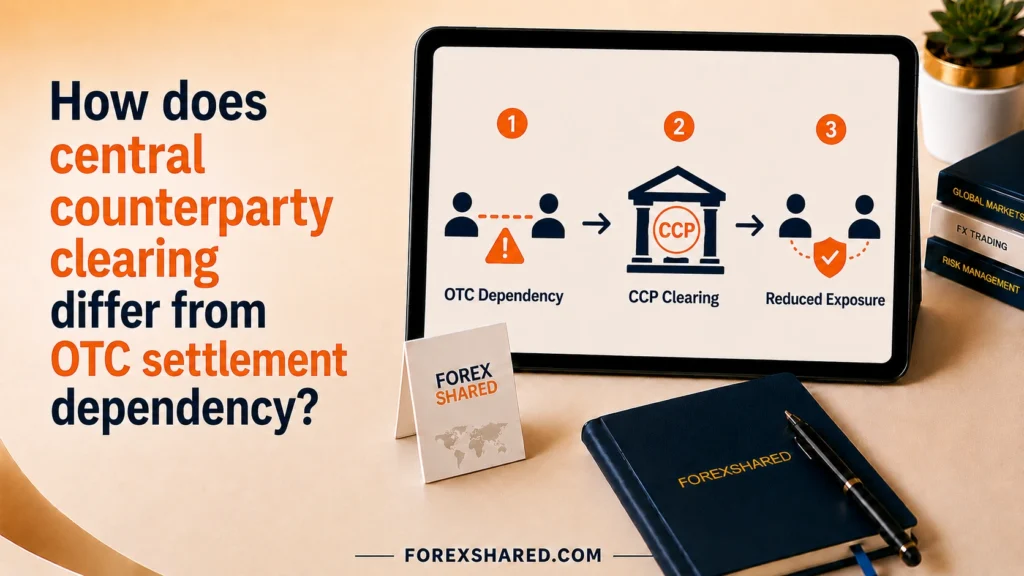
How Does Central Counterparty Clearing Differ From OTC Settlement Dependency?
Central counterparty clearing and OTC settlement dependency address different risk layers. Central clearing changes who stands behind cleared contractual obligations, while settlement dependency concerns whether final currency or cash payments are completed successfully.
The comparison becomes clear once the transaction is split into two questions: who bears contractual performance responsibility before settlement, and how the final currency or cash obligation is completed. A transaction can use strong controls in one layer while retaining exposure in the other.
The parent clearing mechanism is explained in Central counterparty clearing.
This content explains FX market structure and settlement-risk concepts for educational purposes. It does not provide individualized financial, trading, legal, regulatory, tax or operational advice. Clearing, margin, settlement and payment arrangements should be verified against the current rules and procedures that apply to the specific transaction.
What Is the Core Difference Between CCP Clearing and OTC Settlement Dependency?
Central counterparty clearing and OTC settlement dependency control different risk relationships: clearing restructures who stands behind contractual performance, while settlement dependency concerns whether the final currency or cash obligations are completed.
The distinction is best treated as a two-layer risk map. The clearing layer asks who stands behind the contractual obligation and how default exposure is collateralized and managed. The settlement layer asks what final payment remains, when it becomes final, and whether the corresponding payment or delivery is protected.
What dependency does central counterparty clearing change?
Central clearing changes the contractual counterparty relationship by substituting the clearinghouse's credit for that of the original parties.
The changed dependency is the direct contractual credit relationship. The CFTC states that a DCO can substitute its credit for that of the original parties through novation or another mechanism and can provide multilateral settlement or netting. That is a clearing function, not a guarantee about how the final currency payment will be completed. CFTC
What dependency exists at FX settlement?
FX settlement dependency concerns whether the required final currency or cash obligations are actually completed.
For deliverable FX, the final stage requires the sold currency to be paid and the purchased currency to be received. Settlement dependency concerns that completion stage, including the timing and finality of the two payments. It is therefore distinct from the economic replacement cost that can arise if a counterparty defaults before settlement.
How does counterparty credit risk differ from principal settlement risk?
Counterparty credit risk arises when a counterparty defaults while the contract has positive economic value, while principal settlement risk arises when one party delivers its currency but does not receive the corresponding currency.
Replacement-cost exposure is the economic cost of replacing a defaulted transaction at current market terms. Principal settlement risk can involve the full amount delivered if one currency payment becomes final and the counter-currency is not received. BIS treats this loss of full delivered value as principal risk in deliverable FX. BIS
Can the same FX transaction contain both risk layers?
Yes, a deliverable bilateral FX transaction can involve both pre-settlement counterparty exposure and final principal settlement exposure.
A deliverable bilateral transaction can have positive replacement value before maturity and later face principal settlement exposure when the currencies are exchanged. The risks arise at different stages, so identifying one does not remove the need to assess the other.
| Risk Layer | When It Arises | Loss Trigger | Relevant Control | What Can Remain |
|---|---|---|---|---|
| Counterparty-performance exposure | During the contract life and default horizon | Counterparty or clearing-member default while exposure has value | CCP interposition, margin, mark-to-market, default management | Clearing-member, CCP, liquidity and operational dependencies |
| Final settlement exposure | At payment or delivery completion | One required payment or delivery is not completed as expected | PvP, netting, controlled settlement, cash-settlement design | Liquidity, payment-system, settlement-bank and operational dependencies |
How Does CCP Interposition Change Counterparty Dependency?
CCP interposition changes counterparty dependency by placing the clearinghouse between the original parties so that each side's contractual relationship runs through the CCP.
CFTC’s current DCO description explicitly includes substituting the DCO’s credit for that of the original parties through novation or otherwise. CME Rule 804 provides a concrete current example in which the Clearing House is substituted as seller to the buyer and buyer to the seller when the rule’s acceptance conditions are met. CFTC CME
What happens when the trade is accepted for central clearing?
When a trade is accepted for central clearing, the CCP is interposed into the contractual structure.
Acceptance for clearing is the point at which the applicable clearing rules determine whether and when the CCP becomes the contractual counterparty. In CME’s current Rule 804, substitution occurs through novation when the rule’s specified matching or acceptance conditions are satisfied. CME
How does novation change the relationship?
Novation changes the relationship from a direct bilateral contract to two separate clearing relationships running through the CCP.
Before interposition, the structural comparison is Party A directly facing Party B. After novation, the clearing structure creates separate obligations through the CCP. CME Rule 804 states that each clearing member is deemed to have bought from or sold to the Clearing House after substitution. CME
Which dependency becomes less important?
The individual creditworthiness of the original opposite trading party becomes less central to performance of the cleared obligation.
The original opposite party’s credit quality becomes less central to performance of the cleared obligation because the CCP now occupies the clearing relationship. That does not make the original party irrelevant to every exposure or remove other dependencies in the transaction lifecycle.
Which dependencies replace the original bilateral relationship?
The participant instead depends on the FCM or clearing member, the CCP, the collateral and margin process, settlement banks, clearing infrastructure, and CCP default-management procedures.
The new chain can include the participant’s FCM or clearing member, the CCP, collateral processes, settlement banks, custodians, payment systems and default-management procedures. The exact chain varies by venue, service, account type and jurisdiction, so it should be mapped rather than assumed.
What does the CCP do after accepting a trade?
After accepting a trade, the CCP collects collateral, marks positions to market, processes settlement, and manages clearing-member defaults when necessary.
CME Clearing describes ongoing functions that include collateral management and daily settlement processes, while Chapter 8 also provides default-management and clearing-member protection rules. These functions manage the cleared exposure, but final payment arrangements remain a distinct operational layer. CME CME
| Stage | Structure | Meaning |
|---|---|---|
| 1 | Party A ↔ Party B | Original direct contractual relationship |
| 2 | Trade accepted for clearing | Applicable acceptance conditions are satisfied |
| 3 | Novation / CCP interposition | CCP substitutes into the contractual relationship |
| 4 | Party A-side clearing relationship ↔ CCP ↔ Party B-side clearing relationship | Original bilateral performance dependency is replaced |
| 5 | Margin + mark-to-market + default management | Clearing controls support performance exposure; final settlement still requires separate analysis |
Why Can OTC FX Remain Dependent on Bilateral Settlement?
OTC FX can remain dependent on bilateral settlement because the final currency or cash obligations must still be completed according to the agreed settlement process.
The OTC label does not determine the settlement method. A deliverable transaction can use gross bilateral settlement, netting, PvP, on-us or other controlled arrangements, while a cash-settled product can create a different payment dependency. The actual final obligation and settlement method therefore have to be identified directly.
The dedicated comparison of direct final-payment reliance is covered in Bilateral settlement dependency.
What happens when a deliverable OTC FX trade reaches settlement?
When a deliverable OTC FX trade reaches settlement, the contractual currency principals must be transferred according to the agreed settlement process.
At maturity or value date, the contractual principals have to move according to the agreed settlement process. The safety of that final transfer depends on the chosen mechanism, not simply on the fact that the trade was negotiated OTC.
Where does principal settlement risk arise?
Principal settlement risk arises when one party delivers its currency, the payment becomes final, and the other party fails to deliver the corresponding currency.
BIS describes FX settlement risk as the risk that one party fails to deliver the currency owed. The principal-risk problem is most severe when one side has made an irrevocable payment and the corresponding currency does not arrive, exposing the full delivered principal rather than only the transaction’s replacement value. BIS
Why can gross bilateral settlement create material exposure?
Gross bilateral settlement can create material exposure because the amount at risk can be the full value being delivered rather than only the derivative's replacement value.
BIS’s 2026 settlement methodology classifies gross bilateral settlement as fully exposed to FX settlement risk, while methods such as pre-settlement netting mitigate the risk and PvP eliminates the principal settlement risk for covered payments. The classification concerns the settlement method, not whether the trade is OTC. BIS
Does OTC automatically mean gross bilateral settlement?
No, OTC settlement can involve PvP, pre-settlement netting, settlement timing controls, intragroup settlement, or gross bilateral settlement.
No. OTC counterparties can use PvP, pre-settlement netting, on-us or controlled bilateral processes, among other arrangements. The settlement method should be verified directly because the OTC label by itself does not reveal how the final payments are protected. BIS
Do all OTC FX products exchange both principals?
No, BIS defines NDFs as contracts settled in cash without physical delivery of the two underlying currencies at maturity.
BIS defines non-deliverable forwards as cash-settled contracts without physical delivery of the two underlying currencies at maturity. That changes the settlement exposure materially: an NDF still has a final cash-payment dependency, but it does not create the same two-principal delivery sequence as a deliverable forward. BIS
| Stage | Question | Possible Outcome |
|---|---|---|
| 1 | What is the final obligation? | Deliverable principal exchange or net cash settlement |
| 2 | If deliverable, what settlement method applies? | PvP, pre-settlement netting, controlled bilateral, gross bilateral or another process |
| 3 | What exposure remains? | Principal, liquidity, payment timing, operational or cash-payment dependency as applicable |
How Do Clearing Controls Differ From OTC Settlement Controls?
Clearing controls and settlement controls differ because each is designed for a different risk layer: clearing controls manage counterparty-performance exposure, while settlement controls manage final payment completion.
A useful control map separates credit controls from payment controls. CCP interposition, initial margin and variation margin operate primarily on counterparty-performance exposure. Pre-settlement netting reduces gross payment amounts, while PvP addresses asymmetric final currency delivery. Cash settlement changes the final obligation rather than eliminating payment dependency.
What does CCP interposition control?
CCP interposition controls the direct contractual credit relationship by placing the CCP at the centre of the cleared obligations.
Interposition changes the direct contractual credit relationship. It is therefore a counterparty-performance control. It does not by itself synchronize the final movement of two currencies or determine whether the settlement process uses PvP.
What does initial margin control?
Initial margin controls potential exposure after a clearing-member default and losses that may arise while the defaulted portfolio is being managed.
Initial margin is collateral intended to cover potential future exposure over the period needed to manage a defaulted position. BIS’s 2026 consolidated FX-risk guidance describes initial margin as collateral for potential changes in position value over the close-out period after default. BIS
What does variation margin control?
Variation margin controls current market-value exposure by regularly marking positions to market and settling the resulting value changes.
Variation margin addresses current market-value exposure by transferring gains and losses as positions are marked to market. CME states that products it clears are settled at least daily and that settlement variation is exchanged between clearing members with losses and gains, reducing the accumulation of debt in the system. CME
What does pre-settlement netting control?
Pre-settlement netting controls the gross amounts that counterparties ultimately need to exchange by replacing larger gross payment amounts with smaller net payment obligations.
Netting reduces the gross amounts that eligible counterparties have to exchange. BIS identifies pre-settlement netting as a method that mitigates FX settlement risk, but it does not create the if-and-only-if payment linkage of PvP and therefore does not by itself eliminate principal settlement risk. BIS
What does PvP control?
PvP controls final currency-payment asymmetry by ensuring that final payment of one currency occurs only if the corresponding payment of the other currency occurs.
BIS defines PvP as a mechanism in which the final payment of one currency occurs if and only if the final payment of the other currency occurs. The BIS also states that this function is distinct from a CCP and that PvP alone does not remove replacement-cost or all liquidity risk. BIS
Why is cash settlement different again?
Cash settlement removes the need to deliver both underlying currency principals, but the resulting cash payment must still be made.
Cash settlement changes what has to be paid at maturity. Instead of exchanging two underlying currency principals, the parties may owe a single net cash amount. The payment dependency remains because that cash obligation still has to be completed.
| Mechanism | Risk Layer Controlled | What It Does | What It Does Not Do | Remaining Exposure |
|---|---|---|---|---|
| CCP interposition | Counterparty performance | Changes contractual counterparty relationship | Does not link final currency payments | CCP, member, liquidity and operational risk |
| Initial margin | Potential future credit exposure | Provides collateral for default close-out exposure | Does not create payment finality | Tail loss and liquidity demands |
| Variation margin | Current market-value exposure | Transfers marked-to-market gains and losses | Does not synchronize currency delivery | Intracycle and liquidity exposure |
| Pre-settlement netting | Settlement amount | Reduces gross obligations to net amounts | Does not create novation or full principal protection | Residual settlement risk |
| PvP | Principal settlement exposure | Links final currency payments | Does not replace the contractual counterparty | Replacement-cost and liquidity risk |
| Cash settlement | Final obligation design | Removes two-principal exchange | Does not eliminate the final cash-payment dependency | Cash-payment and operational exposure |
Why Can a Cleared FX Position Still Depend on Final Settlement?
A cleared FX position can still depend on final settlement because CCP interposition and margin controls operate at the clearing layer while the final currency or cash obligation must still be completed.
Clearing can restructure the contractual counterparty relationship without making settlement infrastructure disappear. CME currently identifies collateral custodians and settlement banks as part of its collateral and settlement network, illustrating that cleared activity still depends on external payment and custody infrastructure. CME
The broader structural contrast is developed in OTC versus exchange-cleared exposure.
Does the clearinghouse still depend on payment infrastructure?
Yes, clearing operations can rely on settlement banks, collateral custodians, payment systems, liquidity providers, and operational infrastructure.
Yes. CME currently describes a network of approved collateral custodians and settlement banks used to manage collateral and settlements. Clearing therefore reorganizes counterparty performance while still relying on external institutions and payment infrastructure. CME
What if the cleared contract ultimately requires physical delivery?
If the cleared contract requires physical delivery, CCP credit controls can operate before final settlement while the expiring contract still requires currency-delivery processing under its contract rules.
A physically delivered cleared contract can benefit from CCP credit controls before expiration while still requiring the delivery process defined by its rules. The settlement boundary remains: clearing controls the contractual credit structure; the final delivery process controls how the currency obligation is completed.
What if the cleared product is cash settled?
If the cleared product is cash settled, physical exchange of both underlying currencies may disappear, but the final cash obligation and the payment infrastructure supporting it remain relevant.
Cash settlement removes the exchange of both underlying principals but not the need for the final cash amount to be paid. The participant therefore still depends on the CCP, clearing member and payment infrastructure relevant to that cash settlement.
Why is this structurally different from an uncleared bilateral OTC trade?
In a bilateral OTC structure, the named counterparties can remain directly responsible for both contract performance and final settlement, while in a centrally cleared structure those functions are separated more clearly across the CCP, clearing member, settlement mechanism, and payment infrastructure.
In a bilateral OTC structure, the named counterparties can remain directly responsible for contractual performance and settlement. In a centrally cleared structure, performance responsibilities are reorganized through the CCP and clearing members, while the settlement mechanism and payment infrastructure remain a separate layer.
What question should replace "Does clearing eliminate settlement risk?"
The correct question is: What final settlement obligation remains after clearing, and what mechanism protects that obligation?
The useful assessment is to identify the final obligation after clearing, then identify the mechanism that protects it. A deliverable currency exchange calls for settlement-method analysis; a cash-settled obligation calls for analysis of the final cash payment and supporting infrastructure.
Which Risk-Control Mechanism Fits the Actual FX Dependency?
The correct risk-control mechanism depends on the actual FX dependency: identify the risk first, then match the mechanism designed to control that risk.
The decision should start with the risk, not the product label. If the concern is replacement-cost and counterparty-performance exposure, clearing and collateral controls are relevant. If the concern is asymmetric final currency delivery, PvP is relevant. If gross payment size is the concern, netting can reduce the amounts. If both layers are present, both sets of controls need review.
When is CCP clearing the relevant control to examine?
CCP clearing is the relevant control to examine when the primary concern is direct counterparty default, replacement-cost exposure, collateralization, clearing-member default management, or dependence on bilateral credit limits.
CCP clearing is relevant when the problem is who stands behind the contract, how replacement-cost exposure is collateralized, how current exposure is settled, and how member default is handled. Those are counterparty-performance questions rather than final currency-payment questions.
When is PvP the relevant control to examine?
PvP is the relevant control to examine when a deliverable FX trade creates the possibility of delivering the sold currency without receiving the purchased currency.
PvP is relevant when a deliverable FX transaction creates the possibility of paying one currency without receiving the other. BIS states that PvP eliminates this principal settlement risk for the covered settlement because one final payment occurs only if the corresponding payment occurs. BIS
When is pre-settlement netting relevant?
Pre-settlement netting is relevant when multiple eligible bilateral obligations can be combined to reduce the gross currency amounts requiring settlement.
Pre-settlement netting is relevant when multiple eligible obligations can be combined before settlement so that only smaller net amounts need to move. It reduces gross payment exposure and funding needs but should not be confused with PvP or novation.
When must both clearing and settlement controls be reviewed?
Both clearing and settlement controls must be reviewed when the transaction creates both counterparty-performance exposure during its life and payment or delivery exposure at final settlement.
Both layers require review when a transaction can develop replacement-cost exposure during its life and still has a deliverable or cash-payment dependency at maturity. A control that addresses one layer does not automatically satisfy the other.
How does the decision change for an NDF?
For an NDF, the decision changes because the transaction does not exchange both underlying principals at maturity, so the reader should focus on counterparty or CCP performance, fixing/reference-rate dependency, and final cash-payment dependency.
Because an NDF is settled in cash rather than through exchange of both underlying currencies, deliverable principal-risk logic does not apply in the same way. The review should focus on counterparty or CCP performance, the fixing or reference rate used to calculate the amount, and completion of the final cash payment. BIS
| Risk Identified | Relevant Control | What the Control Does | What Remains |
|---|---|---|---|
| Counterparty-performance / replacement-cost exposure | CCP clearing, margin and default management | Restructures and collateralizes performance exposure | CCP, intermediary, liquidity and operational dependencies |
| Deliverable principal settlement exposure | PvP where available and applicable | Links the two final currency payments | Replacement-cost and liquidity risk can remain |
| Excess gross payment amount | Pre-settlement netting | Reduces gross obligations to smaller net amounts | Residual settlement risk remains |
| NDF cash-payment dependency | Counterparty or CCP controls plus cash-settlement process | Addresses performance and final cash-payment completion | Fixing/reference-rate, payment and operational dependencies |
How Can Participants Avoid Confusing CCP Clearing With OTC Settlement Dependency?
Participants can avoid confusing CCP clearing with OTC settlement dependency by identifying the risk layer first, then matching the mechanism designed to control that risk.
The recurring error is mechanism substitution: using a valid control for the wrong risk layer. The diagnostic discipline is to identify the transaction structure, identify the final obligation, separate replacement-cost exposure from principal settlement exposure, then verify the control that addresses each dependency.
Why is "centrally cleared means settlement-safe" incorrect?
"Centrally cleared means settlement-safe" is incorrect because CCP interposition and final payment completion operate at different layers.
BIS explicitly distinguishes the PvP function from the CCP function. CCP interposition changes counterparty relationships, while PvP links final currency payments. A cleared position is therefore not settlement-safe merely because a CCP stands in the contractual chain. BIS
Why is "OTC means full principal exposure" incorrect?
"OTC means full principal exposure" is incorrect because OTC settlement structures can differ materially and can include PvP, netting, controlled bilateral methods, or cash settlement.
OTC transactions can use settlement-risk controls such as PvP, netting and protected on-us arrangements, and some products such as NDFs are cash settled. The correct exposure therefore depends on the actual settlement structure rather than the OTC label. BIS BIS
Why is margin not a substitute for PvP?
Margin is not a substitute for PvP because margin collateralizes defined credit exposure while PvP makes two currency payments legally conditional on each other.
Margin collateralizes defined credit exposure, while PvP makes the final transfer of one currency conditional on the final transfer of the other. The mechanisms operate on different risk layers, so using margin does not create payment finality or principal-risk protection.
Why is PvP not a substitute for CCP clearing?
PvP is not a substitute for CCP clearing because PvP controls final currency-payment asymmetry while CCP clearing manages counterparty-performance exposure.
PvP protects the final currency-payment exchange but does not replace the original contractual counterparty or manage all pre-settlement replacement-cost exposure. BIS states that PvP alone does not eliminate replacement-cost risk or all liquidity risk. BIS
Why must NDFs and deliverable forwards remain separate?
NDFs and deliverable forwards must remain separate because their settlement obligations differ: deliverable forwards exchange currency principals while NDFs settle in cash without physical delivery of both underlying currencies.
A deliverable forward requires the exchange of currency principals, while an NDF settles a cash difference without physical delivery of the two underlying currencies. Applying deliverable-principal logic to an NDF would therefore misidentify the settlement exposure. BIS
What should be verified before comparing clearing with settlement dependency?
Before comparing clearing with settlement dependency, the reader should verify the transaction structure, the relevant counterparties, the settlement method, and the remaining dependencies.
The verification sequence should identify whether the transaction is cleared or bilateral, who the relevant counterparties and intermediaries are, whether the final obligation is deliverable or cash settled, which settlement method is used, and what credit, liquidity, payment-system and operational dependencies remain.
- Identify whether the transaction is centrally cleared, bilaterally uncleared, or uses another applicable structure.
- Identify the relevant CCP, clearing member, FCM, or direct OTC counterparty.
- Separate counterparty-performance exposure from final settlement exposure.
- Understand novation, margin, collateral and mark-to-market controls where applicable.
- Identify whether the transaction is deliverable or cash settled.
- Verify the actual settlement method, including PvP, netted, controlled bilateral, gross bilateral, or another process.
- Assess replacement-cost exposure separately from principal settlement exposure.
- Identify remaining liquidity, payment-system, settlement-bank and operational dependencies.
- Do not assume CCP clearing provides PvP automatically.
- Confirm that the complete clearing and settlement structure addresses the risks relevant to the participant.
Conclusion Direction
Central counterparty clearing differs from OTC settlement dependency because they control different risk relationships.
Central clearing restructures counterparty-performance exposure, while settlement arrangements determine how final currency or cash obligations are completed. If a transaction contains both layers, a complete risk assessment requires separate controls for both rather than assuming one mechanism performs both functions.
FAQs
The FAQs answer the most common clearing-versus-settlement questions directly.
The answers below preserve the same boundary throughout the article: clearing and settlement interact, but they are not interchangeable risk-control layers.
What is the main difference between CCP clearing and OTC settlement dependency?
CCP clearing restructures counterparty-performance exposure, while settlement dependency concerns completion of the final payment obligations.
CCP clearing changes the contractual performance relationship and the controls around counterparty exposure. Settlement dependency concerns completion of the final currency or cash payment. The mechanisms can coexist in one transaction and should be assessed separately.
Does central clearing eliminate FX settlement risk?
No, CCP interposition does not by itself make final currency payments conditional on each other; the actual settlement mechanism must be identified.
No. BIS states that the PvP function is distinct from the CCP function. A cleared transaction still requires analysis of the actual settlement mechanism because CCP interposition alone does not make the two final currency payments conditional on each other. BIS
What is principal settlement risk in deliverable FX?
Principal settlement risk in deliverable FX is the risk of delivering the currency sold without receiving the currency purchased.
It is the risk of losing the full value delivered when the sold currency has been paid but the purchased currency is not received. This differs from replacement-cost exposure, which is based on the economic cost of replacing the failed transaction at current market terms. BIS
How does PvP differ from a CCP?
PvP links final currency payments, while a CCP interposes itself into the contractual counterparty relationship.
PvP links final currency payments so one settles only if the other settles. A CCP interposes itself into the contractual counterparty relationship and manages counterparty-performance exposure. BIS identifies these as distinct functions. BIS
Can an OTC FX transaction reduce settlement risk without central clearing?
Yes, PvP, pre-settlement netting, controlled bilateral settlement, and cash-settled structures can reduce settlement risk without central clearing.
Yes. OTC transactions can use PvP, pre-settlement netting, protected on-us or other controlled settlement methods, and cash-settled products can avoid two-principal delivery. Each mechanism addresses a specific aspect of settlement exposure and should not be treated as equivalent. BIS