How Does Seller Risk Differ From Buyer Risk in Forex Options?
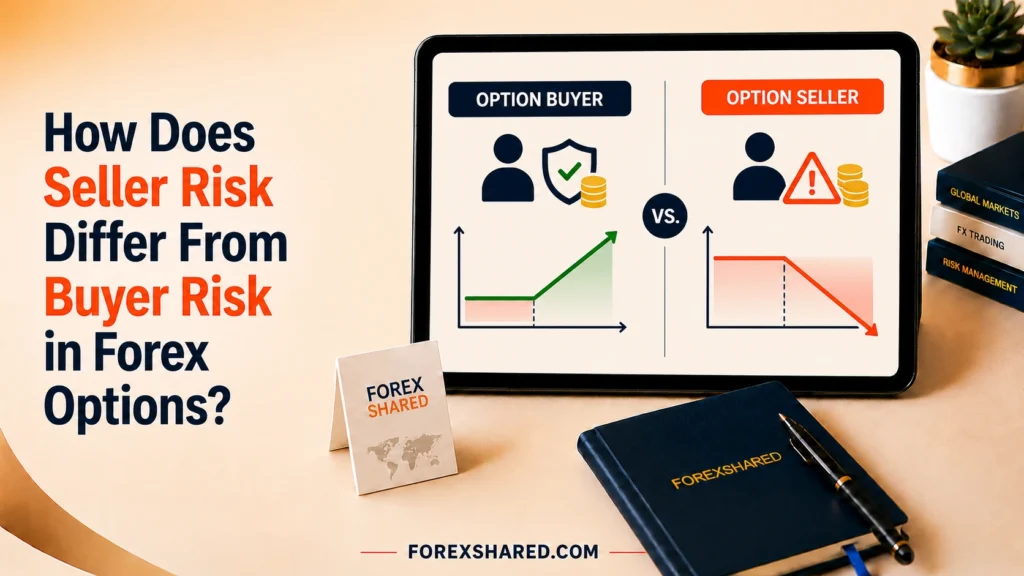
How Does Seller Risk Differ From Buyer Risk in Forex Options? Seller risk differs from buyer risk because the buyer pays a premium for a contractual right, while the seller receives that premium in exchange for accepting a contingent obligation that can produce losses beyond the premium. The comparison is contract-level: buyer and seller hold different rights, cash-flow directions and performance responsibilities. The article separates call and put risk, margin, assignment, covered status, expiration processing and the new futures exposure that can arise after exercise. Educational disclaimer This article explains forex-option risk mechanics for educational purposes only. It does not provide individualized financial, hedging, treasury or trading advice. Contract specifications, margin and expiration procedures should be verified for the exact product and venue. What Creates the Risk Asymmetry Between an Option Buyer and Seller? The risk asymmetry between an option buyer and seller comes from the contract itself: the buyer pays a premium to own a right, while the seller receives that premium in exchange for accepting a contingent obligation. The asymmetry is contractual rather than incidental. One side buys discretion; the other side receives premium for accepting performance risk, so the same option contract creates a bounded cost for the buyer and a potentially much larger obligation for the seller. This contractual division is the foundation of Forex options risk structure. What does the option buyer acquire? The option buyer acquires a contractual right, but not an obligation, to buy or sell the specified underlying exposure. CFTC The right is discretionary, the buyer may exercise it or let it expire. The right has a cost, the premium paid, which becomes the buyer’s maximum option loss. What does the seller accept? The option seller accepts a contingent obligation to perform if the option is exercised or processed as in the money at expiration. CFTC The obligation is contingent, it activates only if the option is exercised or expires in the money. The obligation is the source of the seller’s potentially large downside. What cash flow passes between the two sides? The buyer pays the premium to the seller at the start of the transaction. This single cash flow creates both the buyer’s known cost and the seller’s fixed income. The premium is the buyer’s maximum option loss and the seller’s maximum option income, but not the seller’s maximum loss. Why does that create asymmetric risk? The premium creates asymmetric risk because the buyer has purchased discretion while the seller has sold that discretion and accepted performance risk. The buyer can choose whether to exercise, while the seller must perform if the option is exercised or processed as in the money. The seller’s performance risk is the direct counterpart of the buyer’s discretion. Buyer and seller risk attributes Attribute Buyer / Long Option Seller / Short Option Premium Pays premium Receives premium Contract position Owns a contractual right Accepts a contingent obligation Maximum option loss Generally premium paid, before transaction-cost nuance Can exceed premium received; exact boundary depends on call/put and coverage Maximum option income Not capped by premium in the same way Premium received Margin exposure Fully paid long option generally has no seller-style margin at option stage Margin supports performance and can increase Exercise / assignment Buyer exercises Seller is assigned Adverse market move Option can fall to zero Liability can expand as the short option moves against the seller Structural takeaway: the buyer purchases discretion while the seller accepts performance risk. Premium creates buyer seller risk asymmetryPremium flows from buyer to seller. The buyer receives a right with limited option downside while the seller accepts an obligation with potentially larger downside.BUYER–SELLER RISK ASYMMETRYBUYERPays premiumOwns right, not obligationOption downside boundedSELLER / WRITERReceives premiumAccepts contingent obligationLoss can exceed premiumPREMIUM FLOWRIGHT ↔ OBLIGATIONASYMMETRY IS CONTRACTUALFixed buyer cost does not create a fixed seller liability.FOREXSHARED.COM Swipe or scroll horizontally to view the full diagram. Figure 1. The premium transfers cash while the contract divides discretion and performance obligation. Why Is the Buyer's Downside Limited to the Premium Paid? The buyer’s downside is limited to the premium paid because the purchased option’s worst-case value is zero. For a fully paid long option, the buyer can let an unfavorable contract expire with zero option value. That does not make the loss small: the entire premium can be lost, and transaction costs can increase the total cash loss beyond the quoted premium. The buyer-side boundary is developed further in Maximum loss limited to premium. What is the buyer's known cost at entry? The buyer’s known cost at entry is the premium paid. This cost is known at trade inception, unlike the seller’s potential future outflows. The known cost is also the maximum option loss. What is the worst value of the purchased option? The worst value of the purchased option is zero. An option cannot have negative value to the holder, the buyer can simply let it expire. Zero value means 100% loss of the option investment. How does CME describe buyer risk? CME states that the maximum loss for a long call or long put is limited to the premium paid. CME This is the exchange’s official description of long-option risk. The CME statement describes the option-stage risk, not post-exercise futures risk. Can total cash loss include more than the quoted premium? Yes, the FIA risk disclosure notes that transaction costs can also be lost. FIA The premium is the option cost, but commissions and other costs can add to the total loss. The premium cap applies to the option premium itself, not to the total cash outlay including fees. Does "limited loss" mean "small loss"? No, “limited loss” means the loss is bounded, not that it is small. “limited” describes the boundary, not the magnitude, a buyer can lose the entire premium. A “limited” loss can still be a total loss of the amount invested. Why Can Seller Loss Exceed the Premium Received? Seller loss can exceed the premium received because the seller remains exposed to the contractual obligation until the short
How Do Options Hedge Uncertain Cash-Flow Timing Better Than Forwards?
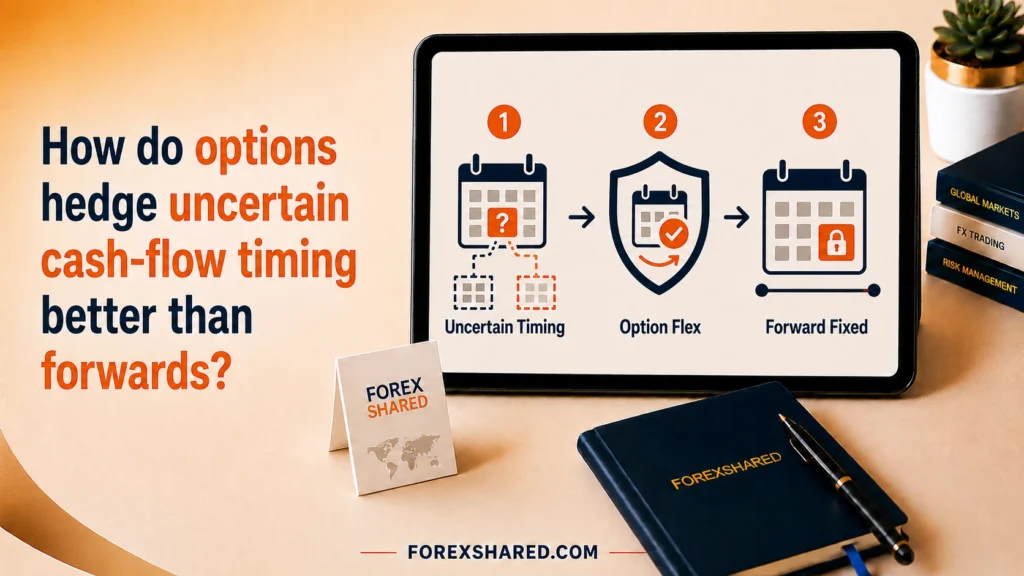
How Do Options Hedge Uncertain Cash-Flow Timing Better Than Forwards? Options hedge uncertain cash-flow timing more flexibly than standard forwards because the option buyer acquires exchange-rate protection without accepting the same mandatory future currency-exchange commitment a forward creates. The comparison turns on three questions: whether the cash flow will occur, how much will occur, and when it will settle. A standard forward, Window FX Forward and purchased option solve different combinations of those uncertainties. Educational disclaimer This article explains FX hedging mechanics for educational purposes only. It does not provide individualized financial, accounting, treasury or trading advice. Product availability, documentation, pricing and settlement depend on the specific contract and counterparty. What Makes an FX Cash Flow Uncertain Enough to Create Hedge-Timing Risk? An FX cash flow creates hedge-timing risk when the expected payment or receipt is uncertain in timing, amount, or whether it will occur at all. The instrument decision starts with the commercial cash flow rather than the derivative. Timing asks when the cash flow will settle, occurrence asks whether it will exist at all, and amount asks how large the final exposure will be. What is cash-flow timing uncertainty? Cash-flow timing uncertainty means the foreign-currency payment or receipt is expected, but the exact settlement date is not known. The cash flow is expected; only the date is unclear. Timing uncertainty as distinct from occurrence uncertainty. How is occurrence uncertainty different? Occurrence uncertainty means the cash flow itself may occur, be cancelled, be reduced, or be postponed materially beyond the hedge horizon. Occurrence uncertainty is the stronger mismatch problem for a binding forward. Occurrence uncertainty as distinct from timing uncertainty. Why does amount uncertainty matter too? Amount uncertainty matters because a hedge sized to the original forecast can become mismatched when the actual cash flow differs in magnitude. IFRS The IFRS reference supports the existence of amount uncertainty; it does not establish hedge-accounting eligibility. Amount uncertainty as distinct from timing uncertainty. What is the core hedge-selection question? The core hedge-selection question asks whether the cash flow will occur, then how much, then when, before choosing the derivative. The sequence applies before comparing instruments. Occurrence certainty is the first gate, amount certainty the second, and timing certainty the third. Timing uncertainty versus occurrence uncertainty Attribute Timing Uncertainty Occurrence Uncertainty Definition Cash flow is expected, but exact settlement date is unclear. Cash flow may occur, be cancelled, reduced, or move materially beyond the hedge horizon. Examples Shipment delay, collection-date uncertainty, project milestone delay. Cancelled order, failed project, conditional transaction. Is cash flow expected? Yes, occurrence is relatively expected. Not necessarily. Instrument implication Standard or Window Forward may fit if occurrence is sufficiently certain. Purchased option gains structural value because buyer optionality matters. Three uncertainty gates for FX hedge selectionA flow asks whether the cash flow will occur, how much it will be, and when it will settle before the hedge structure is chosen.THREE UNCERTAINTY GATES1. WILL IT OCCUR?Firm, forecast or contingent?Occurrence certainty is the first gate.2. HOW MUCH?Fixed, range or materially uncertain?Amount drives notional alignment.3. WHEN?Exact date, window or unknown?Timing drives maturity and expiry.FOREXSHARED.COM Swipe or scroll horizontally to view the full diagram.Figure 1. Occurrence, amount and timing should be classified before selecting the hedge structure. Why Can a Standard FX Forward Create Timing Mismatch? A standard FX forward creates timing mismatch because its contractual settlement date is fixed, while the underlying commercial cash flow can settle at a different time. BIS A standard forward can be an efficient match when the amount and settlement date are sufficiently known. Its sensitivity to uncertainty comes from the fact that the future exchange remains tied to agreed contractual terms even if the commercial date moves or the business requirement changes. Readers who need the baseline contract structure can review Forward forex contracts. What does a forward require? A forward requires the buyer to agree to purchase and the seller to agree to deliver the specified currency on an agreed future date at an agreed price. BIS The definition establishes the commitment that creates timing sensitivity. Forward as a binding agreement, not a flexible arrangement. Why does the agreed date matter? The agreed date matters because the hedge maturity is tied to a contractual settlement date, and any difference between that date and the commercial cash-flow date creates misalignment. The mismatch is a timing mismatch, not necessarily a loss. This section focuses on Commercial Date ≠ Forward Date condition and explain that the hedge is no longer perfectly aligned. What happens if the payment arrives later than expected? If the payment arrives later than expected, the forward can mature before the underlying commercial need arises, creating a temporary funding or currency-position mismatch. The mismatch is temporary but real. This section focuses on temporary funding or currency-position mismatch that results. What happens if the cash flow arrives earlier? If the cash flow arrives earlier, the business may need currency before the forward's settlement date and may need additional transaction management to bridge the timing difference. The mismatch is a timing gap, not necessarily a loss. This section focuses on need for bridging transactions to cover the gap between commercial need and forward settlement. What if the underlying requirement disappears? If the underlying requirement disappears, the forward obligation does not automatically disappear merely because the commercial exposure changes. Bank of Ireland Cancellation cost depends on market rates at the time. The forward is separate from the commercial transaction. Why Does an FX Option Absorb Timing Uncertainty Differently? An FX option absorbs timing uncertainty differently because the buyer acquires a right to exchange currency at an agreed rate without accepting the same mandatory obligation a forward creates. BIS A purchased option separates exchange-rate protection from the same unconditional underlying currency exchange commitment. That distinction is most valuable when uncertainty reaches beyond a small date shift and affects whether the commercial transaction will ultimately occur. What does the option buyer acquire? The option buyer acquires the right, but not the obligation, to buy or sell currency at