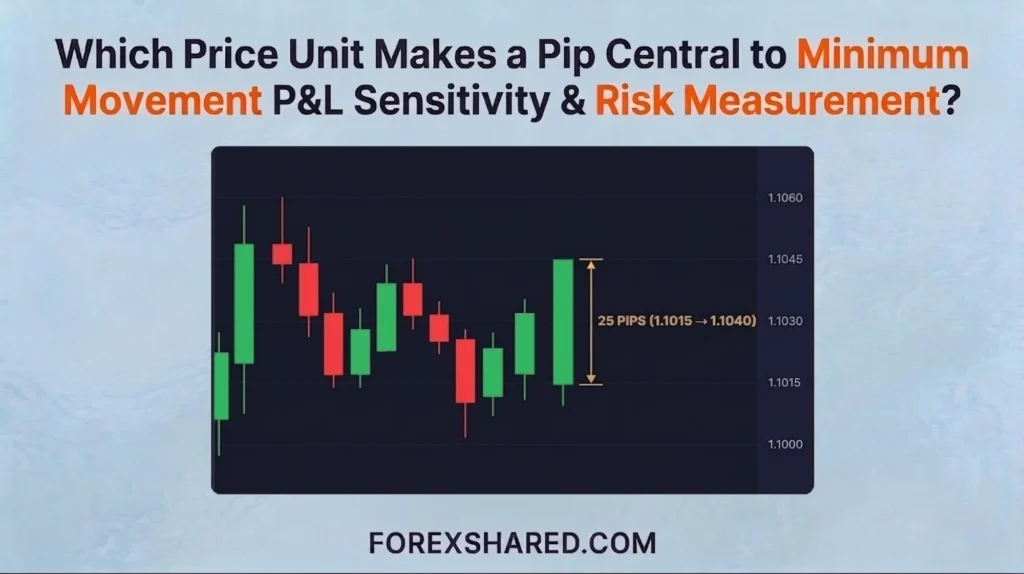
Which Price Unit Makes a Pip Central to Minimum Movement, P&L Sensitivity & Risk Measurement?
The Pip is best understood as the standardized movement unit that turns raw FX quote changes into something measurable, comparable, and risk-relevant. Many readers know a pip is a small price change, but that description is too weak. The pip is the fundamental standardized unit that turns erratic quote movement into a highly usable measurement layer for market operators.
This article will define the pip through three connected jobs: minimum movement, P&L sensitivity, and practical risk measurement. Crucially, a pip by itself is not yet a guaranteed money amount until positional size and denomination are confirmed (OANDA, n.d.)(CME Group, n.d.).
EDUCATIONAL DISCLAIMER
This article is educational only. It is not trading advice, not signal content, not a platform recommendation, and not execution coaching. The article must explain pricing structure and risk measurement, not promise returns.
Why Do So Many Readers Misunderstand What a Pip Actually Does?
Many readers misunderstand the Pip, the standard FX movement unit used to measure quote changes under pair convention, because they treat it as just a tiny decimal move rather than as the standard unit that makes FX movement measurable across pricing, P&L, and risk. Integrating it into the Forex pricing units system demands moving past the visual decimal.
Why Does a Pip Look Like Just a Small Decimal Change?
A pip looks like just a small decimal change because readers notice the digits on the screen before they notice the measurement role behind them. When the digits are seen first, the actual measurement purpose is vastly overlooked, and the pip gets disastrously reduced to its appearance only (OANDA, n.d.).
Why Do Beginners Confuse “Smallest Move” with “Smallest Money Amount”?
Beginners confuse ‘smallest move’ with ‘smallest money amount’ when they forget that movement unit and monetary value are not the same layer. The pip is fundamentally defined as movement; when size is added later, the actual money effect appears only after that specific mathematical translation (OANDA, n.d.)(CME Group, n.d.).
Why Does This Misread Create Bigger Problems Later?
This misread creates bigger problems later because it breaks pip-value reading, P&L sensitivity, and stop-loss sizing before those topics even start. The pip is a movement unit first, a money number second. If the pip is misread at the definition stage, the value and risk layers are systematically misunderstood later (OANDA, n.d.).
Proof Asset: Pip Misread Snapshot
The Pip Misread Snapshot should show how a tiny-looking decimal change actually carries a full measurement role.
| What the Reader Assumes | What a Pip Actually Does | Why It Matters |
|---|---|---|
| It's just the random 4th number after the dot. | It standardizes movement across differently priced assets globally. | Without standardizing movement, comparing EUR volatility to GBP volatility is impossible. |
| One pip means one dollar. | One pip denotes distance; the dollar value depends entirely on trade size. | Assuming fixed money value destroys margin and position sizing logic. |
What Is a Pip, and What Is It Not?
A Pip is the smallest standardized move by which an FX quote changes under market convention, and it is a measurement unit rather than a money value by itself. Grounding What a pip measures prevents basic pricing errors.
What Is a Pip in Plain English?
In plain English, a Pip, originally an abbreviation for percentage in point, is the standard movement unit used to describe a small change in an FX quote. When a quote fundamentally changes, the pip measures that change, allowing traders to utilize a highly repeatable, reusable unit (OANDA, n.d.).
What Is a Pip Not?
A pip is not automatically a dollar amount, not the same thing as a pipette, fractional pip precision below the main pip, and not independent of pair convention. For clarity on fractional precision, examine Pipettes for fractional-pip precision. If the pip is bounded correctly, precision, value, and convention forcefully stop being dangerously mixed (OANDA, n.d.).
Why Does a Pip Exist as a Convention-Based Unit Rather Than as a Random Decimal Habit?
A pip exists as a convention-based unit because FX markets need a repeatable measurement layer rather than relying on arbitrary decimal interpretation. As market convention strictly fixes the movement unit, quote movement instantly becomes comparable across massive global liquidity pools (OANDA, n.d.).
Proof Asset: Pip Definition Table
The Pip Definition Table should show what a pip measures and what it does not automatically mean.
| Pair Type | Pip Convention | What It Measures | What It Does Not Automatically Mean |
|---|---|---|---|
| EUR/USD (Standard) | 4th Decimal Place (0.0001) | One unified increment of quote-side movement. | It does not mean your account equity drops $1 for every tick down. |
| USD/JPY (Yen Cross) | 2nd Decimal Place (0.01) | A standardized fluctuation adapted for JPY denomination. | It does not imply JPY pairs are fundamentally less volatile. |
Which Price Unit Makes the Pip the Core Measure of Minimum Movement?
The Pip is the core measure of minimum movement in spot FX because it gives quotes a repeatable, convention-based movement unit. A full grasp of Pip size and quote interpretation reveals how numbers are structured for processing.
Why Is a Pip the Standardized Minimum Movement Unit in Spot FX?
A pip is the standardized minimum movement unit in spot FX because it lets price changes be compared using one shared convention rather than raw decimal noise. Because the quote convention is strictly fixed, the minimum standard movement seamlessly becomes readable, ensuring broad comparison dramatically improves (OANDA, n.d.).
Why Does “Minimum Movement” Depend on Pair Convention?
Minimum movement depends on pair convention because JPY pairs and most non-JPY pairs are not quoted with the same decimal structure. The JPY pip convention differs structurally. When pair format physically changes, the pip location changes, dictating that movement must be rigorously read through specific convention (OANDA, n.d.).
Why Does This Make the Pip More Useful Than Just Reading Raw Decimals?
This makes the pip more useful than raw decimals because it converts formatting differences into one usable movement language. The pip turns decimal noise into a usable movement unit. While decimal formatting varies erratically, the pip powerfully standardizes reading, ensuring relative movement definitively becomes easier to compare (OANDA, n.d.).
Proof Asset: Minimum Movement Map
The Minimum Movement Map should show where the pip sits in different quote conventions and what one pip means.
| Pair | Standard Price Format | Pip Location | What One Pip Means |
|---|---|---|---|
| EUR/USD | 1.1050 (4 Decimals baseline) | The 4th decimal spot (0.0001) | A 0.0001 change in the USD value of one Euro. |
| GBP/JPY | 190.50 (2 Decimals baseline) | The 2nd decimal spot (0.01) | A 0.01 change in the JPY value of one Pound. |
How Does the Pip Become the Basis for P&L Sensitivity?
The Pip becomes the basis for P&L sensitivity once the movement unit is connected to a stated trade size. By using a Pip lot value calculator, traders transition seamlessly from observing a price flicker to quantifying actual profit and loss exposure.
Why Is a One-Pip Move Not the Same Financially for Every Position?
A one-pip move is not the same financially for every position because the same movement unit scales differently as position size changes. Whenever a one-pip jump occurs, the specific size is applied, dictating that financial sensitivity violently changes across volume profiles (OANDA, n.d.)(CME Group, n.d.).
How Does Pip Value Turn Movement into P&L Sensitivity?
Pip value, the money attached to a one-pip move at a stated size, turns movement into P&L sensitivity, the change in profit or loss caused by a one-unit move, by attaching a money effect to one pip at a stated position size. With a Pip lot value calculator, pip movement is measured, trade size is precisely specified, and money sensitivity brilliantly becomes calculable (OANDA, n.d.).
Why Does This Make the Pip Central to Trade Sensitivity Rather Than Just Quote Reading?
This makes the pip central to trade sensitivity because once value is attached, the same unit starts describing impact instead of appearance alone. Pips measure movement; pip value measures impact. When the movement unit actively gains value translation, P&L sensitivity unquestionably becomes readable (OANDA, n.d.).
Proof Asset: Pip-to-P&L Table
The Pip-to-P&L Table should show how one pip becomes a sensitivity measure once size is known.
| Pair or Product | One-Pip Move | Position Size or Contract Size | Resulting P&L Sensitivity Logic |
|---|---|---|---|
| EUR/USD (Spot) | 0.0001 points | 1 Standard Lot (100,000) | One pip physically alters the floating equity by exactly $10 USD. |
| USD/JPY (Spot) | 0.01 points | 1 Mini Lot (10,000) | One pip adjusts the equity by 100 JPY (requiring conversion to home fiat). |
How Does the Pip Become a Practical Risk Measurement Unit?
The Pip becomes a practical risk measurement unit when traders use pip distance to express stop placement, loss tolerance, and exposure control. Without evaluating position size properly, risk limits remain dangerously theoretical.
Why Do Traders and Platforms Express Stop Distance in Pips?
Traders and platforms express stop distance in pips because pip distance is clearer and more portable than raw decimal offsets for risk planning. Because the stop is robustly defined in pip units, sophisticated risk planning undeniably becomes easier to compare across active trades (OANDA, n.d.).
How Does Position Size Change the Risk of the Same Pip Stop?
Position size changes the risk of the same pip stop because the same distance becomes more or less expensive as the pip value changes with size. Applying a Position size calculator proves that if the stop distance is perfectly fixed, size severely changes pip value, dictating that monetary risk massively changes (OANDA, n.d.)(CME Group, n.d.).
How Does Pip Distance Translate into Monetary Risk?
Pip distance, the number of pips between two price levels, translates into monetary risk when the number of pips to the stop is multiplied by the pip value at the chosen size. By actively referencing pip value against distance, the underlying monetary risk is confidently approximated (OANDA, n.d.).
Why Does This Make the Pip Central to Risk Measurement Rather Than Just Price Description?
This makes the pip central to risk measurement because risk often begins as a pip distance before it is translated into money exposure. Risk often starts as pip distance before it becomes money risk. Since distance is precisely measured in pips, value is relentlessly attached, ensuring real risk phenomenally becomes visible (OANDA, n.d.).
Proof Asset: Pip Risk Table
The Pip Risk Table should show how pip distance becomes approximate money risk once value is attached.
| Trade Size | Stop Distance in Pips | Pip Value Logic | Risk Interpretation |
|---|---|---|---|
| 1 Micro Lot (1,000 Units) | 50 Pips | ≈ $0.10 per Pip | Low capital threshold; 50 pips yields roughly $5 of risk. |
| 5 Standard Lots (500,000 Units) | 50 Pips | ≈ $50.00 per Pip | High capital exposure; identical 50 pip distance implies $2,500 hazard. |
How Do Pip, Pipette, and Tick Work Together Without Meaning the Same Thing?
Pip, pipette, and tick work together inside one pricing system, but they do not describe the same layer of movement. Interchanging these metrics creates immediate accounting failures.
What Does the Pip Define That a Pipette Does Not?
The pip defines the main conventional movement unit, while the pipette, fractional pip precision smaller than the main pip, defines finer fractional precision below that core unit. Because the core pip is strictly fixed by convention, the pipette merely refines the display precision, ensuring the main unit miraculously stays intact (OANDA, n.d.).
What Does a Tick Define That a Pip Does Not in Standardized Products?
A tick, minimum exchange-set price fluctuation in a standardized product, defines the minimum exchange-set price fluctuation in a standardized product, while the pip is the familiar convention-based movement unit in spot-style FX reading. The exchange permanently sets the tick size, and the contract size heavily fixes the tick value, establishing a standardized money mapping (CME Group, n.d.).
Why Does Quote Precision Not Automatically Redefine the Pip?
Quote precision does not automatically redefine the pip because more decimals improve display detail without replacing the core movement convention. More decimals do not replace the core movement unit. As display precision systematically expands, the core pip robustly remains, and the tick remains strictly product-specific (OANDA, n.d.)(CME Group, n.d.).
Proof Asset: Pip vs Pipette vs Tick Matrix
The Pip vs Pipette vs Tick Matrix should show how these nearby terms differ without competing for the same role.
| Measurement Unit | What It Is | Where It Matters Most | What It Should Not Be Confused With |
|---|---|---|---|
| Pip | The conventional 4th or 2nd decimal move. | Global Spot FX quoting and standard risk modeling. | A rigid money value immune to position sizing. |
| Pipette | A 1/10th fractional sliver of a Pip. | Algorithmic high-frequency spread capture. | The core unit utilized for human macro trading. |
| Tick | Exchange-mandated minimum fluctuation bounds. | CME Futures, Options, and standardized derivatives. | Over-The-Counter (OTC) rolling spot pip conventions. |
How Do Pair Convention and Quote Currency Affect Pip Meaning?
Pair convention and quote currency affect pip meaning because pip location and pip-value expression both live inside the quote structure. The identity of the pricing unit controls the financial extraction logic.
Why Does Pip Location Depend on the Pair’s Quote Format?
Pip location depends on the pair’s quote format because the quoted decimal structure is different for most non-JPY pairs and for JPY-style pairs. Once the exact quote format is chosen, the pip location is securely fixed, and the movement is read correctly (OANDA, n.d.).
Why Does Quote Currency Matter for Pip Value Expression?
Quote currency matters for pip value expression because the money impact of a pip is first read through the way the pair expresses value. When the pip violently occurs inside the pair, its value is undeniably expressed through the pair structure, meaning money interpretation originates there (OANDA, n.d.).
Why Does This Make Pip Reading a Structural Task Rather Than a Raw Decimal Task?
This makes pip reading a structural task because the pip only becomes meaningful once quote format, convention, and denomination are read together. The pip lives inside the quote structure. With the structure perfectly identified and the pip reliably located, value and risk reading systematically become cleaner (OANDA, n.d.).
Proof Asset: Pair Convention and Pip Role Table
The Pair Convention and Pip Role Table should show how quote format changes pip location and later value reading.
| Pair | Quote Format | Pip Position | Why It Matters for Value or Risk |
|---|---|---|---|
| GBP/USD | 1.2550 (Standard) | 4th Decimal | The value expression generated is strictly in USD. |
| AUD/JPY | 95.50 (Yen Cross) | 2nd Decimal | The generated pip value is natively JPY, requiring conversion. |
How Does Account Currency Change the Meaning of Pip-Based Risk?
Account currency, the currency in which the account is measured, changes the meaning of pip-based risk because the trader may experience the same pip move through a different home-currency lens than the pair’s own denomination. Risk is an illusion until translated into base ledger fiat.
Why Is Pip Value Not Always the Same as Account-Currency Risk?
Pip value is not always the same as account-currency risk because the money effect may first appear in the pair’s own denomination before it is translated into the account’s home currency. While pip value is distinctly read in the pair context, home-currency translation is applied, ensuring account-level risk finally becomes definitively visible (OANDA Europe, 2025).
How Does Account Currency Change the Way Traders Read the Same Pip Distance?
Account currency changes the way traders read the same pip distance because the same move can carry a different account-level meaning once translated into the home currency context. When stop distance is physically fixed and pip value is translated, the home-currency risk reading heavily changes (OANDA Europe, 2025)(OANDA, n.d.).
Why Does This Matter for Real Risk Measurement?
This matters for real risk measurement because pip distance becomes actionable only after size, denomination, and account-currency pip value (pip impact translated into the account’s own currency) translation are clear. Pip risk becomes real only after currency translation and size are clear. If pip distance is measured and size is known, account-currency risk is seamlessly translated, proving practical exposure becomes incredibly clearer (OANDA Europe, 2025).
Proof Asset: Pip Value vs Account Risk Table
The Pip Value vs Account Risk Table should show why a clear pip value still does not always equal a full account-level risk reading.
| Trade Structure | Pip Value Basis | Account-Currency Translation Issue | Why It Matters |
|---|---|---|---|
| Trading EUR/GBP via a USD Account | Pips are natively priced in GBP. | The GBP yield must be dynamically converted to USD. | Fluctuating GBP/USD rates alter your actual margin impact. |
| Trading USD/CAD via a CAD Account | Pips are natively priced in CAD. | No conversion necessary; native matching occurs. | Pip value yields direct, frictionless P&L modeling. |
How Do Spot-FX Pip Logic and Futures Tick Logic Relate Without Being the Same Thing?
Spot-FX pip logic and futures tick logic relate because both standardize small price moves, but they do not use the same rule-set or money-mapping method. Blending OTC conventions with exchange mandates disrupts execution algorithms.
Why Is Pip Logic Strongest in Spot-Style FX Reading?
Pip logic is strongest in spot-style FX reading because the pip is the familiar convention-based unit used to describe small quote changes. Because the quote convention robustly defines the pip, spot-style movement fundamentally gets standardized (OANDA, n.d.).
Why Does Futures Logic Speak More Naturally in Ticks?
Futures logic speaks more naturally in ticks because the exchange sets the minimum price fluctuation and attaches a fixed contract-specific tick value. Futures tick mapping (comparison layer between spot-style pip logic and exchange-set tick value) works because the exchange aggressively defines tick size and contract size defines tick money value, guaranteeing futures movement becomes directly mapped (CME Group, n.d.).
Why Should Readers Compare the Two Without Treating Them as Identical?
Readers should compare the two without treating them as identical because spot uses pip convention while futures use exchange-defined tick increments. Spot uses pip convention; futures map movement through ticks. While both systems brilliantly standardize movement, their core unit logic undeniably differs, demanding that the comparison must absolutely stay calibrated (OANDA, n.d.)(CME Group, n.d.).
Proof Asset: Spot Pip vs Futures Tick Table
The Spot Pip vs Futures Tick Table should show how both systems measure small price change without using the same monetary rule.
| Context | Core Price Unit | How Money Value Is Attached | What It Should Not Be Confused With |
|---|---|---|---|
| OTC Spot FX | The Pip (e.g., 0.0001) | Calculated dynamically based on user-defined position sizing. | An exchange-mandated contract sizing rule. |
| CME FX Futures | The Tick (e.g., $1.25 per tick) | Fixed absolutely by the rigid contract definitions of the Exchange. | A flexible, infinitely divisible sizing structure. |
How Do Displayed Movement, Pip Value, and Realized P&L Differ?
Displayed movement, pip value, and realized P&L differ because they belong to separate layers of the trading process. Screen movement is potential; realized P&L is permanent institutional reality.
Why Is a One-Pip Move Not Automatically Your Realized P&L?
A one-pip move is not automatically your realized P&L because movement measurement and transaction outcome are not the same thing. When price drastically moves by one pip, trade outcome heavily still depends on how execution organically occurs (OANDA, n.d.).
Why Does Spread Change the Way Pip-Based P&L Feels in Practice?
Spread changes the way pip-based P&L feels in practice because execution begins on a market side rather than at a neutral measurement point. Once pip math begins and the spread heavily shifts the execution start, the realized feel instantly differs from clean unit math (OANDA, n.d.).
Why Can Realized Result Still Differ from Simple Pip Math?
Realized result can still differ from simple pip math because fill conditions, slippage, and execution side can alter the final outcome. Although pip movement is reliably measured, as execution aggressively interacts with the market, the realized result fiercely may shift (OANDA, n.d.).
Proof Asset: Displayed Pip vs Realized Outcome Table
The Displayed Pip vs Realized Outcome Table should show why a correct movement unit still does not equal a full trading result.
| Layer | What It Represents | What It Can Support | What It Should Not Be Mistaken For |
|---|---|---|---|
| Displayed Pip Action | The visual trajectory of the asset pair. | Technical volatility analysis. | A guarantee of execution yield. |
| Realized Profit Outcome | The final net-cleared capital sum. | Bankable accounting entries. | The raw tick movement witnessed prior to spread extraction. |
How Do Stop-Loss Logic, Position Size, and Pip Distance Work Together in Risk Control?
Stop-loss logic, position size, and pip distance work together in risk control because pip-based distance only becomes usable risk once size is specified. Utilizing a Position size calculator unites these variables into one cohesive defensive layer.
Why Is a Stop-Loss in Pips Easier to Manage Than a Raw Decimal Offset?
A stop-loss in pips is easier to manage than a raw decimal offset because pip distance gives traders a cleaner and more standardized risk language. When the stop is smoothly converted into pip units, risk planning vividly becomes easier to compare across active trades (OANDA, n.d.).
How Does Position Size Change the Risk of the Same Pip Stop?
Position size changes the risk of the same pip stop because the same distance becomes more or less expensive as the pip value changes with size. Applying a Pip lot value calculator proves that if the stop distance is perfectly fixed, size severely changes pip value, dictating that monetary risk massively changes (OANDA, n.d.)(CME Group, n.d.).
Why Does This Matter for “Risk Measurement”?
This matters for risk measurement because the same stop distance can look safe in pips while being very different in money terms. Risk often starts as pip distance before it becomes money risk. Since distance is precisely measured in pips, value is relentlessly attached, ensuring real risk phenomenally becomes visible (OANDA, n.d.).
Proof Asset: Stop Distance and Risk Table
The Stop Distance and Risk Table should show how pip distance and position size combine to shape actual exposure.
| Trade Size | Stop Distance in Pips | Pip Value Logic | Risk Interpretation |
|---|---|---|---|
| 1 Micro Lot (1,000 Units) | 50 Pips | ≈ $0.10 per Pip | Low capital threshold; 50 pips yields roughly $5 of risk. |
| 5 Standard Lots (500,000 Units) | 50 Pips | ≈ $50.00 per Pip | High capital exposure; identical 50 pip distance implies $2,500 hazard. |
How Does the Pip Appear Differently in Spot Reading, Broker Risk Tools, and Standardized Products?
The Pip is central across several FX contexts, but it does not always appear in the same operational role. A spot broker uses the pip to describe velocity, while an options clearing house uses standardized derivatives to hedge that identical volatility.
How Does the Pip Function in Standard Spot FX Reading?
In standard spot FX reading, the pip functions as the conventional unit for measuring small quote changes. Because the spot quote is intently observed, the pip precisely measures change, proving price movement reliably becomes highly readable (OANDA, n.d.).
How Do Broker Risk Tools Use Pip Distance Operationally?
Broker risk tools use pip distance operationally because stop-loss, take-profit, and home-currency risk settings can be entered or interpreted through pip-based inputs. If the trader actively enters pip distance, the internal platform tool powerfully translates it, ensuring comprehensive risk planning remarkably becomes operational (OANDA, n.d.).
How Do Standardized Products Make Small Price Units More Explicit Financially?
Standardized products make small price units more explicit financially because the exchange publishes the minimum fluctuation and the value of one tick per contract. When the exchange heavily defines the movement unit, contract size rigidly defines tick money value, allowing robust financial meaning to explosively become explicit (CME Group, n.d.).
Proof Asset: Market Context Comparison Table
The Market Context Comparison Table should show how the pip stays central while its operational role changes by setting.
| Context | How the Pip Appears | What It Anchors | What Can Look Different |
|---|---|---|---|
| OTC Spot Environment | The core 4th/2nd decimal denominator. | Flexible retail and institutional margin parameters. | Fractional pipette availability varies by liquidity provider. |
| Regulated Futures Exchange | Replaced by the highly codified "Tick". | Unwavering execution guarantees and clearing parity. | Tick values are non-negotiable and strictly locked by the CME. |
How Do Minimum Movement, P&L Sensitivity, and Risk Measurement Fit Together as One Pip System?
Minimum movement, P&L sensitivity, and risk measurement fit together as one pip system rather than as isolated facts. Segmenting these phases generates massive trading inaccuracies during volatile transitions.
How Does the Pip Anchor Minimum Movement?
The pip anchors minimum movement because quote convention turns raw decimals into one standardized movement unit. Because the quote format is permanently fixed, the pip location is perfectly set, maintaining that minimum movement functionally becomes readable (OANDA, n.d.).
How Does That Movement Unit Become P&L Sensitivity?
That movement unit becomes P&L sensitivity when pip value attaches a money effect to one pip at a stated size. When pip is cleanly measured and value is securely attached, impact thoroughly becomes calculable (OANDA, n.d.)(CME Group, n.d.).
How Does That Sensitivity Become Risk Measurement?
That sensitivity becomes risk measurement when pip distance is combined with pip value and stop placement. If pip sensitivity is intimately known and stop distance is measured, comprehensive risk inevitably becomes actionable (OANDA, n.d.).
How Do Pair Convention, Account Currency, Size, and Execution Context Change the Outcome Without Replacing the Structure?
Pair convention, account currency, size, and execution context change the outcome without replacing the pip structure because they affect translation and realization rather than the unit itself. The pip fundamentally remains fixed as a unit, whereas context layers dynamically alter value and profound risk outcome (OANDA, n.d.)(OANDA Europe, 2025)(CME Group, n.d.).
Proof Asset: Pip Relationship Matrix
The Pip Relationship Matrix should show what the pip anchors, what context can alter, and what remains structurally true.
| Pip Layer | What It Anchors | What Changes by Context | What Stays Structurally True | Main Misread |
|---|---|---|---|---|
| minimum movement unit | Standardized quote parsing | Addition of deep pipette pricing | Base decimal scale | Confusing a pip with a dollar |
| pip location by convention | JPY vs USD asset syntax | Asset-specific denominator formatting | The mathematical order of magnitude | Applying 4-decimal math to JPY |
| pip value | Financial leverage per tick | Volume block variations | Value requires Size | Assuming standard lots equal mini lots |
| P&L sensitivity | Floating equity velocity | Margin parameters | Outcome is directly proportional | Equating volatility with automatic loss |
| stop distance | Geographical exit limits | Market gaps and spread slip | The mechanical trigger perimeter | Assuming stops kill 100% of risk |
| risk measurement | Overall position jeopardy | Account funding thresholds | Requires translation via pip value | Only measuring risk geographically |
| account-currency translation | The final base-ledger accounting | Live cross-rate fluctuations | Ultimate settlement value | Ignoring pair-to-home fiat discrepancy |
| spread / execution effects | Slippage attrition | Liquidity volume availability | Transaction cost modifies net P&L | Calculating P&L strictly off clean math |
| standardized-product mapping | CME Tick conversion | Contract design specifications | Rigid minimum price bounds | Using rolling OTC logic on futures |
What Do Readers Commonly Misread About Pips in Practice?
Readers commonly misread the Pip when they reduce it to a tiny decimal and ignore its role in value, risk, and quote convention. Diagnosing these errors rescues institutional portfolio sizing algorithms.
“A Pip Is Just a Tiny Decimal” — When Measurement Role Is Ignored
The statement ‘a pip is just a tiny decimal’ ignores that the pip is the standard movement unit used to make FX price change measurable. When decimal appearance is wildly overemphasized, the vital measurement role entirely disappears (OANDA, n.d.).
“One Pip Always Means the Same Money” — When Position Size or Account Currency Is Ignored
The statement ‘one pip always means the same money’ ignores that pip value changes with size and that account-level meaning can change with currency context. If a pip is falsely treated as fixed money, size and denomination are ignored, meaning catastrophic risk is fundamentally misread (OANDA, n.d.)(OANDA Europe, 2025).
“If My Stop Is 20 Pips, My Risk Is Obvious” — When Pip Value Is Missing
The statement ‘if my stop is 20 pips, my risk is obvious’ ignores that distance and money exposure are separate until pip value is known. While stop distance is actively seen, if value translation is carelessly skipped, risk severely remains incomplete (OANDA, n.d.).
“More Decimal Places Mean More Pip Movement” — When Pipette and Precision Are Being Mixed
The statement ‘more decimal places mean more pip movement’ mixes extra precision with the core movement unit defined by convention. Because display precision expands rapidly, the core pip is incorrectly redefined, meaning overarching movement reading disastrously drifts (OANDA, n.d.).
Proof Asset: Misread vs Reality Table
The Misread vs Reality Table should translate common reader statements into correct pip interpretation.
| Common Reader Statement | What It Misses | Correct Interpretation |
|---|---|---|
| "The pair moved 50 pips, I should be rich." | It misses that volume dictates the value extraction of those 50 pips. | "The pair moved 50 pips; my sizing dictates the financial yield." |
| "The 5th decimal is the pip now." | It confuses liquidity depth precision (pipettes) with structural conventions. | "The 5th decimal is a fractional pipette; the 4th decimal remains the Core Pip." |
How Do You Read a Pip Correctly from Start to Finish?
A pip is read correctly only when the reader moves step by step from pair convention to pip location, pip value, risk translation, and execution context. Failing to execute this sequence guarantees severe margin erosion.
Step 1: Identify the Pair Convention
The first step is to identify whether the quote follows a standard four-decimal convention, a JPY-style format, or another pricing format. By identifying the pair format reliably, pip reading can absolutely begin correctly (OANDA, n.d.).
Step 2: Identify the Pip Location
The second step is to identify which quoted digit represents one pip under that convention. As the pip digit is specifically found, massive price movement can dynamically be measured correctly (OANDA, n.d.).
Step 3: Read the Pip Value Layer
The third step is to determine what one pip means financially at the current size. Once the pip is defined and size is rigorously specified, the value layer elegantly becomes readable (OANDA, n.d.)(CME Group, n.d.).
Step 4: Read the Risk Layer
The fourth step is to measure how many pips separate entry from stop or target and in which account currency that risk will ultimately matter. When distance is intelligently measured and value is actively translated, real risk exposure vividly becomes clearer (OANDA, n.d.)(OANDA Europe, 2025).
Step 5: Check the Execution Context
The fifth step is to check whether simple pip math is being distorted by spread, fill side, or market conditions. With pip logic robustly understood and execution context efficiently checked, final institutional interpretation heavily becomes safer (OANDA, n.d.).
Proof Asset: Pip Reading Checklist
The Pip Reading Checklist should give the reader a clean final framework from quote format to execution-aware risk interpretation.
| Question | Why It Matters | Common Mistake If Skipped |
|---|---|---|
| Are you looking at a JPY cross or Standard cross? | Determines whether you evaluate the 2nd or 4th decimal. | Off-by-100x math errors in P&L projections. |
| Did you convert the Quote Currency to Account Fiat? | Reveals the actual impact on your ledger margin. | Assuming native quote P&L equals home currency P&L exactly. |
Final Checklist: Are You Interpreting the Pip the Right Way?
The pip is being interpreted correctly only when the reader validates movement role, sensitivity role, risk role, and context layer together.
Validate the Movement Role
Validating the movement role means confirming that the pip is being read as the standard minimum movement unit under quote convention. Once the pip unit is comprehensively validated, raw-decimal confusion is systematically reduced (OANDA, n.d.).
- Do you know why the pip is the standard minimum movement unit?
Validate the Sensitivity Role
Validating the sensitivity role means confirming that a one-pip move only becomes financial impact after size is attached. If pip value is expertly validated, movement and money structurally stop being destructively mixed (OANDA, n.d.)(CME Group, n.d.).
- Do you understand how a one-pip move becomes P&L sensitivity?
Validate the Risk Role
Validating the risk role means confirming that pip distance only becomes money risk once value and size are specified. Because pip-distance logic is fundamentally validated, stop-based risk reading heavily becomes cleaner (OANDA, n.d.).
- Do you know how pip distance turns into money risk?
Validate the Context Layer
Validating the context layer means separating quote convention, pip value, account-currency translation, position size, and execution effects. By enforcing the context layer, the pip decisively remains structurally clear without immense overreach (OANDA, n.d.)(OANDA Europe, 2025)(CME Group, n.d.).
- Are you separating quote convention, pip value, account-currency translation, position size, and execution effects?
Final Reader Takeaway
The pip matters because it is the unit that turns quote movement into structured measurement. The Pip matters because it is the price unit that standardizes minimum movement, turns quote changes into measurable P&L sensitivity, and gives traders a practical language for stop distance and risk measurement, while the real financial impact of that pip still depends on pair convention, size, account currency, and execution context. Integrating movement unit, value translation, risk distance, and context adjustment culminates in absolute full pip understanding across the entire financial framework.
Frequently Asked Questions
What is a Pip?
A Pip is the standard FX movement unit used under quote convention to measure a small price change.
How does pip value turn movement into P&L sensitivity?
Pip value turns movement into P&L sensitivity by attaching a money effect to one pip at a stated position size.
What is the difference between a pip and a pipette?
The pip defines the main conventional movement unit, while the pipette defines finer fractional precision below that core unit.