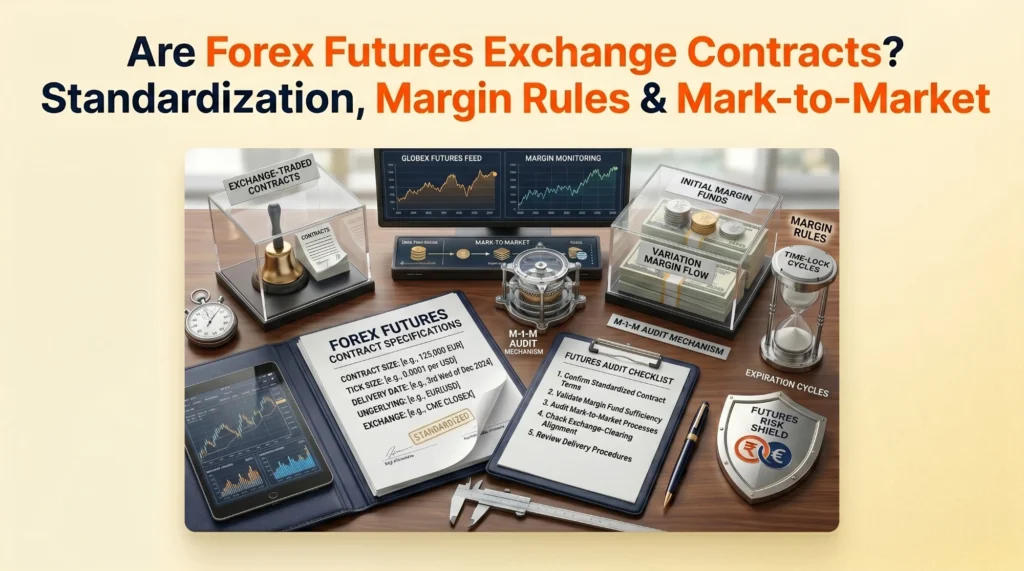
Are Forex Futures Exchange Contracts? Standardization, Margin Rules & Mark-to-Market
Forex Futures are exchange-listed currency contracts built around standardized terms, central clearing structure, and daily mark-to-market settlement. Confusion starts when readers treat futures as though they behave like live spot conversion or customized OTC forwards. In reality, Forex Futures place the user inside a pre-built listed framework rather than a negotiated bilateral arrangement.
Operating in this environment fundamentally alters how risk and capital are managed. This article explains standardization mechanics, quotes to notional exposure, the strict separation of margin layers, mark-to-market funding reality, contract fit, and an objective comparison with spot and forward forex alternatives.
warning EDUCATIONAL DISCLAIMER
This article is educational only. It is not investment advice, trade signaling, platform promotion, or execution coaching. The article explains market structure and contract behavior, not encouraging trading or implying profit potential. Trading derivatives on margin carries a high risk of loss.
Why Do Some Currency Needs Point to Forex Futures Instead of Spot or OTC Forwards?
Some currency needs point to Forex Futures because the user values listed-market structure, transparent contract rails, and central clearing more than bilateral customization. When diagnosing Forex contract types, the choice often hinges on market architecture rather than immediate price direction.
Why Does Exchange Structure Matter Before Price Direction Does?
Exchange structure matters before price direction because market architecture determines execution, clearing, funding rules, and position durability. A trader can be perfectly correct on the direction of a currency pair, but if their chosen market structure introduces unmanageable funding pressure or severe rollover friction, the position will likely fail before the directional thesis materializes.
Why Can Standardization Be a Feature Instead of a Limitation?
Standardization can be a feature because fixed contract rails improve comparability, visibility, and operational consistency. By forcing all participants into the same contract sizes, tick increments, and expiry dates, the listed exchange concentrates liquidity into deep, predictable pools, removing the need for slow, one-on-one bilateral negotiation.
Why Are Forex Futures Not Just Forward Contracts on a Different Screen?
Forex Futures are not just forward contracts on a different screen because futures are exchange-traded and centrally cleared, while forwards are bilateral OTC contracts. They share the same currency theme, different market rails. A forward locks you to the creditworthiness of a single bank, whereas a futures contract interposes a central clearinghouse to guarantee both sides of the trade.
What Are Forex Futures, and What Makes Them True Exchange Contracts?
A Forex Future is a standardized agreement listed on an exchange, with preset contract terms and clearing architecture that replace custom bilateral negotiation. This fundamentally shifts the risk from counterparty performance to standardized margin compliance (CFTC, 2024).
What Is a Forex Future in Plain English?
A Forex Future is an exchange-listed contract on a currency pair with standardized rules and clearing-backed settlement procedures. It obligates the buyer and seller to transact a fixed amount of currency at a predetermined price on a specific future date, overseen entirely by the exchange's rulebook.
What Does “Exchange Contract” Actually Mean in Practice?
In practice, an exchange contract means the instrument is publicly listed, rule-standardized, centrally cleared, and accessed through approved brokerage or FCM (Futures Commission Merchant) channels. Users do not negotiate directly with each other; they submit orders to a central order book where the exchange ensures anonymity and execution integrity.
What Does Exchange Structure Not Solve by Itself?
Exchange structure does not solve hedge-fit problems by itself, and it does not remove basis risk, timing mismatch, or rollover needs. Examining Central counterparty clearing reveals that this structural substitution guarantees execution payment but forces the user to accept the rigidity of the exchange's standardized calendar.
What Should the Exchange-Contract Anatomy Map Include?
The exchange-contract anatomy map clarifies exactly what the venue controls versus what the participant must manage.
| Feature | What the Exchange Fixes | What Still Depends on the User |
|---|---|---|
| Contract listing | Available currency pairs | Choosing the right pair |
| Contract specifications | Notional size and contract rules | Calculating required exposure |
| Clearing | Centralized clearing framework | Funding the account correctly |
| Margin framework | Minimum collateral structure | Maintaining usable buffer |
| Expiry | Listed contract months | Rolling if exposure continues |
| Access channel | Need for broker/FCM access | Selecting a suitable provider |
What Exactly Gets Standardized in a Forex Futures Contract?
Standardization in a Forex Futures contract fixes the contract size, tick increment, listed contract months, trading schedule, and settlement procedures before entry. This ensures that when a trader clicks "Buy," they receive the exact identical economic bundle as any other participant on the network.
Which Contract Terms Are Fixed Before You Even Trade?
Before the user trades, the exchange already fixes contract size, minimum tick increment, listed contract months, trading schedule, and contract procedures. As detailed in Standardized futures contracts, if you trade CME Euro FX futures, you are locked into €125,000 per contract and specific quarterly expiry months, preventing the creation of odd sizes like €142,300 (CME Group, 2024).
How Does Standardization Improve Market Function but Reduce Custom Fit?
Standardization improves market function by concentrating activity into common rails, but it reduces custom fit for irregular exposures. This deep liquidity produces tighter spreads and faster execution, yet it forces a corporate hedger to accept that their unique cash-flow dates will rarely match the rigid exchange calendar perfectly.
Why Does Contract Granularity Create Over-Hedge or Under-Hedge Risk?
Contract granularity creates over-hedge or under-hedge risk because real exposures rarely match listed contract multipliers perfectly. If a company needs to hedge $350,000 using a contract standardized at $100,000, they must choose between buying 3 contracts (under-hedged by $50,000) or 4 contracts (over-hedged by $50,000).
What Should the Forex Futures Standardization Table Include?
The standardization table outlines the benefits and the inevitable friction points of rigid contract design.
| Standardized Element | Why It Helps | Where Fit Can Still Break |
|---|---|---|
| Contract size | Concentrates participation into common units | Leaves odd-sized exposure partially mismatched |
| Tick value | Makes P&L math predictable | Can magnify account volatility |
| Expiry month | Aligns activity around listed dates | Forces rollover when the need runs longer |
| Trading calendar | Creates a stable schedule | May not match specific commercial timing |
| Settlement procedure | Defines contract-end logic clearly | May not match every real-world need |
| Listing convention | Standardizes quote interpretation | Can confuse users used to OTC conventions |
How Are Forex Futures Quoted, and How Does Contract Size Turn Price Into Exposure?
A Forex Futures quote shows the listed price of the underlying currency, but true exposure only appears once that quote is connected to contract size. A microscopic price shift carries heavy economic weight because the exchange multiplies that change against the standardized contract base.
How Does the Reader Interpret an FX Futures Quote?
Interpreting an FX Futures quote requires understanding how the exchange expresses the base currency against the quote currency under a listed convention. Most standard forex futures (like the CME Euro or British Pound) are quoted in U.S. dollars per unit of foreign currency, meaning an upward move in the quote indicates foreign currency strength (CME Group, 2024).
How Does Contract Size Change the Meaning of a Small Price Move?
Contract size changes the meaning of a small price move because even a minor quote shift is applied to a fixed underlying multiplier. A 0.0001 (one pip) movement in price might seem negligible visually, but when multiplied across a standard 100,000 unit contract, it generates a measurable and immediate monetary impact on the account.
Which Simple Formula Helps the Reader Connect Price to Notional Exposure?
A simple exposure formula helps the reader connect the listed quote to the contract’s actual economic size. By calculating this, users can contextualize their true footprint relative to their account equity.
This serves strictly as a reader-orientation formula to emphasize that buying a single future controls a massive underlying block of capital.
Why Does Tick Value Matter More Than Many Readers Expect?
Tick Value matters because the exchange fixes the dollar consequence of the minimum price increment for each contract. For example, if a CME Euro FX contract has a minimum tick increment of $0.00005 and a size of €125,000, every single tick movement translates to exactly $6.25 in profit or loss per contract.
What Should the Quote-to-Tick Value Map Include?
The quote-to-tick map breaks down how execution price translates directly into operational sizing variables.
| Input | What It Means | Why It Matters Operationally |
|---|---|---|
| Futures price | Current listed quote | Sets execution baseline |
| Contract size | Fixed amount controlled per contract | Creates the multiplier |
| Tick increment | Smallest permitted price move | Defines market granularity |
| Tick value | Dollar value of one tick | Defines per-contract sensitivity |
| Number of contracts | Total position size | Scales total risk and margin |
| Total notional exposure | Full economic size | Shows true size versus account equity |
How Do Forex Futures Margin Rules Actually Work?
Forex Futures margin works as a performance-bond structure tied to clearing, and it must be separated into initial, maintenance, and variation components. To master Futures margin requirements, operators must abandon the idea that margin is a down payment and understand it purely as protective collateral (NFA, 2024).
What Is Initial Margin in Forex Futures?
Initial Margin is the collateral required to open and support a new Forex Futures position. It is not a partial purchase payment for the currency; it is a good-faith security deposit held by the clearing system to guarantee that the participant can cover potential near-term adverse price movements.
What Is Maintenance Margin, and Why Does It Matter After Entry?
Maintenance Margin is the minimum equity threshold the account must remain above to keep the position supported without a margin call. If an adverse market move causes the account's total usable equity to drop below this strict baseline, the broker will issue a call requiring immediate capital replenishment to restore the balance back to the initial margin level.
How Is Daily Variation Margin Different from Both?
Variation Margin is different because it represents the actual daily cash movement created by mark-to-market settlement. Unlike initial and maintenance margin—which act as static collateral limits—variation margin is the dynamic process where actual cash is debited from losing accounts and credited to winning accounts every single day.
Why Is Exchange Margin Not Always the Same as Broker House Margin?
Exchange margin is the minimum listed framework, but broker house margin can be higher because firms apply their own risk buffers. An FCM or broker assesses market volatility and client risk profiles, frequently overlaying their own "house" margin requirements on top of the exchange's minimums to protect their own clearing exposure.
What Should the Futures Margin Waterfall Table Include?
The margin waterfall table isolates the purpose of each collateral layer and corrects the most frequent operational misunderstandings.
| Margin Layer | What It Does | When It Matters Most | Common Misread |
|---|---|---|---|
| Initial margin | Supports opening the position | At entry | Thinking it pays for the contract |
| Maintenance margin | Sets the minimum ongoing equity line | During adverse movement | Confusing it with initial margin |
| Daily variation margin | Settles daily P&L in cash | At each settlement cycle | Assuming P&L stays unrealized |
| Broker house margin | Adds firm-level protection | During elevated risk | Assuming exchange minimums are final |
| Excess equity buffer | Provides breathing room | Throughout the trade | Running with no cushion |
How Does Daily Mark-to-Market Change the Real Forex Futures Experience?
Daily mark-to-market changes the Forex Futures experience because gains and losses affect usable account equity every trading day. This mechanism ruthlessly prevents systemic debt buildup by forcing participants to realize their floating volatility in cold cash at the end of every session (CFTC, 2024).
Why Is Mark-to-Market More Than “Floating P&L on a Screen”?
Mark-to-Market is more than floating P&L because the clearing process converts daily price movement into actual account debits and credits. When the daily settlement price is published, the clearinghouse literally moves cash from the accounts of the day's losers into the accounts of the day's winners, making the P&L financially real.
How Can a Good Thesis Still Create Funding Pressure?
A good thesis can still create funding pressure if the market moves against the position early enough to trigger daily debits and margin strain. The market can be early against you and still demand cash today. Even if the currency pair eventually hits your target six months from now, severe interim mark-to-market debits can force a liquidation if your cash reserves run dry.
Why Does Daily Settlement Change Risk Behavior Compared with OTC Products?
Daily settlement changes risk behavior because listed futures require ongoing funding readiness, while many OTC forwards concentrate settlement impact around maturity. A forward user might endure a year of negative floating valuation without posting cash, but a futures user must prove their solvency to the exchange every single afternoon.
What Should the Three-Day Mark-to-Market Example Include?
This sequential timeline converts the abstract mark-to-market process into an operational reality.
| Day | Futures Move | Daily P&L | Margin Equity Impact | Action Needed? |
|---|---|---|---|---|
| Day 0 | Trade entered | Flat | Initial margin posted | None, monitor position |
| Day 1 | Adverse move | Negative debit | Equity moves lower | Check available buffer |
| Day 2 | Further adverse move | Additional negative debit | Equity nears or breaches maintenance | Add funds or reduce risk |
| Day 3 | Partial recovery | Positive credit | Equity improves | Reassess position fit |
How Do Standardization, Margin, and Mark-to-Market Interact Inside Forex Futures?
In Forex Futures, standardization shapes contract fit, margin governs durability, and mark-to-market turns price movement into daily funding consequences. These are not isolated rules; they form an interconnected framework that demands continuous liquidity management from the user.
How Does Contract Size Interact with Margin Burden?
Contract size interacts with margin burden because larger listed exposure increases both required collateral and per-move P&L sensitivity. Utilizing multiple heavy contracts rapidly multiplies the initial margin requirement, leaving less excess equity available to absorb the brutal mark-to-market swings of the variation margin process.
How Does Expiry Structure Interact with Rollover and Basis Risk?
Expiry structure interacts with rollover and basis risk because listed contract months end on fixed schedules while user needs may continue beyond them. When a hedger's exposure outlives the front month, they must execute a Rollover—closing the current contract and opening a deferred one—forcing them to absorb the Futures Basis (the pricing difference) between the two months.
How Does Central Clearing Improve Counterparty Structure While Reducing Customization?
Central clearing improves counterparty structure by replacing bilateral exposure with a clearinghouse framework, but it reduces customization in size and timing. Examining Central counterparty clearing reveals that this structural substitution guarantees execution payment but forces the user to accept the rigidity of the exchange's standardized calendar.
What Should the Feature Relationship Map Include?
The feature relationship map connects isolated futures mechanics into one holistic operational system.
| Feature | Connected Variable | Downstream Effect | What the Reader Should Watch |
|---|---|---|---|
| Contract size | Tick value and notional | Changes P&L sensitivity | Match size to account capacity |
| Expiry month | Roll schedule and basis | Forces timing decisions | Plan the roll early |
| Margin level | Required account equity | Determines durability | Monitor distance to maintenance |
| Daily settlement | Usable cash flow | Creates funding pressure | Keep liquidity available |
| Clearing structure | Counterparty framework | Changes credit exposure pattern | Accept the loss of bespoke fit |
How Do Forex Futures Compare with Spot Forex and Forward Forex?
Comparing Forex Futures with spot and forward forex shows that each instrument solves a different combination of timing, customization, and cash-flow needs. Choosing correctly requires abandoning product favoritism and diagnosing the specific friction point in the user's underlying exposure.
Forex Futures vs Spot Forex — What Job Does Each One Solve?
Spot Forex solves near-immediate conversion needs, while Forex Futures provide standardized listed exposure for a future-oriented market view or hedge. If the user requires physical liquidity to settle a foreign invoice tomorrow morning, spot execution is required. Futures exist specifically to secure a rate for a distant horizon without fully funding the conversion today.
Forex Futures vs Forward Forex — Where Does Standardization Beat Customization, and Where Does It Not?
Forex Futures beat forwards when listed structure and clearing matter more than bespoke fit, but forwards win when exact size and date matching are mandatory. A massive corporate treasury might demand a forward because their €2,415,800 exposure maturing on the 14th of the month misfits the rigid CME multiplier and its standardized quarterly expiration.
Why Does Daily Settlement Make This Comparison More Important Than It First Looks?
Daily settlement makes this comparison more important because a future and a forward can reflect a similar market view while creating very different interim cash-flow demands. A user locked into a listed future must have the working capital to feed daily variation margin drains, whereas the OTC forward user may face minimal cash settlement until the contract's final maturity date arrives.
What Should the FX Instrument Comparison Table Include?
The FX instrument comparison table isolates timing, structure, customization, and funding behavior across the three dominant markets.
| Instrument | Timing Logic | Structure | Customization | Daily Cash-Flow Effect | Best-Fit Use Case |
|---|---|---|---|---|---|
| Spot | Near-immediate | OTC cash market | High | Low ongoing margin burden | Current conversion need |
| Forward | Specific future date | OTC bilateral | High | Often maturity-focused | Exact future hedge |
| Futures | Listed future month | Central exchange | Low | High due to daily mark-to-market | Standardized clearing-sensitive use |
When Are Forex Futures a Good Fit, and When Are They the Wrong Tool?
Forex Futures are a good fit when listed-market structure matches the exposure, but they are the wrong tool when rigid contract rails misfit the real need. Forcing an incompatible exposure into an exchange box creates persistent operational headaches and unrewarded basis risk.
Which Exposure Patterns Usually Fit Forex Futures Best?
Forex Futures fit best when exposure maps reasonably well to listed contract size and listed contract months, and when the user can tolerate margin discipline. For participants managing recurring, highly standardized risk blocks who prioritize clearinghouse security over perfect date granularity, futures provide an exceptionally clean and transparent rail.
When Does a Forward Fit Better Than Forex Futures?
A Forward Forex contract fits better when the hedge requires exact notional precision or a very specific future date that listed months do not match well. In circumstances involving tightly scheduled debt repayments or unalterable supplier contracts, the bespoke customization of the OTC forward market eliminates the rollover stress and residual sizing gaps inherent in listed futures.
When Does Spot Still Make More Sense?
Spot still makes more sense when the need is immediate, because futures add horizon management and margin complexity to a problem that may only require current conversion. A derivative serves no purpose if the underlying cash flow happens today; engaging an exchange contract for instant physical liquidity introduces needless operational friction.
What Should the Forex Futures Fit Matrix Include?
The Forex Futures fit matrix provides an objective diagnostic tool to align need patterns with the correct structural outcome.
| Need Pattern | Better Structure | Main Benefit | Main Trade-Off |
|---|---|---|---|
| Immediate exchange | Spot Forex | Clean current conversion | Exposed to live market rate |
| Standardized future hedge | Forex Futures | Central clearing and listed structure | Margin funding pressure |
| Custom future payment date | Forward Forex | Exact timing match | Bilateral OTC dependence |
| Clearing-sensitive trading use | Forex Futures | Standardized listed access | Inflexible contract sizing |
| Odd-size corporate exposure | Forward Forex | Precise notional fit | Less standardized market rail |
What Does Real-World Forex Futures Use Actually Look Like?
Real-world Forex Futures use shows that the same listed contract can serve very different goals depending on whether the user is trading a market view or managing repeatable exposure. Institutional participants deploy these contracts specifically to exploit the efficiencies of the central network.
How Would a Macro Trader Use Forex Futures?
A macro trader uses Forex Futures to access listed-market liquidity, visible contract rules, and centrally cleared exposure without bilateral dealer negotiation. For directional speculators operating on sovereign interest-rate differentials or cross-border trade flows, the futures exchange delivers pure, scalable currency exposure fortified by a transparent central order book.
How Would a Treasury User Use Forex Futures for a Standardized Hedge?
A treasury user can use Forex Futures when exposure aligns reasonably well with listed contract size and listed months, and when clearing structure matters. A multinational utilizing recurring quarterly budget cycles can efficiently lock their generalized baseline exposure using listed futures, accepting minor sizing imperfections in exchange for avoiding heavy bilateral credit lines with multiple banks.
Why Might a Real User Still Choose a Forward Instead?
A real user may still choose a forward because irregular notionals and off-cycle dates often need precision that standardized futures cannot provide cleanly. Real-world corporate treasuries frequently manage messy, off-date supplier invoices that would require messy, ongoing rollover maintenance if forced into the strict quarterly grid of the futures exchange.
How Do Access, Expiry, and Rollover Change the Real Forex Futures Decision?
The real Forex Futures decision changes once market access, contract expiry, and rollover friction enter the picture. Theoretical hedging models often ignore the gritty operational realities of holding a listed contract through multiple expiration cycles.
Who Can Actually Access Forex Futures Cleanly?
Forex Futures access requires an approved broker or FCM relationship and an account structure that supports listed margin trading. Unlike spot forex which features highly accessible retail platforms, true exchange-listed futures mandate a heavily regulated onboarding process to ensure the participant meets the strict capital standards required by the clearinghouse network.
Why Does Expiry Matter Even Before the Contract Expires?
Expiry matters before the final date because users with longer horizons usually need to decide whether to roll the position before contract-end procedures become relevant. Liquidity in the front month begins to evaporate days or weeks before expiration; operators must proactively monitor the calendar to execute their transitions safely.
How Can Rollover and Basis Create Hidden Drag?
Rollover can create hidden drag because moving from one listed month to another can introduce spread cost, basis change, and execution friction. Shifting exposure forward is never structurally free; entering the new deferred contract often occurs at a slightly different price (basis) reflecting interest rate differentials, creating a subtle but persistent cost over extended timelines.
What Should the Access and Rollover Reality Map Include?
This map identifies the lifecycle frictions that heavily influence whether futures are practically usable.
| Decision Variable | Why It Matters | What It Changes in Practice |
|---|---|---|
| Broker / FCM access | Required for listed participation | Determines account route and trading access |
| Margin policy | Sets usable capital requirements | Changes buffer needs and risk tolerance |
| Expiry month | Defines listed contract horizon | Forces planning before month-end |
| Rollover need | Extends exposure beyond current month | Adds spread cost and administration |
| Basis sensitivity | Connects futures to underlying market reality | Affects roll efficiency and fit |
How Do You Fix a Forex Futures Position That No Longer Matches the Need?
Fixing a Forex Futures position requires structural repair, such as scaling, rolling, reducing, closing, or migrating to another instrument when fit breaks down. Standing frozen inside a rigid listed contract is a recipe for severe capital damage.
What Happens If the Timing Horizon Moves Beyond the Current Contract Month?
If the timing horizon extends, the user usually needs to roll from the current contract month into a later one, accepting that the economic baseline changes. This structural timing repair requires closing the initial obligation and absorbing the calendar spread difference required to enter the deferred month.
What Happens If the Needed Exposure Size Changes?
If the needed exposure size changes, the user has to adjust contract count while accepting that fixed granularity may still leave residual mismatch. You cannot buy "half" a standard listed contract; altering size mandates adding or stripping full blocks, which rarely perfectly seals the newly created exposure gap.
What Happens If Margin Pressure Becomes the Real Problem?
If margin pressure becomes the real problem, the user may need to reduce size, add capital, or exit the position before maintenance pressure forces the decision. A technically correct market thesis is useless if daily debits destroy the account's maintenance threshold before the expected directional movement finally occurs.
What If the User Picked Futures for a Problem That Needed a Forward?
If the position was built in futures but the real need required exact size and date matching, the clean repair may be to close the listed position and shift to an OTC forward. Clinging to the wrong instrument limits operational efficiency; the professional path is an active migration to a bespoke forward that cleanly honors the unique parameters.
What Should the Forex Futures Adjustment Paths Table Include?
The adjustment table provides exact repair routes and the economic consequences associated with each fix.
| Problem | Common Adjustment Path | What Changes Economically | Main Risk |
|---|---|---|---|
| Horizon extended | Roll to deferred month | New basis and pricing apply | Roll cost and slippage |
| Horizon shortened | Close early | P&L is realized sooner | Residual timing mismatch |
| Exposure size reduced | Scale out | Margin burden falls | Realized P&L on reduced size |
| Exposure size increased | Scale in | Margin demand rises | Larger daily P&L swings |
| Margin stress | Add capital or reduce size | Improves durability | Thesis may be weakened or abandoned |
| Wrong-instrument diagnosis | Migrate to OTC forward | Counterparty structure changes | Realized loss and transition friction |
Final Checklist — Are Forex Futures Actually the Right Exchange Contract for Your Need?
Validating Forex Futures means confirming that listed-market structure fits the problem, that margin logic is understood, and that the contract rail matches the real exposure closely enough. Execute this final validation sequence to prevent dangerous structural misfires.
Validate the Market-Structure Need
Validating the market-structure need confirms that central clearing and standardization solve a real problem rather than add unnecessary friction.
- Do you need listed-market structure rather than bilateral OTC customization?
- Does central clearing create a real benefit for this use case?
- Is standardization helping rather than restricting the job?
Validate the Contract Fit
Validating the contract fit ensures that contract size, listed month, and residual mismatch remain acceptable.
- Is the standardized contract size acceptable for the exposure?
- Is the listed contract month workable for the timing need?
- Is remaining notional mismatch manageable?
Validate the Margin and Mark-to-Market Reality
Validating the margin and mark-to-market reality means confirming that daily settlement can be funded without breaking the position.
- Do you clearly understand initial vs maintenance vs variation margin?
- Can the account tolerate daily equity movement and funding pressure?
- Are broker house margin rules understood?
Validate the Alternative Structures
Validating the alternatives ensures that spot or forwards would not solve the same need with less friction.
- Would Spot Forex solve the need more cleanly?
- Would an OTC forward match the exact size and date more precisely?
- Is Forex Futures still the cleanest structure after that comparison?
Forex Futures are strongest when the user genuinely needs listed-market structure, can operate inside standardized contract rails, and understands that margin plus daily mark-to-market define the real financial experience. They become a poor fit when the real job requires exact date precision, exact notional matching, or lower interim funding pressure than a listed futures position can comfortably support.
Forex Futures FAQs
What is the difference between Forex Futures and Spot Forex?
Spot Forex solves near-immediate conversion needs, while Forex Futures provide standardized listed exposure for a future-oriented market view or hedge.
Do I have to take physical delivery of the currency?
Not necessarily. While some Forex Futures are physically delivered, the vast majority of participants offset or roll their positions before expiration to avoid physical delivery procedures.
Is Initial Margin a down payment on the currency?
No. Initial margin acts as a performance bond or good-faith collateral to open the position, proving to the clearinghouse that you can cover potential near-term price fluctuations. It does not represent ownership or partial purchase of the asset.