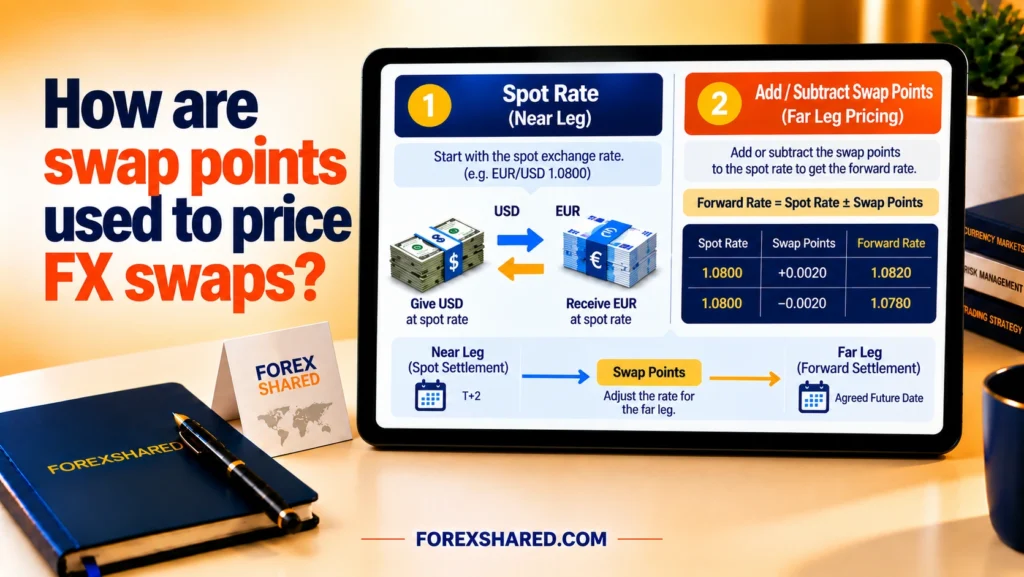
How are swap points used to price FX swaps?
Swap points price an FX swap by expressing how far the far-leg exchange rate sits above or below the near-leg exchange rate. For a conventional spot-starting structure, the raw differential is F − S; after applying the currency pair’s point convention, the converted adjustment is added to the near rate so that Far Rate = Near Rate + Converted Swap Points.
Relative interest rates and tenor provide the core theoretical pricing baseline through covered interest parity, while observed market points can also reflect cross-currency basis, hedging demand, funding conditions, liquidity and dealer balance-sheet constraints. Those economic drivers remain subordinate to the mechanical pricing task: points first express the difference between the two relevant exchange rates, and the resulting far rate then determines the reverse-leg cash amount.
This article explains the swap-point definition, rate conversion, multiplier, positive and negative signs, tenor, relative-rate logic, CIP benchmark, cross-currency basis, implied funding interpretation, bid/ask execution, far-leg principal amount, spot-versus-points repricing, forward-starting swaps, a controlled EUR/USD example and a repeatable pricing workflow.
This article is for general education only and does not constitute financial, investment, trading, funding, legal, regulatory, accounting or tax advice. Actual FX swap pricing depends on the transaction, currency pair, tenor, market convention, counterparties and executable market conditions.
What Are Swap Points in an FX Swap?
Swap points are the quoted exchange-rate difference between the near and far value dates of an FX swap. They are the pricing bridge inside the broader Forex swap pricing mechanics, connecting the reference rate for the near date with the outright rate for the far date.
What two rates do swap points connect?
In a standard spot-starting swap, they connect the spot/near rate with the far/forward rate. In forward-starting structures, the economically relevant near reference can itself be a shorter-dated forward rather than today’s spot.
What is the simplified rate-difference formula?
The raw exchange-rate difference is F − S. BIS describes FX swaps as typically quoted in forward points equal to the difference between the pre-agreed forward rate F and the spot or reference rate S. BIS
Why are they called points?
Dealers commonly scale small exchange-rate differences into price points for compact quotation. A point multiplier converts the decimal rate difference into a quoted integer or decimal point value, and that multiplier must be checked for the applicable convention.
Are swap points themselves the far rate?
No. Swap points are the adjustment applied to the near/reference rate to derive the far outright rate. Swap Points ≠ Far Rate and Swap Points ≠ Separate Fee.
Swap points are the difference between the two leg rates, not a third FX rate and not a separate fee.
How Do Swap Points Convert the Spot Rate Into the Far Rate?
Convert the quoted points into a decimal rate adjustment, then add that signed adjustment to the near rate. This Two-leg pricing delta is the signed difference that bridges the two leg rates. In the controlled EUR/USD convention used here, S = 1.1000 and one point = 0.0001.
What rate adjustment does −50 points represent?
At 0.0001 per point, −50 points equals −0.0050. The conversion is −50 × 0.0001 = −0.0050.
What is the far rate?
1.1000 − 0.0050 = 1.0950. The far rate is therefore the near rate plus the signed decimal adjustment.
What if the points were +50 instead?
The far rate becomes 1.1050 under the same controlled convention because +50 × 0.0001 = +0.0050.
What does this prove?
The point quote specifies how far the far rate is above or below the near rate. It is a differential, not an independent outright exchange rate.
| Quoted Points | Rate Adjustment | Near Rate | Far Rate |
|---|---|---|---|
| −50 | −0.0050 | 1.1000 | 1.0950 |
| 0 | 0.0000 | 1.1000 | 1.1000 |
| +50 | +0.0050 | 1.1000 | 1.1050 |
How Does the Point Multiplier Affect the Quoted Swap Price?
The multiplier converts a small decimal exchange-rate difference into the market or reporting point notation used for the currency. A 10,000 multiplier is common, but it is not universal.
Why is a multiplier needed?
It turns small decimal price differences into manageable quoted point values. The two-way conversion is Rate Difference × Multiplier = Points and Points ÷ Multiplier = Rate Difference.
What is a common multiplier?
10,000 is common for many currencies and is the ECB MMSR default for currencies not otherwise listed in its published v3.7 table.
Is 10,000 universal?
No. Currency conventions can use different multipliers. ECB’s published v3.7 Annex VI, for example, lists 100 for currencies such as JPY and KRW, while many others use 10,000. ECB
What does current ECB reporting require?
Published ECB MMSR v3.7 specifies currency-dependent multipliers and a standard 10,000 default for currencies not listed. It was published on 15 July 2026 and generally applies from 1 July 2027, with permitted early implementation after notification; it should therefore not be described as universally current-effective in October 2026. ECB
What should the reader do first?
Identify the currency’s applicable point convention before converting points into a rate differential. Do not blindly assume a 10,000 multiplier.
| Currency Example | Published Multiplier | Interpretation |
|---|---|---|
| USD | 10,000 | Common four-decimal scaling |
| JPY | 100 | Different scaling convention |
| KRW | 100 | Different scaling convention |
| Currency not listed | 10,000 | ECB v3.7 reporting default |
ECB MMSR v3.7 was published on 15 July 2026 and generally applies from 1 July 2027, with permitted early implementation after notification. The table is used here as published reporting evidence, not as a claim that v3.7 is universally current-effective in October 2026.
What Do Positive and Negative Swap Points Mean?
Positive points mean the far rate is above the near rate; negative points mean it is below the near rate. That is the mathematical interpretation before any funding-cost interpretation.
What do positive points mean mathematically?
F > S. The signed rate adjustment is positive, so the far outright sits above the near/reference rate.
What do negative points mean mathematically?
F < S. The signed rate adjustment is negative, so the far outright sits below the near/reference rate.
Does positive automatically mean expensive funding?
No. Funding interpretation depends on quotation, currency borrowed, currency lent, tenor and counterparty perspective. A positive point sign is not a universal cost label.
Does negative automatically mean cheap funding?
No. The reciprocal counterparty experiences the opposite currency-funding relationship. The economic meaning must be attached to a named currency, direction and party.
Why Do Interest-Rate Differentials Drive the Baseline Swap Points?
Relative interest rates drive the baseline spot-forward relationship because an FX swap economically combines borrowing one currency with lending another. The relationship is developed further in Interest-rate differentials and swap points.
What does the FX swap economically combine?
It economically combines borrowing one currency and lending the other. BIS describes the borrowed amounts as exchanged near and repaid at the pre-agreed forward rate at maturity. BIS
Why should relative interest rates matter?
The two currencies have different financing returns or costs over the same tenor. The relevant baseline is therefore relative, not the absolute interest rate of either currency in isolation.
What pricing relationship compensates for that difference?
The spot-forward exchange-rate differential reflects that relative financing relationship in the no-arbitrage benchmark. That is why the forward or far rate generally differs from the near/reference rate.
What does CIP say in simplified form?
Under BIS’s USD-per-foreign-currency convention, the one-period benchmark can be written F/S = (1+r)/(1+r*), where r is the USD rate and r* is the foreign-currency rate. The quotation and rate definitions must remain attached to the formula. BIS
What does this become in the FX swap quote?
The implied F − S becomes the baseline forward or swap-point differential. Interest-Rate Differential ≠ Swap Points because the variables use different units.
Why Does the Swap Tenor Change the Number of Points?
Swap points are tenor-specific because the relative financing relationship accumulates over the period between the two value dates.
What does tenor measure?
The period from near settlement to far settlement.
Why does time affect the spot-forward differential?
The relative financing effect compounds or accrues over the swap period. Day-count and compounding conventions therefore matter when moving from rate economics to an actual forward relationship.
Should one-week and six-month points be identical?
No such equality should be expected merely because current rates are unchanged. A longer interval generally embeds more time over which the relative financing relationship can operate.
Can raw points from different tenors be compared directly as funding rates?
No. Raw points must be normalized using spot, tenor and relevant conventions before funding interpretation. Swap points are tenor-specific prices, not maturity-neutral annualized yields.
| Input | One Week | Six Months |
|---|---|---|
| Near-to-far interval | Short | Longer |
| Relative-rate accrual period | Short | Longer |
| Raw points | Tenor-specific | Tenor-specific |
| Direct annualized comparison? | No | No |
How Does Covered Interest Parity Provide a Benchmark for FX Swap Pricing?
Covered interest parity supplies the no-arbitrage benchmark linking spot, forward and the two currencies’ interest rates.
What does CIP connect?
Spot rate, forward rate, Currency A rate, Currency B rate and maturity.
What is its economic purpose?
It removes frictionless covered-arbitrage opportunities between cash funding and hedged FX funding in the textbook benchmark. Real-world implementation can still involve balance-sheet, liquidity, credit and transaction costs.
What does CIP imply for swap points?
It produces a theoretical forward-minus-spot differential consistent with relative interest rates. That theoretical differential can then be translated into points using the relevant pair convention.
Does CIP say observed swap points must always equal that level?
No. Real markets include intermediation, balance-sheet, funding, hedging and liquidity frictions. BIS research documents persistent deviations from CIP and links them to hedging demand and costly balance-sheet capacity. BIS
Why Can Market Swap Points Differ From the CIP Benchmark?
Market swap points can diverge from the textbook CIP level when demand for currency hedging or funding meets constrained dealer balance-sheet capacity and other market frictions.
What is the difference commonly associated with?
A cross-currency basis relative to the selected parity benchmark.
What can generate basis?
Hedging demand, funding demand, dealer balance-sheet costs, liquidity, regulation and limits to arbitrage can contribute. BIS analysis emphasises hedging demand interacting with constrained balance-sheet capacity. BIS
What happens to observed swap points?
They can be wider or narrower than the level implied by benchmark rates alone. The words wider and narrower must always be interpreted using the stated currency quotation and direction.
What does BIS emphasize?
BIS analysis shows that dealers can pass balance-sheet and hedging costs into the price of the forward leg, widening points relative to the textbook CIP relationship. BIS
What does this mean for funding?
The FX-swap-implied cost of obtaining a currency can differ from direct cash-market borrowing. That difference is an analytical funding signal, not a recommendation to trade or arbitrage it.
Is Cross-Currency Basis the Same Thing as Swap Points?
No. Swap points are an FX-price differential, while cross-currency basis measures deviation from a selected interest-parity funding benchmark.
What are swap points?
F − S, expressed through the pair’s point convention.
What is basis?
Basis is the interest-rate spread required to reconcile observed FX-implied funding with a chosen CIP benchmark. BIS uses cross-currency basis to describe deviations from covered interest parity. BIS
Can swap points contain basis effects?
Yes. Observed points can reflect basis-related deviations from benchmark-rate pricing, in addition to the baseline interest-rate relationship.
Are the two numerically interchangeable?
No. Basis is generally expressed as an interest-rate spread, while swap points are FX price increments. Basis can affect swap points; basis is not swap points.
| Feature | Swap Points | Cross-Currency Basis |
|---|---|---|
| Core meaning | FX rate differential | Deviation from parity funding benchmark |
| Typical unit | FX price points | Interest-rate spread / basis points |
| Can interact? | Yes | Yes |
| Numerically interchangeable? | No | No |
Basis can affect observed swap points; basis is not swap points.
How Do Swap Points Translate Into an Implied Funding Cost?
Swap points contain funding information because they encode the price difference between obtaining one currency and reversing that exchange later.
Why do swap points contain funding information?
They reflect the relative pricing of temporary currency funding across two value dates.
Can raw points be compared directly with an interest rate?
No. Interpretation requires spot, tenor, quotation convention and the relevant other-currency funding benchmark.
What does the resulting calculation provide?
It can produce an FX-swap-implied funding rate or yield for one currency relative to the other. The exact annualization must follow the applicable day-count and rate conventions rather than one universal formula.
Why does party perspective matter?
Borrow-USD/lend-EUR and borrow-EUR/lend-USD are reciprocal but economically different funding perspectives. Funding cost must therefore be attached to a named currency and party.
How Do Bid and Ask Swap Points Affect the Executable FX Swap Price?
Executable FX swap pricing uses bid and ask points rather than assuming one universal mid-market point level.
Are swap points quoted with bid and ask sides?
Yes. Dealer markets can quote different executable sides for swap-point transactions, while a mid or reference point level can sit between them.
Why are there two sides?
The spread compensates for providing two-sided liquidity and intermediation and reflects the distinction between the price at which liquidity can be bought and sold.
What can influence the spread?
Pair, tenor, size, volatility, liquidity, counterparty factors and dealer balance-sheet conditions can matter. BIS research finds strong co-movement in spot and FX-swap bid/ask spreads and links deteriorating FX funding liquidity with wider market-liquidity spreads. BIS
What should not be confused?
The absolute point level should not be confused with the bid/ask spread around executable pricing. Swap-Point Level ≠ Bid/Ask Spread and Mid / Reference Points ≠ Executable Points.
How Do Swap Points Determine the Far-Leg Currency Amount?
Swap points determine the far-leg amount indirectly by changing the far exchange rate applied to the contract principal. The relationship also shares the broader logic of Forward exchange-rate pricing.
What determines the near USD amount?
In the controlled EUR/USD model, near USD amount is X × S, where X is the EUR principal and S is USD per EUR.
What determines the far USD amount?
Far USD amount is X × F in the controlled fixed-EUR-principal model.
What role do the swap points play?
They create the rate difference F − S, which changes the quote-currency amount paid on the far leg. The chain is Points → F → Far Cash Flow, not Points → Near Principal.
S + P = F, then X × F = Far Quote-Currency Amount. Swap points affect far cash flow through the far rate.
How Can the Spot Rate Move While Swap Points Stay the Same?
Spot and swap points are separate pricing variables, so spot can move while the near/far differential remains unchanged.
What changed?
The spot-rate level changed. For example, suppose S moves from 1.1000 to 1.1100.
What stayed unchanged?
The −50-point near/far differential remained unchanged. Under a 0.0001 point size, the rate adjustment remains −0.0050.
Why does this matter?
The outright far rate depends on both the current reference rate and the point adjustment. With S = 1.1100 and −50 points, F = 1.1050 rather than the previous 1.0950.
| Scenario | Near Rate S | Point Adjustment | Far Rate F |
|---|---|---|---|
| Initial | 1.1000 | −0.0050 | 1.0950 |
| Spot higher | 1.1100 | −0.0050 | 1.1050 |
Can Swap Points Move Even If Spot Is Stable?
Yes. Swap points can change while spot remains stable because relative funding and intermediation conditions can reprice independently.
What can change while spot remains near the same level?
Interest rates, rate expectations, funding demand, basis, dealer balance-sheet costs and liquidity can change. BIS research links swap-market pricing and liquidity to such funding and intermediation conditions. BIS
What happens to the far rate?
If points change while S is stable, F changes because the signed rate adjustment changes.
What does this tell the reader?
FX swap pricing is driven by relative financing conditions as well as the spot-rate level. That observation does not create a directional forecast for future spot.
How Are Forward-Starting FX Swaps Priced With Points?
In a forward-starting swap, the economically relevant differential can connect a shorter-dated forward rate with a later forward rate rather than starting from today’s spot rate.
What is a forward-starting swap?
Its near exchange occurs at future T₁ and its reverse exchange occurs at later T₂.
What rates matter economically?
The shorter-dated forward at T₁ and the longer-dated forward at T₂.
What does CME note about the standard F − S framework?
CME notes that S can be a forward rate if F is the longer-dated forward, allowing forward-swap pricing from one future value date to another. CME
What is therefore the deeper pricing rule?
The far-date rate minus the near-date rate represents the economic rate differential across the swap interval.
What reporting caution applies?
Reporting frameworks may define forward-point fields differently from dealer-market pricing practice. Published ECB MMSR v3.7 calculates reported forward points against its designated reported spot rate and separately recognises forward/forward FX swaps; v3.7 generally applies from 1 July 2027, so that reporting formula should not be presented as a universal dealer quotation rule in October 2026. ECB
| Structure | Near Reference | Far Reference | Economic Differential |
|---|---|---|---|
| Spot / Forward | S | F | F − S |
| Forward / Forward | F₁ at T₁ | F₂ at T₂ | F₂ − F₁ |
What EUR/USD Example Shows How Swap Points Price the FX Swap?
A EUR/USD example shows how a quoted point adjustment converts the near rate into the far rate and then into the far-leg USD amount.
What is the rate adjustment?
−50 × 0.0001 = −0.0050.
What is the far rate?
1.1000 − 0.0050 = 1.0950.
What happens on the near leg?
Party A pays EUR 10m and receives USD 11m because EUR 10m × 1.1000 = USD 11m.
What happens on the far leg?
In the controlled fixed-EUR-principal example, Party A receives EUR 10m and pays USD 10.95m because EUR 10m × 1.0950 = USD 10.95m.
What pricing role did the −50 points perform?
They converted the 1.1000 near rate into the 1.0950 far rate, which then determined the far USD principal.
Does −50 points by itself tell you whether USD funding is expensive?
No. Funding interpretation also requires tenor, EUR and USD funding benchmarks, basis, transaction direction and executable pricing. The sign alone is not a universal cheap/expensive label.
How Should You Price an FX Swap From a Swap-Point Quote?
Price the swap by identifying the pair convention, near rate, tenor, quoted point side and multiplier before converting the points into the far outright rate.
What is the currency pair?
Identify the exact pair and quotation convention.
What is the near / spot rate?
Record the relevant near/reference rate S. For a forward-starting swap this may be a shorter-dated forward rather than today’s spot.
What is the swap tenor?
Identify the period from near value date to far value date.
What points are quoted?
Record whether the quote is bid, ask, mid or another reference.
What multiplier applies?
Confirm the pair’s point convention before conversion. Do not default blindly to 10,000.
What rate adjustment do the points represent?
Calculate P = Points ÷ Multiplier under the applicable convention.
What is the far outright rate?
Calculate F = S + P using the signed adjustment.
What is the far-leg principal amount?
Apply F to the relevant contractual principal using the pair convention and actual transaction notional.
What explains the level of points?
Interpret tenor, relative rates, basis, funding conditions and liquidity without confusing the point level with the bid/ask spread.
Is the quote executable or indicative?
Distinguish mid/reference pricing from bid/ask execution. An indicative level is not automatically the price at which a particular trade can be executed.
- Identify the currency pair.
- Confirm the quotation convention.
- Identify the near/reference rate.
- Identify the swap tenor.
- Read the quoted points and quote side.
- Identify the correct point multiplier.
- Convert points into a signed rate adjustment.
- Calculate the far outright rate.
- Calculate the far-leg principal amount.
- Interpret relative rates, basis and execution conditions separately.
How Can Traders and Treasury Teams Avoid Misreading Swap Points?
Swap points are most often misread when they are confused with fees, outright forward rates, interest-rate spreads, forecasts or executable bid/ask costs.
Why is “swap points are a fee” incorrect?
Because points represent an FX rate differential between value dates rather than a separate institutional broker charge.
Why is “swap points are the forward rate” incorrect?
Because the points must be applied to a reference rate to obtain the far outright rate.
Why is “negative points means cheap funding” incomplete?
Funding interpretation depends on which currency is borrowed, which is lent, the pair convention, tenor and the party perspective.
Why is “points equal the interest-rate differential” incorrect?
Interest rates help determine the FX rate differential, but interest rates and FX points are different quantities expressed in different units.
Why is “CIP always determines the exact quote” incorrect?
Actual quotes can incorporate cross-currency basis, hedging demand, balance-sheet constraints, liquidity and execution frictions.
Why is “same points across tenors means same funding cost” incorrect?
Raw points are maturity-dependent and must be normalized before funding-rate comparison.
Why is “forward premium predicts appreciation” incorrect?
Forward pricing reflects contractual relative-financing economics rather than a simple forecast of future spot.
What should be checked before accepting an FX swap price?
Verify near rate, far rate, point quote, multiplier, sign, tenor, rate differential, basis distinction, bid/ask status and far-leg amount.
- Near / reference rate identified.
- Far / forward rate kept separate.
- Swap points treated as a rate differential.
- Correct multiplier confirmed.
- Sign interpreted using the pair convention.
- Tenor identified.
- Relative interest rates treated as the baseline driver.
- CIP treated as a benchmark, not a guaranteed traded quote.
- Basis kept separate from swap points.
- Point level kept separate from bid/ask spread.
- Mid kept separate from executable quote.
- Funding interpretation attached to a named currency and perspective.
- Forward premium or discount not treated as a spot forecast.
- Far-leg amount calculated from the resulting far rate.
- Forward-starting pricing not forced into spot-start mechanics.
Conclusion
Swap points price an FX swap by expressing the exchange-rate differential between its two relevant value dates. For a conventional spot-starting swap, the raw differential is F − S, and the market or reporting convention converts that decimal difference into quoted points through the applicable multiplier.
The calculation therefore runs in both directions: Quoted Points = (F − S) × Pair Multiplier, while the signed rate adjustment is Points ÷ Pair Multiplier. The far outright is then F = S + Converted Point Adjustment. Once F is known, it can be applied to the relevant contractual principal to calculate the far-leg currency amount.
Relative interest rates and tenor provide the core covered-interest-parity benchmark for the near/far relationship. Actual market pricing can additionally reflect cross-currency basis, hedging and funding demand, dealer balance-sheet constraints, liquidity and execution conditions. Those layers explain why observed points can differ from a textbook parity level without changing what swap points are.
Swap points are therefore the pricing bridge between the near and far legs of an FX swap. They are not a separate fee, not the far rate itself, not an interest rate, not automatically comparable across tenors, and not a simple forecast of future spot. Correct interpretation requires the near rate, point convention, sign, tenor, currency perspective, benchmark rates, basis distinction and executable quote side to remain separate.
FAQs
What are swap points in an FX swap?
Swap points are the quoted difference between the far exchange rate and the relevant near/reference rate, expressed using the currency’s point convention. They are not a separate fee.
How do swap points determine the far exchange rate?
Convert the point quote into a signed rate adjustment and apply it to the near/reference rate. In compact form, F = S + P, where P is the converted point adjustment.
Why do interest rates affect swap points?
Relative currency interest rates determine the baseline spot-forward relationship under covered interest parity. Tenor determines the period over which that relative financing relationship operates.
Are cross-currency basis and swap points the same thing?
No. Basis measures deviation from a funding-parity benchmark; swap points are an FX price differential. Basis can affect observed points without being numerically interchangeable with them.
Are negative swap points a fee paid by one side?
No. Negative points mean the far rate lies below the reference rate under the stated quotation convention. Funding-cost interpretation additionally requires currency, tenor, benchmark rates, transaction direction and execution side.