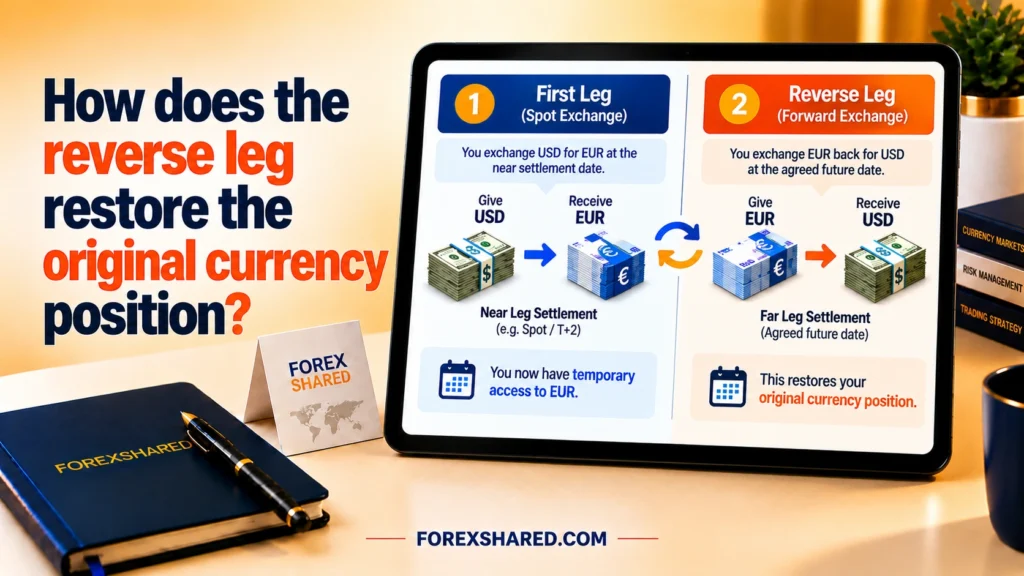
How does the reverse leg restore the original currency position?
The reverse leg restores the original contractual currency principal by requiring the party to return the currency received on the near leg and receive back the currency originally supplied. From Party A’s perspective, the swap therefore follows Near A→B and Far B→A, with both directions established as part of the original FX swap.
The restoration follows the pre-agreed far terms rather than a new spot conversion chosen at maturity. In a controlled EUR/USD example, the same EUR principal can return even though the USD amount differs because the near rate S and far rate F are different. What is restored is the contractual principal relationship, not necessarily the participant’s entire portfolio, wealth, liquidity condition or economic state.
This article explains what the reverse leg does, which principal is restored, which currency must be returned, why numerical amounts can differ, when the far rate is fixed, how temporary currency access ends, how the mechanism resembles funding repayment, why actual settlement matters, which risks remain, how rollover differs from restoration, how forward-forward swaps behave and how to trace the mechanics through a controlled EUR/USD example.
This article is for general education only and does not constitute financial, investment, trading, funding, legal, regulatory, accounting or tax advice. Actual FX swap principal amounts, settlement rights, modification terms and obligations depend on the transaction documentation and applicable framework.
What Does the Reverse Leg of an FX Swap Actually Do?
The reverse leg completes the second principal exchange by reversing the currency directions created on the near leg. The same two currencies move in opposite directions under terms established when the swap was entered. The full parent flow is explained in Two-leg swap currency movement.
What happened on the near leg?
Party A delivered Currency A and received Currency B. That initial principal exchange created the reference flow that the far leg later reverses.
What happens on the far leg?
Party A delivers Currency B and receives Currency A back. Party B performs the exact reciprocal flow, so the same two currencies remain inside the transaction.
Why is this called the reverse leg?
It is the reverse leg because both principal-payment directions reverse. “Reverse” refers to Currency A → Currency B becoming Currency B → Currency A, not to the market price of a currency pair moving higher or lower.
When was this reversal agreed?
The reversal was agreed when the FX swap was concluded, not when maturity arrived. BIS defines an FX swap as an exchange of two currency principals followed by a reverse exchange of the same currencies later, with the rates for both legs agreed when the contract is concluded. BIS
The reverse leg closes the same currency-exchange cycle opened by the near leg.
What Does “Restore the Original Currency Position” Mean?
In this article, restoration primarily means receiving back the currency principal originally delivered under the swap.
What is being restored?
The far leg restores the originally supplied currency principal. In the controlled EUR/USD example, Party A originally supplies EUR and later receives that EUR principal back under the far-leg terms.
What is not automatically restored?
The far leg does not automatically restore the participant’s original portfolio, liabilities, market value, liquidity condition, or wealth. Those can change during the swap period independently of the principal reversal.
Why is this distinction important?
The distinction matters because the temporary currency may have been spent, invested, lent, or used to satisfy another obligation. A principal can be restored under the swap while the participant’s broader economic state remains materially different.
| Automatically Addressed by Far Leg | Not Automatically Restored |
|---|---|
| Originally supplied swap currency principal | Investment portfolio |
| Temporary currency repayment obligation | Asset prices |
| Pre-agreed currency reversal | Liabilities |
| Far-leg contractual exchange | Realised or unrealised P&L |
| Temporary swap currency cycle | Broader liquidity conditions |
Which Currency Is Returned and Which Currency Comes Back?
The currency received near is delivered far, while the currency originally delivered near is received back.
Which currency did Party A receive near?
Party A received USD on the controlled EUR/USD near leg.
Which currency must Party A deliver far?
Party A must deliver USD on the far leg. This is a fungible currency obligation; the contractual requirement does not mean the identical physical units received earlier must be preserved.
Which currency did Party A originally supply?
Party A originally supplied EUR.
Which currency does Party A receive far?
Party A receives EUR back on the far leg.
| Stage | Party A Pays | Party A Receives |
|---|---|---|
| Near | Currency A | Currency B |
| Far | Currency B | Currency A |
Why Does the Far Leg Reverse Rather Than Extend the Currency Position?
The original far leg reverses the temporary currency transformation because the FX swap has a defined maturity and reciprocal second exchange.
What would extension require?
Continued Currency B access generally requires a rollover, replacement swap, or another funding source. Continuation is therefore a new or modified funding arrangement rather than an automatic property of the original far leg.
What does the original contract require?
The original contract requires the contracted Currency B payment at the far date, subject to the actual transaction terms.
What happens to Currency A?
Currency A is received back under the far-leg reversal.
Why is this structurally important?
Without the pre-agreed far reversal, the first exchange would not have the same temporary two-leg swap structure. The reciprocal maturity exchange is what closes the original currency-transformation cycle.
Why Can the Amount Returned Differ From the Amount Originally Received?
The amounts can differ because the near and far exchange rates can differ even when the same principal currency is restored.
For a controlled teaching model, let X = EUR principal, S = near EUR/USD rate and F = far EUR/USD rate.
What does Party A receive near?
In the controlled example, X EUR exchanged at near rate S produces X × S USD.
What does Party A deliver far?
Holding X EUR constant in the teaching example, Party A delivers X × F USD to receive X EUR back. Actual contract notionals govern real transactions.
Why can the USD amounts differ?
The USD amounts differ when F differs from S. If S = 1.1000 and F = 1.0950, the USD amount associated with X EUR differs across the two legs.
What is restored in this common structure?
The controlled structure restores X EUR.
What is not necessarily identical?
The USD amount is not necessarily identical across the two legs.
The formulas deliberately hold X EUR constant for clarity. Actual notionals and settlement amounts must follow the specific swap documentation.
How Does the Pre-Agreed Far Rate Restore the Currency Without Depending on Future Spot?
The far leg uses the exchange rate agreed when the swap was entered, so the contractual reversal does not wait for the future spot rate.
When is the far rate set?
The far rate is agreed when the FX swap is concluded. BIS defines the reverse exchange as occurring at a later date at a rate agreed at the time of the contract. BIS
What does the far rate determine?
The far rate determines the contractual conversion relationship used at far settlement.
What if the market spot rate is very different at maturity?
The far exchange still follows the contracted far terms. The parties do not replace the agreed far rate with the then-current spot rate merely because the market has moved.
What can future spot rates affect?
Future spot can affect the mark-to-market value of the outstanding swap before maturity. Market valuation and contractual settlement mechanics therefore remain separate concepts.
The far leg restores principal through a pre-agreed exchange, not a fresh spot conversion at maturity.
How Does the Reverse Leg End Temporary Currency Access?
Temporary access ends when the far leg requires the temporary currency to be delivered and returns the originally supplied currency. The first-leg side of that lifecycle is explained in Temporary currency access.
What happened after the near leg?
After near settlement, Party A temporarily holds or uses Currency B in place of the supplied Currency A within the swap flow.
What happens at the far leg?
Party A delivers Currency B and recovers Currency A.
What period therefore defines temporary access?
The temporary-access period runs economically from near settlement to far settlement.
What if Currency B is still needed afterward?
Continued access requires replacement or extended funding rather than automatic continuation of the matured swap.
How Does the Reverse Leg Resemble Funding Repayment?
Economically, the far leg repays the currency temporarily obtained while returning the currency supplied at the start of the swap.
What happens at maturity?
Party A returns the temporarily obtained currency and recovers the currency it supplied.
What does BIS call this economic relationship?
BIS analysis describes FX swaps economically as borrowing one currency while lending another. The borrowed currency is exchanged near and repaid at the pre-agreed far rate. BIS
What does the reverse leg therefore accomplish economically?
Economically, it repays the temporary currency funding and restores the supplied currency principal.
Why should this not simply be called loan repayment?
Because the contractual instrument is an FX swap with two reciprocal principal exchanges, not necessarily a conventional loan. Economic similarity does not create universal legal identity.
Near: lend A / borrow B. Far: repay B / recover A.
Does the Reverse Leg Restore the Entire Portfolio to Its Starting Point?
No. The far leg restores the swap’s contractual currency-principal relationship, not the participant’s complete portfolio history.
What if the temporary USD was never used elsewhere?
The currency balances may end relatively close to the original swap-related state, subject to the contract’s actual cash flows. That still does not prove an identical economic state.
What if USD was used to buy an asset?
The far leg does not automatically eliminate or reverse the asset purchased with the USD. Party A may still need to source the required USD for far settlement while continuing to hold the asset.
What if liabilities changed during the swap period?
Those liability changes remain unless separately reversed or discharged.
What if asset prices changed?
Gains or losses on assets remain economically relevant after far settlement.
What is therefore restored?
The far leg restores the contractual currency-principal relationship defined by the FX swap.
| Can Be Restored by Far Leg | Does Not Automatically Revert |
|---|---|
| Original swap Currency A principal | Assets purchased during swap |
| Currency B repayment relationship | Liability changes |
| Contractual currency cycle | Market-value changes |
| Temporary swap principal transformation | Realised P&L |
| Far-leg exchange obligation | General liquidity conditions |
What If the Temporarily Received Currency Has Already Been Used?
Using the temporary currency does not remove the far-leg obligation to deliver the contracted amount at maturity.
Can Party A spend or invest Currency B?
Yes, subject to its purpose and applicable constraints. The FX swap itself does not ordinarily require the received currency to remain untouched.
Does that remove the far-leg obligation?
No. The contracted far payment remains due.
What must Party A have at maturity?
Party A must have the contracted Currency B amount required for far settlement.
Where might that currency come from?
It may come from asset proceeds, cash balances, business cash flow, new borrowing, another FX transaction, or asset sales. These are examples of possible sources, not recommendations.
Why is this important?
Currency A is restored only if the far-leg Currency B payment is successfully performed. Contractual entitlement to receive Currency A is therefore distinct from completed settlement.
When Does Currency Restoration Actually Occur?
Contractual restoration is agreed at inception, but actual currency restoration occurs only when the far-leg payments settle successfully.
Is restoration complete when the swap is entered?
No. Inception creates the future reversal obligation.
Is restoration complete after the near leg?
No. Only the first principal exchange has been performed. The far exchange remains outstanding and the residual position can become forward-like after the first leg settles. BIS
When is the principal actually restored?
The principal is restored when the far leg settles successfully. BIS defines FX settlement risk as the risk that one party fails to deliver the currency owed, which means contractual terms alone do not guarantee successful cash settlement. BIS 2026
Why does this distinction matter?
A contractual receivable of Currency A is not the same as having settled Currency A available.
What Risks Remain Before the Reverse Leg Restores the Currency?
A pre-agreed far rate fixes the contractual reversal terms but does not remove settlement, counterparty, liquidity, rollover, basis, or underlying-mismatch risks.
Potential risks include settlement risk, counterparty risk, liquidity risk, rollover risk, basis risk and mismatch with an underlying asset or liability. Their relevance depends on the participant and transaction structure.
What risk does the pre-agreed far rate reduce?
It removes uncertainty about the contractual exchange rate used for the far reversal.
What does it not eliminate?
It does not ensure liquidity, repayment-currency availability, counterparty performance, or alignment with the underlying exposure. BIS 2026 settlement research specifically shows that one party can fail to deliver the currency owed even when contractual payment obligations exist. BIS 2026
A fixed far rate defines the restoration terms; it does not guarantee every condition required for successful economic completion.
What Happens If the Original Currency Is Needed Before the Far Date?
The original swap does not automatically return Currency A early merely because the participant’s needs change.
Can Party A demand Currency A back early automatically?
No. The original transaction specifies its settlement dates, subject to the actual contractual terms.
What may Party A need to do?
It may need an offsetting transaction, contractual amendment or termination, or another liquidity source, depending on applicable terms. These are possible mechanisms rather than transaction-specific recommendations.
What does this show?
The far leg restores Currency A at the contractual far date unless the transaction is validly modified.
What Happens If the Temporary Currency Is Still Needed After the Far Date?
The original far obligation still matures even if the participant wants to continue holding or funding Currency B.
What does the original swap require?
The original swap requires its far-leg settlement or valid contractual management.
Can the position be maintained?
It can potentially be maintained through a rollover or replacement transaction. The mechanics of short-dated continuation are covered separately in Tom-Next rollover mechanics.
Does the rollover erase the original reverse leg?
No. The maturing exposure must still be settled, replaced, or otherwise contractually managed.
Why does this matter?
Economic Currency B access can continue even though the original swap reaches its contractual end. BIS research notes that FX swaps are often short term and can create rollover risk when replacement funding must be obtained under changed market conditions. BIS 2026
Original Swap Far Leg → original temporary position closes. If continued exposure is needed, Replacement / Rolled Swap → new exposure begins.
Do Forward-Forward FX Swaps Restore Currency the Same Way?
Yes. A forward-forward FX swap uses the same reciprocal principal-restoration logic even though the first exchange occurs on a future date.
What happens at T₁?
Currency A is exchanged for Currency B at T₁.
What happens at T₂?
Currency B is exchanged back for Currency A at T₂.
Does the principle change?
No. The far leg still restores the currency principal supplied on the first leg.
What changes?
Only the timing of the first settlement changes relative to a spot-starting swap. BIS 2025 methodology expressly includes forward/forward FX swaps along with spot/forward and short-dated structures. BIS 2025
What EUR/USD Example Shows the Restoration Mechanics Clearly?
A fixed-EUR-principal EUR/USD example shows how the same EUR principal can return while the USD amounts differ across the two legs.
Assume EUR Principal = EUR 10,000,000, Near EUR/USD Rate S = 1.1000 and Far EUR/USD Rate F = 1.0950. This is a controlled teaching example, not a universal contract convention.
What happens on the near leg?
Party A pays EUR 10m and receives USD 11m at 1.1000.
What currency position does Party A have during the swap?
Relative to the swap principal, Party A has temporarily exchanged EUR liquidity for USD access. This does not mean Party A’s entire portfolio has become a USD-only position.
What happens on the far leg?
Party A pays USD 10.95m and receives EUR 10m at 1.0950 in the controlled example.
What was restored?
EUR 10m, the original EUR principal in this teaching example.
What did not return identically?
The USD amount differed: USD 11m near versus USD 10.95m far because S ≠ F.
Does this mean Party A’s entire economic position is back to the starting point?
No. Other assets, liabilities, transaction costs, P&L, liquidity conditions and cash flows may have changed during the swap period.
| Stage | Party A Pays | Party A Receives | Rate |
|---|---|---|---|
| Near | EUR 10.00m | USD 11.00m | 1.1000 |
| Swap period | Temporary USD position | EUR recovery remains contractual | Far obligation outstanding |
| Far | USD 10.95m | EUR 10.00m | 1.0950 |
How Should You Trace Restoration in Any FX Swap?
Trace restoration by identifying the originally supplied currency, the temporarily received currency, both contractual rates and dates, and the final far-leg payment.
What currency was originally supplied?
Identify Currency A.
What currency was received near?
Identify Currency B.
What amount was delivered near?
Record the contractual near Currency A principal.
What amount was received near?
Apply or verify the near rate according to the transaction’s quotation convention rather than assuming one universal formula.
What is the far date?
Identify the contractual maturity / far settlement date.
What amount of Currency B must be delivered far?
Read or calculate the contracted Currency B far payment from the transaction terms rather than assuming it equals the near Currency B receipt.
What Currency A amount is received back?
Identify the Currency A principal restored under the far leg.
Did Currency B get used elsewhere?
If Currency B was deployed, identify how the far payment will be funded. This is a liquidity-analysis question, not a recommendation about how funding should be obtained.
Does the participant still need Currency B after maturity?
If yes, identify the existence of a replacement-funding or rollover requirement without assuming rollover availability.
Is the article discussing swap restoration or total portfolio restoration?
Keep the analysis limited to swap-principal restoration unless broader portfolio effects are explicitly being examined.
- Identify Currency A.
- Identify Currency B.
- Record near principal.
- Identify near rate.
- Identify far date.
- Identify far rate or contractual payment.
- Determine Currency B returned.
- Determine Currency A restored.
- Check funding source for far payment where relevant.
- Separate swap restoration from portfolio restoration.
How Can Traders and Treasury Teams Avoid Misreading Reverse-Leg Restoration?
Reverse-leg restoration is easiest to misread when principal restoration is confused with identical cash amounts, future spot conversion, portfolio restoration, or automatic rollover.
Why is “everything returns to exactly where it started” incorrect?
Because the far leg restores the swap’s contractual currency principal, not every intervening economic event.
Why is “the same exact currency amount must come back on both sides” incorrect?
Because different near and far rates can produce different amounts in one currency.
Why is “future spot determines the reversal” incorrect?
Because the contractual far rate was fixed when the swap was entered. BIS’s FX swap definition explicitly places the long-leg rate at contract conclusion rather than at later maturity. BIS
Why is “the far leg is optional” incorrect?
Because it is part of the contractual swap obligation unless validly modified, terminated, or otherwise managed under applicable terms.
Why is “using the temporary currency removes the repayment obligation” incorrect?
Because use of Currency B does not change the contracted Currency B payment due at far settlement.
Why is “rollover means nothing was restored” incorrect?
Because a replacement transaction can continue economic exposure while the original swap is settled, replaced, or otherwise contractually closed. The original and replacement transactions remain analytically distinct.
What should be verified before accepting a restoration claim?
Verify the two currencies, both directions, both rates, far date, far payment, restored principal, settlement status, and any rollover or portfolio assumptions.
- Originally supplied currency identified.
- Temporarily received currency identified.
- Far direction reverses near direction.
- Same two currencies remain involved.
- Near and far rates are separate.
- Numerical amounts are not assumed identical.
- Far rate is pre-agreed.
- Actual restoration requires successful far settlement.
- Principal restoration is separated from portfolio restoration.
- Use of Currency B does not cancel repayment.
- Rollover is separate from original maturity.
- Residual settlement, liquidity and counterparty risks are not ignored.
Conclusion
The reverse leg restores the original contractual currency principal by undoing the currency exchange created on the near leg.
From Party A’s perspective, the structure is Near A → B and Far B → A. Currency A is supplied near, Currency B is temporarily received, Currency B is delivered at the far date and Currency A is received back.
In the controlled amount model, Near = X EUR → X × S USD and Far = X × F USD → X EUR. X EUR can therefore be restored even though the USD amount differs when F ≠ S. The far rate F was agreed when the swap was entered, so future spot does not redefine the contractual reversal.
Successful far settlement completes the principal restoration and ends the original temporary currency transformation. That restoration remains narrowly defined: Swap Principal Restoration ≠ Complete Portfolio / Balance-Sheet / Wealth Restoration.
The reverse leg closes the FX swap’s temporary currency cycle by requiring repayment of the currency received on the near leg and returning the originally supplied currency under far terms agreed at inception. This restores the swap’s contractual currency-principal relationship, but it does not automatically restore every asset, liability, valuation, liquidity condition, or economic outcome that existed before the swap.
FAQs
What does the reverse leg of an FX swap return?
It returns the currency principal originally supplied by one party while requiring delivery of the currency that party received on the near leg. From Party A’s perspective, Near A → B becomes Far B → A.
Does the reverse leg return exactly the same amounts exchanged on the near leg?
Not necessarily. Different near and far rates can make one currency amount differ even when the original principal in the other currency is restored. Actual notionals depend on the transaction documentation.
Is the far exchange based on the spot rate at maturity?
No. The far exchange follows the rate or pricing terms agreed when the FX swap was entered. Future spot can affect valuation but does not redefine the contractual reversal.
Does the reverse leg restore the participant’s entire portfolio?
No. It restores the swap’s contractual currency-principal relationship. Other assets, liabilities, gains, losses, liquidity conditions and cash flows may remain changed.
What happens if the temporary currency is still needed after maturity?
The original far obligation still needs to be settled or otherwise contractually managed, while continued access generally requires replacement or rolled funding. Rollover is not an automatic extension of the original swap.