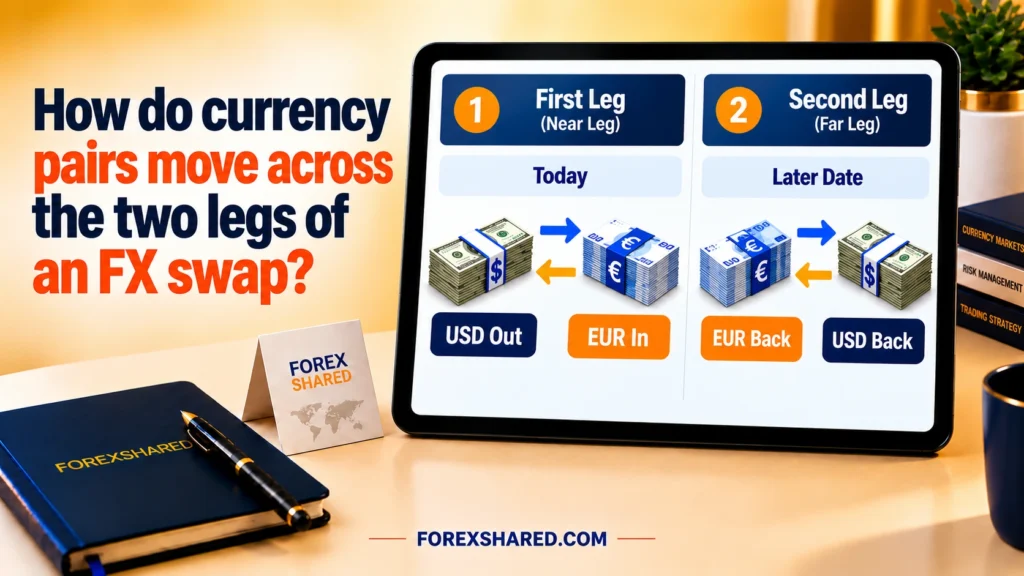
How do currency pairs move across the two legs of an FX swap?
Across an FX swap, the same two currencies move in opposite directions on the near and far legs. From Party A’s perspective, the near leg delivers Currency A and receives Currency B; the far leg later delivers Currency B and receives Currency A.
The currency-pair identity remains unchanged. For EUR/USD, Party A can Sell EUR / Buy USD on the near leg and Buy EUR / Sell USD on the far leg. EUR remains the base currency and USD remains the quote currency. Only the transaction direction and principal cash-flow direction reverse. Near and far exchange rates can also differ, so one numerical currency amount can differ across the legs without changing the reciprocal structure.
This article separates principal flow from FX price movement, explains base and quote roles, fixes counterparty perspective, maps the near exchange and far reversal, preserves same-pair continuity, explains separate near and far rates, shows why amounts can differ, connects swap points to far-leg amounts, covers forward/forward timing and post-near lifecycle, and finishes with one controlled EUR/USD example.
This article is for general education only and does not constitute financial, investment, trading, legal, accounting or tax advice. Actual FX swap notionals, rates, settlement dates and obligations must be verified from the transaction documentation.
What Does “Currency Movement” Mean Across an FX Swap?
Currency movement here means movement of currency principal between the counterparties, not a prediction that the quoted FX rate will rise or fall. The parent mechanics are explained in Forex swap two-leg structure.
Is the article describing currency-price movement?
No. It describes Principal Currency Flow: which currency each party delivers and which currency each party receives on each leg.
What question does currency flow answer?
For a stated counterparty, currency flow answers two questions: What currency do I deliver, and what currency do I receive?
What does market movement answer?
Market movement asks whether the quoted FX price, such as EUR/USD, rises or falls through time. That price can change while the contractual currency-delivery directions remain fixed.
Why must they remain separate?
Because the swap fixes principal-payment directions under the contract even while live market prices continue changing. Contracted Currency Flow ≠ Market Price Direction. BIS defines FX swaps as exchanges of principal amounts in two currencies followed by a reverse exchange of the same two currencies at a later date. BIS
| Concept | Main Question |
|---|---|
| Currency flow | Which currency is paid and received? |
| Contract rate | At what rate are the contractual amounts converted? |
| Market movement | Has the quoted pair price risen or fallen? |
| Swap structure | How does the first principal flow reverse later? |
This article tracks principal currency movement, not FX price direction.
How Do the Two Currencies Move on the Near Leg?
On the near leg, Party A delivers one currency and receives the other while Party B performs the exact reciprocal principal exchange.
What does Party A deliver?
Assume Party A enters EUR/USD and Sells EUR / Buys USD on the near leg. Party A delivers EUR.
What does Party A receive?
Party A receives USD under the agreed near-leg exchange terms.
What does Party B do?
Party B does exactly the opposite: Party B delivers USD and receives EUR.
What has occurred?
One reciprocal principal exchange has occurred: EUR ↔ USD. Party A’s Sell EUR / Buy USD and Party B’s Buy EUR / Sell USD are two perspectives on the same transaction.
How Do the Currencies Reverse on the Far Leg?
The far leg reverses the near-leg principal exchange: the currency Party A received near is delivered far, while the currency Party A delivered near is received back.
What did Party A receive near?
Party A received USD.
What does Party A deliver far?
Party A delivers the contractual USD amount on the far settlement date.
What did Party A deliver near?
Party A delivered EUR.
What does Party A receive far?
Party A receives EUR on the far leg. Party A therefore moves from Sell EUR / Buy USD near to Buy EUR / Sell USD far, while Party B performs the reciprocal flows.
Currency received near → currency delivered far. Currency delivered near → currency received far.
Does the Currency Pair Reverse on the Far Leg?
No. The currency pair remains the same; the transaction direction reverses.
Pair near?
EUR/USD.
Pair far?
Still EUR/USD.
What reverses?
The Buy / Sell Direction reverses. Party A can Sell EUR/USD near and Buy EUR/USD far.
What remains unchanged?
EUR remains the base currency, USD remains the quote currency, and the pair remains EUR/USD on both legs.
Why avoid automatically writing USD/EUR?
Because USD/EUR changes the quotation convention. It is not necessary to invert the pair label merely to describe the opposite transaction direction.
| Element | Near | Far |
|---|---|---|
| Pair | EUR/USD | EUR/USD |
| Base | EUR | EUR |
| Quote | USD | USD |
| Party A | Sell EUR / Buy USD | Buy EUR / Sell USD |
| Direction | Initial | Reverse |
How Do Base and Quote Currency Roles Help You Read Both Legs?
Base and quote roles give the reader a stable rule for translating pair-level Buy or Sell instructions into actual principal currencies delivered and received.
EUR?
EUR is the base currency in EUR/USD.
USD?
USD is the quote currency in EUR/USD.
Buy EUR/USD?
Buy EUR/USD means Buy EUR + Sell USD.
Sell EUR/USD?
Sell EUR/USD means Sell EUR + Buy USD.
How does this work in the swap?
Party A can Sell EUR/USD on the near leg and Buy EUR/USD on the far leg. CME’s FX quotation guidance confirms that the first currency in the pair is the base currency and that the trading action applies to that first currency. CME
Buy Pair → Buy Base + Sell Quote. Sell Pair → Sell Base + Buy Quote. The far leg reverses the near direction without switching base and quote identities.
Why Must the Same Two Currencies Appear on Both Legs?
The same two currencies must appear because the far leg reverses the original currency-principal exchange rather than creating a different currency relationship.
What is being reversed?
The original currency-principal exchange between Currency A and Currency B.
Which currencies must therefore appear far?
The same Currency A + Currency B must appear on the far leg.
What if near is EUR/USD and far is GBP/USD?
Then GBP/USD does not reverse the original EUR/USD exchange because GBP has replaced EUR. That is a different currency relationship.
Structural rule?
Same Currency Pair + Opposite Direction = Reciprocal FX Swap Flow. BIS explicitly defines the long leg as the reverse exchange of the same two currencies. BIS
Why Must the Direction Reverse Across the Two Legs?
The direction must reverse because the far leg is designed to unwind the near-leg principal relationship.
What if Party A buys USD both times?
If Party A receives USD on the near leg and again buys USD on the later trade, the later transaction adds USD exposure instead of returning the USD side of the original swap.
Reusable rule?
Near Receipt → Far Delivery. Near Delivery → Far Receipt.
| Near | Far |
|---|---|
| Receive Currency B | Deliver Currency B |
| Deliver Currency A | Receive Currency A |
| Buy | Sell |
| Sell | Buy |
Why Can Currency Amounts Differ Between the Two Legs?
Currency amounts can differ because the near rate and far rate can differ, so the reciprocal principal relationship does not require both currencies to have numerically identical amounts on both dates.
For a controlled EUR/USD teaching model, let X = EUR principal, S = Near EUR/USD rate and F = Far EUR/USD rate.
Near USD amount?
The simplified near USD amount is X × S.
Far USD amount?
In the controlled example holding the EUR principal X constant, the far USD amount is X × F.
Why can they differ?
Because S ≠ F can make X × S different from X × F.
Does that break the reversal?
No. The same EUR principal relationship can still be unwound: Near = X EUR → X × S USD; Far = X × F USD → X EUR. Different numerical USD amounts do not change the reciprocal direction.
This formula deliberately fixes X EUR for teaching clarity. Actual notionals and settlement amounts must follow the specific swap documentation.
How Do Swap Points Change the Far-Leg Amount Without Changing the Flow Direction?
Swap points can change the far rate and therefore the far-leg numerical amount, but they do not change pair identity, base/quote roles or reciprocal direction.
Simplified relationship?
For a simplified conventional quotation, Swap Points = F − S, subject to the market quotation convention.
What do they influence?
They influence the Far Rate and therefore can influence the Far Currency Amount. BIS describes the difference between F and S as the forward-point relationship in an FX swap. BIS
What do they not determine?
They do not determine pair identity, base/quote roles, which currencies reverse or which party buys and sells. Swap points change how much moves, not which way the currencies move.
Swap points change how much moves, not which way the currencies move.
How Do Both Counterparties Experience the Same Swap Differently?
Both counterparties experience opposite descriptions of the same exchange, so every flow statement must identify the party whose perspective is being described.
| Leg | Party A | Party B |
|---|---|---|
| Near | Sell EUR / Buy USD | Buy EUR / Sell USD |
| Far | Buy EUR / Sell USD | Sell EUR / Buy USD |
Why does perspective matter?
Because “USD is bought near” is incomplete. The precise statement is: Party A buys USD while Party B sells USD on the near leg. Every currency receipt by one party is a corresponding currency delivery by the other party.
What Happens to the Currency Position Between the Near and Far Legs?
After the near leg settles, Party A temporarily holds the received Currency B while the pre-agreed obligation to reverse that position remains outstanding.
What does Party A have after near settlement?
In the EUR/USD example, Party A has received USD and has delivered the EUR principal. This creates Temporary currency access through the first leg.
What obligation remains?
Party A must later deliver the contractual USD far-leg amount and receive EUR back.
Is EUR→USD permanent?
No. The already-contracted far leg requires USD → EUR, so the near exchange creates a temporary currency position inside the complete swap.
What may the temporary USD support?
Depending on context, the USD may support funding, payments, investment settlement or liquidity management. The FX swap establishes the receipt and reversal; the participant’s underlying activity determines the use.
The near leg creates a temporary currency position; the far leg unwinds it.
How Can These Currency Flows Be Interpreted as Borrowing and Lending?
The reciprocal flows can be interpreted economically as borrowing the currency received near while lending the currency supplied near. For Party A, EUR → USD near and USD → EUR far can therefore resemble temporary USD borrowing funded by temporary EUR lending.
BIS uses this borrow-one/lend-another framework when explaining FX swaps: one party borrows one currency and simultaneously lends another, with the exchanged amounts reversed at the pre-agreed far rate. This remains an economic interpretation; the contractual mechanism is still two reciprocal currency-principal exchanges. BIS
The institutional application is covered separately in Swap funding and liquidity use. This page keeps funding interpretation subordinate to the principal-flow mechanics.
Do Forward-Forward FX Swaps Use the Same Currency-Flow Logic?
Yes. Forward/forward FX swaps use the same reciprocal currency-flow logic; only the timing of the near leg changes.
At T₁?
At future near date T₁, Party A delivers Currency A and receives Currency B.
At T₂?
At later far date T₂, Party A delivers Currency B and receives Currency A, where T₂ > T₁.
What changed relative to spot/forward?
Only when the near leg occurs. The reciprocal flow remains A → B and then B → A. BIS 2025 methodology explicitly includes forward/forward swaps, along with spot/forward, overnight, spot-next and tomorrow/next structures, within the FX swap category. BIS 2025
| Swap Type | Near Leg | Far Leg | Flow |
|---|---|---|---|
| Spot/Forward | Spot date | Future date | A→B then B→A |
| Forward/Forward | Future T₁ | Future T₂ | A→B then B→A |
| Tomorrow/Next | Tomorrow | Following business date | A→B then B→A |
What Happens After the Near Leg Has Settled?
After the near leg settles, the initial Currency A → Currency B exchange is complete and only the pre-agreed Currency B → Currency A far exchange remains outstanding.
What has already happened?
Party A has delivered Currency A and received Currency B.
What remains?
Only the Currency B → Currency A far-leg reverse exchange remains. The purpose of that remaining reversal is developed in Reverse leg restoring the original currency position.
Why is remaining exposure forward-like?
Because one future FX exchange remains outstanding. BIS notes that once the spot leg is completed, the remaining FX swap position is economically indistinguishable from an outright forward. BIS
Does future spot change the direction?
No. Future spot can change the market valuation of the outstanding far leg, but it does not change the contractual payment direction or the pre-agreed far terms.
What EUR/USD Example Shows the Two-Leg Currency Flow Clearly?
A controlled EUR/USD example shows pair identity, reciprocal direction, counterparty perspective and amount differences together. Assume EUR Principal = EUR 10,000,000, Near EUR/USD Rate = 1.1000 and Far EUR/USD Rate = 1.0950, while holding the EUR principal constant for teaching clarity.
Party A near?
Party A pays EUR 10,000,000 and receives USD 11,000,000.
Party B performs the opposite flow: Party B delivers USD 11,000,000 and receives EUR 10,000,000.
Party A far?
Party A pays USD 10,950,000 and receives EUR 10,000,000.
Party B again performs the reciprocal flow.
What reversed?
Party A moved EUR → USD near and USD → EUR far.
What remained unchanged?
The pair remained EUR/USD, EUR remained the base currency, USD remained the quote currency, the same counterparties remained on opposite sides, and the EUR principal remained EUR 10 million in this controlled example.
Why did USD change?
Because 1.1000 ≠ 1.0950. The near USD amount is USD 11.00 million while the far USD amount is USD 10.95 million.
| Leg | Party A Pays | Party A Receives | Rate |
|---|---|---|---|
| Near | EUR 10.00m | USD 11.00m | 1.1000 |
| Far | USD 10.95m | EUR 10.00m | 1.0950 |
How Should You Read Currency Flow From Any FX Swap?
Read any FX swap by fixing pair identity and counterparty perspective first, then translating the near buy/sell direction into actual delivered and received currencies, reversing those currencies on the far leg, and only then applying the separate near and far rates.
- Identify the currency pair.
- Identify the base currency.
- Identify the quote currency.
- Choose one counterparty’s perspective.
- Identify whether that party buys or sells the pair on the near leg.
- Translate the instruction into actual currencies delivered and received.
- Reverse both currency flows for the far leg.
- Identify the near rate.
- Calculate or verify near amounts.
- Identify the far rate.
- Calculate or verify far amounts.
- Confirm the same two currencies appear on both legs.
- Confirm directions reverse.
- Confirm future spot movement is not being confused with contracted cash flow.
How Can Traders and Treasury Teams Avoid Misreading the Two-Leg Currency Flow?
Traders and treasury teams can avoid the main errors by keeping pair identity, base/quote convention, counterparty perspective, principal flow, exchange rate, numerical amount and market valuation as separate concepts.
Why is “EUR/USD becomes USD/EUR” misleading?
Because pair quotation and trade direction are different concepts. EUR/USD can remain the pair while Party A changes from Sell EUR/USD to Buy EUR/USD.
Why is “currency movement means EUR/USD moved higher/lower” incorrect?
Because this page describes principal cash flows. A higher or lower EUR/USD market quote describes price movement instead.
Why must counterparty perspective be stated?
Because Party A’s buy is Party B’s sell. A statement such as “USD is bought” is incomplete unless the buyer and seller are identified.
Why can far USD differ from near USD?
Because Far Rate ≠ Near Rate can make the quote-currency amounts different even when the same EUR principal is used in the controlled teaching model.
Why does future spot not determine far-leg direction?
Because the far exchange was pre-agreed under the swap. Future spot affects valuation, not which currency Party A is contractually required to deliver and receive.
Why is “every FX swap begins spot” incorrect?
Because FX swaps also include forward/forward and short-date structures. BIS 2025 methodology explicitly recognises forward/forward, overnight, spot-next and tomorrow/next structures. BIS 2025
What should be verified?
Verify that currency movement means principal cash flow; the same currencies and pair remain on both legs; base and quote roles do not switch; one counterparty perspective is maintained; near delivery and receipt are explicit; Party B is reciprocal; far flow reverses near flow; near and far rates are separate; far pricing is pre-agreed; numerical amounts are not automatically assumed identical; swap points affect amount rather than direction; forward/forward mechanics remain reciprocal; and post-near settlement leaves the far obligation outstanding.
- Currency movement means principal cash flow.
- The same two currencies appear on both legs.
- Pair identity remains constant.
- Base currency remains constant.
- Quote currency remains constant.
- One counterparty perspective is maintained.
- Party A near delivery is identified.
- Party A near receipt is identified.
- Party B is shown as reciprocal.
- Far flow reverses near flow.
- Near rate is identified separately.
- Far rate is identified separately.
- Far rate is pre-agreed.
- Numerical amounts are not automatically assumed identical.
- Swap points affect amount and pricing, not direction.
- Near leg is not universally labelled spot.
- Forward/forward structures follow the same flow rule.
- Temporary currency position is correctly described.
- Funding interpretation remains secondary.
- After near settlement, the far obligation still remains.
- Future market prices affect valuation rather than contractual direction.
Conclusion
Across an FX swap, the same two currencies move in opposite directions on its two legs. From Party A’s perspective, the near leg delivers Currency A and receives Currency B; the far leg delivers Currency B and receives Currency A.
For EUR/USD, Party A can Sell EUR / Buy USD near and Buy EUR / Sell USD far. The pair remains EUR/USD, EUR remains the base currency and USD remains the quote currency. What changes is Buy / Sell Direction and Principal Cash-Flow Direction.
If X is the EUR principal, S is the Near Rate and F is the Far Rate, the controlled teaching model gives X EUR → X × S USD near and X × F USD → X EUR far. S ≠ F can therefore make the Near USD Amount different from the Far USD Amount without changing the same-pair reciprocal structure.
An FX swap uses the same currency pair to create two reciprocal principal exchanges. The near leg moves Currency A into Currency B from one party’s perspective, while the far leg later moves Currency B back into Currency A. Pair identity and base/quote convention remain unchanged; the transaction direction reverses, and different near and far exchange rates can cause one currency’s numerical amount to differ across the two legs without changing the underlying principal-reversal mechanism.
FAQs
Does EUR/USD become USD/EUR on the far leg?
No. EUR/USD can remain the quoted pair. What reverses is the buy/sell direction. EUR remains the base currency and USD remains the quote currency.
Which currency does a party return on the far leg?
Generally, from that party’s perspective, the currency received on the near leg is delivered on the far leg, while the currency originally supplied is received back.
Why can the amounts differ between legs?
Because near and far rates can differ. In a controlled structure one principal may remain fixed while the corresponding amount of the other currency changes.
Do forward-forward FX swaps follow the same flow pattern?
Yes. Timing changes from T₁ to T₂, but the principal flow remains Currency A → Currency B and then Currency B → Currency A.
Does the market exchange rate at maturity determine the far-leg direction?
No. The currency direction and contractual far pricing were already established under the swap. Future market prices affect valuation, not the agreed direction of payment.
One Response