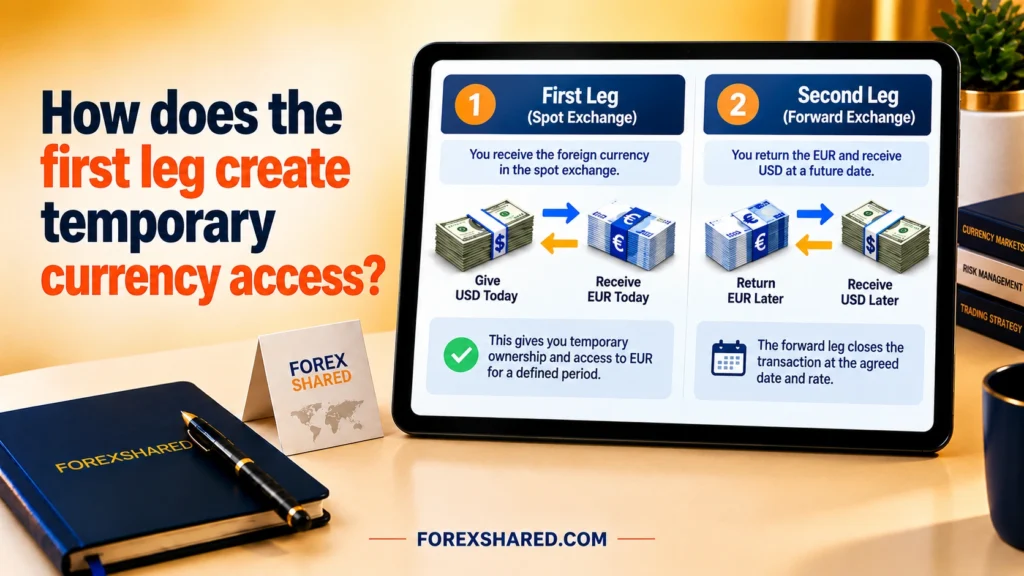
How does the first leg create temporary currency access?
The first leg of an FX swap creates temporary currency access when the near-leg principal exchange settles: the participant delivers one currency and actually receives another currency that can then be used during the swap period.
The access is temporary because the far-leg reversal already exists from inception. The currency received on the near leg must later be delivered under the contracted far terms while the currency originally supplied is received back. Economically, this can resemble borrowing the received currency while lending the supplied currency, but the contractual form remains two reciprocal currency-principal exchanges.
This article explains when usable access begins, what settles on the near leg, why the received balance can function as liquidity, what currency is supplied, how the borrowing-and-lending interpretation works, why the far leg terminates the access, how the tenor and near/far rates matter, what swap points do and do not do, which risks remain, how forward-starting swaps differ and why continued access at maturity requires rollover or replacement funding.
This article is for general education only and does not constitute financial, investment, trading, legal, regulatory, accounting or tax advice. Actual FX swap settlement, documentation, accounting, funding and risk treatment depends on the transaction terms, institution and applicable framework.
What Does Temporary Currency Access Mean in an FX Swap?
Temporary currency access means the party actually obtains the received currency principal at near settlement and can use that currency during a defined period before the already-contracted far reversal becomes due. The broader principal-flow relationship is mapped in Currency movement across swap legs.
What does the party gain?
After near settlement, the receiving party gains actual access to the contracted currency principal. In a deliverable FX swap, this is settled currency, not merely a mark-to-market exposure.
Why is this more than market exposure?
Because the near leg involves an exchange of principal amounts. The party that receives Currency B obtains a usable currency balance once settlement completes, while simultaneously giving up Currency A. BIS
Why is it temporary?
Because the same swap already contains a pre-agreed far-leg reversal. The currency received near must later be delivered under the far-leg terms while the originally supplied currency is received back.
Does temporary mean unusable?
No. Temporary describes the defined duration of the access and the future return obligation; it does not mean the received currency must remain idle or segregated.
When Does Temporary Currency Access Actually Begin?
Temporary currency access begins when the near principal exchange settles, not merely when the FX swap is agreed on trade date.
What happens on trade date?
The parties create the contractual obligations: currencies, directions, principal amounts, near and far dates, and pricing terms are agreed.
Does currency necessarily arrive then?
No. Trade formation does not itself mean the currency balance has settled into the receiving party’s account.
When does usable access begin?
Usable access begins when the near principal exchange actually settles and the contracted Currency B balance is received.
What exists before settlement?
Before near settlement, the party has a contractual receivable and payment obligation, not necessarily cash already available for payments or investment.
Why does this distinction matter?
Treasury liquidity is date-sensitive. A funding need must be matched to the value date on which the currency becomes available, not merely to the earlier trade date.
What Exactly Happens on the First / Near Leg?
The first leg performs a reciprocal principal exchange: Party A delivers the currency it has and receives the currency it needs, while Party B performs the opposite payments.
What does Party A deliver?
Assume Party A has EUR and needs USD. Party A delivers EUR on the near settlement date.
What does Party A receive?
Party A receives USD on the same near settlement date, subject to the agreed settlement mechanics.
What does Party B deliver?
Party B delivers USD, the currency Party A needs.
What does Party B receive?
Party B receives EUR, the currency Party A supplied.
What changed for Party A?
Before settlement Party A held EUR liquidity. After the reciprocal principal exchange, Party A holds USD liquidity for the swap period while the far-leg obligation remains outstanding.
Why Does Receiving the Currency Create Usable Liquidity?
Receiving Currency B creates usable liquidity because deliverable settlement places an actual currency balance with the receiving party, subject to the outstanding far-leg obligation.
What was received?
The party received an actual currency principal balance through deliverable settlement rather than only derivative price exposure.
What can it support?
Depending on the institution’s purpose, the received currency can support payments, foreign-currency asset financing, investment settlement, treasury cash needs, temporary funding needs or liquidity buffers.
Does the swap dictate the use?
No, not ordinarily. The swap defines the currency exchange and the later reversal; the institution’s treasury, investment, operational and regulatory constraints determine how the received balance is used.
Why is this useful for institutions?
It can temporarily transform liquidity already held in Currency A into liquidity needed in Currency B without making the first exchange a permanent conversion under the original swap. BIS 2025
Why Must One Currency Be Supplied to Obtain the Other?
One currency must be supplied because an FX swap near leg is a reciprocal principal exchange, not a free transfer of the needed currency.
Does Party A simply receive USD?
No. Party A receives USD because it simultaneously delivers EUR. The near leg is a reciprocal principal exchange, not a one-way transfer.
What does Party B receive?
Party B receives the EUR supplied by Party A while Party B provides the USD received by Party A.
What structural rule follows?
Currency access is reciprocal: obtaining Currency B requires supplying Currency A under the near-leg terms.
What economic interpretation follows?
Party A can be viewed economically as obtaining or borrowing USD while supplying or lending EUR for the swap period, without turning the contract into a conventional cash loan.
FX-swap access is obtained against another currency, not created from nothing.
How Does the First Leg Resemble Borrowing One Currency and Lending Another?
The first leg resembles borrowing one currency and lending another because Party A receives Currency B for temporary use while supplying Currency A for the same period.
Which currency is economically borrowed?
USD is economically borrowed in the example because Party A receives USD, can use it during the swap period and later owes the contractual USD far-leg amount.
Which currency is economically lent?
EUR is economically lent because Party A delivers EUR on the near leg and receives EUR back on the far leg.
Why is this interpretation useful?
It explains how an FX swap can provide foreign-currency funding through reciprocal currency exchanges rather than through a traditional one-currency loan. BIS
Why Is FX-Swap Currency Access Different From a Conventional Cash Loan?
FX-swap currency access differs from a conventional cash loan because the contractual form is two reciprocal currency exchanges rather than a single-currency advance followed by conventional loan repayment.
What does a normal cash loan generally involve?
A conventional cash loan generally advances one currency to a borrower, who later repays principal and any contractual interest according to the loan agreement.
What does the FX swap involve?
An FX swap involves two reciprocal currency-principal exchanges: Currency A against Currency B on the near leg, followed by Currency B against Currency A on the far leg.
Where are funding economics reflected?
They are reflected in the relationship between the near and far exchange rates, including the swap-point relationship, rather than requiring the FX swap itself to contain a conventional periodic interest coupon.
Why use the loan analogy at all?
The analogy is useful because the participant temporarily receives one currency, uses it and later returns the contractual amount, while the supplied currency is returned on the other side.
What wording should be used?
The precise wording is that an FX swap economically resembles or replicates borrowing one currency while lending another; it should not be described as legally identical to a conventional unsecured loan.
Why Does the Far Leg Make the Currency Access Temporary?
The far leg makes the access temporary because it already requires Party A to return Currency B and receive Currency A back on a defined future date. The dedicated reversal mechanics are explained in Reverse leg restoration.
What obligation already exists when Currency B is received?
When Party A receives Currency B, the same swap already obliges Party A to deliver Currency B on the far date under the agreed far terms.
What does Party A receive back?
Party A receives Currency A back on the far leg, subject to the contractual principal and pricing terms.
Is the far leg optional?
No, not under the original swap contract. Using or spending the received Currency B does not cancel the far-leg obligation.
Why does that matter?
Without a pre-agreed reversal, Currency A to Currency B could be an outright conversion. With Currency B to Currency A already contracted, the first exchange becomes a temporary currency transformation.
| Feature | Outright FX Conversion | FX Swap |
|---|---|---|
| Initial currency exchange | Yes | Yes |
| Currency B obtained | Yes | Yes |
| Reverse exchange pre-agreed | No | Yes |
| Defined far date | No | Yes |
| Currency A contractually recovered | No | Yes |
| Temporary transformation | Not inherent | Yes |
How Long Does the Temporary Currency Access Last?
The temporary-access period runs economically from near settlement to far settlement, not automatically from the earlier trade date.
When does access begin?
The access period begins economically when the near leg settles and Currency B is actually received.
When does it end?
It ends contractually at the far settlement date, when the reverse currency exchange becomes due.
What defines the duration?
The interval from near settlement to far settlement defines the relevant swap tenor and the period of temporary currency access.
Does trade date necessarily start the period?
No. If the swap is forward-starting, trade date can precede the near settlement date by days, weeks or longer.
Why does this matter operationally?
The institution must align currency availability with the date on which the real payment, investment or liquidity need occurs.
How Do the Near Rate and Far Rate Shape the Currency Access?
The near rate determines the amount relationship when Currency B is obtained, while the far rate determines the amount relationship when the exchange is reversed.
What USD amount is received near?
In a controlled EUR/USD example with X EUR principal and near rate S quoted as USD per EUR, the simplified near USD amount is X × S.
What USD amount is returned far?
If the teaching example holds X EUR principal constant and the far rate is F, the simplified far USD amount is X × F.
Why can the amounts differ?
Because S and F can differ. The far quote-currency amount can therefore differ from the near quote-currency amount.
Does the difference alter the access mechanism?
No. Near settlement still makes USD available and the far leg still requires USD to be returned. The rate difference changes the economics and numerical amounts, not the basic direction of temporary access.
This fixed-EUR-principal structure is a controlled educational representation. Actual contractual notionals and settlement amounts must be taken from the specific transaction confirmation.
Do Swap Points Create the Temporary Currency Access?
No. Near-leg settlement creates the currency access; swap points help price the far reversal by linking the near and far exchange rates.
What creates access?
Near-leg principal settlement creates the usable currency access because that is when the receiving party actually obtains Currency B.
What do swap points affect?
Swap points affect the relationship between the near rate and far rate and therefore help determine the economics of the future reversal.
Why are swap points economically important?
They influence the implied relative cost or return of the swapped currencies over the tenor, subject to the pair’s quotation convention and market pricing.
What do they not do?
They do not determine whether Party A receives USD on the near leg. Settlement creates access; swap points price the reversal.
Settlement creates the currency access; swap points price the reversal.
How Does the First Leg Change the Currency Composition of Liquidity?
The first leg can change the currency composition of available liquidity by replacing a settled Currency A balance with a settled Currency B balance for the swap period.
Before settlement?
Before settlement, Party A in the example holds EUR liquidity and has contractual near and far obligations.
After settlement?
After settlement, the EUR amount delivered is no longer available to Party A and the received USD becomes the relevant usable currency liquidity.
What changed?
The currency composition of available liquidity changed from EUR toward USD for the swap period.
Does this necessarily mean conventional balance-sheet expansion?
Not necessarily. Institutional accounting can treat FX swap obligations differently from conventional borrowing, so the effect on reported balance-sheet size depends on the accounting and institutional context. BIS 2025
What must not be concluded?
Do not conclude that every institution’s total balance sheet is unchanged. The result depends on accounting treatment, other transactions, the legal entity and jurisdiction.
Does the First Leg Eliminate Foreign-Exchange Risk?
No. The pre-agreed far leg defines the contractual reversal, but settlement, counterparty, liquidity, rollover, basis, operational and underlying asset or liability risks can remain.
What does the far leg lock?
The far leg locks the contractual reversal currency, settlement date and exchange rate according to the swap terms.
What risks may still exist?
Settlement risk, counterparty risk, liquidity risk, rollover risk, basis risk, operational risk and asset/liability mismatch can remain, depending on how the swap and the underlying exposure are structured. BIS
Does use of received Currency B matter?
Yes. If Currency B is used to finance an asset, settle a liability, make a payment or fund an investment, that underlying position can introduce its own market, liquidity, credit or maturity risks.
Correct conclusion?
Temporary Access ≠ Risk-Free Access. A defined reversal rate removes one uncertainty but does not eliminate all risks attached to the transaction or the financed activity.
Does the First Leg Always Settle Spot?
No. Spot/forward is common, but the near leg can also settle tomorrow, on another short date or at a future T1 in a forward/forward swap.
What is the common structure?
A common structure is a spot/forward FX swap: the near leg settles on the spot date and the far leg settles on a later forward date.
Can access begin later?
Yes. A forward/forward FX swap can be agreed at T0 while the first principal exchange does not occur until future date T1.
When does access begin there?
In a forward/forward swap, usable access begins at T1 settlement, not at T0 trade date.
What remains unchanged?
The flow rule remains Currency A → Currency B at T1 and Currency B → Currency A at later T2. Only timing changes. BIS 2025
| Swap Type | Trade Date | Access Begins | Access Ends |
|---|---|---|---|
| Spot/Forward | T₀ | Spot/near date | Far date |
| Forward/Forward | T₀ | Future T₁ | Future T₂ |
| Tom/Next | T₀ | Tomorrow | Following date |
What Happens If the Currency Is Still Needed When the Far Leg Arrives?
If Currency B is still needed at maturity, the original far obligation remains due and continued access requires replacement, rollover or another source of funding. This maturity mismatch can become part of Temporary funding deficits.
What happens to the original far leg?
The original far leg becomes due according to its contractual maturity terms.
Can Party A simply retain Currency B indefinitely?
Not without addressing the contractual Currency B far-leg payment. The original swap does not automatically become open-ended.
How might access continue?
Continued access can require another FX swap, a rollover or replacement transaction, cash-market borrowing, another source of Currency B or a reduction in the underlying currency need.
Why does rollover create risk?
Replacement access can be more expensive, shorter, less liquid, available only in smaller size or unavailable during stressed funding conditions. BIS 2026
What does this prove?
Near-leg access is term funding or term liquidity access, not permanent currency access.
What EUR/USD Example Shows Temporary Currency Access Clearly?
A EUR/USD example shows the full mechanism by exchanging EUR 10 million for USD 11 million at the near leg, using the USD for three months and reversing the principal relationship at the far date.
What happens near?
Party A has EUR 10 million and needs USD for three months. At a near EUR/USD rate of 1.1000, Party A delivers EUR 10 million and receives USD 11 million.
What did Party A gain?
Party A gains usable access to USD 11 million from near settlement until the far maturity, subject to the swap’s contractual obligations.
What might USD support?
The USD can support a payment, a USD asset, treasury liquidity or another temporary USD funding requirement, depending on Party A’s purpose.
What happened to EUR?
Party A supplied EUR 10 million to the counterparty on the near leg and therefore does not simultaneously retain that same EUR balance as available liquidity.
What far obligation already exists?
Under the controlled example, a far EUR/USD rate of 1.0950 implies Party A later delivers USD 10.95 million and receives EUR 10 million.
Why was access temporary?
Because the USD receipt was linked from inception to a future USD delivery obligation and the return of the EUR principal.
| Stage | Party A Pays | Party A Receives | Rate |
|---|---|---|---|
| Near | EUR 10.00m | USD 11.00m | 1.1000 |
| Access period | USD available for use | Far obligation outstanding | 3 months |
| Far | USD 10.95m | EUR 10.00m | 1.0950 |
How Should You Identify Temporary Currency Access in Any FX Swap?
Identify temporary access by tracing the supplied currency, received currency, actual near settlement date, usable amount, far maturity and return obligation in that order.
Which currency does the party already have?
Identify the currency supplied on the near leg. This is Currency A in the generic framework.
Which currency does it need?
Identify the currency received on the near leg. This is Currency B and is the candidate temporary funding or liquidity currency.
What is the trade date?
Identify when the contractual near and far obligations were formed.
What is the near date?
Identify the value date on which Currency B is actually received. That date determines when usable access begins.
What amount is received?
Apply the near rate to the contractual principal according to the pair’s quotation convention, or read the exact settled amount directly from the confirmation.
What is the economic purpose?
Determine whether the currency supports funding, liquidity, settlement, hedging or investment financing without assuming that all FX swaps share one purpose.
What is the far date?
Identify the date that contractually ends the access period and requires the reverse exchange.
What must be delivered then?
Normally the currency received on the near leg must be delivered on the far leg in the contractual far amount.
What is recovered?
The party receives back the currency originally supplied, subject to the far-leg principal terms.
Will currency still be needed afterward?
If yes, identify a rollover or replacement-funding dependency rather than assuming that the existing swap automatically continues.
Correct interpretation sequence
Identify Currency A; identify Currency B; identify the supplied and received currencies; separate trade date from near date; verify the near amount; identify when usable liquidity begins; determine the economic purpose; identify the far date and return obligation; verify what currency is recovered; then test whether maturity matches the actual currency need.
- Identify Currency A already available.
- Identify Currency B needed.
- Separate trade date from near settlement date.
- Verify which principal is delivered and received.
- Identify when Currency B becomes usable.
- Identify the economic purpose without assuming funding-only use.
- Identify the far date and contracted Currency B return obligation.
- Verify what Currency A amount is recovered.
- Check whether the access period matches the real currency need.
- Identify rollover or replacement-funding dependency if the need extends beyond maturity.
How Can Traders and Treasury Teams Avoid Misreading First-Leg Currency Access?
Avoid misreading first-leg access by separating trade formation from settlement, economic borrowing from legal loan form, usable currency from an unsettled receivable, and temporary access from automatic rollover.
Why is “access begins when the trade is signed” incomplete?
Because trade formation and cash settlement are separate events. The currency can be contractually due before it becomes settled cash available for use.
Why is “the first leg permanently converts the currency” incorrect?
Because the original swap already contains the reverse far leg, so the first exchange is temporary within the complete swap structure.
Why is “FX swap funding is just an unsecured loan” incorrect?
Because the contractual form is a reciprocal currency-principal exchange, not a one-currency cash advance with conventional loan repayment mechanics.
Why is “the received currency must stay untouched” incorrect?
Because currencies are fungible. The party must later deliver the required contractual amount of Currency B, not preserve the identical physical units received on the near leg.
Why is “swap points create liquidity” incorrect?
Because principal settlement creates the usable currency balance. Swap points affect the economics of the future reversal.
Why is “future spot determines what currency gets returned” incorrect?
Because the far-leg currency direction and contractual pricing were established when the swap was formed. Future spot can affect market value, not the agreed payment direction.
Why is “the swap automatically continues if Currency B is still needed” incorrect?
Because the original swap has a defined far maturity. Continued access requires a new, replacement or otherwise validly modified funding arrangement.
What should be verified?
Verify the needed and supplied currencies, trade and near dates, actual principal settlement, usability of the received balance, reciprocal economics, far obligation, near/far rates, swap-point role, residual risks, maturity and any rollover dependency.
- Needed currency identified.
- Supplied currency identified.
- Trade date separated from near date.
- Actual access begins at near settlement.
- Deliverable principal actually exchanges.
- Received currency becomes usable liquidity.
- Supplied currency remains part of reciprocal economics.
- Currencies are treated as fungible.
- Borrow/lend wording remains economic rather than legal.
- FX swap is not treated as a conventional unsecured loan.
- Far return obligation already exists.
- Temporary access is separated from permanent conversion.
- Near and far rates remain distinct.
- Swap points are separated from access creation.
- Balance-sheet claims remain qualified.
- Temporary access is not described as risk free.
- Forward-starting structures are allowed.
- Far maturity is treated as binding.
- Rollover is not automatic.
- Settlement risk is not assumed away.
Conclusion
The first leg creates temporary currency access because actual currency principal is exchanged at near settlement. Party A delivers Currency A and receives Currency B; once Currency B has settled, it can function as usable liquidity for the participant’s relevant payment, funding, investment, settlement or treasury purpose.
The access is temporary because the far leg already exists. At maturity, Party A must deliver the contractual Currency B amount and receive Currency A back under the pre-agreed reversal terms. Economically, that can resemble borrowing Currency B while lending Currency A over the period from near date to far date, but FX Swap ≠ Conventional Unsecured Loan: the contractual structure is two reciprocal currency-principal exchanges.
Trade execution therefore does not automatically equal settled liquidity, swap points do not create the currency balance, and future spot does not determine which currency must be returned. Near settlement creates the usable access; the far leg gives that access its contractual endpoint. If the currency is still needed beyond maturity, the original far obligation remains due and continued access requires a replacement or otherwise validly modified funding arrangement.
FAQs
When does temporary currency access begin in an FX swap?
It begins economically when the near leg settles and the receiving party actually obtains the contracted currency principal. It does not necessarily begin on trade date.
Why is the received currency considered temporary?
Because the same swap already includes a reverse far-leg exchange. The currency obtained near must later be delivered under the contracted far terms while the originally supplied currency is received back.
Can the received currency be used?
Yes. Once settled, it can function as usable liquidity, subject to the participant’s own operational, regulatory, investment and contractual constraints.
Is obtaining currency through an FX swap the same as taking a normal loan?
No. Economically it can resemble borrowing the received currency while lending the supplied currency. Contractually it remains a two-leg FX principal exchange rather than a conventional one-currency loan.
What happens if the currency is still needed at maturity?
The existing far-leg obligation remains due. Continued access generally requires rollover, another FX swap or alternative replacement funding rather than automatic continuation of the original swap.
2 Responses