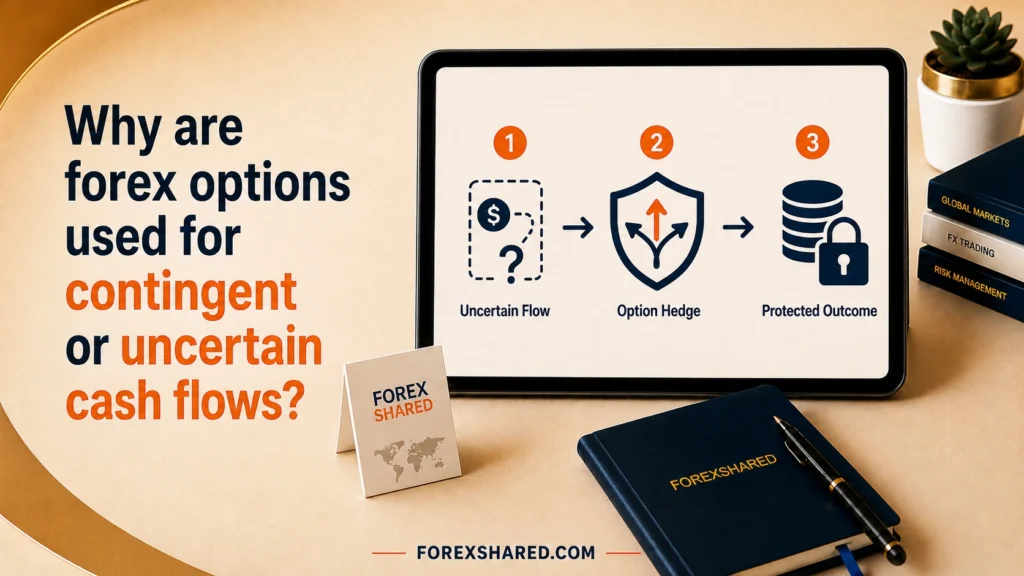
Why Are Forex Options Used for Contingent or Uncertain Cash Flows?
Forex options are used for contingent or uncertain cash flows because the buyer acquires a contractual right, not an obligation, to exchange currency, allowing conditional protection that does not force the underlying transaction if the exposure changes or disappears.
The article separates three different uncertainty dimensions: whether the cash flow will exist, how large it will be, and when it will occur. It then compares a binding forward with the conditional rights of a purchased option, while keeping premium cost, pair orientation, notional, expiry and hedge-accounting eligibility as separate boundaries.
This article explains forex option and corporate hedging mechanics for educational purposes only. It does not provide individualized financial, treasury, accounting or trading advice. Contract terms, execution rights, accounting treatment and suitability depend on the specific product, exposure and applicable rules.
What Makes a Foreign-Currency Cash Flow Contingent or Uncertain?
A foreign-currency cash flow is contingent or uncertain when its existence, amount, or timing is not fully fixed at the time the hedge decision is made.
Existence uncertainty asks whether the cash flow will occur, amount uncertainty asks how large it will be, and timing uncertainty asks when it will settle. That classification comes before instrument choice because each uncertainty dimension creates a different matching problem.
What is a contingent cash flow?
A contingent cash flow depends on another event occurring first, such as winning a tender, completing an acquisition, receiving regulatory approval, confirming an export order, or completing a project milestone.
Examples are illustrative, not exhaustive. Contingent means depends on another event occurring first.
What is an uncertain forecast cash flow?
An uncertain forecast cash flow is one the business reasonably expects but whose amount, timing, or existence is not yet fixed.
The uncertainty may affect one or several features simultaneously. Forecast means reasonably expected but not contractually fixed.
Why can FX risk exist before the cash flow is contractually certain?
FX risk can exist before the cash flow is contractually certain because an adverse exchange-rate move can change the economic value of the expected receipt or payment before the commercial event becomes final.
This is an economic exposure, not necessarily an accounting exposure. Economic exposure means the change in value caused by exchange-rate movement before the cash flow is final.
Why must the uncertainty type be identified first?
The uncertainty type must be identified first because existence uncertainty requires conditional protection, amount uncertainty requires careful notional sizing, and timing uncertainty requires expiry and exercise alignment.
A cash flow may have mixed uncertainty affecting more than one dimension.
| Uncertainty Type | Definition | Example | Hedge Response |
|---|---|---|---|
| Existence uncertainty | Whether the cash flow will occur is not fixed. | Tender, acquisition approval or conditional order. | Conditional protection that does not assume the event will occur. |
| Amount uncertainty | The cash flow exists or is expected, but the final amount can vary. | Variable export revenue or uncertain procurement quantity. | Notional sizing that reflects forecast confidence and residual mismatch. |
| Timing uncertainty | The cash flow date can move earlier or later. | Receipt or payment date remains uncertain. | Expiry and exercise terms aligned to the realistic exposure window. |
| Mixed uncertainty | More than one dimension is uncertain at the same time. | A forecast receipt whose amount and timing can both change. | Combine conditional protection, careful notional sizing and timing alignment. |
The visual below restates the section mechanism without adding a separate rule.
Why Can a Fixed FX Forward Create a Mismatch With an Uncertain Cash Flow?
A fixed FX forward can create a mismatch with an uncertain cash flow because the forward obliges the company to exchange currency at the agreed rate even if the underlying commercial exposure changes, shrinks, or disappears.
A forward is structurally strong when currency, amount, direction and settlement date are sufficiently known. When those inputs can change, the binding derivative can outlive or exceed the commercial exposure, which is why the obligation must be compared with the uncertainty of the underlying cash flow. HSBC
The obligation contrast is developed directly in Options versus forwards for uncertain cash flows.
What does a forward require?
A forward requires the company to exchange currency at an agreed rate on a future date, fixing the exchange rate for a known future payment or receipt. HSBC
The forward fixes the rate but does not eliminate the obligation. Forward means a binding agreement to exchange currency at a fixed rate on a future date.
What happens if the commercial cash flow occurs as forecast?
If the commercial cash flow occurs as forecast, the forward can match the currency, amount, direction, and date, providing a defined exchange rate.
This is the favourable case for a forward.
What happens if the commercial cash flow disappears?
If the commercial cash flow disappears, the derivative obligation does not necessarily disappear with the business transaction, leaving the company with a forward position but no commercial exposure.
The forward is a separate contract from the commercial transaction.
Why can that create a new FX risk?
The hedge itself can become an open currency position when the commercial exposure disappears, requiring the company to cancel, close, or offset the forward, potentially at a gain or loss.
The gain or loss depends on market conditions. Open position means a derivative exposure without corresponding commercial exposure.
What is the structural mismatch?
The structural mismatch is that a certain exposure with a binding hedge can be a good match, but an uncertain exposure with a binding hedge can create over-hedging or an unwanted FX position.
The mismatch is conditional on the exposure being uncertain. Over-hedge means hedge notional exceeding actual exposure.
| Feature | Forward | Purchased Option |
|---|---|---|
| Obligation type | Binding exchange at the agreed rate/date. | Buyer holds a right rather than the same unconditional exchange obligation. |
| If cash flow disappears | Derivative commitment can remain and may need to be closed or offset. | Underlying exchange need not be forced solely because protection was purchased. |
| If cash flow shrinks | Full notional can exceed the remaining commercial exposure. | Conditionality reduces the obligation mismatch, but notional can still be oversized. |
| If timing changes | Original settlement date may no longer match. | Expiry and exercise terms may offer flexibility, but contractual windows still apply. |
| Upfront cost | Often structured without the same upfront option premium. | Premium is paid for optionality and conditional protection. |
| Exercise requirement | Transaction is obligatory under the contract. | Exercise depends on contract rights and expiration rules. |
How Does the Option Contract Match a Contingent Cash Flow?
The option contract matches a contingent cash flow because the buyer acquires the right, but not the obligation, to buy or sell currency at an agreed exchange rate, so the hedge remains conditional rather than becoming an unconditional currency-exchange commitment.
The option changes the hedge from a compulsory exchange into a conditional right. The business pays premium for that flexibility, and the contract still has to be aligned to the correct pair, strike, notional, expiry and exercise terms. BIS
This conditional structure is the central reason behind Forex options hedging use when the underlying exposure is not yet fully fixed.
Commercial exposure uncertain + purchased option right = protection can exist without the same unconditional exchange commitment as a forward.
What does the currency-option buyer acquire?
The currency-option buyer acquires the right, but not the obligation, to buy or sell currency at an agreed exchange rate at or by a specified date. BIS
The key issue is right-without-obligation structure. Right without obligation means the buyer may choose whether to exercise.
Why does that right fit a cash flow that might never occur?
The right fits a cash flow that might never occur because purchasing the option does not itself impose the same unconditional currency-exchange requirement as entering a forward. BIS
The option purchase is separate from the commercial transaction.
What happens if the exposure materializes and FX has moved adversely?
If the exposure materializes and FX has moved adversely, the option can provide the contractual protection specified by its currency pair, strike, notional, expiry, and exercise terms.
Protection is defined by the contract terms. Strike means the agreed exchange rate at which the option can be exercised.
What happens if the commercial event does not occur?
If the commercial event does not occur, the buyer may no longer need the underlying currency transaction, and the option can potentially expire unused or be closed according to its contract and market structure, with the premium remaining paid.
Closing depends on contract and market structure. Lapse means the option expires without being exercised.
Why are corporations using options for this flexibility?
Corporations use FX options for this flexibility because options can cover event risks and help manage uncertain forecasts. HSBC
This connects the institutional use case to the conditional-protection mechanism.
The visual below restates the section mechanism without adding a separate rule.
How Do Calls and Puts Match Uncertain Foreign-Currency Payments and Receipts?
Calls and puts match uncertain foreign-currency payments and receipts by giving the business the right to obtain or sell the foreign currency at a protected exchange-rate relationship, with the exact call or put label following the contract's currency-pair convention.
The economic direction is straightforward: a payable is hurt when the required foreign currency strengthens, while a receivable is hurt when the foreign currency weakens. The formal call or put label, however, depends on the two-currency contract convention.
What risk does an uncertain foreign-currency payable create?
An uncertain foreign-currency payable creates the risk that the required foreign currency strengthens before payment, raising the domestic-currency cost.
The risk is that the foreign currency appreciates. Payable means a future foreign-currency payment obligation.
What option right can protect that exposure?
The business needs the right to obtain the foreign currency at a protected exchange-rate relationship, with the exact call or put label following the contract's currency-pair convention.
The label follows the contract convention. Call currency means the currency the option gives the right to buy.
What risk does an uncertain foreign-currency receivable create?
An uncertain foreign-currency receivable creates the risk that the foreign currency weakens before conversion into the functional currency, reducing the domestic-currency value.
The risk is that the foreign currency depreciates. Receivable means a future foreign-currency receipt.
What option right can protect that exposure?
The business needs a contractual right that protects the selling or conversion side of the foreign-currency exposure, with the exact label following the pair convention.
The label follows the contract convention. Put currency means the currency the option gives the right to sell.
Why should the article not use "payable = call, receivable = put" without qualification?
The article should not use "payable = call, receivable = put" without qualification because FX options always involve two currencies, and the correct terminology depends on base/quote orientation, call currency, put currency, and contract convention.
The correct label is contract-specific. Base/quote orientation means which currency is the base and which is the quote in the pair.
| Cash-Flow Direction | FX Risk | Required Right | Label Qualification |
|---|---|---|---|
| Uncertain foreign-currency payable | Foreign currency strengthens, increasing domestic-currency cost. | Right to obtain the foreign currency at a protected exchange-rate relationship. | Exact call/put label depends on base/quote orientation and contract convention. |
| Uncertain foreign-currency receivable | Foreign currency weakens, reducing domestic-currency value. | Right to sell or convert the foreign currency at a protected exchange-rate relationship. | Exact label depends on which currency is the call currency and which is the put currency. |
Why Are Options Especially Useful When the Cash Flow Depends on an Event?
Options are especially useful when the cash flow depends on an event because they allow the company to buy protection during the uncertainty period without necessarily committing to the underlying exchange if the event does not proceed.
Event-driven exposures create a timing dilemma: waiting for commercial certainty can leave the exchange rate unprotected, while locking a binding forward too early can leave a derivative obligation after the event fails. A purchased option makes the hedge conditional during that waiting period. HSBC
What types of events can create contingent FX exposure?
Events that can create contingent FX exposure include international tenders, proposed acquisitions, foreign asset purchases, contract awards, conditional supplier agreements, litigation settlements, and regulatory approvals.
Examples are illustrative.
When does the FX exposure begin economically?
The FX exposure can begin economically before the event becomes legally final because exchange rates may move while the company is waiting for the outcome.
Economic exposure precedes legal exposure.
Why can waiting until the event is confirmed be risky?
Waiting until the event is confirmed can be risky because the exchange rate may deteriorate before confirmation, so the company receives certainty over the commercial event only after losing the earlier FX rate.
The risk is that the rate moves adversely during the wait.
Why can hedging immediately with a forward create another problem?
Hedging immediately with a forward can create another problem because if the event fails, the commercial exposure becomes zero while the forward obligation does not.
The forward is a separate contract.
What does the option change?
The option changes the relationship by allowing the company to buy protection during the uncertainty period without necessarily committing to the underlying exchange if the event does not proceed. HSBC
The option protects the FX side, not the commercial event.
How Do Options Handle Uncertainty in Cash-Flow Amount?
Options handle uncertainty in cash-flow amount by allowing the buyer to avoid the same unconditional obligation to exercise the entire protection when the commercial receipt is lower than forecast, but they do not automatically solve notional mismatch.
The option does not make the forecast amount certain. Its benefit is that an oversized protection amount does not create the same unconditional exercise obligation as a full forward, although notional sizing, operational processing and lifecycle decisions can still create mismatch.
What happens when a forecast revenue amount changes?
When a forecast revenue amount changes, the actual receipt can be lower than, equal to, or higher than the forecast.
The actual amount is unknown at hedge time.
Why can a full-notional forward create over-hedging?
A full-notional forward can create over-hedging because if the company expects USD 1,000,000 but receives only USD 600,000, the forward exceeds the underlying receipt by USD 400,000.
The arithmetic is USD 1,000,000 forward vs USD 600,000 receipt = USD 400,000 excess. Over-hedging means hedge notional exceeding actual exposure.
Does using an option automatically solve the notional mismatch?
Using an option does not automatically solve the notional mismatch because an option can also be oversized, but the buyer is not under the same unconditional obligation to exercise the entire protection merely because the commercial receipt is lower.
The option reduces the obligation mismatch but does not eliminate it.
How can hedge sizing respond to amount uncertainty?
Hedge sizing can respond to amount uncertainty by hedging only a high-confidence base amount, protecting uncertain incremental exposure with options, and layering maturities or notionals as forecast confidence improves.
Sizing depends on multiple factors.
Why should the article avoid presenting one universal hedge ratio?
The article should avoid presenting one universal hedge ratio because the correct amount depends on forecast confidence, commercial exposure, treasury policy, premium budget, and tolerance for residual FX risk.
The correct amount is situation-specific.
The visual below restates the section mechanism without adding a separate rule.
How Does Cash-Flow Timing Uncertainty Affect Option Use?
Cash-flow timing uncertainty affects option use because the option must remain usable across the realistic period during which the commercial exposure can materialize, and its expiry and exercise style define that window.
Timing flexibility depends on the actual contract. Expiry, exercise style and settlement mechanics have to cover the realistic window in which the commercial exposure can materialize; otherwise the hedge can expire too early or require a new decision.
Why does payment-date uncertainty matter?
Payment-date uncertainty matters because the commercial cash flow may occur earlier, on schedule, or later than originally expected.
The actual date is unknown at hedge time.
Does any option automatically solve timing uncertainty?
No option automatically solves timing uncertainty because every option still has an expiry, an exercise window, and settlement mechanics.
Every option has contractual time limits.
What must the hedger align?
The hedger must align the option so it remains usable across the realistic period during which the commercial exposure can materialize.
The option must cover the realistic timing window.
How can exercise style affect timing flexibility?
Exercise style can affect timing flexibility because a contract permitting exercise over a broader period can provide more date flexibility than one exercisable only at a single expiry point. Westpac
The key distinction is broader exercise windows with single-point exercise. American-style option means an option exercisable over a broader period rather than only at expiry.
What remains the limitation?
The limitation is that even flexible exercise terms have contractual boundaries, so if the commercial cash flow occurs outside the protected window, a new hedge decision may be required.
The option's protection ends at its contractual boundary.
The visual below restates the section mechanism without adding a separate rule.
How Can Options Reduce Over-Hedging When Forecast Cash Flows Change?
Options can reduce over-hedging when forecast cash flows change because the buyer is not required to invoke protection solely because the option exists, preventing the derivative from automatically becoming an unwanted opposite FX position.
Conditional exercise reduces the chance that a hedge automatically becomes an opposite FX position when the underlying exposure shrinks or disappears. It does not remove the need to manage notional, expiry, exercise and operational rules.
What is over-hedging?
Over-hedging occurs when the hedge notional exceeds the actual underlying exposure.
The mismatch is between hedge and exposure. Over-hedging means hedge notional exceeding actual exposure.
How can forecast error create it?
Forecast error can create over-hedging because if a company forecasts a EUR 2 million receipt but receives only EUR 1.2 million, a binding hedge for the full forecast amount leaves EUR 800,000 of hedge exposure without corresponding business cash flow.
The arithmetic is EUR 2 million forecast vs EUR 1.2 million actual = EUR 800,000 excess.
How does a purchased option change that outcome?
A purchased option changes that outcome because the buyer is not required to invoke protection solely because the option exists, preventing the derivative from automatically becoming an unwanted opposite FX position when the underlying exposure disappears or shrinks.
The option reduces the obligation mismatch.
Does an option eliminate over-hedging risk entirely?
An option does not eliminate over-hedging risk entirely because problems can still arise from oversized exercise, poor expiry alignment, operational errors, automatic exercise rules, or using the wrong underlying contract.
The option reduces but does not eliminate the risk.
What is the correct claim?
The correct claim is that options can reduce the obligation mismatch associated with uncertain exposure, but they do not eliminate the need for correct notional and lifecycle management.
The claim is about reduction, not elimination.
Why Is Premium the Cost of Protecting an Uncertain Cash Flow?
Premium is the cost of protecting an uncertain cash flow because the buyer pays for downside FX protection, conditional exercise rights, and freedom from a symmetric forward-style obligation, whether or not the underlying cash flow eventually occurs.
Premium is the explicit price of keeping the hedge conditional. It purchases protection during the uncertainty period and the right to avoid a symmetric forward-style obligation, even when the commercial event ultimately does not occur.
The premium remains paid even if the commercial event never materializes.
What does the buyer pay for?
The buyer pays for downside FX protection, conditional exercise rights, and freedom from a symmetric forward-style obligation.
Premium is paid at purchase. Premium means the price paid to acquire the option right.
Why does a forward often not have the same upfront option premium?
A forward often does not have the same upfront option premium because a forward exchanges a fixed future commitment between counterparties rather than selling buyer-side optionality.
The forward's cost structure differs from the option's.
Why is premium especially relevant when the cash flow itself might disappear?
Premium is especially relevant when the cash flow itself might disappear because the business may pay premium even if the tender is lost, the order is cancelled, the acquisition fails, or the forecast receipt never occurs.
Premium is paid at purchase regardless of the commercial outcome.
Is that premium therefore "wasted"?
The premium is not necessarily wasted because it was the known price paid for protecting against FX risk during the period when the commercial outcome remained uncertain.
The premium's value is the flexibility itself.
What is the economic trade-off?
The economic trade-off is that a forward offers lower or no explicit optionality premium but a stronger future commitment, while a purchased option requires a premium but provides conditional protection and flexibility.
The trade-off depends on cash-flow certainty.
Why Can Options Preserve Favourable FX Outcomes on an Uncertain Cash Flow?
Options can preserve favourable FX outcomes on an uncertain cash flow because a standard purchased option does not require the buyer to use an inferior protected rate merely because protection was purchased, subject to product-specific exercise rules.
A standard purchased option can establish a protected rate while leaving the buyer free not to use an inferior protected rate when the market outcome is more favourable, subject to the specific exercise and settlement rules of the product. Lloyds
What happens if FX moves adversely?
If FX moves adversely, the option can provide protection according to the strike and exercise terms.
Protection follows the contract terms.
What happens if FX moves favourably?
If FX moves favourably, a standard purchased option does not require the buyer to use an inferior protected rate merely because protection was purchased, subject to product-specific exercise rules.
The benefit is subject to contract terms.
Why does this matter when the cash flow itself is uncertain?
This matters when the cash flow itself is uncertain because two uncertainties coexist — whether or how much cash flow occurs, and where the FX market will be — and the option preserves conditionality across both dimensions.
The option preserves conditionality across both dimensions.
How does Lloyds describe this feature?
Lloyds describes FX options and structures as instruments that can provide certainty around a conversion rate while allowing participation in favourable exchange-rate movements. Lloyds
This connects directly to the option's conditional structure.
What is the cost of retaining that upside?
The cost of retaining that upside is the premium.
The premium is the explicit cost.
When Is a Forward More Natural Than an Option?
A forward is more natural than an option when the business knows the currency, amount, direction, and future settlement date with high commercial confidence.
The key question is not whether one instrument is universally better. It is whether the derivative obligation matches the certainty of the commercial cash flow: known obligations often suit forwards more directly, while uncertain exposures can place more value on conditionality.
When the obligation is sufficiently fixed, Forward hedging for fixed obligations provides the relevant comparison point.
What exposure characteristics favour a forward?
A forward becomes more natural when the business knows the currency, amount, direction, and future settlement date with high commercial confidence.
The characteristics must be known with high confidence.
What does HSBC say about this use case?
HSBC states that if a business knows it will need or receive a currency amount on a future date, a forward can fix the exchange rate for that future transaction. HSBC
This connects directly to the known-cash-flow case.
Why may a forward be attractive for certain cash flows?
A forward may be attractive for certain cash flows because it provides rate certainty, direct amount and date matching, and no purchased-option premium in the usual forward structure.
The advantages apply when the cash flow is known.
What exposure characteristics favour an option instead?
Options become more compelling when uncertainty exists around transaction occurrence, final amount, timing, or event completion.
The characteristics involve uncertainty.
What is the correct comparison?
The correct comparison is not "forward or option — which is better?" but "which contract obligation matches the certainty of the underlying cash flow?"
The comparison depends on cash-flow certainty.
| Cash-Flow Certainty | Natural Hedge Structure | Key Consideration |
|---|---|---|
| Known currency, amount, direction, date | Forward can be a direct structural match. | Binding exchange can align closely with a firm obligation. |
| Existence uncertainty | Purchased option can better preserve conditionality. | The commercial event may never occur. |
| Amount uncertainty | Option or layered approach can preserve flexibility. | Notional still needs careful sizing. |
| Timing uncertainty | Option with suitable exercise window may fit. | Expiry and settlement mechanics must cover the realistic window. |
| Mixed uncertainty | Conditional structure may be more valuable. | Existence, amount and timing have to be managed together. |
What Example Shows Why Options Fit a Contingent Foreign-Currency Receipt?
A company bidding for an overseas project with a potential USD 2,000,000 receipt three months after contract award faces the risk that USD weakens before conversion, and an option can protect that potential receipt without forcing the FX sale if the tender is lost.
The tender example isolates existence uncertainty. The prospective USD receipt creates economic FX exposure before award, while the option can protect the receipt if the project is won without forcing the same underlying sale if the tender is lost.
What FX risk exists before the tender decision?
Before the tender decision, the FX risk is that if the company wins but USD weakens materially before conversion, the domestic-currency value of the project receipt can fall.
The key issue is consequence of USD weakening.
What happens if the company sells USD forward immediately?
If the company sells USD forward immediately, it obtains rate certainty, but if it loses the tender, the USD commercial receipt becomes zero while the forward sale can remain outstanding.
The key issue is mismatch if the tender is lost.
What changes if the company buys suitable option protection instead?
If the company buys suitable option protection instead, it pays premium for the right to protect the potential USD receipt, and if the project is won the protection can remain relevant, while if the project is lost the company does not have the same mandatory underlying FX sale solely because it purchased the option.
The key distinction is the won-project and lost-project outcomes.
What cost remains if the tender is lost?
If the tender is lost, the premium paid for the protection remains the cost.
The premium is paid at purchase.
What does the example prove?
The example proves that the option matches conditional commercial exposure with conditional hedge execution.
The example illustrates the mechanism.
What Example Shows Why Options Fit an Uncertain Foreign-Currency Payment?
A company considering acquiring overseas equipment with a potential EUR 5 million purchase price faces the risk that EUR strengthens before approval, and an option can protect against EUR appreciation while the acquisition remains uncertain.
The acquisition example applies the same logic to a potential payable. EUR appreciation can worsen the acquisition budget before approval, but the transaction itself may never proceed, so the hedge has to address FX risk without assuming commercial certainty.
What is the FX risk?
The FX risk is that if EUR strengthens before the acquisition is approved, the domestic-currency cost rises.
The key issue is consequence: higher domestic-currency cost.
Why could a full forward be problematic?
A full forward could be problematic because if the acquisition is cancelled, the company can remain obligated under an EUR purchase hedge without needing the EUR commercially.
The key issue is mismatch: EUR hedge obligation without commercial need.
What does a purchased option provide?
A purchased option provides the company with protection against EUR appreciation while the acquisition remains uncertain.
The key issue is conditional nature of the protection.
What happens if the acquisition is abandoned?
If the acquisition is abandoned, the company may no longer need to exercise the currency-protection right, and the premium remains the known cost of that flexibility.
The premium remains the cost.
What must still be matched correctly?
The notional, strike, expiry, acquisition decision window, and option exercise rules must still be matched correctly.
The matching is deliberate, not automatic.
What Risks Remain When Options Hedge Uncertain Cash Flows?
Risks remain when options hedge uncertain cash flows because the premium can be a meaningful cost, the notional can be wrong, the option can expire before the transaction, the strike can provide insufficient protection, market liquidity can affect exit value, and exercise can create unwanted currency exposure.
Optionality changes the obligation profile, not every source of risk. Premium cost, wrong notional, unsuitable strike, expiry mismatch, liquidity, exercise processing and forecast error remain material boundaries that must be checked contract by contract.
Optionality changes the obligation profile, but notional, strike, expiry, liquidity, exercise processing and commercial forecast risk still require active verification.
Can the premium itself become a meaningful cost?
Yes, the premium itself can become a meaningful cost because the business pays for optionality whether or not the underlying cash flow eventually occurs.
Premium is paid at purchase.
Can the hedge notional still be wrong?
Yes, the hedge notional can still be wrong because the actual commercial cash flow may exceed or fall below the protected amount.
The actual cash flow can differ from the protected amount.
Can the option expire before the business transaction occurs?
Yes, the option can expire before the business transaction occurs because timing mismatch remains possible.
Expiry defines the protection boundary.
Can the strike provide less protection than the business budget requires?
Yes, the strike can provide less protection than the business budget requires because the strike must be evaluated against the desired budget or worst-case rate.
The strike defines the protection level.
Can market liquidity affect exit value?
Yes, market liquidity can affect exit value because an option that can theoretically be closed still depends on available market and liquidity conditions.
Closing depends on market conditions.
Can exercise create unwanted currency exposure?
Yes, exercise can create unwanted currency exposure, especially where automatic exercise rules or options-on-futures structures apply, so contract-specific expiration mechanics must be verified.
Contract-specific rules apply.
Does an option eliminate forecast risk?
No, an option does not eliminate forecast risk because it manages the FX consequence of the forecast, not the sale, purchase, tender, acquisition, invoice, or project itself.
Options manage the FX side only.
Why Must Economic Hedging Be Kept Separate From Hedge Accounting?
Economic hedging must be kept separate from hedge accounting because a business may economically use an option for an uncertain cash flow without that forecast automatically qualifying for hedge-accounting treatment.
An option can make economic sense as risk management even when the forecast exposure does not satisfy accounting designation requirements. The economic question concerns risk fit; the accounting question concerns formal eligibility and documentation. IFRS
Economic fit asks whether the option manages the FX exposure. Hedge accounting asks whether the forecast and hedge relationship meet the applicable formal criteria.
Can a business economically hedge a forecast exposure with an option?
Yes, a business can economically hedge a forecast exposure with an option because companies use purchased options to protect expected foreign-currency cash flows.
Economic and accounting questions are separate. Economic hedging means risk management without regard to accounting treatment.
Does every forecast exposure qualify for cash-flow hedge accounting?
No, not every forecast exposure qualifies for cash-flow hedge accounting because IFRS requires a forecast transaction designated in a cash-flow hedge to be highly probable. IFRS
The key issue is highly-probable requirement. Highly probable means the IFRS threshold for forecast-transaction designation.
What uncertainty does IFRS say matters?
IFRS notes that uncertainty over both timing and magnitude is relevant when assessing whether the forecast transaction is highly probable. IFRS
The reason is that timing and magnitude matter.
Why is this separate from the H1?
This is separate from the H1 because the H1 asks why an option might economically fit uncertainty, while accounting asks whether the forecast meets the formal criteria to receive hedge-accounting treatment.
The two questions are separate.
How Should an Uncertain FX Cash Flow Be Matched to an Option Hedge?
An uncertain FX cash flow should be matched to an option hedge by classifying the cash flow's certainty, identifying the uncertainty type, determining the currency exposure, defining the downside scenario, mapping the option right, sizing the notional, aligning the expiry, evaluating the premium, and defining the response if the cash flow does not occur.
A disciplined match starts with the commercial exposure rather than the derivative. Only after existence, amount, timing, currency direction and downside are defined should the option direction, notional, maturity, premium and fallback actions be selected.
The treasury decision process is extended in Treasury hedging for uncertain exposure.
Does the cash flow definitely exist?
The first step is to classify whether the cash flow is firm, highly expected, contingent, or speculative and too uncertain.
The classification is the first step.
What exactly is uncertain?
The next step is to identify whether the uncertainty concerns existence, amount, or timing.
The uncertainty may be mixed.
What currency exposure exists if the cash flow occurs?
The next step is to identify the foreign currency, functional currency, and payment or receipt direction if the cash flow occurs.
The exposure is defined relative to the functional currency. Functional currency means the currency in which the business measures its results.
What adverse exchange-rate movement matters?
The next step is to define the downside FX scenario that matters for the specific exposure.
The downside depends on the exposure direction.
What option right protects that downside?
The next step is to map the exposure into the correct call currency, put currency, and pair orientation.
The label follows the contract convention.
What notional should be protected?
The notional should not automatically be the highest imaginable forecast; protection should match forecast confidence, risk tolerance, and commercial exposure.
The notional should match realistic exposure.
When could the event occur?
The option maturity and exercise terms should be chosen to realistically cover the exposure window.
The option must cover the realistic timing window.
What premium is required?
The premium should be treated as the cost of conditional protection.
Premium is the cost of flexibility.
What happens if the commercial cash flow does not occur?
The response if the commercial cash flow does not occur should be defined in advance, including whether the option will be sold, lapse, expire, or require another action under its rules.
The response depends on the contract rules.
What is the correct contingent-hedging sequence?
The correct contingent-hedging sequence is to identify the commercial event, determine whether the FX cash flow is firm or contingent, classify the uncertainty type, identify the payable or receivable exposure, determine the adverse currency move, compare forward obligation with option conditionality, set option direction and notional, align expiration and exercise window, evaluate premium cost, define the response if the forecast changes, verify exercise and settlement rules, and assess hedge-accounting qualification separately.
The sequence is a decision framework, not a strategy recommendation.
The visual below restates the section mechanism without adding a separate rule.
How Can Businesses Avoid Mistakes When Hedging Uncertain Cash Flows With Options?
Businesses can avoid mistakes when hedging uncertain cash flows with options by correcting the assumptions that forecasts are guaranteed, options eliminate over-hedging, premium is refundable, any expiry is acceptable, payable always means call, options are always preferable, and forecast transactions automatically qualify for hedge accounting.
Most errors come from overstating what the option solves. Forecasts can change, options can be oversized, premium is not refundable, expiry must match the exposure window, call and put labels are pair-specific, and accounting qualification remains separate.
Why is "the forecast exists, so a full forward is automatically appropriate" incorrect?
This is incorrect because forecasts can change in existence, amount, and timing while the forward commitment can remain.
The forward commitment is separate from the forecast.
Why is "options eliminate over-hedging" incorrect?
This is incorrect because option notional can still exceed the actual exposure, and exercise or operational processing can still create mismatch.
Options reduce but do not eliminate the risk.
Why is "the premium is wasted if the event does not happen" incomplete?
This is incomplete because the premium bought protection during the uncertainty period, and its economic purpose was the flexibility itself.
The premium's purpose is the flexibility itself.
Why is "any expiry date is acceptable" incorrect?
This is incorrect because the option must remain usable when the commercial exposure can realistically materialize.
The expiry must cover the realistic window.
Why is "payable always means call" incomplete?
This is incomplete because FX options involve two currencies, and call and put labels must follow the specific currency pair and contract convention.
The label follows the contract convention.
Why is "options are always preferable to forwards" incorrect?
This is incorrect because a certain amount and known settlement date may match a forward more directly and avoid paying for optionality that is not needed.
The fit depends on cash-flow certainty.
Why is "forecast transaction means hedge accounting automatically applies" incorrect?
This is incorrect because IFRS requires a forecast transaction designated in a cash-flow hedge to meet its applicable highly-probable requirement. IFRS
The key issue is highly-probable requirement.
What should be verified before using an FX option for an uncertain cash flow?
Before using an FX option for an uncertain cash flow, the business should verify the underlying cash flow, uncertainty type, currency direction, downside exposure, forward comparison, option direction, notional, expiry, premium, exercise rules, residual risk, and hedge-accounting eligibility.
The checklist supports disciplined evaluation.
- Verify the underlying commercial cash flow.
- Classify whether the exposure is firm, highly expected, contingent or too speculative.
- Identify whether uncertainty concerns existence, amount, timing or a mixture.
- Confirm the foreign currency, functional currency and payment or receipt direction.
- Define the adverse exchange-rate movement that matters.
- Compare the obligation created by a forward with the conditionality of a purchased option.
- Map the correct call currency, put currency and pair orientation.
- Size the notional to realistic commercial exposure and forecast confidence.
- Align expiry and exercise terms to the realistic exposure window.
- Treat premium as the cost of conditional protection.
- Verify exercise, automatic-exercise, closing and settlement rules.
- Assess hedge-accounting qualification separately from economic usefulness.
Conclusion
Forex options are used for contingent or uncertain cash flows because the option contract makes the hedge conditional, allowing a business to protect an expected foreign-currency exposure while preserving flexibility if the underlying payment or receipt changes, shrinks, moves in time, or fails to materialize.
The useful boundary is simple: options can make the hedge conditional when the cash flow is uncertain, but they do not make the commercial event certain, eliminate mismatch, remove premium cost or create automatic hedge-accounting eligibility.
FAQs
The FAQs answer the most common follow-up questions about FX options for uncertain cash flows, including payment uncertainty, forward cancellation risk, forecast revenue hedging, over-hedging, and hedge-accounting qualification.
Why are FX options useful when a foreign-currency payment is uncertain?
FX options are useful when a foreign-currency payment is uncertain because the buyer can protect against an adverse currency move without creating the same unconditional future exchange obligation as a forward. BIS
Why can a forward be risky when a forecast cash flow is cancelled?
A forward can be risky when a forecast cash flow is cancelled because the commercial exposure can disappear while the derivative commitment remains, potentially leaving the company with an unwanted FX position. HSBC
Can FX options hedge uncertain forecast revenue?
Yes, FX options can hedge uncertain forecast revenue because options can protect the adverse side of expected foreign-currency receipts while preserving contractual flexibility if the forecast changes. HSBC
Do options remove all over-hedging risk?
No, options do not remove all over-hedging risk because notional, timing, exercise, and forecast errors can still produce mismatch; options primarily remove the same unconditional exercise obligation faced under a binding forward structure.
Does an uncertain forecast automatically qualify for hedge accounting?
No, an uncertain forecast does not automatically qualify for hedge accounting because IFRS states that forecast transactions designated in cash-flow hedges must satisfy the highly-probable requirement, with uncertainty over timing and magnitude relevant to that assessment. IFRS