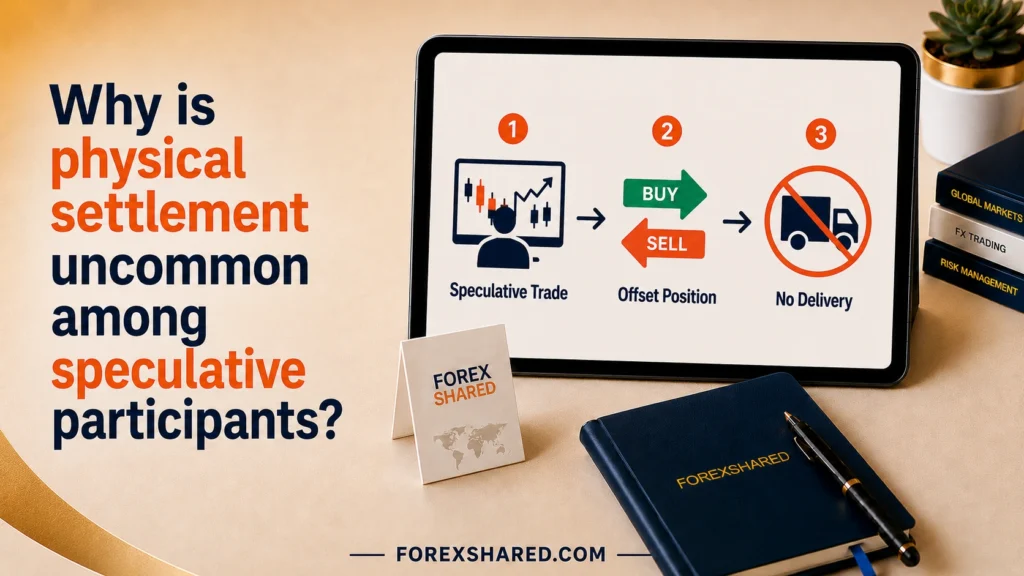
Why Is Physical Settlement Uncommon Among Speculative Participants?
Physical settlement is uncommon among speculative futures participants because speculation normally seeks financial exposure to price movement, and offsetting or rolling completes that objective without converting the position into an asset-transfer obligation.
As a physically deliverable contract approaches its delivery process, the position can stop being only a price exposure and begin carrying funding, eligibility and asset-transfer obligations. A trader who does not need those obligations can normally manage the contract through offset or roll before the relevant boundary.
This article separates speculative intent from delivery intent, explains the long and short delivery obligations, distinguishes physical from cash settlement, and provides a pre-expiration decision sequence without treating physical delivery as defective or economically irrelevant.
This article explains futures settlement mechanics for educational purposes and does not provide individualized financial or trading advice. Delivery rules, contract dates, settlement procedures and broker or clearing-member requirements are product-specific and should be verified for the exact contract and account.
Why Does the Speculative Objective Usually Not Require Physical Settlement?
The speculative objective is financial exposure to futures price movement, and that objective is normally completed by closing the position rather than by taking or making delivery of the underlying asset.
CFTC defines a futures speculator as a trader who is not hedging and who seeks profit through successful anticipation of price movements. That definition centers the task on price exposure rather than on obtaining the deliverable asset. CFTC CFTC also states that most futures contracts by volume are liquidated through offset and do not result in delivery. CFTC
What is a speculative futures participant trying to achieve?
A speculative futures participant seeks profit through anticipation of price movements rather than through acquisition or disposition of the underlying asset.
The objective is Price Exposure → Financial Gain or Loss, not Futures Position → Underlying Asset Acquisition. The CFTC definition describes intent, not outcome.
What does the trader actually need when the speculative objective ends?
When the speculative objective ends, the trader needs the futures exposure to stop, which requires position closure rather than physical ownership of the underlying asset.
Position closure removes the exposure without requiring ownership of the underlying. Standardized futures and clearing structure allow offset without private renegotiation.
Why does asset transfer add a different economic task?
Physical settlement adds ownership or disposition of the underlying, payment of delivery value, delivery eligibility, and operational coordination: tasks that may have no connection to why the speculative position was opened.
These tasks may have no connection to the reason the speculative position was opened. They serve legitimate commercial delivery objectives.
Is the pattern visible in actual futures-market structure?
Yes, CFTC states that most futures contracts by volume are liquidated through offset and do not result in delivery, and CME explains that most traders focused on price movement do not want physical delivery or final settlement at expiration.
Most futures contracts by volume are liquidated by offset and do not result in delivery; cite the CME explanation that most traders focused on price movement do not want physical delivery or final settlement at expiration. Some speculative positions do proceed to delivery, and some contracts are cash settled.
| Comparison Point | Speculative Objective | Physical Settlement Task |
|---|---|---|
| Primary goal | Financial exposure to futures price movement | Make or take delivery under contract rules |
| Completion mechanism | Offset or roll depending on whether exposure should end or continue | Remain open into the applicable delivery process |
| Asset involvement | Underlying asset ownership is not required to complete the price-exposure task | Underlying asset, currency, security or delivery instrument can become operationally relevant |
| Funding requirement | Futures account resources support the open position | A long can need the full delivery value; a short must be able to make delivery |
| Operational requirement | Position execution and expiration management | Delivery eligibility, notices, locations, instruments and settlement procedures can apply |
| Typical participant fit | Price-focused participant | Participant with an intentional delivery or commercial asset-transfer objective |
Why Does Offsetting Usually Fit Speculative Participation Better Than Delivery?
Offsetting fits speculative participation better than delivery because an equal opposite transaction removes the open position before the delivery obligation becomes applicable, completing the price-exposure task without asset transfer.
CFTC explains that standardized exchange futures can be bought and subsequently sold so the position is offset and extinguished through the common clearing structure. That is why a speculative exit can end the financial exposure without converting the trade into an asset-transfer task. CFTC
The broader pre-delivery lifecycle is covered in Futures offsetting before delivery.
What does offsetting accomplish?
Offsetting accomplishes the removal of the open position through an equal opposite transaction in the same futures contract and delivery month.
Futures traded through a common clearinghouse can be bought and subsequently sold so that the position is offset and extinguished. The clearing structure extinguishes the position without private renegotiation.
Why does offsetting avoid the need to own the underlying asset?
Offsetting avoids the need to own the underlying asset because the futures position becomes zero before the delivery obligation becomes applicable.
No open position remains from which delivery needs to be made or taken. Rolling also avoids delivery while preserving exposure.
Does the trader have to locate the original counterparty?
No, standardized futures and the clearing structure allow the open position to be extinguished without privately renegotiating the original trade.
Standardized futures and the clearing structure allow the position to be extinguished without private renegotiation. The page only needs the offset consequence.
Why is this especially efficient for speculation?
Offsetting is especially efficient for speculation because it directly completes the path from price exposure to position exit without adding asset transfer and physical-market management.
The two paths are Price Exposure → Position Exit versus Price Exposure → Asset Transfer → Physical-Market Management. Rolling may be appropriate when exposure should continue.
Why Do Speculators Roll Futures When They Still Want Market Exposure?
Speculators roll futures when they still want market exposure because rolling offsets the expiring contract and establishes a position in a later contract month, preserving the price position while leaving the delivery process behind.
CME describes rolling as the path used when a participant wants to avoid settlement but retain market exposure: the expiring position is offset and a new position is established in a later contract month. CME
What happens when the speculative objective continues beyond the current expiry?
When the speculative objective continues beyond the current expiry, the trader may still want exposure after the current contract approaches expiration.
The roll allows exposure to continue in a later month.
How does rolling solve that problem?
Rolling solves the problem by combining the offset of the expiring futures position with the establishment of a position in a later contract month.
Rolling as the method used when traders want to avoid settlement but retain market exposure. The roll involves transaction costs and a new position in a different contract month. CME
Why is rolling different from physical settlement?
Rolling differs from physical settlement because rolling transfers financial exposure across expiries, while physical settlement converts the expiring open position into an underlying asset-transfer obligation.
Rolling transfers financial exposure across expiries, while physical settlement converts the expiring open position into an asset-transfer obligation. Roll is a position-management action, not a settlement outcome.
Why is rolling not the same as simply offsetting?
Rolling is not the same as simply offsetting because offset only ends the current exposure, while a roll offsets the current expiry and establishes new exposure in a later contract month.
The roll has two components while offset has one. They produce different position outcomes.
What Additional Obligations Appear When a Futures Position Enters Physical Settlement?
When a futures position enters physical settlement, the long must be prepared to take delivery and pay the full delivery value, while the short must be prepared to make delivery of the applicable underlying asset.
CME states that during a physically deliverable contract’s delivery period, a short position holder must be prepared to deliver the underlying, while a long position holder must be prepared to take delivery and pay the full delivery value. The exact delivery process varies by product. CME
What must a long position holder be prepared to do?
A long position holder in a physically deliverable contract must be prepared to take delivery of the underlying and pay the full delivery value of the futures contract.
The long must take delivery and pay the full delivery value. Full delivery value is a materially larger funding requirement.
What must a short position holder be prepared to do?
A short position holder must be capable of delivering the applicable underlying commodity, currency, security, or contractual delivery instrument according to the product rules.
The short must deliver the applicable underlying according to product rules. The delivery must match the contract’s specifications.
What kinds of operational requirements can physical settlement create?
Physical settlement can create operational requirements such as approved delivery facilities, warehouse receipts or shipping certificates, eligible securities, currency funding, quality specifications, delivery locations, notice procedures, and settlement deadlines.
These requirements vary by product. That belongs to a separate logistics reference.
Why is full delivery value different from ordinary futures margin?
Full delivery value differs from ordinary futures margin because margin supports the open futures position, while physical settlement can require payment or delivery of the full underlying contractual amount.
Margin supports the open position, while physical settlement can require the full contractual amount. Margin is collateral supporting exposure, not a guaranteed cap on market loss or delivery funding.
| Participant Role | Core Delivery Obligation | Typical Operational Requirements |
|---|---|---|
| Long position holder | Be prepared to take delivery and pay the full delivery value | Funding, delivery eligibility, settlement account capability and product-specific procedures |
| Short position holder | Be prepared to make delivery of the applicable underlying or delivery instrument | Eligible deliverable, notices, quality or instrument specifications, location and deadline compliance |
Why Can Delivery Infrastructure Make Physical Settlement Impractical for Speculators?
Delivery infrastructure can make physical settlement impractical for speculators because price-focused traders usually do not maintain the physical-market infrastructure needed to use the deliverable asset commercially.
CME Rule 716 places responsibility on clearing members to assess whether account owners in physically deliverable expiring contracts can make or take delivery. If satisfactory delivery capability is not demonstrated, the rule requires orderly liquidation before trading expires. CME
Can every futures customer automatically make or take delivery?
No, CME Rule 716 places responsibility on clearing members to ensure account owners in physically deliverable contracts can meet delivery obligations.
Rule 716 makes delivery capability an intermediary control point because clearing members must assess whether account owners can meet delivery obligations. Clearing members are responsible for assessing delivery capability. CME
Why can delivery eligibility matter?
Delivery eligibility matters because some products require specialized infrastructure such as approved warehouses, registered receipts or certificates, clearing membership, eligible securities, or specified settlement accounts.
The generic categories include approved warehouses, registered receipts or certificates, clearing membership, eligible securities, specified settlement accounts. The exact requirements depend on the product and were not supplied.
Why does this create a mismatch with speculative participation?
This creates a mismatch with speculative participation because a price-focused trader usually does not maintain the physical-market infrastructure needed to use the deliverable asset commercially.
The infrastructure serves commercial use of the asset, not price exposure. Some may have it; the point is that it is not normally part of the speculative task.
What can the intermediary require as delivery approaches?
As delivery approaches, an FCM or clearing member can require an account to demonstrate delivery capability, provide required funding, or exit the position before the delivery process, depending on the applicable product and account arrangements.
Possible requirements include demonstrate delivery capability, provide required funding, exit the position before the delivery process. They vary by firm and account arrangement.
How Do Delivery Deadlines Encourage Speculators to Exit Before Physical Settlement?
Delivery deadlines encourage speculators to exit before physical settlement because notice and expiration boundaries determine when delivery obligations can become relevant, and offsetting or rolling before those boundaries removes the operational risk.
The relevant delivery boundary is product-specific. CME’s physical-delivery guidance explains that First Notice Day can make delivery assignment possible for applicable contracts, while Last Trading Day marks the final exchange trading session and can lead an open physically settled position into the delivery process. CME
The exact close-out mechanism is explained in Closing futures before delivery.
What happens as a physically delivered futures contract approaches its delivery period?
As a physically delivered futures contract approaches its delivery period, open-position holders are generally notified that they must either close the position or be prepared for delivery.
Holders must either close or prepare for delivery. The delivery obligation can become effective under the contract rules.
Why can First Notice Day matter?
First Notice Day matters because, for applicable physically delivered products, delivery assignment can become possible around the notice process, and traders seeking to avoid delivery must manage the position before that boundary.
Cite the CME note that traders seeking to avoid delivery must manage the position before the applicable First Notice Day boundary. Notice schedules are contract-specific. CME
Why does Last Trading Day also matter?
Last Trading Day matters because open positions remaining through the relevant final trading deadline can become subject to the contract’s settlement or delivery rules.
Explain the consequence of remaining open past the deadline. Delivery can occur over a period after trading ends.
Are these deadlines identical for every physically delivered future?
No, delivery schedules and procedures are contract-specific, and the participant must verify the actual notice dates, last trading day, position day, delivery period, and broker deadline.
The items to verify include notice dates, last trading day, position day, delivery period, broker deadline. They are product-specific and were not supplied.
Why does this encourage earlier speculative exit?
This encourages earlier speculative exit because the trader can remove an unnecessary operational risk by offsetting or rolling while normal market liquidity and ordinary execution remain available.
Offsetting or rolling while liquidity and execution remain available is preferable to managing a delivery obligation. Market conditions vary.
How Does the Pattern Appear in Physically Delivered FX Futures?
The pattern appears clearly in physically delivered FX futures, where CME describes delivery as the actual exchange of the underlying currencies and states that most customers trade out of or roll their positions before delivery.
CME describes physically delivered FX futures as an actual exchange of the underlying currencies. It also states that most customers trade out of or roll their FX futures positions before delivery, while positions held through the last trading day require the clearing firm to be fully funded for the currency exchange. CME
For a separate comparison with the spot-market currency-exchange context, see Spot forex physical exchange.
Do physically delivered FX futures actually exchange currencies?
Yes, CME describes physical FX futures delivery as the actual exchange of the underlying currencies.
CME’s delivery description provides the relevant mechanism. Some FX products may be cash settled. CME
What do most customers do before FX futures delivery?
Most customers trade out of or roll their FX futures positions before delivery, according to CME.
This reflects the price-exposure objective. Some customers do hold through delivery. CME
What happens if the participant deliberately holds through the last trading day?
If the participant deliberately holds through the last trading day, the clearing firm must be fully funded to facilitate the physical exchange of the currencies.
This reflects the full delivery value requirement. The exchange is facilitated through the clearing and brokerage infrastructure.
Why does that illustrate the speculative mismatch?
This illustrates the speculative mismatch because a trader who only wanted exposure to a currency pair’s futures price ordinarily does not need full currency exchange to complete financial price speculation.
The contrast is Financial Price Speculation does not require Full Currency Exchange. It may be intentional for participants with currency needs.
| Scenario | Action | Outcome |
|---|---|---|
| Exposure no longer wanted | Offset the current contract before the applicable delivery boundary | Price exposure ends without physical currency delivery |
| Exposure still wanted | Offset the expiring contract and establish a later expiry | Exposure continues while the current delivery process is left behind |
| Intentional hold through physical delivery | Remain open with the required funding and delivery capability | The clearing process facilitates the physical exchange of the underlying currencies |
Why Must Cash-Settled Futures Be Kept Separate From Physical-Settlement Frequency?
Cash-settled futures must be kept separate from physical-settlement frequency because some futures contracts terminate through cash settlement, where no physical underlying is transferred and positions are financially resolved using a final settlement price.
Cash-settled contracts resolve through a financial settlement rather than a physical transfer. CME explains that positions held through the close of Last Trading Day in cash-settled contracts are cash settled based on the applicable settlement price, so physical delivery is not an available outcome for that contract design. CME
Do all futures contracts offer physical settlement?
No, some futures terminate through cash settlement, where no physical underlying is transferred and open positions are financially resolved using a final settlement price.
In a cash-settled future, no physical underlying is transferred; positions are financially resolved using a final settlement price. They resolve positions through different mechanisms.
Can physical settlement occur in a contract that is defined as cash settled?
No, physical delivery is not one of a cash-settled contract’s settlement outcomes.
The contract’s settlement outcomes are defined by its specifications. The contract does not offer that outcome.
Why does this matter when interpreting the title?
This matters when interpreting the title because the claim that physical settlement is uncommon among speculators should not be explained solely by trader preference: part of the broader futures universe consists of products where physical settlement is not available in the first place.
Some products do not offer physical settlement at all. Preference still explains why speculators avoid delivery in physically deliverable contracts.
Can speculators hold cash-settled futures through expiration?
Yes, speculators can allow cash-settled futures to proceed to final cash settlement if that fits their objective, so speculative settlement does not necessarily require pre-expiry offset.
Final cash settlement resolves the position financially, which may fit a speculative objective. The decision depends on the trader’s objective and market conditions.
Why Does Physical Delivery Remain Important Even If Speculators Rarely Use It?
Physical delivery remains important even if speculators rarely use it because the delivery mechanism links the futures contract to the underlying physical market and helps ensure price convergence as expiration approaches.
CFTC states that the purpose of futures delivery provisions is to ensure convergence between the futures price and the cash-market price. Delivery can therefore be uncommon as an actual participant outcome while remaining structurally important to a deliverable futures contract. CFTC
What function does physical delivery provide to a futures contract?
Physical delivery links the futures contract to the underlying physical market.
This connection is structural, not incidental. Other mechanisms also contribute.
Why can this matter for price convergence?
This matters for price convergence because CFTC states that delivery provisions help ensure convergence between futures prices and cash-market prices as expiration approaches.
Delivery provisions help align futures and cash prices near expiration. The page only needs the structural consequence. CFTC
Can commercial participants intentionally use physical settlement?
Yes, participants with real underlying asset needs can have a legitimate reason to make or take delivery.
Real asset needs justify delivery. Commercial participants also offset when delivery is not needed.
Why should speculative participants still understand delivery rules?
Speculative participants should still understand delivery rules because the possibility of delivery affects expiration management, contract pricing, position deadlines, and the consequences of remaining open too long.
The affected areas include expiration management, contract pricing, position deadlines, consequences of remaining open too long; cite the CME emphasis that even participants who never intend to deliver should understand the delivery mechanism. The participant only needs enough knowledge to manage the position correctly.
How Should a Speculative Participant Decide Whether to Offset, Roll, or Enter Settlement?
A speculative participant should decide by first identifying whether the position objective is purely speculative price exposure, then determining whether that exposure is still wanted, and then choosing offset, roll, or intentional settlement accordingly.
The decision is a settlement-path choice rather than a market-direction forecast. The participant first identifies the contract and settlement type, then the position objective and lifecycle dates, and finally whether exposure should end, continue in another expiry, or intentionally proceed to settlement.
Is the position objective still purely speculative price exposure?
The first question is whether the position objective is still purely speculative price exposure, and if so, whether that exposure is still wanted.
The answer determines the appropriate path. Participants can shift between speculative and commercial objectives.
What should happen if the exposure is no longer wanted?
If the exposure is no longer wanted, the participant should offset the current open position before the applicable settlement boundary.
Offset must occur before the applicable settlement boundary. The position may already be subject to delivery or settlement rules.
What should happen if the exposure is still wanted after the current expiry?
If the exposure is still wanted after the current expiry, the participant should evaluate a roll: offset the current expiry and establish a later expiry.
The two components are offset current expiry, establish later expiry. The participant could also choose to end exposure and re-enter later.
When should physical settlement be considered intentional?
Physical settlement should be considered intentional only when the participant understands and can support the full delivery obligation, required funding, required asset or delivery instrument, operational procedures, and applicable deadlines.
The requirements include full delivery obligation, required funding, required asset or delivery instrument, operational procedures, applicable deadlines. The participant must also have the capability and funding.
What if the futures contract is cash settled?
If the futures contract is cash settled, the participant should evaluate whether to offset before expiration, roll into another contract, or intentionally remain open for final financial settlement.
Final financial settlement is a valid outcome for cash-settled contracts. Final cash settlement is a valid outcome.
What is the correct decision sequence?
The correct decision sequence is to identify the exact futures contract, confirm whether it is physically delivered or cash settled, identify whether the position objective is purely speculative, confirm relevant expiration and delivery dates, determine whether current exposure is still wanted, offset if exposure should end, roll if exposure should continue, verify delivery capability before deliberate retention, verify final-settlement mechanics if cash settled, and avoid allowing an unintended settlement path to determine the outcome.
Each step builds on the previous one. It only determines the settlement path.
How Can Speculative Participants Avoid Physical-Settlement Mistakes?
Speculative participants can avoid physical-settlement mistakes by verifying the contract’s settlement type, respecting product-specific deadlines, understanding full delivery funding, distinguishing offset from roll, and confirming broker or clearing-member requirements before expiration.
Error prevention depends on separating mechanisms that are easy to conflate: offset is not roll, ordinary margin is not the same as full delivery funding, cash settlement is not physical delivery, and product-specific deadlines cannot be inferred from a generic calendar.
Why is assuming every futures contract physically settles a mistake?
Assuming every futures contract physically settles is a mistake because futures can use either physical delivery or cash settlement.
Futures can use either physical delivery or cash settlement. Each serves different contract designs.
Why is ignoring the contract’s delivery schedule risky?
Ignoring the contract’s delivery schedule is risky because product-specific notice and expiration dates determine when delivery obligations can become relevant.
Notice and expiration dates determine when delivery obligations become relevant. Schedules are product-specific.
Why is treating normal margin as sufficient delivery funding incorrect?
Treating normal margin as sufficient delivery funding is incorrect because a long taking physical delivery can need to fund the full delivery value, not merely maintain ordinary futures margin.
Full delivery value differs from ordinary margin. Full delivery value is a separate obligation.
Why is confusing offset with roll incorrect?
Confusing offset with roll is incorrect because offset removes current exposure, while roll removes the current expiry and establishes new exposure in another month.
The distinction is offset removes current exposure; roll removes the current expiry and establishes new exposure. They produce different position outcomes.
Why is assuming a broker will permit accidental delivery unsafe?
Assuming a broker will permit accidental delivery is unsafe because clearing members are responsible for assessing account owners’ ability to make or take delivery in physically deliverable contracts.
Cite the CME Rule 716 responsibility on clearing members. The participant is responsible for managing the position. CME
Why is saying delivery is irrelevant because it is uncommon incorrect?
Saying delivery is irrelevant because it is uncommon is incorrect because the delivery mechanism helps connect deliverable futures prices with the underlying cash market.
Delivery supports price convergence. The mechanism serves a structural function.
What should be verified before a speculative futures position approaches expiration?
Before a speculative futures position approaches expiration, the participant should verify the contract’s settlement type, the position’s purpose, the relevant dates, the offset mechanism, the distinction between offset and roll, the delivery funding requirement, delivery capability, and broker or clearing-member requirements.
Each item prevents a specific mistake. It only prevents settlement-path errors.
- Identify whether the exact futures contract is physically delivered or cash settled.
- Confirm the position purpose and whether it remains purely speculative price exposure.
- Verify the relevant notice dates, last trading day, delivery period and intermediary deadline.
- Confirm the exact offset mechanism for the current contract and month.
- Keep offset and roll conceptually separate.
- Confirm that any continued exposure after the current expiry is intentional.
- Understand the full delivery funding requirement for a physically delivered long position.
- Understand the required delivery capability or deliverable instrument for a physically delivered position.
- Check current broker, FCM or clearing-member requirements before expiration.
- Manage the position before an unintended settlement path determines the outcome.
Conclusion Direction
Physical settlement is uncommon among speculative participants because speculation normally targets price movement rather than physical ownership or delivery of the underlying asset.
CFTC defines a speculator by the objective of profiting from anticipated price movement and states that most futures contracts by volume are liquidated by offset rather than delivery. CFTC CFTC CME likewise explains that most traders focused on price movement do not want physical delivery or final settlement when contracts expire, and it identifies liquidation and rolling as the two common ways to leave the expiring contract while either ending or preserving exposure. CME
Physical delivery is still a legitimate and important contract function. CME’s delivery framework requires a physically delivered long to be prepared to take delivery and pay the full delivery value, while a short must be prepared to make delivery. CME In physically delivered FX futures, CME says most customers trade out or roll before delivery, while an intentional hold through the last trading day requires the clearing firm to be fully funded for the actual currency exchange. CME
The practical distinction is therefore objective-driven: offset when the speculative exposure should end, roll when the exposure should continue in another expiry, and enter physical settlement only when the participant intentionally needs the settlement path and can support its funding, delivery capability and deadlines. Cash-settled contracts remain a separate category because they resolve financially rather than through physical transfer.
FAQs
Why do futures speculators usually avoid physical delivery?
Futures speculators usually avoid physical delivery because speculative participation normally seeks a financial result from price movement rather than acquisition or supply of the underlying asset.
The central mismatch is between a price-exposure objective and an asset-transfer obligation. Offset can end the exposure, while a roll can preserve exposure in another expiry, so physical ownership or supply of the underlying is usually unnecessary for the speculative task.
What do speculative traders normally do before a physically delivered future expires?
Speculative traders normally offset or roll their positions before a physically delivered future expires.
They commonly offset if the exposure should end or roll if the exposure should continue. CFTC states that most futures contracts by volume are liquidated through offset, while CME identifies liquidation and rolling as ways to manage an approaching expiration. CFTC CME
What happens if a speculative trader holds a physically delivered futures position too long?
If a speculative trader holds a physically delivered futures position too long, the open position can enter the applicable delivery process, with the long potentially required to take delivery and the short to make delivery.
The open position can enter the applicable delivery process. Under CME’s delivery framework, the long must be prepared to take delivery and pay the full delivery value, while the short must be prepared to make delivery under the contract rules. CME
Why does physical delivery require more than ordinary futures margin?
Physical delivery requires more than ordinary futures margin because a long taking delivery can be required to pay the full delivery value of the underlying contract.
Ordinary futures margin supports the open derivatives position. Physical delivery can require the long to fund the full delivery value, which is a separate resource requirement from maintaining the ordinary futures margin balance. CME
Does physical settlement occur in cash-settled futures?
No, cash-settled futures resolve financially at expiration rather than transferring the physical underlying.
No. A contract defined as cash settled resolves financially at expiration and does not offer physical delivery as an outcome. CME