Why Do Most Speculative Traders Offset Futures Instead of Taking Delivery?
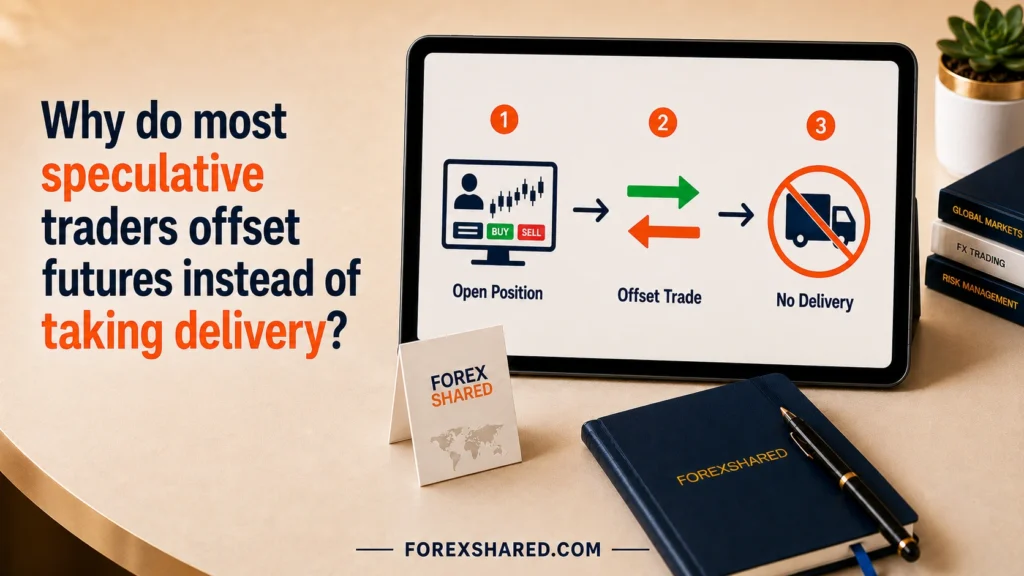
Most speculative traders offset futures because they seek gains from price movement, not ownership of the underlying asset. An opposite transaction removes the position before delivery obligations arise.
The key lifecycle question is not simply whether a contract can settle, but whether settlement serves the trader’s objective. A speculative participant typically wants price exposure; offsetting ends that exposure, rolling transfers it to a later expiry, and settlement completes the contract under its cash or physical rules.
The broader parent context is Forex futures settlement behavior. This page focuses specifically on why speculative futures positions commonly exit through offset rather than operational delivery.
This article explains futures contract lifecycle mechanics for educational purposes and does not provide individualized financial or trading advice. Settlement type, delivery procedures, notice dates, broker deadlines and funding requirements are contract-specific and should be verified before an expiring position is carried forward.
Why Does the Speculative Objective Naturally Favor Offsetting?
The speculative objective is price exposure, and offsetting ends that exposure without requiring the trader to acquire or supply the underlying asset.
CFTC defines a speculator as a futures trader who does not hedge and instead seeks profit through successful anticipation of price movements. That objective is fundamentally different from an operational need to acquire, deliver, receive or transfer the underlying asset. CFTC CFTC also states that most futures contracts by volume are liquidated by offsetting rather than delivery. CFTC
What is a futures speculator trying to achieve?
A futures speculator seeks profit through successful anticipation of price movements rather than through hedging or acquiring the underlying asset.
The central exposure is futures price movement, not ownership of the underlying asset. The section defines the objective, not the outcome. CFTC
Why does the speculative objective differ from a commercial delivery objective?
A commercial participant may need the underlying asset for operational reasons, while a speculative participant needs only the financial result of the price move.
The speculator needs only the financial result associated with the market move. The contrast exists only to explain why delivery does not fit the speculative objective.
Why does this make delivery unnecessary for many speculative positions?
Once the desired price exposure has been captured or abandoned, acquiring or supplying the underlying asset adds nothing to the original speculative task.
The speculative task was price exposure → financial result, not price exposure → asset acquisition. Delivery can be intentional and operationally appropriate for some participants.
Is this behavior actually common across futures markets?
Yes, most futures contracts by volume are liquidated by offset rather than delivery.
Add the CME statement that most traders seeking price movement do not want physical delivery or cash settlement at expiry. Some positions are intentionally held to settlement.
How Does Offsetting Remove a Speculative Futures Position?
Offsetting removes an open futures position through an equal and opposite transaction in the same contract month.
CFTC defines offset as liquidating a futures purchase by selling an equal number of contracts of the same delivery month, or liquidating a short sale by purchasing an equal number of the same delivery month. The mechanism neutralizes the participant’s open position without requiring a private cancellation with the original counterparty. CFTC
The exact close-out mechanism is developed further in Offsetting a futures position before delivery.
What does offsetting mean for a long futures position?
A trader who is long removes the position by selling an equal number of the same futures contract and delivery month.
The CFTC offset definition supplies the governing long-side and short-side mechanics. Standardized futures are fungible within the clearing structure. CFTC
What does offsetting mean for a short position?
A trader who is short offsets by buying an equal number of the same futures contract and delivery month.
The short-side mechanism mirrors the long-side offset in the opposite direction. Offsetting removes the obligation before delivery. CFTC
Does the trader have to locate the original opposite counterparty?
No, standardized futures of the same contract and delivery month are fungible within the exchange-clearing structure.
The offsetting transaction neutralizes the participant’s open position rather than requiring a private cancellation. That is a separate topic owned by another page.
What happens to market exposure after a complete offset?
After a complete offset, the net open position becomes zero and the trader no longer participates in subsequent price movement through that position.
The trader no longer participates in subsequent price movement through that position. The loss or gain from the position is realized at the offset price.
Why is offsetting especially compatible with speculation?
Offsetting lets the trader end price exposure itself without converting the trade into an operational acquisition or disposition of the underlying asset.
Offsetting avoids converting the trade into an operational task. Rolling and intentional settlement are also legitimate paths.
| Question | Decision | Result |
|---|---|---|
| Price exposure no longer wanted | Offset the current contract | Open exposure ends |
| Exposure still wanted beyond current expiry | Offset current contract and open a later month | Exposure continues through a roll |
| Intentional settlement objective | Remain open under the applicable settlement rules | Position proceeds to cash or physical settlement |
Why Does Physical Delivery Usually Not Fit a Purely Speculative Objective?
Physical delivery creates asset, funding, notice, and operational obligations that a purely speculative price objective does not require.
CME describes delivery as the transfer of ownership or control of the commodity or an applicable delivery instrument under exchange procedures. For a participant whose task is only price exposure, entering notices, funding and make-or-take delivery procedures introduces an operational objective that the speculative trade did not originally require. CME
The delivery-side explanation is extended in Why physical settlement is uncommon.
What changes when a physically delivered futures position enters the delivery process?
The position stops being merely an open price exposure and becomes subject to the contract’s delivery procedures.
Possible contract-specific elements include delivery notices, approved locations, acceptable grades, delivery instruments, asset transfer, settlement funding. Contract-specific rules vary. CME
What does a long participant potentially have to do?
The long side can be assigned to take delivery under the applicable contract rules.
This is a potential obligation under the contract rules. Assignment depends on contract rules and position status. CME
What does a short participant potentially have to do?
The short side can be required to make delivery according to the contract’s specifications.
The obligation follows the contract’s specifications. Offsetting or rolling can remove the obligation first. CME
Why are these obligations often unnecessary for a speculator?
These obligations solve a physical or operational settlement task that the speculative strategy did not originally require.
Contrast “Price Exposure → Financial Result” with “Price Exposure → Asset Acquisition / Delivery Process.”. Cost depends on the contract, the participant, and the circumstances.
What does this look like in physically delivered FX futures?
CME states that most FX futures customers trade out of or roll positions before delivery, while positions held through delivery require clearing-firm funding for the currency exchange.
A participant holding certain physically delivered FX futures through the last trading day must ensure the clearing firm is fully funded for the actual currency exchange. That is a separate topic owned by another page. CME
| Stage | Speculative Path | If Exposure Continues | If Delivery Is Intentional |
|---|---|---|---|
| Open position | Price exposure is the objective | Keep the market objective under review | Verify the exact physical-delivery process |
| Before delivery | Sell the same long contract or buy back the same short contract to offset | Offset expiring contract and establish a later month | Remain open only with funding and operational preparation |
| Outcome | Exposure ends before delivery | Exposure moves to a later expiry | Currency principals and clearing-firm funding become relevant |
How Does Cash Settlement Change the Delivery Question?
Cash-settled futures resolve through a financial payment based on the final settlement price rather than physical transfer of the underlying asset.
Cash settlement changes the operational problem because the contract can resolve financially instead of through physical transfer. CME explains that cash-settled positions can be marked to a final settlement price and settled financially, while physically delivered contracts proceed through the applicable asset-delivery process. CME CME
Do cash-settled futures require physical delivery?
No, cash-settled futures resolve through a financial payment based on the applicable final settlement price rather than transfer of the physical underlying asset.
The contract resolves through a financial payment determined by the applicable final settlement methodology. They resolve the contract through different mechanisms. CME CME
Can a speculative trader hold a cash-settled futures contract through expiration?
Yes, if the position remains open, it can proceed to financial settlement under the contract rules rather than physical delivery.
The position proceeds to financial settlement under the contract rules. The trader still chooses whether to hold or offset.
Why might a speculator still offset before final cash settlement?
A speculator may offset before final cash settlement to end exposure at a chosen time, avoid remaining price risk through expiration, control the exit, or move exposure to another contract month.
Offsetting gives the trader control over the exit timing. The choice depends on the trader’s intent.
Does this mean cash settlement is undesirable for speculators?
No, cash settlement removes physical-delivery requirements and can make expiry operationally simpler for participants seeking financial exposure.
Contrast “Physically Delivered Contract → potential make/take delivery obligations” with “Cash-Settled Contract → final financial settlement.”. The right choice depends on the trader’s objective and the contract.
| Comparison Point | Physically Delivered Contract | Cash-Settled Contract |
|---|---|---|
| Settlement mechanism | Potential make-or-take delivery obligation under contract rules | Financial resolution using the final settlement methodology |
| Underlying transfer | May involve the commodity, currency or delivery instrument | No physical transfer of the underlying asset |
| Operational requirements | Can involve notices, funding, delivery capability and contract-specific procedures | Requires understanding of final financial settlement |
| Expiration decision | Offset, roll or intentionally enter delivery | Offset, roll where applicable, or intentionally hold to cash settlement |
Why Do Expiration and Delivery Deadlines Influence When Speculators Offset?
Every futures contract has a finite lifespan, and avoiding delivery requires action before the contract’s notice and trading deadlines.
CME states that futures contracts have a limited lifespan and that an approaching expiration presents three broad choices: offset, roll or proceed to settlement. For deliverable contracts, first notice day can make delivery assignment relevant before the final trading endpoint, so the exact lifecycle dates must be checked for the specific contract. CME CME
The standardized contract rules behind those lifecycle obligations are covered in Futures contract format.
Why can a trader not treat every futures contract as open indefinitely?
Every futures contract has a finite lifespan and a defined expiration process.
Traders approaching expiration can offset, roll, or proceed into settlement. Contract-specific rules vary. CME
Why does first notice day matter for physically delivered contracts?
First notice day matters because it is associated with the start of delivery-notice and assignment procedures for relevant deliverable contracts.
It is associated with the start of delivery-notice and assignment procedures. Contract-specific rules vary. CME
Why does the last trading day matter?
The last trading day defines the final point at which the contract can be traded under its applicable rules.
After the relevant trading and notice thresholds, the trader’s available choices become more limited. Contract-specific rules vary.
Should every futures position simply be held until the last possible trading moment?
No, the applicable first notice date, last trading date, settlement date, delivery period, and broker deadline must be checked for the specific contract.
The dates to verify include first notice, last trading, settlement, delivery period, broker deadline. Physically delivered contracts can have notice procedures that begin earlier.
Why can a broker impose an earlier practical deadline?
A broker may impose an earlier practical deadline to ensure customers entering a delivery process have the required funding, asset capability, and settlement infrastructure.
The intermediary may need to ensure customers have funding, asset capability, and settlement infrastructure before exchange-level obligations arise. Broker policies vary and require current verification.
Why Is Rolling Different From Simply Offsetting a Futures Position?
Rolling offsets the current contract while establishing a position in a later contract month, so it continues exposure rather than ending it.
CME defines rolling as offsetting the current contract while establishing a new position in a later contract month. A simple offset ends the current exposure; a roll combines an exit from the expiring month with continued exposure in another expiry. CME
What happens when a trader simply offsets?
When a trader simply offsets, the current futures exposure ends.
No further mechanism required: this is the baseline. Rolling continues exposure while offsetting ends it.
What happens when the trader rolls?
Rolling offsets the current contract while establishing a position in a later contract month.
Rolling combines two actions: offsetting the current contract and establishing a later-month position. It is two actions: offset current + open later. CME
Why would a speculative trader roll instead of exit completely?
A speculative trader rolls when the current contract is approaching its lifecycle endpoint but market exposure is still desired.
Rolling answers “I still want the exposure, but not through this expiring contract.”. Rolling introduces spread economics between expiries.
Does rolling preserve exactly the same contract price and economics?
No, different expiration months can trade at different prices, so rolling changes the contract month and introduces the economics of the spread between expiries.
Different expiration months can trade at different prices, introducing the spread between expiries. Those are separate topics.
Why can liquidity influence roll timing?
Liquidity can influence roll timing because traders may shift when trading volume migrates toward the next contract month.
Traders may shift when liquidity migrates toward the next month. Liquidity is a market condition, not a guarantee. CME
Why Does Delivery Still Matter If Most Speculative Positions Are Offset?
Delivery still matters because the credible possibility of delivery connects the futures contract to the underlying market even when most positions are closed beforehand.
The fact that most positions are offset does not make delivery irrelevant. CFTC states that delivery provisions help ensure convergence between futures and cash-market prices, so the credible possibility of delivery remains part of the contract’s price connection to the underlying market. CFTC
If most contracts are offset, why have delivery provisions at all?
Delivery provisions help ensure convergence between futures prices and cash-market prices as expiration approaches.
The credible possibility of delivery connects the futures contract to the underlying market. The section only needs the structural reason. CFTC
Does low actual delivery volume make the delivery mechanism irrelevant?
No, the credible possibility of delivery connects the futures contract to the underlying market even when most positions are closed beforehand.
The credible possibility of delivery is what connects the contract to the underlying market. The possibility of delivery is structurally important. CFTC
Does the speculative trader need to understand every physical-delivery detail?
Not necessarily, but the trader must understand enough to know whether the contract physically delivers, when the delivery process begins, when to offset or roll, and what happens if the position remains open.
List the four essential facts: physical delivery or not, when delivery begins, when to offset or roll, what happens if open. The trader must know enough to avoid unintended obligations.
Can commercial participants intentionally use the delivery process?
Yes, delivery may be operationally useful to participants whose underlying business actually requires the asset, currency, or financial instrument.
Delivery fits when the underlying business requires the asset, currency, or instrument. Delivery serves a legitimate settlement function for commercial participants.
How Should a Speculative Trader Choose Between Offset, Roll, and Settlement?
The choice between offset, roll, and settlement depends on whether the speculative objective is complete, whether exposure should continue, and whether the participant is prepared for the applicable settlement process.
The choice is an intent-and-lifecycle decision. Offset fits when exposure should end; roll fits when the current contract is ending but exposure should continue in a later month; settlement fits only when the participant intentionally accepts the relevant cash or physical settlement process and its contract-specific requirements.
When does simple offset fit the objective?
Simple offset fits when speculative exposure is no longer desired, the trader wants to terminate the open position, and delivery or final settlement is unnecessary.
Offset answers “I no longer want this exposure.”. Rolling or settlement may fit other objectives.
When does rolling fit the objective?
Rolling fits when the current contract is approaching its lifecycle endpoint, market exposure is still desired, and the trader wants to move to a later expiry.
Rolling answers “I still want the exposure, but not through this expiring contract.”. Rolling introduces spread economics.
When might holding through cash settlement be intentional?
Holding through cash settlement is intentional when the contract is cash settled, the participant understands the final settlement methodology, and continued exposure through expiration is desired.
Holding through cash settlement is a deliberate choice, not an accident. It can be a legitimate choice.
When might physical delivery be intentional?
Physical delivery is intentional only when the participant understands the delivery process, has the operational capability, has required funding, and intends to make or take delivery.
Physical delivery requires operational and funding preparation. Delivery requires operational capability and funding.
What is the correct expiration decision sequence?
The correct sequence is to identify the objective, confirm the contract and settlement type, verify the relevant dates, and then choose offset, roll, or settlement before any unwanted obligation becomes effective.
Each step narrows the decision. Contract-specific rules vary.
| Comparison Point | Offset | Roll | Settlement |
|---|---|---|---|
| Objective | End current exposure | Continue exposure beyond current expiry | Complete the contract’s settlement path |
| Action | Equal and opposite transaction in the same contract month | Offset current month and establish a later month | Remain open under the applicable contract rules |
| Exposure outcome | Current exposure ends | Exposure continues in another expiry | Contract resolves through cash or physical settlement |
| When it fits | Price objective is complete or abandoned | Exposure is still wanted but current expiry is ending | Settlement is intentional and the participant understands the requirements |
How Can Speculative Traders Avoid Expiration and Delivery Mistakes?
Speculative traders avoid expiration and delivery mistakes by verifying the contract type, the relevant dates, and the action required before any unwanted obligation becomes effective.
The safest conceptual sequence is to identify the exact contract and month, verify whether settlement is physical or cash based, check notice and trading deadlines, distinguish offset from roll, and decide before any unwanted settlement obligation becomes effective. Contract-specific and broker-specific deadlines should be verified rather than assumed.
Why is assuming every futures contract physically delivers a mistake?
Assuming every futures contract physically delivers is a mistake because some futures contracts are cash settled and never require physical transfer of the underlying asset.
Cash-settled contracts never require physical transfer. Many are physically delivered.
Why is assuming every contract can safely be held until the last trading day a mistake?
Assuming every contract can safely be held until the last trading day is a mistake because physically delivered contracts can have notice and delivery procedures that become relevant before or around final trading.
Notice and delivery procedures can begin before or around final trading. Exact contract rules must be checked.
Why is confusing offset with roll incorrect?
Confusing offset with roll is incorrect because offset alone ends exposure, while a roll combines a current-contract offset with a new later-month position.
Roll = current contract offset + new later-month position. They produce different exposure outcomes. CME
Why is ignoring broker delivery policy risky?
Ignoring broker delivery policy is risky because the broker may impose practical close-out or funding requirements before the exchange’s final delivery process.
The broker may require close-out or funding before exchange-level delivery. Broker policies vary and require current verification.
Why is treating delivery as irrelevant because most positions offset incorrect?
Treating delivery as irrelevant is incorrect because delivery remains a contractual settlement mechanism and helps connect deliverable futures pricing with the underlying cash market.
Explain the convergence connection. It serves a legitimate settlement function. CFTC
Why is saying speculators “take delivery” regardless of position direction inaccurate?
Saying speculators “take delivery” regardless of position direction is inaccurate because a long can take delivery while a short can make delivery.
A long can take delivery and a short can make delivery. The applicable obligation depends on position direction and contract terms.
What should be verified before carrying a speculative futures position toward expiration?
Before carrying a speculative futures position toward expiration, the trader should verify the position purpose, contract month, settlement type, relevant dates, and the action required.
Each item prevents a specific lifecycle error. Contract-specific rules may add requirements.
- Confirm that the position purpose is speculative price exposure.
- Identify the exact futures contract and contract month.
- Verify whether the contract is physically delivered or cash settled.
- Verify first notice, last trading, settlement and broker deadlines that apply.
- Understand the exact offset action for the current position direction.
- Keep a simple offset separate from a roll.
- Confirm that continued exposure is intentional before rolling.
- Understand physical-delivery funding and operational requirements if delivery is possible.
- Understand the final settlement methodology if the contract is cash settled.
- Manage the position before any unintended obligation becomes effective.
Conclusion Direction
Most speculative traders offset futures instead of taking delivery because their primary objective is usually to profit or lose from changes in the futures price rather than acquire or supply the underlying asset.
CFTC’s definitions align the core logic: a speculator seeks price-movement gains, while an offset closes a long or short futures position with the opposite transaction in the same delivery month. CFTC CFTC also states that most futures contracts by volume are liquidated by offsetting rather than delivery. CFTC
Delivery remains a legitimate and structurally important contract path. CME’s FX futures guidance states that most customers trade out of or roll before delivery, while positions intentionally held through delivery require the clearing firm to be funded for the actual currency exchange. CME Cash-settled contracts resolve differently because the contract reaches a financial final settlement rather than a physical transfer. CME
The decision is therefore simple in concept but contract-specific in execution: offset when exposure should end, roll when exposure should continue in a later month, and proceed to settlement only when the settlement path is intentional and its requirements are understood.
FAQs
The FAQs answer the most common follow-up questions about offsetting, delivery, and rolling.
Why do speculators usually close futures before delivery?
Speculators usually close futures before delivery because their primary objective is generally price exposure rather than receiving or supplying the underlying asset.
CFTC states that most futures contracts by volume are liquidated by offsetting rather than delivery. The behavioral logic is that a price-only objective can be completed financially without entering an asset-transfer process. CFTC
How does a trader offset a futures position?
A long position is offset by selling an equal number of the same contract month, while a short position is offset by purchasing an equal number.
CFTC defines the long-side action as selling an equal number of the same delivery month and the short-side action as buying an equal number of the same delivery month. CFTC
Is offsetting the same as rolling a futures contract?
No, offsetting ends the current position, while rolling offsets the current expiry and establishes a new position in a later contract month.
No. CME explains that a roll combines the current-contract offset with establishment of a new later-month position, so market exposure continues instead of simply ending. CME
What happens if a physically delivered futures contract is not offset?
If a physically delivered futures contract is not offset, the position can enter the applicable delivery process, with long and short participants potentially required to take or make delivery according to the contract rules.
The position can proceed into the applicable delivery process. CME’s delivery materials distinguish the long side that can take delivery from the short side that can make delivery, subject to the relevant contract rules and notices. CME
Do cash-settled futures need to be offset before expiration?
Not necessarily, cash-settled futures can be held to financial settlement, but traders may still offset earlier when they want to end exposure at a chosen time.
No. A cash-settled contract can remain open into financial final settlement if that is intentional. A trader can still choose to offset earlier to end exposure at a chosen time. CME