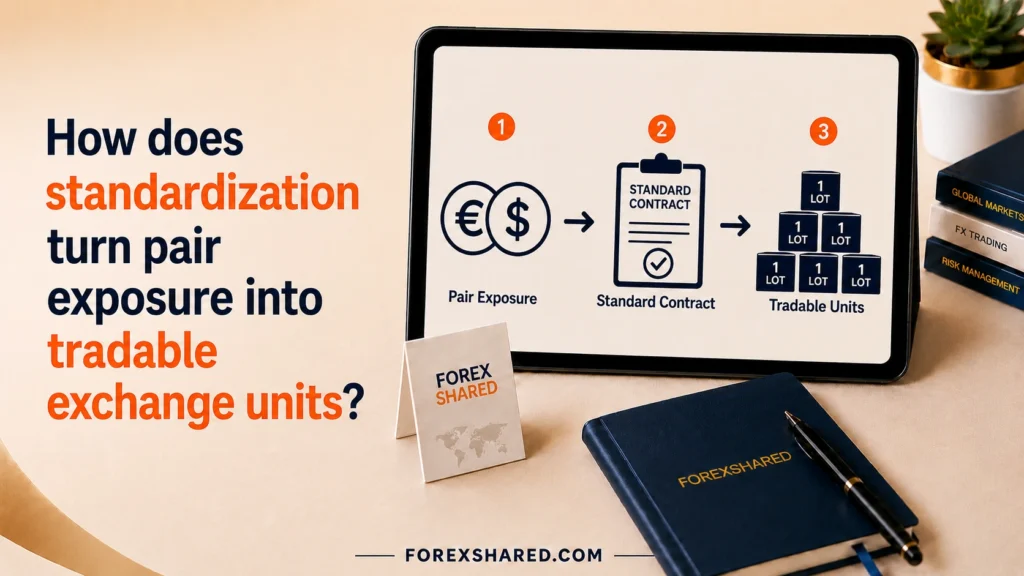
How does standardization turn pair exposure into tradable exchange units?
Standardisation turns open-ended currency-pair exposure into tradable exchange units by replacing individually chosen amounts and dates with a published futures specification. Each listed product defines a contract currency, fixed unit, quotation, minimum price increment, expiry and settlement process; traders then personalise exposure through whole-contract quantity, direction and execution price rather than renegotiating the unit itself.
The parent explanation of how the currencies are encoded is available in Currency pairs in futures contracts.
This article is for general education only and does not constitute financial, investment, legal, accounting, operational, regulatory or tax advice. FX futures involve leverage, performance-bond margin, daily settlement variation and product-specific delivery or cash-settlement obligations. Contract availability, pricing, liquidity, margin, expiry and hedge effectiveness depend on the exchange, product, broker or clearing member, jurisdiction and market conditions.
What does raw currency-pair exposure contain?
Raw pair exposure begins as a commercial or investment cash-flow problem rather than an exchange contract. The amount may be irregular, the timing may be uncertain and the organisation may need to buy or sell the exposed currency. A minimum high-level description therefore identifies the currencies, expected amount, payable or receivable direction, timing and hedge objective.
Why is the exposure continuous?
A business can owe EUR 47,500, expect USD 930,000 or receive GBP 212,000 on almost any eligible business date. Those cash flows do not naturally arrive in exchange-defined multiples or listed expiries. The economic exposure is therefore continuous even though a listed futures market trades discrete units.
Why can the raw cash flow not enter one central order book?
A central order book requires every order in one instrument to refer to the same material contract terms. Individually selected amounts, dates and settlement instructions would create different instruments that require bilateral negotiation rather than anonymous matching. Exchange standardisation solves that compatibility problem.
| Attribute | Raw commercial exposure | Listed FX futures unit |
|---|---|---|
| Amount | Can be almost any commercial amount. | Fixed unit for the selected product. |
| Timing | Commercial date or forecast window. | Listed contract month and expiry timetable. |
| Direction | Need to buy or sell the exposed currency. | Long or short whole-contract position. |
| Price expression | Depends on the commercial or OTC convention. | Exchange-defined quotation and tick grid. |
| Settlement | Commercial payment or receipt. | Product-specific physical or financial settlement. |
What does the exchange standardise?
The exchange standardises the characteristics that define the listed instrument, including the contract unit, quotation, minimum price fluctuation, listed expiries and final-settlement process. CFTC educational material identifies contract size, delivery months and the last trading day among the standard terms set by exchanges. CFTC2026
What remains open to the market?
The exchange fixes the structure, not the transaction price. Buyers and sellers choose direction, whole-contract quantity, order type, execution timing and acceptable prices. This distinction is developed further in the Futures contract format page.
Why must the terms be published before trading?
Order-entry systems, market-data feeds, brokers, clearing members and settlement systems need one authoritative definition of the instrument. Published specifications allow all orders in one product and expiry to refer to the same economic and operational object.
Contract terms such as unit and tick are part of the listed product. Margin levels are different: they are risk parameters that can change with product risk, volatility, portfolio offsets and broker requirements.
How does contract size create one exchange unit?
The contract unit is the fixed quantity of the contract currency represented by one futures contract. It lets the exchange, clearinghouse and market participants count positions in identical blocks. A trader changes total exposure by changing the number of whole contracts rather than changing the amount inside one contract.
For example, three standard Euro FX contracts represent EUR 375,000 because 3 × EUR 125,000 = EUR 375,000.
Can the trader request a different unit?
No. A listed contract remains a whole standardised unit. The trader may select a separately listed smaller product or combine whole-contract positions across suitable variants, but one standard contract cannot be divided into an arbitrary fraction.
How do Standard, E-mini and Micro products expand sizing choices?
CME lists separate Euro FX products with different fixed units: standard Euro FX `6E`, E-mini Euro FX `E7` and Micro EUR/USD `M6E`. The E-mini is one-half of the standard unit, while the Micro is one-tenth; each product remains independently standardised. CME2026
| Product | Product root | Contract unit | Outright tick | Tick value |
|---|---|---|---|---|
| Standard Euro FX | 6E |
EUR 125,000 | USD 0.00005 per EUR | USD 6.25 |
| E-mini Euro FX | E7 |
EUR 62,500 | USD 0.0001 per EUR | USD 6.25 |
| Micro EUR/USD | M6E |
EUR 12,500 | USD 0.0001 per EUR | USD 1.25 |
The E-mini tick value is not one-half of the standard tick value because the E-mini uses a larger minimum price increment. The product unit and tick must therefore be read together rather than scaled by assumption. CME publishes the applicable units and ticks in its FX product materials. CME2026
How are quote value, tick value and daily P&L separated?
Three different calculations answer three different questions. The current USD equivalent describes the contract unit at a futures price; tick value measures one minimum price movement; settlement variation measures the daily change in the marked position.
At a hypothetical price of USD 1.0850 per EUR, one standard EUR 125,000 contract has an indicative USD equivalent of USD 135,625. If the settlement price rises from 1.0850 to 1.0860, a one-contract long position has a positive daily variation of USD 125: `(1.0860 − 1.0850) × 125,000 = 125`.
Does the indicative USD equivalent equal margin?
No. Margin is performance collateral designed to cover potential losses; it varies by product and market volatility and can also be affected by portfolio offsets and clearing-member or broker requirements. CME2026
How do expiry and product codes complete the unit?
A tradable futures unit is identified not only by the currency relationship but also by product variant and expiry. The standard Euro FX product uses the Globex root `6E`, while `E7` and `M6E` identify the E-mini and Micro variants. Month and year characters are then added under the relevant platform or data-vendor convention.
Why is “EUR/USD” insufficient?
The pair label does not identify the contract unit, product variant, contract month, tick or settlement method. Operational systems therefore need a venue-specific contract identifier. Code formats can differ across trading, clearing and data platforms, so the applicable source must be checked rather than assuming one universal ticker format.
Are different expiries fungible?
No. September and December contracts are separate instruments with different maturity horizons and market prices. An opposite trade must use the same listed product and expiry to reduce the cleared position in that contract.
How does the central order book match standard units?
Standardisation allows bids and offers to compete because each order refers to the same product, expiry and unit. A marketable incoming order can trade against an eligible resting order, while allocation among orders at the same price follows the product’s published matching algorithm. CME Globex uses several algorithms, including FIFO, pro-rata and configurable methods, rather than one universal price-time rule. CME2026
How do fungibility and clearing enable offset?
Fungibility means contracts of the same listed product and delivery month are interchangeable because their material specifications are standardised. CFTC’s glossary links futures fungibility to standardised quantity, delivery date and other specifications. CFTC2026
A trader who is long five contracts can sell five contracts of the same product and expiry to reduce the cleared net position. The trader does not need to locate the original opposite party. Standard and E-mini contracts, or two different expiries, are not the same fungible contract even though their economic exposures may be related.
How do margin and daily mark-to-market support participation?
Margin allows participants to support a leveraged futures position without paying the full indicative currency equivalent at trade entry. It is a performance bond rather than a purchase deposit, and requirements can change with market volatility and portfolio risk. The detailed participation layer is covered in Futures margin requirements.
Futures markets use an official daily settlement price under a published methodology. Open positions are marked to that settlement, producing daily gains and losses; using one settlement reference does not mean every account has the same cash flow because direction, quantity and prior settlement values differ. CME2026
Does the same unit create the same margin for every trader?
No. A common clearing methodology applies, but actual requirements can reflect contract quantity, offsets, concentration, volatility, account classification and broker add-ons. Margin is therefore connected to the unit without being a permanently fixed product term like contract size.
How does settlement complete the futures unit?
Settlement is product-specific. CME states that most of its FX futures use physical delivery, while selected contracts use financial settlement. Major products such as Euro, Japanese Yen and British Pound futures are among those delivered through the applicable clearing and banking process. CME2026
What happens in physical delivery?
An open long position that reaches the delivery process has an obligation, handled through its clearing member, to receive the contract-currency amount and pay the required quote-currency amount. The short side has the opposite obligation. Daily settlement variation before expiry remains distinct from the final currency-principal exchange.
What happens in financial settlement?
A cash-settled contract uses its specified final reference and calculation rules to complete the remaining settlement amount without exchanging both currency principals. The exact fixing source, time, settlement currency and calculation method must be read from the product specification.
How should a commercial exposure be converted into futures units?
Assume a company expects to receive EUR 312,500 and reports in USD. A short EUR/USD futures position is directionally appropriate because it gains when the euro futures price falls, helping offset a lower USD value of the euro receipt.
How can the initial amount be represented?
Two standard Euro FX contracts and one E-mini contract provide an initial EUR notional of exactly EUR 312,500:
The treasurer would sell the selected whole contracts for an eligible listed expiry, subject to product availability, liquidity and the organisation’s hedge policy.
Why is the hedge still imperfect?
An exact initial amount match does not remove other differences. The commercial receipt may occur on another date, the futures–spot basis can change, daily settlement variation can create liquidity demands, E-mini liquidity can differ from standard-contract liquidity and the underlying receivable can change.
| Risk type | Meaning | Example |
|---|---|---|
| Notional mismatch | Listed units do not equal the commercial amount. | A remainder remains after whole-contract sizing. |
| Timing mismatch | Futures expiry differs from the cash-flow date. | The receivable arrives between listed expiries. |
| Basis risk | The futures price and the relevant spot or cash reference do not move identically. | The futures–spot relationship changes before hedge close-out. |
| Margin liquidity | Daily settlement creates interim funding needs. | The hedge is economically offsetting but requires a cash margin payment. |
| Product liquidity | Smaller variants may trade differently from the standard contract. | The E-mini spread or depth differs from the standard product. |
Standardised units can reproduce an initial currency amount, but they do not automatically reproduce the commercial date, spot conversion process, liquidity profile or accounting treatment of the underlying exposure.
How should the selected unit be validated?
- Exposure: confirm the currencies, amount, direction, expected date and hedge objective.
- Product: confirm the listed pair and whether standard, E-mini or Micro variants exist.
- Unit: verify the official contract amount rather than relying on a generic size.
- Tick: verify both the minimum increment and the monetary tick value.
- Expiry: select the listed month and review the exact last-trade and settlement timetable.
- Code: verify the venue-specific product root, month and year convention.
- Matching: understand the product’s published order-allocation algorithm.
- Margin: estimate performance-bond and daily settlement cash-flow requirements.
- Settlement: determine whether the product is physically or financially settled.
- Residual risk: measure notional, timing, basis, margin-liquidity and product-liquidity differences.
Conclusion
Standardisation turns currency-pair exposure into tradable exchange units by fixing the product’s contract currency, unit, quotation, tick, expiry and settlement method. That common structure makes whole contracts countable, comparable, fungible and eligible for central order-book execution and clearing.
The trader still chooses direction, contract quantity, execution price and timing. Standard, E-mini and Micro products can provide several fixed building blocks, but each remains a separate listed instrument. An exact initial notional match therefore does not guarantee a perfect hedge: expiry, basis, daily margin cash flows, liquidity and changes in the underlying exposure still require active control.
Frequently Asked Questions
Can a trader buy half of a standard FX futures contract?
No. Ordinary listed futures quantities are whole contracts. A trader needing less exposure must use an available smaller listed product, such as an E-mini or Micro contract, or combine whole contracts across suitable product variants.
Are standard, E-mini and Micro Euro FX contracts interchangeable?
They reference the same EUR/USD relationship but are separate listed products with different product roots, contract units and minimum price increments. Whole-contract positions can be combined in a portfolio, but one product is not a fractional piece of another.
Does an exact notional match create a perfect hedge?
No. The initial currency amount can match exactly while expiry timing, futures-versus-spot basis, daily margin cash flows, execution costs and later changes in the commercial exposure still create residual risk.
Why can an incoming buy order execute at the resting offer price?
A marketable buy order with a limit at or above the best resting offer can trade against that offer. The execution occurs at one eligible price, while allocation among orders resting at that price follows the product’s published matching algorithm.
Are most CME FX futures cash-settled?
No. Settlement is product-specific, and CME states that most of its FX futures use physical delivery. Selected contracts, particularly some emerging-market products, use financial or cash settlement instead.